
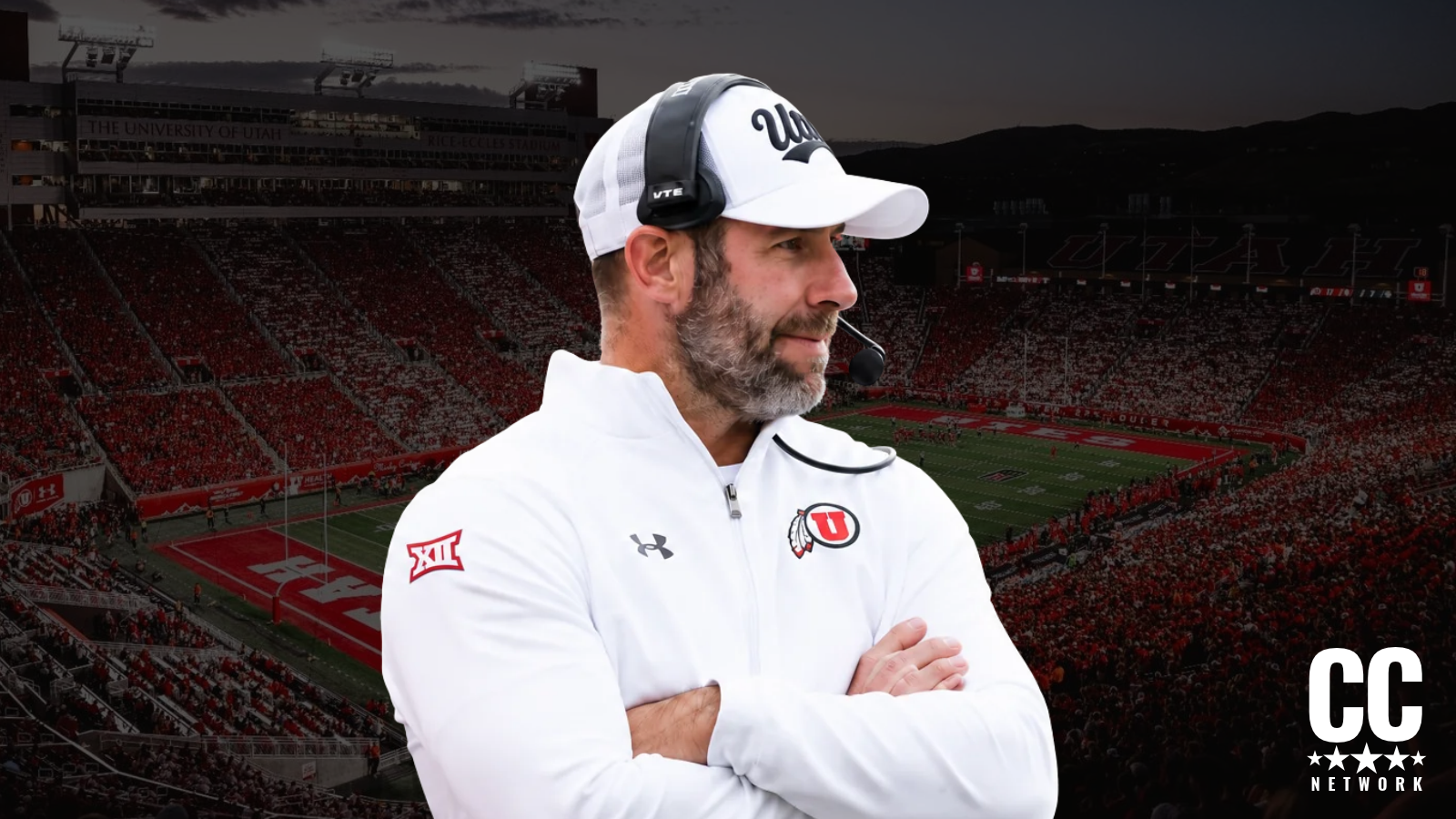
Asked how he keeps players sharp and motivated as a season moves toward the playoffs and championships, Morgan Scalley didn’t talk about either.
“It’s really about getting those guys to understand those behaviors need to happen for us to be successful, for us to be true to who we are, regardless of what the scoreboard says or regardless of what the win-loss column is,” he said. “Whether it’s things didn’t go right and you’re finishing up the season out of it or things are going exactly like you want it to, the behaviors between those two situations should look exactly alike if you’re really establishing the culture.”
Scalley gave that answer in 2023, during Coach and Coordinator’s The Season series. He was Utah’s defensive coordinator and safeties coach then. Across those conversations, he described a defense built around four behaviors: relentless, smart, nasty and ballhawks, or RSNB.
Three years later, Scalley is Utah’s head coach. As of October 29, 2026, the Utes are 7-0 and ranked No. 6 in the AP poll. According to Utah Athletics, the RSNB identity he described as a coordinator now guides the entire team. The 2023 interviews show how he ran that defense: how the staff defined the behaviors, checked them and put them in front of players every week.
The word he kept coming back to was behavior.
Other Morgan Scalley recordings:
“It’s behavior that gets you results”
When he was asked how he prepares players for an opponent, Scalley started with what he thinks decides games.
“The process is what matters. The process is what gets you results. It’s behavior that gets you results. It’s not scheme.”
He isn’t against game planning. “As much as we may have a couple of wrinkles here and there in scheme,” he said, “it’s all about the fundamentals and techniques of the game that pretty much win you the football game.” When Utah faced an opponent it didn’t see every year, or one that had changed coaches, the staff helped players figure out what to study and which film to watch. The upperclassmen helped the younger players learn how the defense operated day to day. Still, he warned about leaning too hard the other way: “If you focus too much on the opponent, you end up screwing yourself in the long run.”
His evidence was a loss. Looking back at Utah’s game against Florida the season before, he said, “it wasn’t scheme. It was our inability to hold gaps or inability to tackle properly.” Against a very good opponent in Week 1, that is what shows up. “The team that is more fundamentally and technically sound is usually the team that ends up winning the football game.”
So the weekly focus stayed narrow: “Behavior, behavior, behavior, and it’s one week at a time.”

Clarity comes before accountability
You can’t hold players to a behavior until they know what it is, and Scalley put that responsibility on the coaches.
At Utah, the first day of school had usually not been a good practice day, because players were finding their classes and learning the campus. So the staff used that day to teach game-day procedure at the stadium, along with lighter work like seven-on-seven. They covered sideline procedure, substitutions for offense, defense and special teams, pregame, halftime, and Coach Whittingham’s rule that nobody calls timeouts but him.
Scalley pointed to the mistakes teams make across college football in Week 1. “We’re not immune to it,” he said. “A lot of that is if you haven’t covered it, and if you haven’t covered it enough.” He called everything from the sideline in practice. On fall-camp scrimmage days the staff wore headsets, and players learned where to stand, where to sit on the bench and how the position groups line up around him.
Then he explained the staff’s role in one line:
“Our job is to provide clarity, hold them accountable to it, and give them all the support they need. The clarity is the biggest thing. If we’re yelling at kids for something that we haven’t made clear, we haven’t explained properly, that’s on us.”
A culture every player can name
Scalley expected every player on his defense to be able to name its culture. “If you ask anyone on our defense, what is your culture? They’ll say relentless, smart, nasty, ballhawks. RSNB.” The staff defined what each one looks like: what relentless looks like, what smart looks like, what nasty is, what being a ball hawk is.
Next to the culture sat specific defensive goals. He listed a few: 3.3 yards per carry, 16 first downs allowed per game, opponents held to 32 percent on third down and 45 percent touchdowns in the red zone. The goals were set at the start of the season, and he said the players helped set them.
After every game, the first thing the defense took up was culture. “What is our culture? And are we behaving that way?”
The self-scout every three games
The defense also ran a self-scout every three games. Scalley described it as a search for the places where the unit fell short of its own standard. “Where are we deficient? Where are we not living up to our standard, our culture? And how can we improve?” Is the problem tackling? Is it missed chances at takeaways?
He gave an example from the previous season. Early on, the front seven wasn’t good enough against the run. “We just weren’t good enough,” he said. “And man, did we turn that around fairly quickly in the second half of the season.”
The questions he asked when the behavior wasn’t there led straight into practice planning: “If you’re not living it, why? What are the issues? How can we fix them? And how can we refocus, restructure practice to work on those deficiencies?”
Culture clips
After every game, the defense also watched what Scalley called culture clips. Some clips were praise: “shouting out, loving up guys for living the culture, the behavior that we’re looking for.”
Others showed what didn’t fit. That might be a stupid penalty, not being firm or stout or physical enough in the run game, or missing chances to get the ball back to the offense. “Whatever it is, we got to be able to show where we’re deficient,” he said. “And if we don’t provide that feedback constantly, in my opinion, you lose opportunities to right the ship quickly.”
He had a name for the second kind of clip. “You got to call out counterculture when you see it.” And he didn’t want calling it out to be only the coaches’ job: “It’s the players that have to be able to call it out and live the culture as well.”
Where it came from
Scalley said he had always been interested in leadership and had read a lot about it. In his second year as a coordinator, he listened to a podcast of a keynote Tim Kight gave to a business audience, about a year after Ohio State won the national championship.
“His talking points on leadership were simple, they made sense, and I completely bought in,” Scalley said. “You come look at what we do on the defensive side of the ball, a lot of the sayings, a lot of things that we have, they’re all from Tim Kight.”
The connection came up in an unexpected place. Before Utah played USC in the championship game, Scalley looked across the field. “There’s Tim Kight dressed in USC gear. I’m like, you got to be kidding me.”
Utah didn’t copy the material word for word. “Our guys have completely bought into it. We’ve kind of made it our own and done a few things differently.”
His definition of culture explains why the praise clips mattered as much as the corrections. “It’s not just stuff that is plastered on walls. Culture’s what you believe, what you behave, and it’s the experience that’s delivered to your players through that behavior. And if the experience isn’t great, don’t expect the behavior that you’re looking for. The experience has to be awesome.”
For his defense, he said, it had been: back-to-back championships, players who understood what wins and loses football games, “and we have a lot of fun doing it.”
At the time, Scalley was describing the culture of his defense. Now, as Utah’s head coach, he’s responsible for a program guided by that same RSNB identity. The standard he described in 2023 was one that had to be reinforced regardless of results.
“Culture is something that you better practice every day,” Scalley said. “You better promote it when you see it, and call it out when it’s not there. It’s the driving force, you bet, in everything we do.”
Hear Morgan Scalley’s full conversations from his time as Utah’s defensive coordinator in The Season 2023 on the Coach and Coordinator Podcast.
Related:
Connect on X:
Morgan Scalley: @RSNBUtes
Coach and Coordinator Network – Keith Grabowski: @CoachKGrabowski