

When defenses disguise their intentions or shift pre-snap, an offense has two options — respond or take control. The best offenses don’t simply react. They create structure that forces defenders to declare, then punish whatever decision they make. Protection schemes and route concepts aren’t just tools for moving the ball — they’re weapons that expose defensive adjustments in real time.
Coach Tracy Malone, a veteran offensive coach featured on The Passing Lab podcast, breaks down how to bake these responses into your playbook without overwhelming your system. His approach leans on simplicity, spacing, and protection rules that adjust automatically to movement in the box.
Create Protection Rules That React to the Box
Dealing with post-snap pressure starts with protection that adapts. Static rules get beat by movement. Malone builds flexibility into his calls by treating blocking as a living response to the front — not just a checklist.
“Any time we go pin and pull, I’m going to take the back side of that and I’m going to turn that into a seven-man protection. And then I’ve got a fullback coming across to clean up the backside edge guy or the end man on the line of scrimmage.” (23:09)
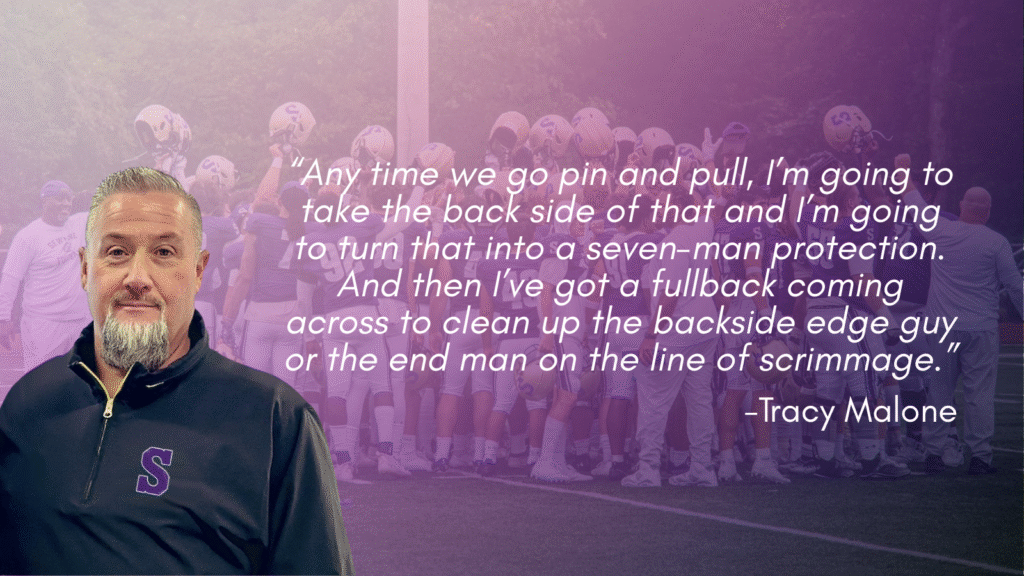
This rule locks down the backside against odd looks or backside fire, allowing the quarterback to stay clean and confident. Malone’s structure doesn’t guess where pressure is coming from. It answers it.
Use Route Structure to Freeze Linebackers
Once the protection holds, the next layer is manipulating the second level. Malone’s offense doesn’t wait for linebackers to react — it forces them to think.
“We want to eat the safety… if you’re the outside post guy, you got to get vertical, inside leverage, and eat the safety. That’s your job.” (19:14)
This kind of vertical stress, paired with route layering — often in the form of over routes and double posts — challenges defenders to cover space both deep and underneath. Play-action stretches them even thinner. Linebackers hesitate, safeties lose leverage, and windows open.
Build Flexibility with Route Timing and Landmarks
Malone coaches his quarterbacks and receivers to see the same picture — regardless of the front or rotation. That comes down to consistent timing and smart route spacing.
“I want the quarterback to be able to take the snap, close his eyes, open them, and just know that he’s got a receiver over the ball, he’s got a receiver running the over route, and he’s got somebody running a post.” (33:01)
This picture-based approach trains QBs to trust what they see. It also keeps the offense fast, even when the defense bluffs or rotates late. Everyone knows their spot, the timing stays intact, and the ball comes out on time.
Conclusion: Win the Adjustment Game Before the Snap
Offenses that thrive against modern defenses don’t rely on talent alone — they build answers into their structure. They set protection rules that handle movement and craft route combinations that create stress.
By tying together the box and the back end, you make defenders wrong every time. Not with guesswork, but with design. If you want your offense to thrive against chaos, don’t just draw up plays. Build a system that punishes defenders — no matter what they choose.
Related:
Getting More Out of Your Scout Teams