
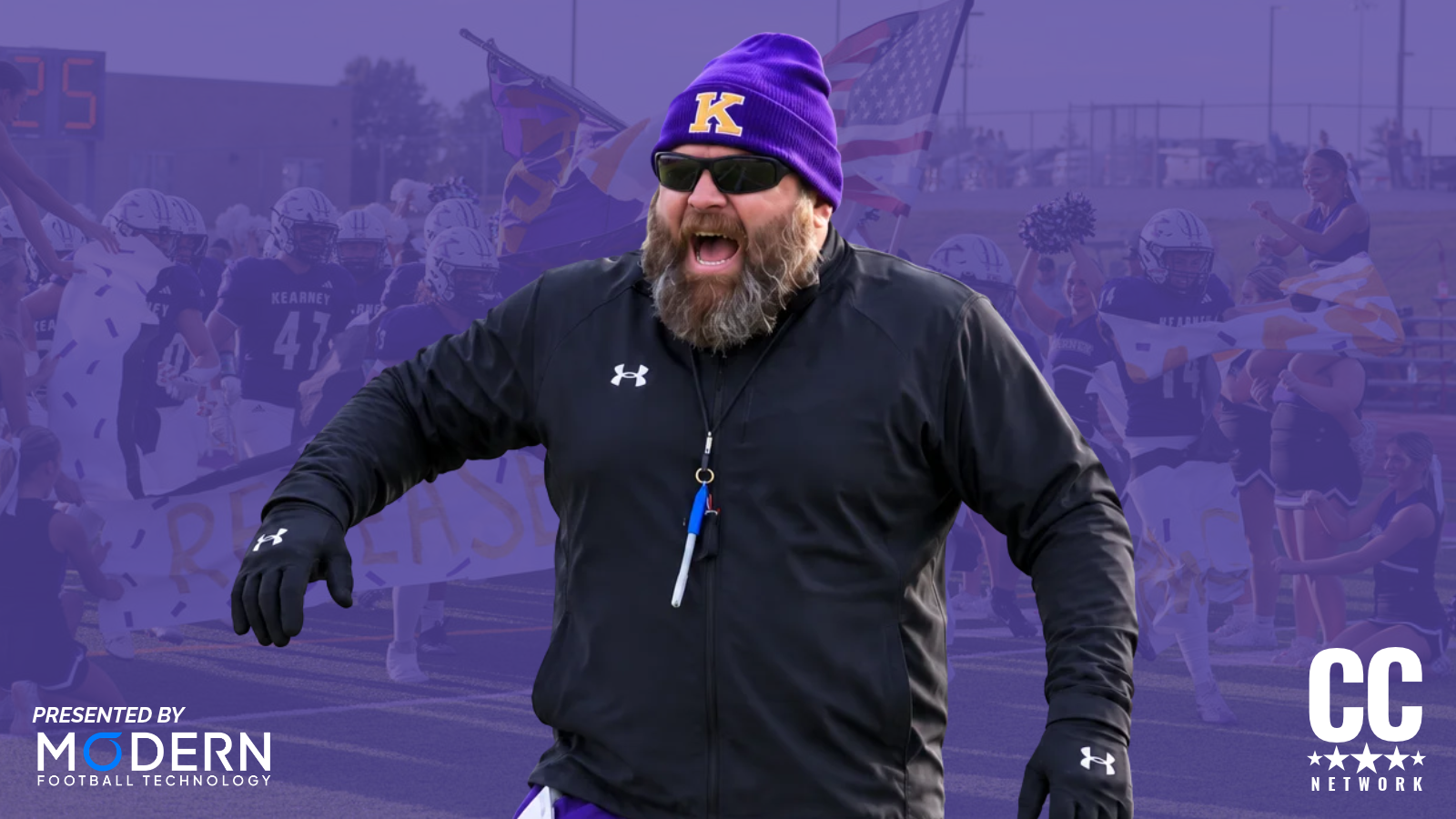
When Logan Minnick was the head coach at Raytown, his coaches picked up two or three kids and drove them to practice because the kids had no rides. People had warned him about the job. “You would hear you shouldn’t take that job, the kids don’t show up,” Minnick said. What he found was different. A lot of them didn’t have cars or any other way to get there. “It was kind of a hidden gem,” he said. “Once you got there, they didn’t want to go home.”
At Kearney High School in Kearney, Missouri, the parent meeting covers something else. “You say, you know, fifteen minutes early is on time, and parents are kicking them out of the car at 5:45.”
Minnick did not run those two programs the same way. “We had to be a little more lenient on the Raytown side of things, in comparison to what it is here at Kearney,” he said, “but at the same time you just gotta find the way to get the kids there.”
Minnick has won two state championships at Kearney, and his team is defending a title this season. When he talked about how the program works, most of what he described sorted into two groups: things he holds constant, and things he changes for the kids in front of him. He put it in one line while talking about offense and defense: “Keep your base principles, but you may have to change up what you do a little bit.”
Discipline, without making it personal
Minnick starts with two things: a disciplined program and real relationships with players.
“I guarantee our players will tell you I’m old school, and I’ll get after your rear end when needed, and I don’t know any other way to coach it,” he said. “But at the same time that kid knows it’s not personal. I’m coaching you up. I’m coaching your technique more than I am you as a person.”
He said discipline “looks different ways at different places.” At Raytown, that meant more leniency than Kearney asks for. What didn’t change was the rest of his answer: once you get the kids there, he said, you “really coach the heck out of” them.
Every class is its own group
The adjustment doesn’t stop when a coach settles into a school. Minnick said his Kearney classes have all been different. Some years have brought “super serious senior leadership groups.” This year’s team, he said, has “great leadership, but they’re about the squirreliest group we’ve had.”
“I don’t think you can be always ‘Here’s the way it is’ all the time,” he said, “’cause you’ve got to adapt to the kids you have.”
He applies the same thinking to scheme. “Yes, we’re gonna have the things we hang our hats on, but at the same time you may have three running backs one year and no running backs the next year.”

Eighty percent pass, then 75 percent run
His own play-calling shows how far that can go. In his first year at Raytown, Minnick said, the offense was “eighty percent pass out of empty and threw it all over the field, and we were not great on the line of scrimmage.” The quick game and bubbles served as the run game.
Last year at Kearney, he estimated, the offense was about 75 percent run out of a flexbone-based scheme. “We’re gonna run the football. We wanna control the clock,” he said. “You play your best defense when your offense is on the field.”
Part of that is about who Kearney plays. “Here in the city we definitely have played more athletic teams than what we are,” he said, “and I’d like to have those guys stand on the sideline next to their coach while we control the ball and keep them off the field.”
He said his defensive coordinators like him a lot more at 75 percent run than at 80 percent pass. He also said a pass-first offense still has to manage the clock. “You don’t wanna be, we got the ball in a tight game and three incomplete passes, now you’re punting it back and you took eighteen seconds off the clock.” In a spread offense, he said, you have to find creative ways to run some time off and hold onto the ball.
Simple up front
Kearney’s offense can look complicated, but most of what changes is on the back end. “Offensively we’ll run all the different smoke and mirrors and all the things and try to hide stuff to run the same five or six schemes up front,” Minnick said.
“You can be super multiple, but you’ve got to keep it simple up front, because if you’re not taking care of business there, you don’t wanna be the guy that, we run 714 plays and we can’t block any of them worth a dang.”
The line of scrimmage is where Kearney has “made all our hay,” he said, and that starts with the weight room, which the program preaches “day in and day out.” On defense, Kearney is multiple out of a three-man front. What it hangs its hat on is stopping the run and forcing teams to throw. “I think we do an unbelievable job of coaching leverage and understanding where the football’s supposed to go, or where we’re trying to force the ball to go,” he said. Being gap sound and understanding the defense have been big for them.
“If you can block and tackle and force penetration on the D-line,” he said, “you’re gonna have a lot of chances to win a lot of ballgames.”
Take pieces and make your own
Minnick learned this from watching coaches who did things differently and still won. He worked under several Hall of Fame head coaches, including his own high school coach, Rob Bowers, in his hometown of Richmond, Missouri, and Greg Jones, whom he served as an assistant at Kearney. They all had very different approaches, and they all worked.
As a young coach who wanted to become a head coach, he took notes. Some said “love this.” Others said, in his words, “I would probably do this a little bit different, even though it worked.”
“All you do in football is steal ideas and thoughts from other people,” he said, “but you make your own, and you take bits and pieces you like.”
He holds clinic learning to the same standard. He sees how fast trends move: whatever play was hot in college on Saturday shows up in high school games the next Friday. Kearney has done that too, he said. Still, he tells his young coaches the goal of a clinic is small. “We’re gonna keep our base system and our base thoughts and run our program. But if there’s something we can add, if you get one little thing that helps you win a ballgame the following year from a clinic, that’s what it’s all about.”
Who you are by week ten
The adjusting happens during the season too, but by late in the year Minnick wants the identity settled. “On paper you might think we’re this team or that team, and injuries happen, things happen throughout the year,” he said. “By weeks eight, nine, ten, you know what your team’s identity is and what you’re gonna be.”
After that, Kearney’s practices get shorter, which he said some coaches think “is insane.” Because Kearney plays two platoons, the staff can go more ones-versus-twos than ones-versus-ones. During the season, Tuesdays usually include a solid ones-versus-ones period. Late in the year, he said, you already know whether your team is physical. If Kearney is getting ready for a counter team, a defender “doesn’t need to spill the varsity guard six times in practice” to be ready.
Kearney has played 14 or 15 weeks three years in a row, so the late-season priority is getting bodies ready for a playoff run. “You just gotta take care of them,” Minnick said, “and you definitely don’t want to get a kid dinged late in the year.”
His rule for that stretch: “I don’t think you overcomplicate it once you get to that point. You don’t wanna be making a lot of changes or doing something crazy once you’ve established who you are.”
Elevate your game with Modern Football Technology!
Modern Football helps coaches chart and tag in real time, delivers sideline reports to keep the booth and sideline aligned, and makes self-scout faster with on-demand reports.
Visit ModernFootball.com for more information.
Related
Connect on X:
Keith Grabowski: @CoachKGrabowski
Logan Minnick: @CoachMinnick
Modern Football: @modernFB
Keith Grabowski (00:00) at Kearney High School in Missouri. Coach Logan Minnick. Coach, great to have you here on the podcast and congratulations on a a big win. Logan Minnick (00:08) Yeah, thank you very much. I was beyond excited when I got the text ’cause I follow you guys on Twitter, so a lot of a lot of things I’ve seen and taken from your show, so you know, just happy to be part of it. Keith Grabowski (00:20) Yeah, I appreciate that, Coach. Well, you’ve done an outstanding job here at Kearney fifty-five and four since you started there. Two state championships. You guys have you guys are defending a state championship this season. And those things don’t happen without a strong culture. And I want to make sure we dig into that a little bit as well as some other things you do. But before that, I want to talk about this particular win and the preparation that you and your staff put into it. Logan Minnick (00:51) Yeah, I think it’s one of the bigger regular season games we’ve had here since I’ve been here and obviously when you get you know, I think we’re ranked by several places one and two in all the Kansas City Metro. so anytime you have those kind of games, you know, you’re excited for and that was one in the off season. we got a call on, you know, if asking if we’d be willing to take that game and I think over our run here we figured out, you know, it doesn’t really matter who you play during the season, you know as far as your record and some of those things, more so getting good teams like the year before we had two class six schools on our schedule, which I thought prepared us for playoffs. So it was very much a playoff atmosphere. So great for our kids to get that kind of experience, you know, midway through the season and and great for our staff to go into a game and prep it like it is a playoff game. And, you know, obviously it’s a two different classes, you know, not Not somebody we’re gonna see in the playoffs, but definitely, you know, a formidable opponent that we could prep and go about our business. Keith Grabowski (01:55) Yeah, you always learn a lot about yourselves in those big games. And I’m sure there were a ton of takeaways for you guys as you continue in the season. But all of this is built on having a strong culture, something you’ve obviously done here and and at other programs you’ve been in the past. I know you turned a program around and and took them to places they had never been before. So for you, coach, when you’re looking at, you know, building a strong culture that continues year after year, what are s what are the keys for you? Logan Minnick (02:23) I think first and foremost you gotta have you gotta run a discipline program. and and depending on what that looks like. I mean I think the other thing is having really good relationships with your players. You know, I guarantee our players will tell you I’m old school and and I’ll get after your rear end when when needed and and I don’t know any other way to coach it, but at the same time that kid knows, you know, it’s not personal. I’m coaching you up, I’m coaching your technique more than I am, you know, you as a person and and I think that’s something we’ve been you know, really good at and I think that looks different ways at different places. Like for example, we had to be a little more lenient on the rate down side of things, in comparison to what it is here at Kearney, but at the same time you just gotta find, you know, find the way to get the kids there, you know, and then and then really coach the heck out of when you got Keith Grabowski (03:13) Yeah, I I I like that point you bring up because I think you do need to be adaptable to the kids you’re coaching and where that particular program is at. And you mentioned, you know, being at Ray Town and that you had to be a a little bit more lenient there. W what do you feel helps you understand that w what are particular well, even class needs? ‘Cause I’m sure this class is different than last year’s class. Logan Minnick (03:39) Yeah, I like for example at at Array Town, you know, as coaches we were picking up two, three kids and and getting them to practice ’cause they didn’t have rides. and it was kind of a hidden gem there of you know, you would hear you shouldn’t take that job, the kids don’t show up and it’s like, Well they k a lot of them didn’t have cars or, you know, ways to get there and it was kind of a hidden gym once you got there, they didn’t want to go home. sort of deal. And then here at Kearney, you know, you have a parent meeting and you say You know, fifteen minutes early is on time and parents are kicking them out of the car at at five forty five years. So just just different things with that. And and as you said, from year to year, your our classes have all been different here. We’ve had some super serious senior leadership groups and this year we have great leadership, but they’re about the squirreliest group we’ve had. so you know, it’s just as I mentioned, build relationship with those kids and you’ve got to I don’t think you can be always Here’s the way it is all the time, ’cause you’ve got to adapt to the kids you have and and I I feel the same way offensively and defensively at times. Yes, we’re gonna have the things we hang our hats on, but at the same time you may have three running backs one year and no running backs the next year, so keep your base principles, but you may have to change up what you do a little bit. Keith Grabowski (04:56) Yeah, i I think that’s the key to to being successful is is understanding where you’re at. I mean, I I talk about this all the time, you know, and another you know, it’s crazy to think it, but a month or so, you got guys are already out of their seasons and looking to do clinics and stuff like that. And, you know, all the things you see are great, but ultimately, you know, this game is played in context, but programs are created in context too of of the people that you serve. I think that’s what it always comes down to. So whether it you’re talking about, like you said, your offense or you’re talking about a group of kids, this is not a cookie cutter thing that you can necessarily take what w what’s done over here and works at this place may not work exactly the same way somewhere else. Right. Logan Minnick (05:43) And and that’s that’s definitely been my experience and I was blessed with my past of where I’ve been. I you know, I went back to my hometown, my first year as a coach, to Richmond, Missouri and coached under Hall of Fame Rob Bowers, who was my high school coach and then then I think I just kinda figured out what city coaches made versus being in small town Richmond and I I liked money a lot more back back then and but then was blessed to be under Fred Bichard at Staley High School in North Kansas City, another Hall of Famer. and then Leon Douglas got that North Kansas City program turned around. I was there with him for four years and then had the opportunity to come be an assistant here at Kearney under Hall of Fame Greg Jones. so and got I’ve gotten to see, you know, so many different styles of coaches and I’ve taken little pieces from this coach and that coach. You know, obviously all you do in football is steal. ideas and thoughts from other people, but you make your own and you take bits and pieces you like from certain things. Keith Grabowski (06:45) Yeah, I I I love that part of it, coach. I really believe that you do make it your own. And and I hear coaches say that all the time. Well, I stole this idea here. And I think what the best coaches do is is like we talked about, you understanding how do you adapt X concept, whatever it is, the weight room. It could be offense, defense, your culture, how you handle parrots, how whatever it might be, I think you have to be able to adapt that and apply it to your own situation. I think that’s the art of of coaching. and you mentioned some great influences that you know, it’s easy to see, well that’s working for this guy and you know, for you as a younger coach, I guess, how did you evolve yourself rather than saying, I’m doing it exactly that way because it worked for that guy? Yeah. Logan Minnick (07:33) I think that was something, you know, I always thought when I got into this profession I wanted to be a head coach and so I I was just kind of a sponge and again so fortunate, you know, two of those guy or all three those guys won over two hundred high school games as head coaches. So and all were very different with their approaches to it. So all all they obviously all worked. but there were different things that, you know, I just took a lot of notes as a younger coach of love this or, you know, I would probably do this a little bit different, you know, even though it worked and and not super loyal and coached it however they wanted it, but at the same time, you know, little tweaks here and there that of things you would do differently. Keith Grabowski (08:12) Yeah. I I we’re we’re in a digital world now and my notes start to live in my phone now more than they are on paper. But I mean I still have those stacks of notebooks that I did those exact same things, right? Like being able to go through and see how different people do it, explore those things. I mean we’re the I think the co younger coaches today they’re spoiled, you know, with being able to see all these things. Maybe they get too much. Logan Minnick (08:36) Yeah, there there’s a lot of that. I feel like we we see every week there whatever the hot play from college was on Saturday, we’re gonna see it on Friday ’cause somebody thought it looked cool on T V or you know, that’s been retweeted several times or whatever and and those are good and and we’ve done that ourselves as well, but for sure. And you know, something I tell our young coaches, like we are big and believing in going to clinics and and getting better and you know, if you can just find one little thing as we already talked, ’cause you’re gonna We’re gonna keep our base system and our base thoughts and and and run our program. But if there’s something we can add, you know, if you get one little thing that helps you win a ballgame the following year from a clinic, you know, that’s what it’s all about. And and we’re we’re big on, you know, continuing to to learn ’cause there’s so much, you know, how those guys I coach for, I think they’ve forgotten more football than I even know. So I’m always trying to get better at that. Keith Grabowski (09:30) The the challenge is always how do you fit it within the way that you teach it? ‘Cause you know, you you can’t necessarily teach a million different things, but when you can make the connections that here’s how it fits and here’s what we call it within our terminology, all those kinds of things, I think that’s when things are become successful for you. And I know you said before we got going like, you know, offensively, hey, we’ll run a ton of formations, ton of plays. how do you keep that all manageable? And I think more than that is probably the word teachable. Logan Minnick (10:08) Are you good? Keith Grabowski (10:09) Yeah, you froze for a second, but did you hear my question? Logan Minnick (10:13) Yeah. So we’re, you know, offensively will run all the different smoke and mirrors and all the things and try to hide stuff to run the same, you know, five or six schemes up front. so I think you can be super multiple, but you’ve got to keep it simple up front because if you’re not taking care of business there, you know, you don’t wanna be the guy that we run seven hundred and fourteen plays and we can’t block any of you know, worth a dang. So we try to pick and choose what we make the back end look like, but we definitely keep it. You know, very limited for the guys up front. that way you can you can really coach it and have a lot of things, but at the same time super simple up front. Keith Grabowski (10:51) Yeah, I I think I’ve found this too and just being back at the game now and being able to watch, you know, all all the film over the course of the week and what other teams are doing to opponents and I’ve noticed that that these teams who can do more are really good in the box, really good with the offensive line. And you see that while they have great skill players, they’re not able to do all those things without having One, having a limited set of things for those guys to do. but them doing it well. Right. And I can you know, one one team in particular I watched early season and came away so impressed with all that they could do, but really it was that. It was these guys are really good on the line. Logan Minnick (11:37) Right. And that that’s where, you know, we’ve made all our hay here at Carney for sure. We’re huge believers in the weight room. you know, that’s something we preach day in and day out and and we’ve been really good on on both sides of the line of scrimmage. And so again, it when it comes to that it does it’s not really matter what you run. You know, if you can block and tackle and and and force penetration on the D line, you’re gonna have a lot of chances to win a lot of ballgames. Keith Grabowski (12:01) What would you say coach is the the scheme you guys most hang your hat on? Logan Minnick (12:06) for us, defensively we’re gonna be super multiple. now we’ve we’ve hammered out of a three front and I think the biggest thing we do hang our head on, we’re gonna stop the run and force you to throw it. I think we do an unbelievable job of coaching leverage and and understanding where the football’s supposed to go or where we’re trying to force the ball to go. so just being gap sound and understanding the defense has been big for us. and then offensively, we’re big believers in, you know, if If we don’t have to throw a pass, we won’t. now at the same time as a head coach I’ve ran, you know, my first year at Ray Town, we were eighty percent pass out of empty and threw it all over the field and we were not great on the line of scrimmage. So that was kind of our run game where the extended, you know, quick game and bubbles and those things. And I think last year here we were probably seventy five percent run out of kind of a flex bone based scheme. So I th I think it just kinda varies on that, but definitely more more recently here at Kearney, we were gonna we’re gonna run the football. We wanna control the clock. We’ve also figured out that, you know, you’re you play your best defense when your offense is on the field and controlling the clock. And here in the city we definitely have played more athletic teams than what we are and you know, I’d like to have those guys stand on the sideline next to their coach while we control the ball and keep them off the field. Keith Grabowski (13:27) Coach, how important is it to how much Sorry about that. Logan Minnick (13:33) No. Keith Grabowski (13:35) Hold on one second. Logan Minnick (13:36) Blah blah blah. Keith Grabowski (13:41) My little office dog. talk to my editor here, make a note. Kim, please make sure you cut that out and bring me back in on this question. Coach, and thinking about complimentary football and you know, how for example, now you’re running the ball seventy-five percent of the time, controlling the clock, you know, what what do you look for your defense to be compared to let’s say where you were in a situation you mentioned throwing the ball at Raytown eighty percent of the time. What do you look for and what’s the strategy that you feel needs to go along for those kind of concepts, I guess, those those strategies of how you attack to work together well with the defense? Logan Minnick (14:23) Yeah. You know, I I tell you my D coordinators like me a lot more when we’re seventy five percent run than I do eighty percent pass. but at the same time you still gotta be just as efficient. You know, if you’re gonna be throwing it that much, you still have to be able to throw passes you know you can complete to take some time off the clock. You don’t wanna be we got the ball in a tight game and three incomplete passes, now you’re punting it back and you took, you know, eighteen seconds off the clock. So I think you gotta be creative in that of how you find ways to you know, ensure you’re at least gonna run some time off the clock and control the c control the ball a little bit when you’re in that spread stuff. and then at the same time, you know, understanding, you know, I think we do a really good job here of of time management and game management when it comes to being complimentary, you know, in in the offense and defense and and special teams. Like for example, this week, you know, roster wise, Pius might have a better roster than we do. but we won the special team side of it. You know, you run back the opening kickoff. we had a fake field goal that we converted. they had two fake punts that they did not convert. So there was a lot of of the third phase of the game that was definitely the difference. And then, you know, regardless, they both teams were lights out defensively. We had zero turnovers and they had three. And that’s, you know, in those big ball games, if you can win the special teams and win the turnover battle, you’ve got a shot. Keith Grabowski (15:47) Coach, as you head into the second half of the season, just looking at practice and player load and knowing that, you know, you’re you’re probably gearing up for another long playoff run. so half the season is really maybe about a third of it. do you do anything practice wise to make sure that, you know, when it comes around to week twelve, thirteen, fourteen, these guys are still playing at their best. Logan Minnick (16:13) Yeah, I think you know, obviously I think something we do too, the later we get in the season, the shorter our practices get, which some coaches seem like that is insane. You know, obviously when you get to the playoffs especially you’d think you would want more practice time to make sure you have things down, but I think another thing we’ve done here is, you know, you’re figuring out what ball team you are as well throughout the season. You know, on paper you might think we’re this team or that team and You know, injuries happen, things happen throughout the year. I think you kinda figure out, you know, by weeks eight, nine, ten, you know, what your team’s identity is and what you’re gonna be. And, you know, I don’t think you overcomplicate it once you get to that point. You don’t wanna be making a lot of changes or, you know, doing something crazy once you’ve, you know, established who you are and and I think we’ve done a good job of that here. Keith Grabowski (17:02) When you look at, you know, that that part of the season where maybe you start to cut things down, where do you cut time? How do you how do you condense that? Logan Minnick (17:10) Yeah, a great thing with us being platooned. we we go a lot more ones versus twos than we do ones versus ones. I think and that helps shorten some practice time as well because normally throughout the year, definitely on Tuesdays, you know, we have a pretty good ones versus ones session to make sure we’re getting a good look. But I think by, you know, getting starting to get this point in the season you know if your team’s physical or not physical and you know they don’t need You play in a counter team, he doesn’t need to spill the varsity guard six times in practice and know we’re gonna try to spill that or and just just to be get their bodies ready for a playoff run. Cause once you get into, you know, and even especially here, we’ve played fourteen or fifteen weeks, you know, three years in a row here. So they’ve played a lot of football and you just gotta take care of them and and you definitely don’t want to get a kid dinged late in the year, you know, trying to do something you know they can they can physically do. Keith Grabowski (18:05) Yeah, well and and I’m sure you guys have an advantage too and those extra weeks are also extra weeks your younger guys get to develop, right? I think that’s an advantage for a team who is, you know, in the playoffs consistently, has longer playoff runs. Those extra weeks, you know, those add up. You know, you look a kid at a kid maybe over the course of his career might have played one extra season. Logan Minnick (18:29) Yeah, dude, we’ve got several of these seniors that started sophomores have played an entire extra season. So they’ve played over, you know, fifty games in four years. So definite. And and just the experience alone of, you know, when some of these kids weren’t playing here as sophomores and freshmen, we we keep all our freshmen out after their season’s over. If they want to stay with the team throughout the playoffs, you know, we bought extra jerseys. I I’m a big believer in getting them that experience and and understanding what the locker room looks like, what a varsity practice looks like, what, you know, how we practice during the playoffs and and and getting our kids that experience I think is huge. Now I know our basketball coaches may not be big fans of it because they’ve got some kids who probably are not going to get any reps, you know, in a playoff game, but they’re definitely getting big time experience with the playoff runs. Keith Grabowski (19:24) Yeah, I I think that c experience does carry over to, you know, they’re they’re guys not coaches might not like them missing those practices, but you know, being in that highly competitive environment, right, in in some very meaningful games, like they may not be the guys out on the field, but they’re still learning along the way on how do you handle these situations. Logan Minnick (19:46) Right, absolutely. You know, I’m and we’re a big believer in multi sport athletes. Obviously our our quarterback this year is a a three time state champ wrestler and you know, Fargo national champion, which isn’t normal, you know, for the quarterback position either. So definitely we we take a lot of pride in here as well. Keith Grabowski (20:04) Coach, I appreciate you joining us. Congratulations again on being named our National Coach of the Week and everything that you’re doing there at Kearney. And best of luck to you and the Bulldogs the rest of the way as you defend your state championship. Logan Minnick (20:17) Perfect. Thank you very much for having me.