

Even the best coaches can get it wrong. We watch the tape, evaluate returning players, and start designing our schemes with confidence. But every so often, a season reminds us that what we think we know isn’t always what they understand.
This was exactly the case for Chris Fisher, the offensive line coach at Ridge Point High School in Texas. Despite having a core group of returning starters with size, experience, and physical talent, something wasn’t clicking. And it didn’t take long to realize why.
The assumption of readiness had quietly taken root — and it nearly derailed their season.
Misjudging Readiness: A Hard Lesson
As coaches, we often trust in the development curve. If a player starts as a sophomore, by junior year he should be ready to dominate. But that belief can be dangerous if it blinds us to what’s missing.
“We assumed that they knew and were able to do more than what we thought.” (00:54)
Coach Fisher reflected on this mistake early in the year. Despite having three big, strong returning linemen, Ridge Point’s offensive line struggled. Execution broke down, and drives stalled. The issue wasn’t effort or attitude — it was the foundation.
The players had advanced tools but shaky fundamentals. They could survive, not excel. And as competition ramped up, that gap widened.
Returning to Fundamentals: Why Basics Still Matter
To correct the course, Fisher stripped everything down. That meant cutting through complexity and returning to core principles.
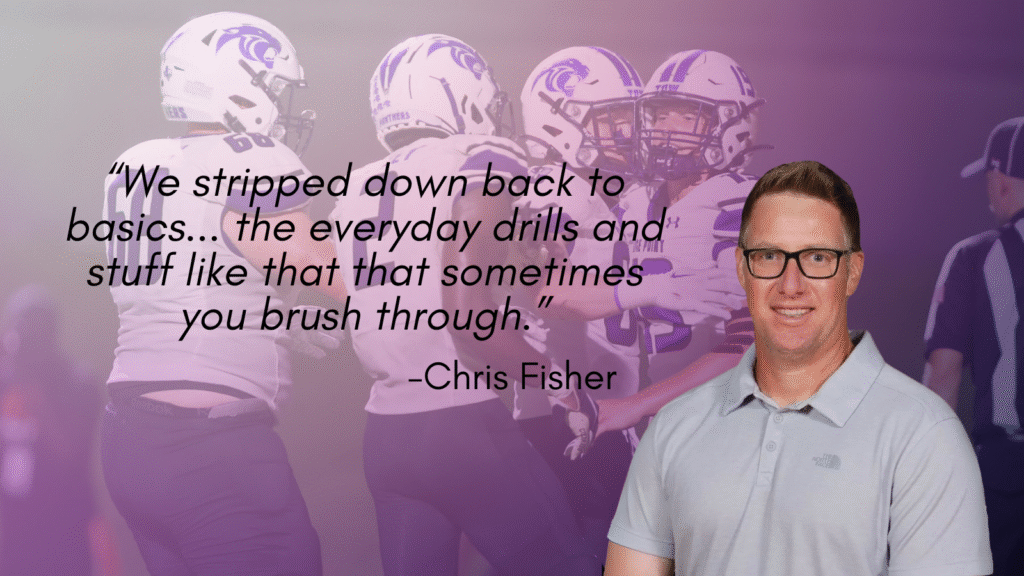
“We stripped down back to basics… the everyday drills and stuff like that that sometimes you brush through.” (02:27)
For 5 to 15 minutes each day, the offensive line drilled relentlessly on the fundamentals: step circuits, fit and drive, quick pass sets. They practiced double teams without the distraction of combo blocks. Every rep reinforced what they had skipped — and what they needed to win.
Even during team periods, Monday was reserved strictly for double teams. Why? Because, as Fisher explained, they needed to learn how to work together again — to trust the first steps before worrying about the second.
“We were just working double teams… so they would get used to just working together.” (04:47)
See the Player, Not the Prospect
There’s a powerful lesson in all of this: coach the player in front of you, not the one you expect them to be.
It’s easy to fall in love with potential. That’s especially true with linemen who are big and strong — the kind of players who “look the part.” But even seasoned starters are still kids. They need reminders, structure, and constant reinforcement of the basics.
Fisher’s renewed approach didn’t just help the veterans. It created a clearer environment for younger players and JV call-ups to thrive. One lineman went from a developmental depth piece to a key starter by season’s end — all because the foundation was finally built for him to stand on.
Final Thoughts: Reset, Rebuild, Recommit
The assumption of readiness is a silent threat. It sneaks in when we get comfortable, and it’s hard to spot until results suffer. But as Coach Fisher’s season shows, humility, simplicity, and a focus on the basics can bring a team back from the edge.
So this offseason, ask yourself: Am I coaching who they are — or who I want them to be?
Importance of the Basics- Mike Cummings, Offensive Line Coach, Central Michigan (Part 1)
Van Malone, Be the Thermostat- Assistant Head Coach, Kansas State