
If only one team showed up in your weight room tomorrow, would you know how to turn that into buy-in across your entire school?
That’s exactly where building buy-in in the weight room begins, not with perfect facilities or big budgets, but with consistency, relationships, and proof of results. At Cuyahoga Falls High School, one strength coach turned a fragmented system into a thriving program that now reaches hundreds of athletes across every sport.
Start Small to Build Big Momentum
Every football coach understands this truth: you don’t need everything, you just need a starting point.
When the program began, there was no unified structure. Each coach ran their own lifts, often without a clear plan. Instead of trying to change everything at once, the approach focused on one team and one mission: deliver value every single day.
“We started with 33, first year… second year we had about 150. And now… we have about 300 varsity high school athletes.” (02:05)
Because the results spoke for themselves, athletes began to show up. Then, just as importantly, coaches started paying attention.
Momentum built naturally. Instead of forcing people in, the program made them want to be part of it.
Turn the Weight Room Into a Competitive Environment
Football players already love competition. The challenge is getting every athlete, especially across different sports, to feel that same energy.
To solve this, the program introduced real-time performance tracking using Tully. Instead of guessing, athletes could see their progress right away through live feedback.
“Whatever we do, it’s always a competition.” (07:27)
Athletes did not just train; they competed. Tully helped drive that by showing progress in real time, giving athletes numbers to chase and proof that the work was paying off. That daily feedback created accountability and kept athletes engaged because every rep had a purpose.
Create Buy-In by Meeting Athletes Where They Are
Not every athlete walks into the weight room ready to max out a squat. While football players often embrace that culture, other teams may be hesitant to do so.
So instead of forcing one style, the program adapted. Coaches made training approachable, competitive, and enjoyable in ways that fit each group.
“The girls are the hard part… showing that training is fun has really pushed the buy-in.” (05:10)
Because of this shift, athletes who once avoided the weight room began to take ownership of it. In turn, participation expanded beyond traditional “lifting sports”, accelerating buy-in in the weight room across the entire school.
Get Coaches in the Room and Keep Them There
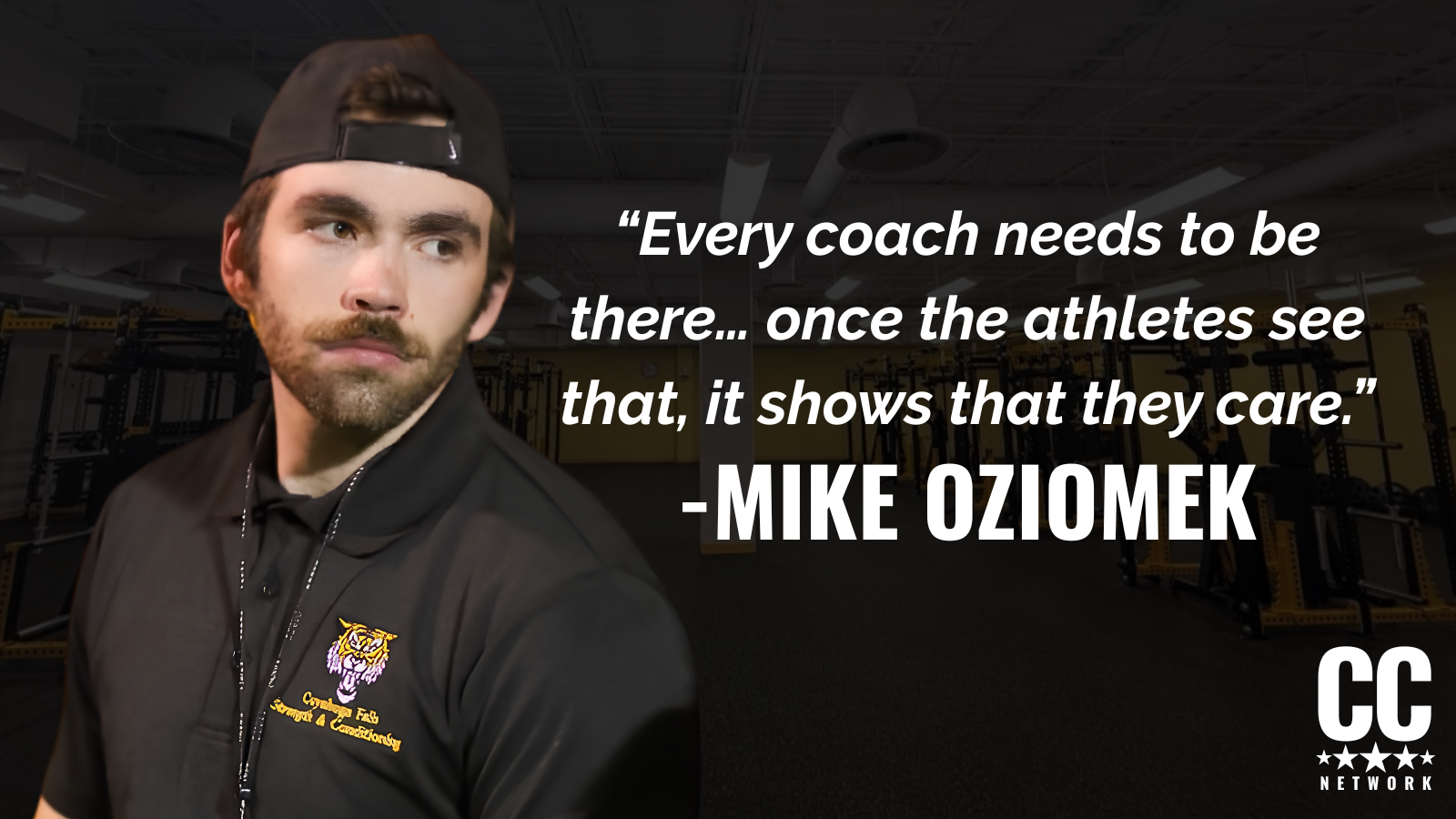
Getting coaches in the room changed everything. When athletes saw their coaches show up consistently, they knew the work was important. As Oziomek put it:
“Every coach needs to be there… once the athletes see that, it shows that they care.” (10:15)
This created one standard across every program and sent athletes a clear message: development matters, and everyone is invested.
Build Trust with Parents to Sustain Growth
Many programs overlook one key stakeholder: parents. However, involving them can accelerate building buy-in in the weight room faster than almost anything else.
Instead of keeping training behind closed doors, Oziomek’s program focused on transparency and communication. Parents began to see changes not only in performance but also in behavior and mindset.
“My kid is starting to act better at home… they’re starting to get higher GPAs.” (13:30)
Because parents saw real-life benefits, they became supporters of the program. That trust helped the program grow and gave it long-term stability.
Key Lessons for Scaling a Strength Program
If you want to replicate this kind of growth, focus on what drives building buy-in in the weight room:
- Start with one team and prove the system works.
- Use competition and data to create daily engagement.
- Align sport coaches by involving them in the process.
- Require the coach’s presence to reinforce the importance.
- Build trust with parents through transparency.
The Bigger Picture: Culture Wins
Facilities help. Equipment matters. Still, culture drives everything.
This program didn’t start in a state-of-the-art space. In fact, it began in a worn-down facility. Yet the mindset remained the same: maximize what you have and prove it works.
As a result, administrators eventually invested in a larger, modern weight room, but the real transformation had already happened.
For football coaches, the lesson is simple:
Build the culture first; everything else follows.
And when you pair that culture with training tools like Tully, you don’t just run workouts, you build a system athletes believe in.
Track and improve your athlete’s progress with Tully!
Schedule a meeting to learn more about Tully today!

Related:
The Power of Buy-In: How Coach Nick Codutti Builds a Program Where Every Player Matters
Creating Buy-In and Playing to Strengths for a Strong Start