

By Keith Grabowski
Jeff Traylor doesn’t leave identity to chance.
At UTSA, every phase of the game reflects a clear set of expectations. Those expectations reside in what he calls the “Always List”—a framework that anchors weekly preparation, keeps coordinators aligned, and ensures the Roadrunners show up as the team they claim to be.
Traylor’s Always List isn’t a motivational gimmick. It’s a practical system that connects his program’s core philosophy—what they value and believe—to what actually happens on game day.
“You can’t score if you don’t try,” Traylor said. “Throw the freaking thing in the end zone.”
That one line captures the spirit of the Always List. His coordinators know the formula. They know what has to be on tape. If it’s not—if fly sweep doesn’t get called, if the reverse doesn’t show up—there’s a conversation coming. Not because he’s a micromanager, but because the team’s identity is built around those pieces.
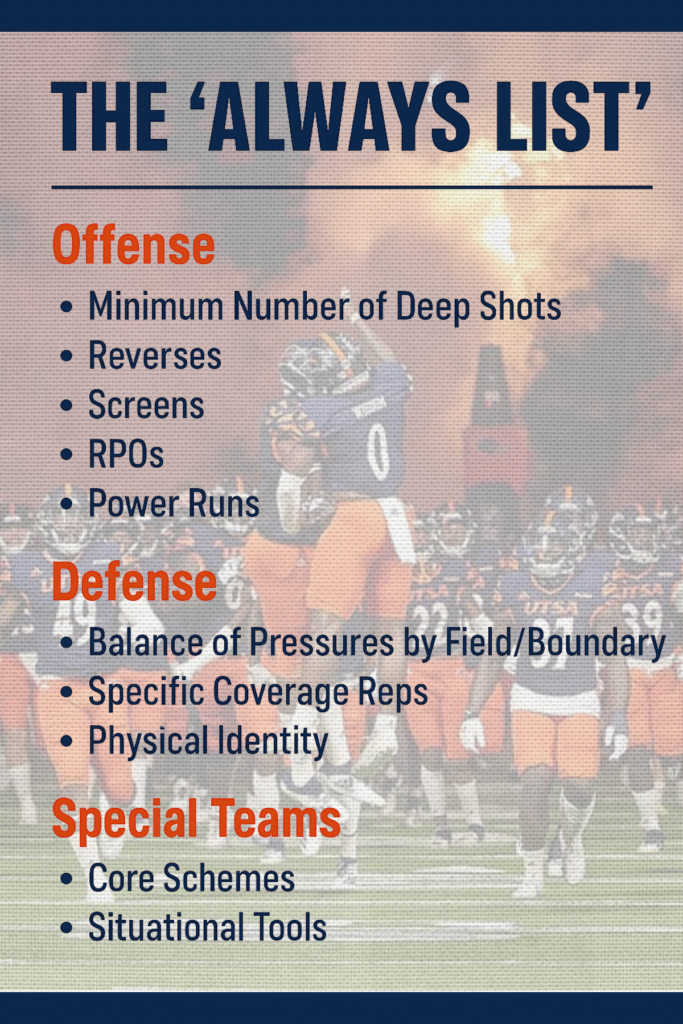
What’s on the Always List?
Each coordinator has their own version, built with Traylor’s guidance and reviewed weekly:
- Offensively: Minimum number of deep shots, reverses, screens, RPOs, and power runs.
- Defensively: Balance of pressures by field/boundary, specific coverage reps, and physical identity.
- Special Teams: Core schemes and situational tools that define UTSA’s style.
“If you don’t, it’s not going to look the way I want it to look,” Traylor said.
He doesn’t call plays on game day. He builds the structure during the week. Analysts check the tape every Sunday and report to Traylor. If a call sheet didn’t match the Always List, he asks why. When the answer holds up, fine, but if it doesn’t, the conversation shifts from explanation to decision.
Why It Works
The Always List enforces clarity. Every coach knows what they’re responsible for. It sharpens the weekly install, and shapes personnel decisions. The list even drives postgame reflection—Traylor used to go through it in his truck with his coordinators after Friday nights at Gilmer High School.
It also eliminates surprises. There’s no guessing what the head coach wanted or why he’s upset. Everyone operates from the same shared standard.
Teaching Beyond the Call Sheet
Coaches talk about culture. Traylor operationalizes it. The Always List reflects more than just scheme—it reflects identity. It’s a way to ensure the team lives up to its Triangle of Toughness: play your best players on defense, commit to running the ball, and dominate special teams.
That triangle isn’t just a slogan. It appears in the playbook, on the call sheet, and on tape. The Always List keeps it there.
Implementation for Your Program
Whether you coach high school or college, consider these takeaways:
- Define your identity. What must show up for your team to look like your team?
- Create your Always List. Limit it to things that truly define who you are.
- Review it weekly—before and after each game—with coordinators and staff.
- Be consistent. Hold yourself accountable to it, just like your coaches.
Traylor’s approach isn’t complicated. It’s just consistent. That’s what makes it powerful.