

By Garrett McLaughlin | Defensive Line Coach & Special Teams Coordinator, Columbia University
Presented by Lauren’s First and Goal Foundation
Why Hidden Yardage Special Teams Decides Playoff Games
When the margin is thin — as it is for every team still playing in November and December — hidden yardage special teams becomes a decisive factor in the outcome. Explosive plays and scoring opportunities aren’t the only things deciding games.
Most importantly, field position is what truly separates winning from losing.
Therefore, Garrett McLaughlin built a clear, objective grading system to quantify hidden yardage special teams in the kicking game.
No opinions cloud the analysis. Emotions don’t factor in. Arguments have no place here. Just numbers.
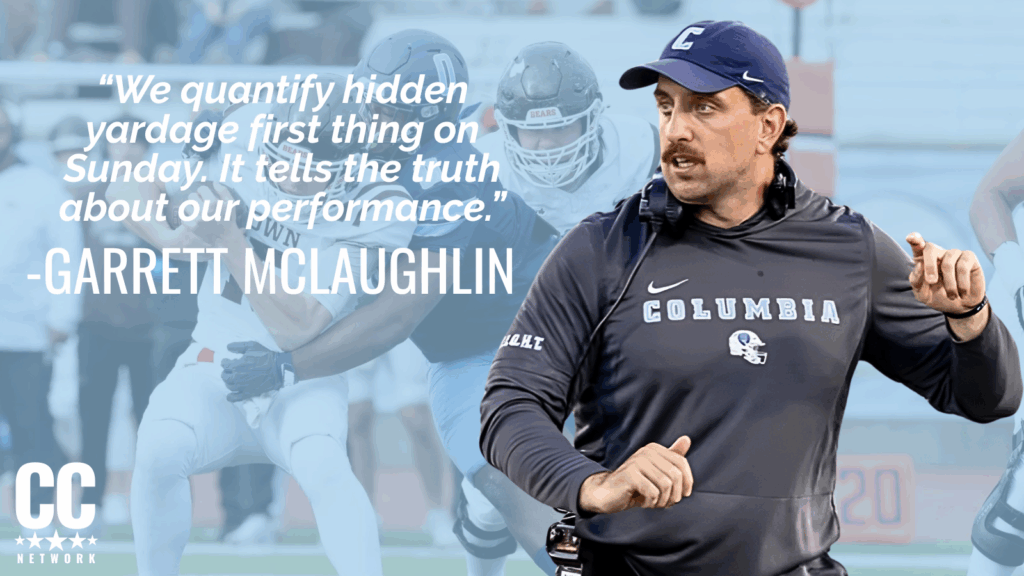
“We quantify hidden yardage first thing on Sunday. It tells the truth about our performance.”
Consequently, this system gives players the same clarity they get from offensive and defensive production — and it turns special teams into a measurable weapon.
1. Start With the National Standard
To evaluate performance honestly, McLaughlin uses national averages rather than internal expectations.
For punts, he uses a 30-yard national net average as the baseline.
Punt team grading:
- Net 36 = +6
- Net 30 = 0
- Net 25 = –5
Punt return team grading:
- Opponent net below 30 = plus
- Opponent net above 30 = minus
“This keeps us from lying to ourselves. It gives us a real standard.”
Clearly, this foundation helps quantify hidden yardage special teams efforts without bias. Moreover, it provides an objective starting point for comparison.
2. Explosives in the Kicking Game: ±30 Yards
Most coaches track explosive plays on offense and defense — but often ignore the kicking game.
Therefore, McLaughlin fixes that with one simple rule:
Every swing of +30 yards or –30 yards is an explosion.
Examples:
- Big return out to midfield → +30
- Poor coverage allowing opponent to reach the 40 → –30
- Bad punt + return combo flipping the field → –30
- Coffin-corner or sting punt pinning the opponent deep → +30
“If it moves the field 30 yards, good or bad, the players see it in green or red immediately.”
Consequently, this turns previously invisible momentum shifts into visible coaching points—crucial for recognizing hidden yardage special teams impacts.
3. Kickoff & Kickoff Return: Always Grade Against the 25
Using the 25-yard line as the standard simplifies evaluation:
Kickoff team:
- Opponent starting inside 25 = plus
- Opponent starting beyond 25 = minus
Kickoff return:
- Return reaching past 25 = plus
- Tackled short of 25 = minus
Because of its simplicity and universality, this metric is easily recognized by every player and clearly reflects hidden yardage special teams success or failure.
4. The “Sting Punt” Metric — A Game-Changer
One of McLaughlin’s most valuable tools is his Sting Punt scoring model.
Any punt downed inside the 10 is worth positive points equal to the yard line.
Examples:
- Downed at the 9 → +1
- Downed at the 5 → +5
- Downed at the 1 → +9
“That’s +9 without gaining a yard. That’s winning the game without even playing offense.”
Thus, this metric rewards:
- Precision
- Hustle
- Technique
- Situational awareness
Moreover, it builds a culture where punting isn’t viewed as surrender — it’s a weapon, and a vital component of hidden yardage special teams strategy.
5. Why This Matters in the Playoffs
Hidden yardage swings possessions.
Possessions swing momentum.
Momentum decides playoff games.
McLaughlin’s grading system:
- Makes hidden yardage visible
- Gives players a scoreboard for special teams
- Shows coaches exactly where field position was won or lost
- Reinforces complementary football
- Helps the entire team understand the stakes
Most importantly, it teaches players how special teams win games — not just how not to lose them.
Without a doubt, understanding hidden yardage special teams is key to playoff success.
Key Takeaway
If you aren’t measuring hidden yardage special teams, you’re missing the truth.
“Numbers don’t care about feelings. Hidden yardage tells you who really won the kicking game.”
Related:
Game Planning Tips: The ABCs of Punt Blocking and Winning Hidden Yardage
Special Teams & Technology in Recruiting- Justin Stovall, LB and Special Teams Coordinator, Columbia