

By Siddiq Haynes | Defensive Line Coach & Run Game Coordinator, UTSA
Presented by Lauren’s First and Goal Foundation
Why Great Pass Rush Isn’t About “Rushing the QB”
When Siddiq Haynes builds a pass-rush plan, he doesn’t start with blitz ideas or favorite stunts.
He starts with a simple truth:
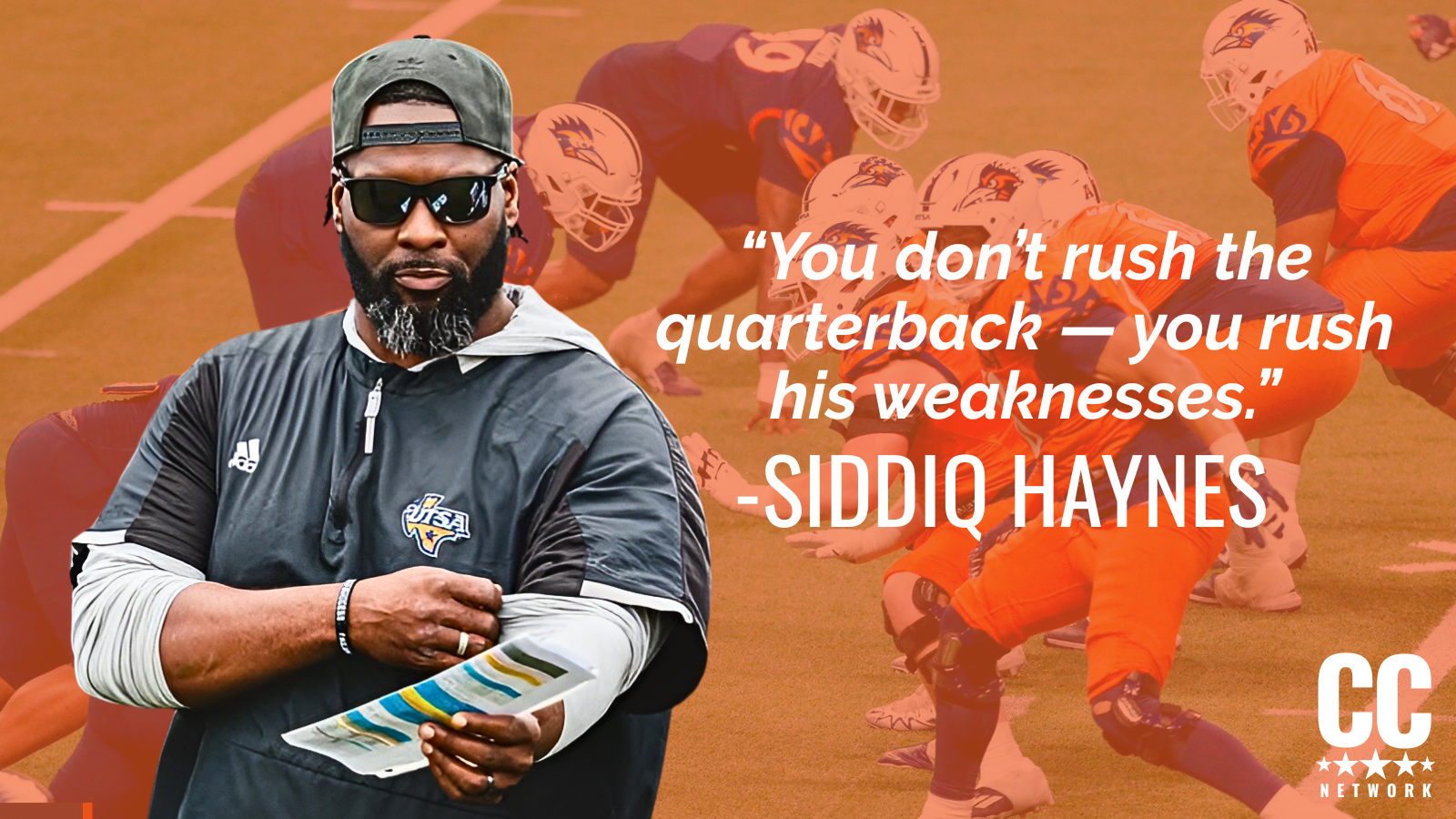
“You don’t rush the quarterback — you rush his weaknesses.”
To identify those weaknesses, Haynes studies what he calls the QB Window Evaluation — a four-window map of the pocket that reveals where sacks occur, where completions happen, and where the quarterback becomes uncomfortable. This evaluation directly supports his QB window pass rush philosophy.
This system gives your defense answers, not guesses.
1. The Four QB Windows
Haynes breaks the pocket into four teaching windows based on where the quarterback is protected and where he wants to throw:
- Window 1: Outside the right tackle
- Window 2: Right tackle → center
- Window 3: Center → left tackle
- Window 4: Outside the left tackle
Every sack, scramble, pressure, and completion gets labeled by window, a core part of applying the QB window pass rush method.
Patterns start appearing fast.
2. Where Are the Sacks Happening?
In one of Haynes’ evaluations:
“Between windows two and three, he’s been sacked seven times. That tells me the middle of the line is the weakest.”
This shifts your entire rush plan:
- Interior picks
- B-gap penetrators
- Mugged looks
- Late stem movement
- Occupy the center and attack the launching point
This is how you stop calling pressures blindly and start calling pressures intentionally through a targeted QB window pass rush plan.
3. Where Does He Want to Throw?
You also chart completions by window.
For the same QB:
“Window one — he completed the most balls. A right-handed quarterback typically wants to throw to his right.”
This tells you:
- Cloud the right side
- Build traps or rotations
- Push the pocket toward his weak throwing window
- Press or re-route the favorite receivers
- Simulate pressure into his comfort zone
Coverage and rush become one plan, aligned with the QB window pass rush framework.
4. Is He Really a Scramble Threat?
Scrambles must be evaluated with yardage, not just attempts.
“If a QB has ten scrambles for twenty yards, that’s not a runner — that’s a guy barely getting back to the line.”
This determines:
- Whether edges need firm containment
- Whether green-dog rules apply
- Whether you can run interior games aggressively
If the QB cannot hurt you with his feet, you can collapse the pocket at will — an important part of controlling the QB window pass rush picture.
5. Hit Charting Makes the Picture Complete
Haynes also charts hits on the quarterback, because that reveals not only protection issues but timing and hesitation.
- Do the hits all come from LT?
- Did the RT struggle vs power?
- Do hits occur after the QB resets his feet?
- Are hits connected to coverage sacks?
These answers help align:
- Who should run the high side
- Who should attack interior lanes
- When secondary pressure is actually useful
Hit charting helps clarify exactly how each window affects your QB window pass rush approach.
6. Turn the Evaluation Into a Targeted Plan
The QB Window evaluation narrows what you carry into the game:
- Which stunts matter (A/B picks, long loops, spike runs)
- Which edges to attack (based on hits and pressures)
- Which coverages marry to the plan (cloud, trap, bluff pressure)
- Where the simulated pressures should hit
- Where the QB actually panics
This is the opposite of a “call sheet full of guesses.”
It’s a blueprint — and the foundation of a disciplined QB window pass rush strategy.
Why This Matters in the Playoffs
Playoff quarterbacks rarely get rattled by generic pressure.
They get rattled when the defense:
- Attacks their weak windows
- Moves the pocket toward their off-hand
- Closes their favorite launch point
- Forces them into uncomfortable exits
- Matches coverage to the rush pattern
Haynes’ system helps you stop calling pressures to call pressures — and start calling pressures that change the game. This is where the QB window pass rush approach separates itself.
Key Takeaway
If you don’t study where the QB succeeds and fails, you’re not game planning — you’re guessing.
“Chart the windows. Chart the hits. Build your rush plan from the truth.”
A complete QB window pass rush evaluation reveals everything you need.
Related:
Double Your Hits, Hurries, and Sacks on the QB
Coaching Through Chaos: Designing Game-Like Drills That Actually Transfer
More on Coach Siddiq Haynes
About Coach and Coordinator Media
Coach and Coordinator Media is the leading daily football coaching podcast and educational platform, featuring interviews with elite coaches from the NFL, NCAA, and high school ranks. With 1.5 million downloads per year and a community of 20,000 coaches, we’re committed to developing the “10% Coach”—those dedicated to excellence and continuous growth.