
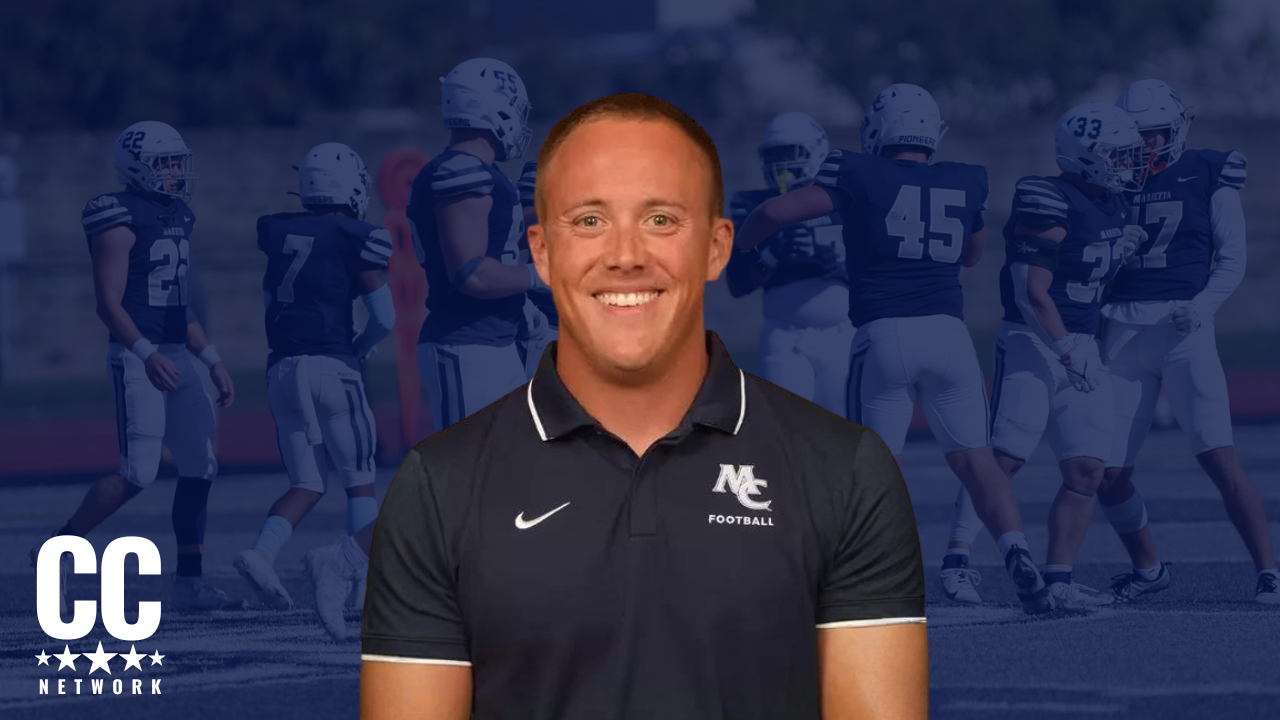
Austin Cordova — Defensive Coordinator, Marietta College
Most coaches talk about effort.
Fewer define how participation actually looks inside the program.
During his LFG Clinic presentation, Marietta defensive coordinator Austin Cordova shared a framework his staff uses to identify the types of players inside their culture. It comes down to two categories:
Passive participants and aggressive participants.
Once players understand the difference, expectations become clear.
Passive Participants
Cordova begins by identifying behaviors that quietly erode a culture.
These are players who technically show up but do not actively engage with the standard.
1. Lack of Communication
The first indicator is simple.
Players who fail to communicate with teammates or coaches.
If a player is late to a lift, misses a meeting, or is dealing with an issue but does not communicate it, Cordova considers that passive participation.
Communication is not optional. It is a responsibility.
2. Seeking Comfort Disguised as Being Right
Another sign appears when players hesitate to step into new situations.
When the defense installs a new call, coverage, or drill, passive participants often try to avoid going first.
Instead of embracing the rep, they defer to someone else.
Cordova describes these players as “toe dippers.”
They want certainty before they act.
Aggressive participants do the opposite. They jump in and learn through the rep.
3. Apathy Toward Negative Outcomes
Passive participants also tend to disconnect from others’ success or failure.
If a teammate misses a tackle or struggles during practice, they show little concern.
But when they personally make a play, they celebrate themselves.
That mindset separates individual achievement from team responsibility.
4. Viewing Teammate Struggles as an Opportunity
Cordova warns coaches about another subtle problem.
Players who treat a teammate’s weakness as their own advantage.
A backup might quietly hope the player ahead of him struggles so he can move up the depth chart.
Instead, Cordova teaches the opposite standard.
If the No. 2 player makes a great play, the No. 3 player should celebrate it.
And if the No. 2 player struggles, the No. 3 player should help him improve.
Because when the room gets better, the defense gets better.
What Aggressive Participants Look Like
The goal is not simply to eliminate passive behavior.
It is developing aggressive participants who actively elevate the group.
They Force Communication
Aggressive participants do not wait for information.
They ask questions, communicate with teammates, and clarify details, ensuring the room stays connected.
They Embrace Adversity
When something new is installed or a drill becomes uncomfortable, aggressive participants step forward.
They do not avoid the moment; they treat it as an opportunity to improve.
They Accept Outcomes and Learn
Aggressive participants own both positive and negative results.
They celebrate success but also use mistakes as teaching moments.
They Empower Teammates
Cordova’s staff uses a term for players who elevate those around them.
They call it “Zone One.”
Zone One players bring others with them.
They push teammates to perform better and raise the overall standard of the room.
According to Cordova, that trait becomes the clearest marker of leadership inside the defense.
The Standard
Cordova’s framework simplifies something many programs struggle to define.
Culture is not just effort.
It is participation.
And every player eventually reveals their type.
Passive participants maintain the status quo.
Aggressive participants elevate everyone around them.
Watch the Full Presentation
This clip is a section of Austin Cordova’s full LFG Clinic presentation on building a defensive culture and accountability within the program.
Beyond the Passive vs. Aggressive Participants lesson, Austin Cordova’s full presentation shows how Marietta builds its defense.
Inside the full course:
- The “One More” culture and defensive accountability standards
- A simple 0–1–2 grading system tied to production
- Teaching methods that help players learn faster and play faster
- Marietta’s Football School approach to building football IQ
- Core defensive structure: gap control, 3 strong / 2 weak, seam protection
- Film breakdowns of pursuit, tackling, block destruction, and creating havoc
The free clip teaches one culture idea.
The full presentation shows the complete defensive culture system.
Inside LFG Clinic Premium Access, coaches can watch the complete presentation along with:
• Every session from the 2026 LFG Clinic
• 500+ additional presentations inside Lauren’s Library
• Full coaching development tracks including OC School, DC School, HC School, Special Teams Coordinator School, and Position Coach Schools
• Ongoing clinics, Q&A sessions, roundtables, and private podcast episodes
• A coaching community where ideas continue year-round
Access everything at LFGClinic.com.
About Austin Cordova:
Austin Cordova is the Defensive Coordinator and Linebackers Coach at Marietta College, joining the Pioneers’ staff in March 2025 under head coach Tom Hinkle.
Cordova brings experience from both the Division I and Division III levels, with a background that spans defensive coaching, recruiting, and player development. Before arriving at Marietta, he served as the Run Game Coordinator and Linebackers Coach at Ithaca College. Prior to Ithaca, he worked at the University of Rhode Island as a defensive backs assistant and video coordinator, and at Austin Peay State University as a defensive quality control coach working with the safeties.
Earlier in his career, Cordova coached at Ohio Northern University, where he was the recruiting coordinator and coached linebackers and safeties, and at The College of Wooster as an outside linebackers coach and strength and conditioning assistant.
A native of Perry, Ohio, Cordova played defensive back at Baldwin Wallace University, where he was a three-year letterwinner at strong safety and nickel. He earned his bachelor’s degree in Exercise Science from Baldwin Wallace in 2015.