
Keith Grabowski, offensive coordinator and QB coach at Bay High School, walks through the actual install calendar behind his offense on One Play at a Time, built for a two-way roster of 44 players learning more than one job, and explains why Just Play is the first platform he’s used that lets him hold the entire color-coded, quiz-gated system together in one place.
Before a single Bay High player steps on the turf for the first practice of the season, the staff is asking for 60 to 90 minutes of his time. Watching, learning, quizzing, just to walk in ready. That’s almost a full practice’s worth of preparation before practice even starts, and Grabowski says it surprised his players more than it surprised him.
What Does the Flight School Analogy Actually Mean for an Install Calendar?
Grabowski builds on an analogy from the previous episode: a playbook is the manual, but video and quizzes are what actually put a player in the cockpit before game night. He extends it to how pilots are trained in ground school. Nobody hands a student the entire flight manual on day one with a due date at the end of the week. There’s a syllabus. Lesson one covers exactly what lesson one needs to cover and nothing else, lesson two builds on it, and partway through there’s a check ride, a real evaluation where a student has to prove what he’s learned in an actual plane.
Bay’s install calendar follows that same shape. Nine practices happen before the season goes live, with a scrimmage after practice five and a second scrimmage after practice nine. Every practice in between has its own specific, non-negotiable lesson plan, nothing more.
Why Does a 44-Player Roster Need Conceptual, Interchangeable Teaching?
Bay runs 22 varsity and 22 JV players, 44 kids total, on one staff where every assistant, including Grabowski, has a full-time job outside of coaching. Only one staff member is actually in the building during the school day. That reality shapes everything else.
Take the offensive line: Bay has roughly seven varsity-ready linemen and seven more at the JV level. A true two-deep at every position, taught the traditional way, isn’t realistic at that depth. So Bay doesn’t teach a guard one job and a tackle a separate one. It teaches conceptually, so a tackle can play center or a guard can slide out to tackle, because the depth chart only survives if those parts can move. The same logic applies on the skill side: a bigger receiver needs to be able to play some tight end, and a running back needs to be able to line up at fullback.
Grabowski describes the approach to his staff as a box of Legos. Give a player a small number of basic shapes, and depending on how you combine them, he can build a race car or a spaceship. Bay isn’t teaching five separate jobs to five position labels. It’s teaching a small number of core rules and techniques, then combining those same pieces differently depending on where a kid lines up that week. The player becomes interchangeable because the teaching was never built around the position label in the first place.
Why Couldn’t This Just Be a Google Doc?
Before Just Play, Grabowski says his install lived across a scattered set of tools: some in Hudl, some in a shared drive, some in a text thread, some only in someone’s head. A kid playing two positions had to hunt through four different places to find what he needed for both jobs, and a coaching staff working part-time didn’t have the bandwidth to keep four systems updated and in sync. The kid who suffers most in that setup, Grabowski points out, is usually the cross-trained one, since he’s the player with double the material and half the time everyone else has to track it down.
His take on general-purpose tools is direct: Google can host a document, but it can’t tag a quiz to a position group, gate a rep behind a completed quiz, or show which of his linemen actually watched a protection video all the way through versus clicked play and walked away. That’s not a knock on Google. It was never built for football. It’s a knock on trying to force a general-purpose tool to do a football-specific teaching job.
That reframed the first problem Bay had to solve. It wasn’t a teaching problem. It was a filing problem: where does everything live, and how does a kid playing two spots know exactly what applies to him without wading through what doesn’t. In Just Play, the diagram, teaching video, quick hitter, and quiz all live attached to the same play. If Grabowski updates a rule, it updates everywhere that concept shows up, not across four separate documents he has to fix by hand. When he assigns a quiz, he tags it to a position group once, and it automatically routes to his linemen, his skill players, or his hybrids, whoever it’s actually built for.
How Should Coaches Organize a Digital Football Install?
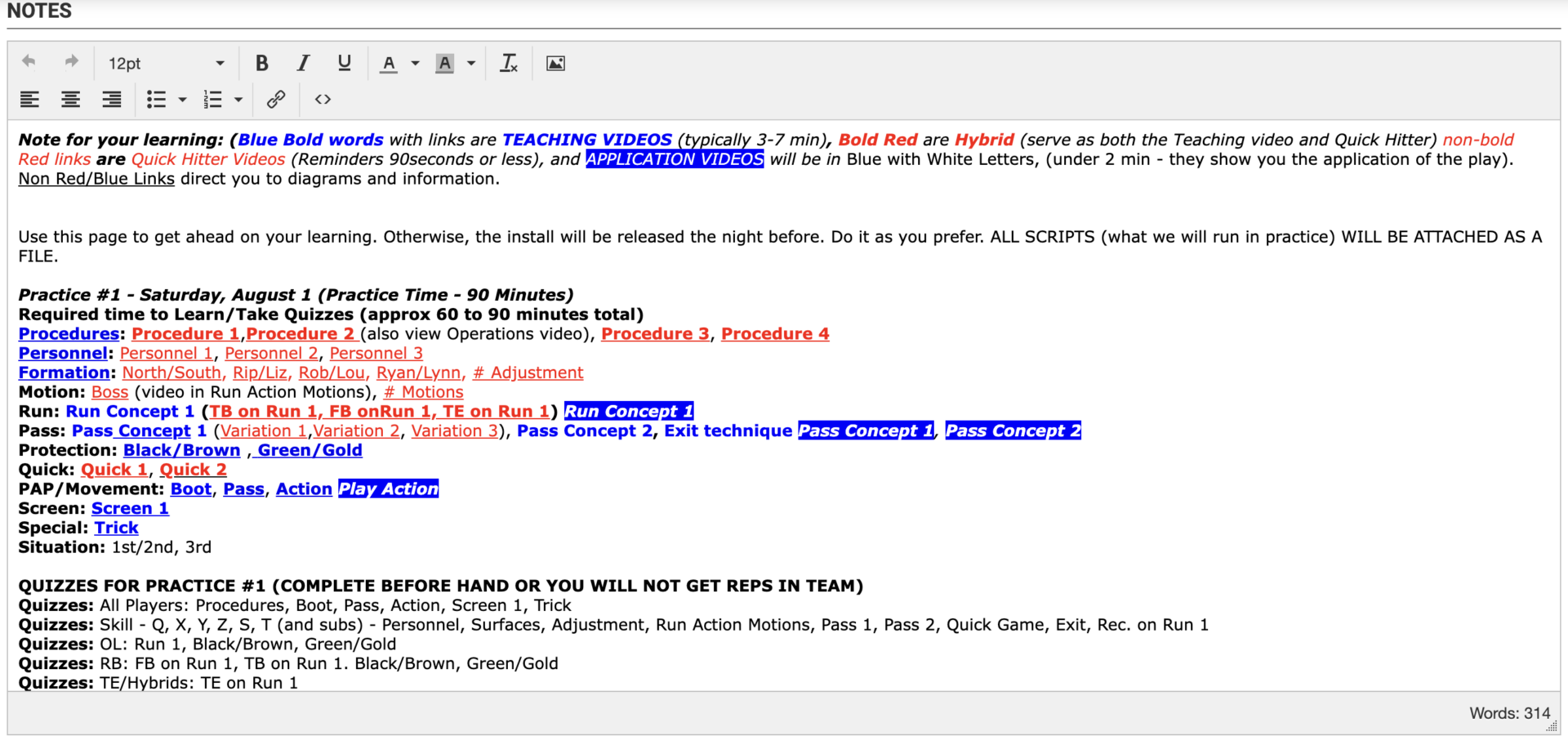
Every install cycle at Bay starts with what Grabowski calls the general information page, a single front door where a player can see the entire install laid out practice by practice, term by term, with every word a live link to the video, diagram, or information behind it.
The color coding tells a player what he’s about to get before he clicks it:
- Bold blue text with a link is a full teaching video, three to seven minutes, covering a complete concept.
- Bold red is a hybrid video that pulls double duty as both a teaching video and a quick hitter, used for smaller concepts that don’t need two separate pieces of content.
- Plain, non-bold red is a pure quick hitter, a reminder under 90 seconds.
- White text on a blue background is an application video, usually under two minutes, showing the concept actually being run, sometimes with a voiceover.
- Anything else on the page is a link to a diagram or supporting information, and quizzes are listed separately.
The point isn’t aesthetics. Grabowski is asking a 14 to 17-year-old to self-manage 60 to 90 minutes of learning around baseball practice, a job, or a family trip, and if a player has to click every link just to find out what’s behind it, he’s eventually not going to do it at all. One quarterback told Grabowski he’d knock out an install during a six-hour drive back from a trip to Canada. Installs get released the night before practice by default through Just Play’s presentation tool, but players who want to get ahead can click through everything early since it’s all sitting on the page.
What Does Practice One Actually Look Like on the Install Calendar?
Practice one runs 90 minutes and is, by design, the heaviest install day of the entire preseason. It includes procedure calls, the operational words that tell a player to run a play, reset, run it again, or that the play is dead, a handful of personnel groupings, formation calls with directional reads and number adjustment rules built in, a motion, a run concept, two full pass concepts with their tag families, two protections, a quick game concept, a play action concept, a screen concept, a trick play, and situational football for first, second, and third down.
Grabowski is upfront that practice one isn’t really about the plays. It’s about vocabulary. Every term a player will hear for the rest of the season gets introduced that day in its smallest, cleanest form, so everything after it is addition, not translation.
From there, the calendar breathes. Practice two runs 50 minutes and adds only one new personnel grouping and a couple of formations and tags. Practice three goes back to 90 minutes and introduces the first full slide protections and more advanced pass concepts, since the players have enough foundation by day three to handle it. Practice four is shorter again, mostly protection variations plus red zone and goal line work. Practice five, the day before the first scrimmage, is almost entirely tags and wrinkles on pass concepts the players already know, plus a screen and a trick play. The shape is heavy, then light, then heavy, then light, then a wrinkle day, deliberately built around the limits of working memory rather than how much material is left to cover.
Why Should Football Quizzes Be Split by Position Group?
Every quiz on the install page is tagged to a specific group rather than the team as a whole. There’s a set every player takes, covering procedures and the handful of concepts that touch everyone, like play action and the screen game. There’s a separate skill player set for receivers, backs, and hybrids, covering personnel groupings, formations, motions, and core pass concepts. Offensive linemen get an entirely different set built around protection rules and the run scheme from their perspective, and running backs get their own version of run concept quizzes, since a tailback’s job on a given run differs from a lineman’s or tight end’s. Tight ends and hybrid players get a set built specifically around the jobs they’re actually asked to do.
Grabowski built the underlying question banks efficiently by creating a knowledge base in ChatGPT, then used Just Play’s fields to house the diagrams, videos, descriptions, and quizzes tied to each play. He’s direct about why the position-specific split matters: a general, team-wide quiz doesn’t work for recall, and recall, not just compliance, is the actual goal. An offensive lineman doesn’t need mastery of the formation system, so testing him on it wastes his time. A hybrid tight end does need pieces of both the receiver and lineman material, so he gets both quizzes.
The quizzes aren’t optional. At the top of the practice one quiz section, the language is direct: complete these beforehand or you will not get reps in team. Grabowski ties this to the retrieval practice research he discussed in the previous episode. If a player hasn’t retrieved the information through the quiz, he doesn’t get the rep, since there aren’t enough snaps in a 50 or 90-minute practice to let a player guess through a rep he hasn’t proven he understands on paper first.
Does Flipped Learning Work for Football Teams?
Grabowski doesn’t oversell the science behind flipped learning. The largest meta-analysis on the subject, 114 studies out of the University of Utrecht published in 2019, found the average benefit is real but small, roughly equivalent to a student in a flipped classroom performing like they landed around the 64th percentile compared to a traditional classroom. A separate, tightly controlled study out of Johnson & Wales found flipping moved the needle for under 15 percent of students, with over 80 percent showing no significant change and a few doing worse, even though most of those same students said in a survey that they preferred the flipped format.
Both studies point to the same explanation: it’s not the concept that fails, it’s the execution. Classrooms that cut into real face-to-face application time saw students learn less, and the ones that protected and built out real in-person practice time saw the actual gains. The lead researcher on the Utrecht study concluded flipped learning can work, but only when it’s designed properly, and that the lift required is heavy enough that a teacher shouldn’t try to build it alone.
That’s the standard Grabowski holds Bay’s own system to. Meetings have been rebuilt down to 15 to 20 minutes of actual interactive application instead of him talking, followed by 30 minutes of walkthrough on the field before practice starts. In his framing, most attempts at flipped learning fail because a coach records a lecture, posts it, and hopes the in-person half sorts itself out. That’s still a manual. It just has a play button on it now.
When Should Coaches Stop Installing New Plays?
After the first scrimmage, something shifts. Practices six through nine add almost no new plays. Instead, they add operational football: procedure calls like how the team checks at the line, handles two-minute and clock management situations, opens a series, or manages the last plays of a half or game. Grabowski describes the first scrimmage as a check ride, not a final exam, confirming the foundation is solid enough to build a situational layer on top of it. A two-minute drill only means something to a player who already trusts his assignments well enough to execute them fast, without re-deriving them under pressure. The second scrimmage comes after practice nine, and the season starts from there, with the install shifting into an ongoing weekly rhythm.
Why Do Two-Way High School Football Teams Need a Different Install Process?
Grabowski closes with the number he says actually explains why Bay built this system in the first place. A college program gets 25 practices before its first game, with a full staff, one-way players, and often multiple position coaches per spot. Bay gets nine practices before game week, plus four more once game week begins, 13 total between the first snap of camp and the first snap that counts. That’s 13 against 25, and it isn’t a number Bay chose. It’s a number the roster hands them, since their players go both ways and practice time has to be split between two units.
Grabowski’s point to other coaches is that a program this size isn’t the exception a platform like this doesn’t apply to. It’s exactly the program that needs it most, because there’s no time to spend thirteen practices reteaching something a player could have already learned on his own.
Football Install Planning: Quick Answers for Coaches
How do you build an install calendar for a small coaching staff? Sequence installation like a syllabus rather than handing players an entire manual at once. Load core vocabulary in the heaviest install day early, get lighter as the calendar progresses, and save situational or operational football for after a live scrimmage confirms the foundation is solid.
Why tag quizzes to position groups instead of giving the whole team the same quiz? Testing every player on the same material wastes time for players who don’t need certain concepts and can leave gaps for players who do. Splitting quizzes by role, offensive line, skill players, running backs, and hybrids, keeps recall targeted to what each player is actually asked to do on Friday night.
Does flipped learning actually work for football teams? Research on flipped learning shows a real but modest average benefit, and one controlled study found it only moved the needle for a small percentage of students. Both major studies found that execution, specifically protecting real in-person application time, determines whether a flip works, not simply moving a lecture online.
How can coaches teach a roster of players who play multiple positions? Teaching core rules and techniques instead of position-specific jobs lets players move between spots more easily, since the underlying concept stays the same no matter where a player lines up that week.
Why might a small coaching staff need a dedicated platform instead of shared drives and documents? General tools can host and share documents, but they can’t tag a quiz to a specific position group, gate a rep behind a completed quiz, or show which players actually watched a video versus clicked through it. A platform built specifically for football teaching can automate that tracking and distribution in a way general-purpose tools aren’t designed to do.
Presented by Just Play Sports Solutions
Just Play is used by more than 1,400 teams, including staffs at Clemson, Iowa, Army, and Liberty, to centralize playbooks, presentations, game planning, and quizzing in one platform. Its quizzing tools support auto-grading, real-time scoring, and content tagged directly to the plays and position groups it applies to. Learn more at justplaysolutions.com/football.
Related
Why Your Playbook Isn’t the Problem: How Bay High School Built a Better Way to Teach Football
Connect on X:
Just Play Sports Solutions: @JustPlaySS
Keith Grabowski: @CoachKGrabowski
Okay, let’s go. Here’s the honest answer. Every piece I just described, the color coding, the position tagging, the quiz gating isn’t a formatting trick I layered on top of a general tool. It’s how the platform is actually built. When I build a play, the diagram, the teaching video, the quick hitter, and the quiz all live attached to that same play. If I update a rule, it updates everywhere that.
The concept shows up, not in four separate documents. I now have to remember to go fix by hand. When I assign a quiz, I’m not manually building a distribution list. I tag it to a position group once and it automatically routes to my lineman or my skill guys or just my hybrids, whoever it’s actually built for. And I can see a and I can see player by player who watched the video all the way through versus who clicked it and closed the tab, and whether a quiz result
Reflects real understanding or a lucky guess.
You can get documents into one share folder. What you can’t get from Google Drive or any general purpose tool is a system that was actually designed around how football gets taught. Plays, personnel, install calendars, and player-by-player accountability built as a n built as native pieces of the same platform instead of five tools stitched together with Hope. I spent a decade stitching.
That’s exactly the frustration I described in our first episode. Just play is the first tool I’ve used in this game where I wasn’t the one doing the stitching anymore. It’s the system I’ve found that was actually built for this job, not repurposed for it.
So let’s actually so let’s walk so let’s walk through what’s on that page for our very first practice because the scope of it tells you something and I’ll say up front, I’m not gonna hand you our actual terminology here. We’re bringing a new offense to bay this year, and I’d rather our opponents learn it on Friday nights than off this podcast. So think of the categories, not the code words.
Practice one is 90 minutes, and it is by design our heaviest install day of the entire preseason. It’s a handful of procedure calls, the operational war the operational words that tell a player to run a play, reset, or run it again, or that the play is dead. A few personnel groupings will call them personnel one, two, and three. Several formation calls with directional read built right in.
Plus the number adjustment rule that goes with them. A motion, a run concept, two full pass concepts with its entire family of tags, two protections, a quick game concept, a play action concept, a screen concept, and even a trick play. Situational football for first, second, and third down are emphasized as well. And that’s a lot for day one. And I’ll be honest, it’s on purpose. Practice one.
isn’t really about the plays, it’s about the vocabulary. Every single term a player is going to hear for the rest of the season gets introduced that day in its smallest, cleanest form, so that everything so that everything after is addition, not translation. We’re not re explaining what personal we’re not re explaining what personnel one mean we’re not re explaining what personnel one means in week four. We already spent
Day one making sure that word means something specific and permanent in a kid’s head.
Then here’s what happens across the next four. And then here’s what happens across the next four practices. Practice two is 50 minutes. It adds one new personnel grouping and a couple of new formations and tags. Nothing close to the volume of day one. Practice three is back to 90 minutes, and that’s where we add our first full slide protections, some more advanced pass concepts, because by day three, they’ve got enough foundation to handle it. And practice four is shorter again, and it’s mostly
Protection variations, a situational red zone, and goal line work. Practice five then is the day before our scrimmage. And it’s almost entirely about tags and wrinkles on the past concepts they already know. Plus a screen and a trick play. You can see the shape of it if you step back. It’s heavy, then lighter, then heavy, then lighter, and then more of a wrinkle day. And it’s not random that’s
respecting exactly what I talked about the last time. You can only load so much new information into working memory before retention starts to drop. So we don’t do that. We stack the biggest concepts early and then when the well is empty, we get lighter as the well starts to fill up.
Now here’s the one piece that actually protects all of that, the quizzes and specifically how we built them. Every quiz on that page is tagged to a group, not just the team. There’s a set every player takes, procedures and the handful of concepts that touch everybody, like our play action pass concepts and our screen game. Then there’s a skill player set for receivers and backs, the hybrids in that room, covering personnel, groupings.
covering personnel groupings, formations, motions, and our core pass concept. There’s a separate offensive line set, different quizzes entirely built around their protection rules and the run scheme from their perspective. Running backs get those ver own running back get their own version of some of those concepts because a tailback’s job is different on a given run concept than a than an offensive lineman or a tight end. And and they’re not the same quiz. Our tight ends then
Our hybrid players along with them get a set built specifically around the jobs they’re actually going to be asked to do. And I made all of this possible and easier for myself by creating a knowledge base within Chat GPT and then cranking out the quizzes, cranking out descriptions for our playbook. there’s a lot of fields you could fill in and just play. And I felt that they’re there for a reason and we wanted to take advantage of them. So if you
were to dig into our just play playbook, every single place that content can be, we have it there. It’s designed by purpose and it’s utilized to help the teaching and the learning. And it’s utilized to help the teaching and the learning.
So I I want you to think about that for a minute because when we build a quiz, so I want you to think about that for a minute because I think most of us I did it in the past when we built a quiz, it was for the whole team. it was it was done just because at the time it wasn’t very efficient for me. As I said, using AI now I can tailor these specifically and then using just play as the platform allows me to distribute them to who they’re supposed to go to. the
I think the general quizzes, you know, they don’t work for the recall. That’s the whole purpose for us. It’s not just compliance. It’s about recall. So a kid who exclusively is an offensive lineman, he doesn’t need to have mastery of our formation system. It’s not important to him. It doesn’t touch him. But the kid who’s cross trained to maybe be a tight end, who does need to know some of those things that an offensive lineman does and needs to know receiver jobs, he’s gonna get both quizzes because he’s asked to perform
Parts of both of those jobs on Friday night. So again, we’ll tailor that quiz specifically to him. So things like the quiz we developed that are tight end on run concept one. Building it any other way wastes his time or it leaves a hole in his preparation with a rosterage size. We just can’t afford either one of those things. And we don’t treat these as optional. Right at the top of the quiz for practice.
Right at the top of the quiz section for practice one, it says this explicitly: complete these beforehand, or you will not get reps in team. And it’s not a threat, it’s just the truth of how our practice time works. We don’t have enough snaps in a 50 or a 90-minute practice to let a kid guess his way through a rep he hasn’t proven he understands yet on paper first. In the last episode.
I told you about retrieval practice that it is the single most effective tool we have for moving something into long-term memory. And this is where that stops being research citation and becomes the gate for us. If you haven’t retrieved it through the quiz, you don’t get the rep. Most of you listening to this already know the term that I’m about to use: flip learning. And it isn’t new, it’s not a fringe idea, it’s something that I’ve written about.
started writing about it fifteen years ago. and I just walk you through how we do it. the video, the quizzes before practice, the meeting and the field time spent doing instead of listening is a flip model. I’m not telling you we invented something. I’m telling you that we finally built an infrastructure to do it properly. And I would say what I did in the early days was very much limited by the tools that I had.
The part that doesn’t get said enough though is that research on flipped learning is not a slam dunk. So did some research on this. The largest meta-analysis on it, which was 114 studies out of the University of Utrecht published in 2019, found that the average benefit is real but small. And translated into plain terms, the average student in a flipped classroom performed like they’d landed around the 64th percentile compared to
a traditional classroom. And it’s good, but it’s not the revolution that the buzzword promised. And a separate study that was tightly controlled out of Johnson and Wales was even more sobering in than that when they actually pre-imposed when they actually pre-impost tested learning, flipping the classroom moved the needle for under 15% of the students. Over 80% showed no significant change
And a few actually did worse, even though the overwhelming majority of those same students said on a survey that they liked the flip format better. That gap between we liked it and we actually learned is the whole ballgame. And both studies point to the same reason for it. It’s not the concept, it’s the execution. In the U-Trect research, the classrooms that quietly cut into real face-to-face application time saw students learn less, not more.
The ones that protected and built out real in-person practice time saw the actual gains. The lead researcher’s own conclusion was that flipped learning could work better, but only when it’s designed appropriately. And designing it properly is such a heavy lift that he doesn’t recommend a teacher try to do it alone. And I think that’s the piece we really need to sit with here because the difference.
And that’s the piece I think we really need to sit with here because it’s the difference between a flip that helps your players and a flip that just moves the same problem online. Flip learning fails most of the time, not because the idea is wrong, but because most people who attempt it record a lecture, record their presentation, post it, and hope the in-person half sorts itself out. That’s still a manual. It just now has a play button on it.
So everything I walked you through in this episode for us, it was the color coding so the kids know what he’s about to watch before he clicks it, the quiz gating for us, how we say, take it or you’re not getting reps. Whether he learns a rep.
The quiz gating, whether he earns a rep, the meeting rebuilt down to fifteen or twenty minutes of actual application of me.
the the meeting rebuilt down to 15 or 20 minutes of actual application instead of me talking, the 30 minutes on the field before practice ever starts, that’s not flipped learning bolted onto an old system. That’s what the research that’s what the research says a flip actually has to look like to move the needle. And I’ll be honest, I could not have built that myself on the side the way most of us attempt to do it.
It took a platform that was built to carry the structure, not just host the videos. And I think this is where I missed before. I thought we did a decent job at it. I know it helped our players in a lot of ways, but it certainly did not maximize their l learning like we are right now. So back to the syllabus and the flight simular and the flight simulator analogy of the check ride.
Notice what happens across our nine practices. The first five are almost entirely about installing new football, new personnel, new formations, new concept, stacked practice over practice. And then we play our first scrimmage. After that, something shifts. Practices six through nine barely add any new plays at all for us. What they add is operational football.
More procedure calls like how we check at the line or how we handle our two minute and clock management situations, how we kill the clock, how we open a series, how we handle our last plays of the half of the game. Those are procedures, not plays. They’re about how the team functions in real time under a clock in exactly the kind of pressure that shows up in a game and never shows up in a walkthrough. We didn’t sequence it that way by accident and we didn’t
do it because we ran out of new plays to teach. We did it because you can’t install situational football on top of a foundation that isn’t there yet. A two minute drill only means something to a kid who already trusts his assignment well enough to execute them fast.
A two-minute drill only means something to a kid who already trusts his assignments well enough to execute them fast, under pressure, without re-deriving them in his head. So the first scrimmage isn’t the final exam on this install. It’s the check ride that tells us the foundation is solid enough to build the situational layer on top of it. And that scrimmage functions exactly like that. It’s the typical 10-play scrimmage, maybe a drive at the end of it. Then we play our second scrimmage.
After practice nine, and the season starts. Pract that scrimmage then has some of these situations. Now we’re testing those. So the real install never actually stops. It changes shape once the games start counting. It goes to a weekly rhythm of install and how we’re going back through and doing that. Something we’ll show you later in this series.
Before I get to what I’d ask you to take from this one, sit with a number that I haven’t given to you yet, because I think it’s the one that actually explains why we built all of this in the first place. A college program gets 25 practices before their first game. That’s 25, full staffs, one-way players, a position coach dedicated to nearly every spot on the roster, probably multiple position coaches. We get nine before game week.
We get nine before game week even starts. And that’s not a number we chose. It’s a number our roster hands us because our guys are playing both sides of the ball. And there’s only so much practice time you can split between two units, between two units before game week has to start eating into it. And the four practices we get once the game week begins, that’s 13 practices total, standing between our first snap of camp and our first snap that counts. That’s 13 against 25.
So if anybody hears video platform and pictures something built for programs with a full complement of assistants, one-way players and time to burn, they got the whole thing backwards. We have less than half the practice time a college staff gets, a fraction of the coaching bodies, and players learning multiple jobs instead of one. A program our size isn’t the exception,
this doesn’t apply to, it’s exactly the program that needs it most because we can’t afford to spend a single one of those thirteen practices reteaching something a kid could have already learned on his own.
Here’s what I’d ask you to take away from this episode. Whatever platform you’re using, or whether you’re using one at all, build one front door for your install, not four. Use color codes or ways to flag it or tag it in the content so the kid knows that, so a kid knows what he’s clicking before he clicks it. Tag your quizzes to the jobs your players actually do, not just to the team as a whole, especially if you’re running a roster like ours where kids are wearing more than one hat.
And sequence your install like a syllabus, not a manual. Load the vocabulary early, get lighter as you go. Save the situational football for after you’ve proven in a live scrimmage that the foundation can hold it. And if you’re already flipping your meetings or thinking about it, don’t stop at recording a lecture or presentation and posting it. That’s the version the research says. That’s the version the research says barely moves the needle. Protect the in-person time, spend it on real application.
Spend it on real applic, protect the in-person time, spend it on real application, and build the structure to actually gate and track it. And that’s the difference between a flip that works and one that’s just a manual with a play button. Think back to that first episode and and I said I could put a twenty dollar bill on that first binder I designed as a head coach. I’m still not gonna tell you the exact number, but I can tell you this that it is very encouraging to see
our players in our playbook learning. The difference this year isn’t that our players are smarter or work harder than the ones I coached 20 years ago. It’s that we finally built a system for them, a syllabus, instead of handing them a manual and pointing at the interstate.
In the next episode, we’re going to get into the part of this that starts to get messier. How did we handle the kids who missed all of this over the summer? Whether that was another sport or a family vacation, kids we didn’t see till tomorrow, which is day one of camp, and how our quarterbacks actually use the platform differently than our offensive linemen do. Everything from today, a look at how our general information page is structured, will be in a separate video. We’ll link that in the show notes.
I want to thank Just Play for presenting this series. Everything I walked you through today, the one page, the color coding, the role-based quizzes, the gate on reps that we’re using isn’t something you can bolt together out of Google Docs and good intentions. It’s possible because Just Play built a system specifically for how football actually gets taught. That’s the difference, and that’s why they’re the perfect partner for a series about teaching the modern player.
So we’ll see you next time on One Play at a time presented by Just Play on the Coach and Coordinator Network. Be sure to follow all we’re doing at coachandcoordinator dot com and follow us on X at Coach K Grobowski.