

The Wednesday Bob Benson joined One Play at a Time, he had just come off the practice field at Episcopal School of Dallas. The scout cards were on iPads. The practice film was already graded and posted. That night his players would take their weekly quiz on the opponent.
“It helps us,” Benson said. “It just helps especially me. I’m probably on the low totem pole of technology and it just keeps me grounded and it makes it easy for me.”
The “it” is Just Play, the virtual playbook Benson used at Penn and asked ESD to commit to before his first season there. The week he described is built for a small staff and young players. The coaches put the opponent in one place, and the players spend the week learning it and learning where to find it.
A college coach’s first high school job
Benson spent “thirty-five, forty years” coaching college football, at Georgetown, Johns Hopkins, the Colorado School of Mines and Penn, where he spent 10 years and used Just Play as defensive coordinator. ESD is his first high school job, and this is his first season there as head coach.
“I’ve never coached high school and I was actually a little bit intimidated, honestly,” he said.
Penn had prepared him for part of it. Players there carried heavy academic hours, and the staff did not have much support behind the scenes. “We didn’t have all the manpower,” Benson said. He did not expect more at ESD, so he asked the school whether it could make the commitment to Just Play. It did. The platform was in place in May, and every player at ESD from seventh grade through twelfth has access to the virtual playbook.
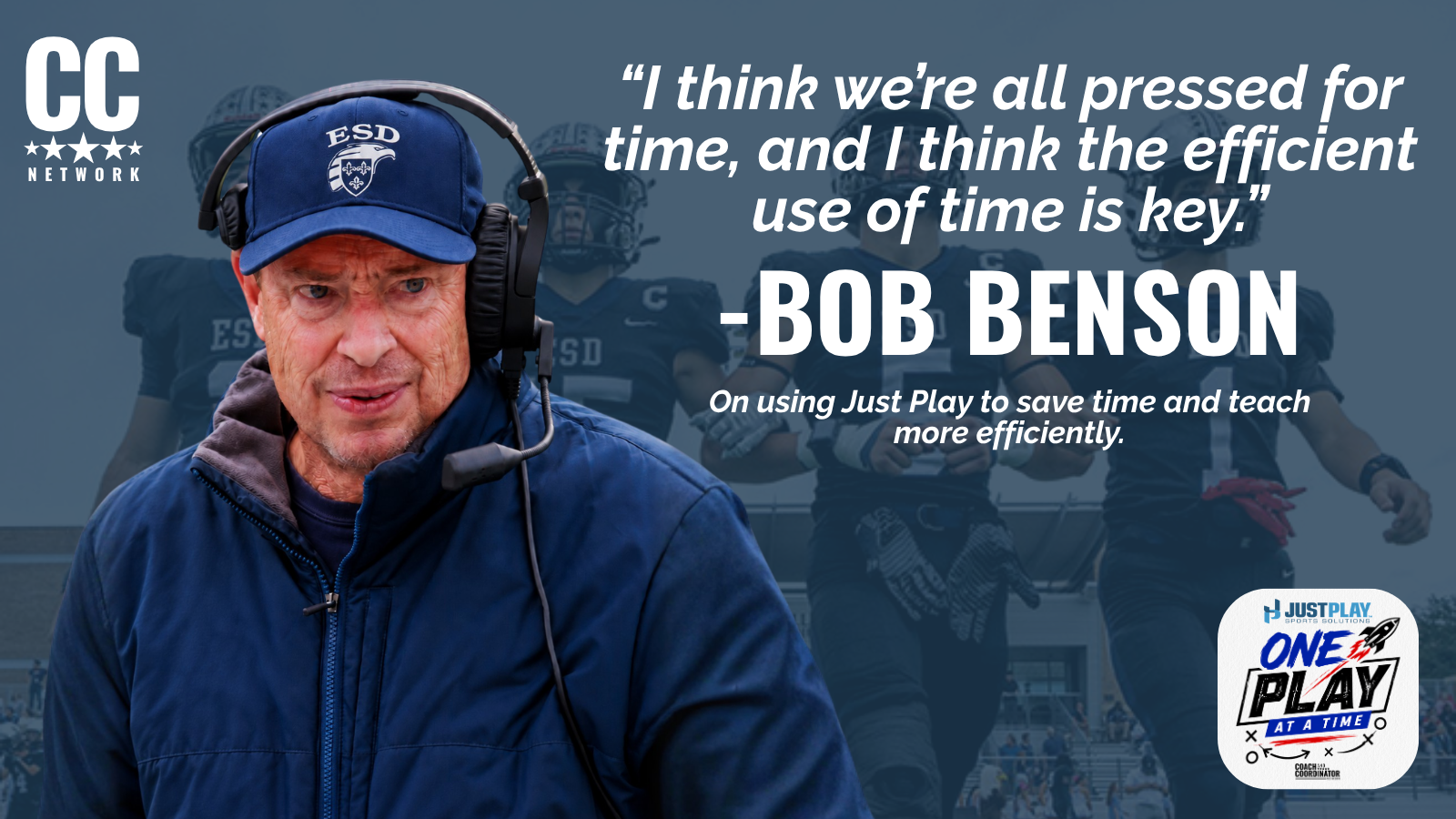
“I think we’re all pressed for time,” Benson said, “and I think the efficient use of time is key.” Players can get into the playbook on their phones at any hour, he said, “take 20 minutes and get efficient teacher-student learning and move on.”
High school brought a new version of the time problem. “We don’t have a lot of time with offense and defense,” he said. “And yet how are we going to do this with special teams? So you got to be right on with your special teams.”
Monday: keys, personnel, and the exotic stuff
Benson’s starting point for the weekly scout report is simple: “You don’t wanna overwhelm your players.” Players get access to the report on Sunday, and the staff presents it on Monday. It is built in layers on both sides of the ball.
The keys to the game come first, kept together in one area as the introduction. Benson used ten keys as his example. Next is the opponent’s personnel. The depth charts go into Just Play at the push of a button, he said, “so at the very least, they’ve got the keys to the game, they got some scout report on their personnel.”
Then the staff adds what Benson calls important items, the specialty looks ESD will see that week. He listed unbalanced sets and exotic formations, like swinging gates or muddle huddles on extra points. Those go in with quick film clips. Because Just Play works with film from Hudl or XOS, Benson said, loading clips into the report is pretty simple.
Special teams, on paper too
Special teams scout reports are “a no brainer for us,” Benson said. “I think we’d be in the office twenty-six hours a day right now at ESD if we didn’t have this type of system.”
He had just printed that week’s special teams report straight out of Just Play. His players have the virtual version on their phones, and they also get it on paper.
“I’m old school and I still like the paper,” he said. ESD players keep binders, bring their playbooks to meetings, and take notes, with a lot of Just Play printed into those binders.
From the report to the practice field
Once the staff types the opponent’s run game and pass game into the scout report, Benson said, the scout cards are set. The cards connect to the report, and the staff can print them or take iPads onto the field.
The cards are not always right the first time. Benson said he makes a lot of mistakes drawing them, and the day before the interview some of that week’s exotic formations needed fixing. When anyone on staff catches an error, it can be corrected in seconds, even out at practice.
“If you find a mistake, you can click it, even fix it out at practice if someone’s on that iPad,” he said. “Sometimes with other playbooks or other scout reports, it can take you, it can handicap you.”
Wednesday night, twelve questions
ESD started quizzing every Wednesday in the preseason. In season, the Wednesday quiz covers the scout reports. It is 12 questions: four on offense, four on defense and four on special teams.
The players can see their grades, and so can the coaches. First thing the next morning, the staff goes through the twelve questions with the team to make sure everyone is good on it.
Benson ties the length to who is taking it. “You have to be efficient in the classroom,” he said. “Their span of attention, their focus is limited. And like for me coming down now to teach 14 and 15 year olds, you know, that attention span’s even less than 19 year olds.”
He said the players look forward to it. “They like the quizzes, they like the competition of the quizzes, and they like to know their opponents.”
The quizzes can carry film, diagrams and a clock. “You can get as elaborate as you want,” Benson said. Some of his younger coaches, who he said are better at it than he is, “bring all the film all the time.”
Just Play also lets the staff check each night which players are on it and for how long. “Even at the high school level,” Benson said, “we are charting how much time our kids are putting in.”
Asked about a group version of the quiz, Benson went straight to Friday night. “The beauty of it is this perfect communication. It’s an eleven man game,” he said. “The group quizzes and the perfect communication that is necessary in a game, you can kind of duplicate in a group quiz if you want.”
The answers are in there
“It’s basically like an open book test,” Benson said of the weekly quiz. “All the answers are in Just Play.”
The answer to a defensive question is in the playbook and the installs. In a first year, with players still getting used to the platform, that is part of what the quiz is for.
“The kids are getting more and more comfortable getting used to Just Play,” Benson said, “and the quizzes allow them to do so.”
He also likes what the format does for a young player who is stuck on a question. “It allows them to have success,” he said. “Even if you don’t have the answer, you can find the answer because it’s right there in front of you.”
Presented by Just Play
Bob Benson’s weekly process works because the scout report, practice cards, film, quizzes, and corrections all live in one place. Players can study the opponent from their phones, coaches can fix scout cards in seconds, and the Wednesday quiz gives the staff a clear picture of what players know before game day.
If your staff is looking to save time, simplify weekly preparation, and help players learn the game plan more efficiently, see how Just Play can fit into your program.
See what Just Play can do for your staff
Related:
Connect on X:
Keith Grabowski: @CoachKGrabowski
Bob Benson: @CoachBobBenson
Just Play: @justplayfb
Keith Grabowski (00:01.325)
This week on One Play at a Time presented by Just Play, we’re bringing in a guest coach to discuss his experience with Just Play. It’s a huge part of his program. He’s used it at the college level, is now using it at the high school level at the Episcopal School of Dallas. And that’s the head coach there, Bob Benson. Bob, it’s great to have you here on the podcast.
ROBERT BENSON (00:22.476)
Thank you, Keith. Thanks for having me.
Keith Grabowski (00:24.419)
So my first experience with you, Bob, was when you were at Penn and we just started the Lawrence First and Goal Clinic. I believe you were in that first year one of the speakers there and ha give a great presentation on red zone defense. but before we get going on some of these things that we’re doing with just play, want our audience to understand your experience in the places you’ve been.
ROBERT BENSON (00:45.258)
Yeah, I’ve you know, again, I’ve been thirty five, forty years at the college level, from Georgetown to Hopkins to the Colorado School of Mines to Penn. have had some great experiences and then now this is our first year down in Texas at the Episcopal School of Dallas. So been around a little bit, but this has been a unique challenge and my first high school job.
Keith Grabowski (01:12.011)
And this was something with just play, you you began using it at Penn and obviously when you think about, you know, Penn and in the schools in that league, a lot of academic requirements, probably a little bit less time, you know, resources, all those kinds of things and we see that stuff translating to the high school level and division three level level quite a bit where you know, it’s
how are we gonna get all this work done? How are we gonna be the best teachers possible? And for you, this was this was a non negotiable. When coming to the Episcopal School of Dallas it was something, you know, right off the bat you’re saying this is what we’re gonna use and what we need here.
ROBERT BENSON (01:52.195)
Yeah, I just thought it was critical. and again, I’m new. I’ve never coached high school and I was actually a little bit intimidated, honestly. And I just thought that we had had such success with just play at Penn. being challenged not just academically with the hours that our kids had both as a student athlete, but also with some of the support, you know, behind the scenes, you know, we didn’t have all the manpower.
So I just had asked the people at ESD and look, can I can I make and can we make the commitment to just play? And and they were great. And so we brought in Just Play right from the start in May and currently everybody at ESD from seventh grade to twelfth grade has access to the Just Play virtual playbook.
Keith Grabowski (02:48.6)
Yeah, I think it’s it’s such a good platform and I know when you talk to guys at different levels, even at the small college level, using things like Google Docs and place things that are great for storing your content, but aren’t necessarily designed for the learner, right? So it’s great that we could put all all of our stuff digitally, but making it something that’s easy g easily accessible and the primary tool for any of our kids is
is their phone. so it’s easily accessible there. And it’s something I experienced this first hand as I started in in my current responsibilities with Bay High School. If that’s what they had, they had Google Docs and I was trying to teach through that and things on Huddle and it was like this is crazy. I just need to we need to get just play guys. Like here’s what it is, here’s what it does. I think having a tool that is specifically built for that teaching and learning
is so much more valuable and what I’ve found way more efficient in in terms of the time that you have to put into it as a coach and as a learner than than these things that really spread you out over maybe three or four different kind of platforms.
ROBERT BENSON (04:03.391)
Yeah, I think we’re all pressed for time. And I think the efficient use of time is is is key. And I think just play, you know, we’re educators, we’re teachers, and I think just play has that unique abilities to support us from our role in the classroom, from our role in on the practice field, from our film study post practice. I think
Just play has a great way of combining it and supporting everything we’re doing as a teacher. And it’s very organized, it’s very easy. And you said it best too, is the kids, they can access it on their phones twenty-four hours a day, they can take 20 minutes and get efficient teacher-student learning and move on. And so for me.
It’s also a way to keep you organized. But and then just in terms of the time commitment, you know, the ability to organize your scout reports, the ability to organize your scout cards, and not just organize them, but to revise them and edit them on a weekly basis. the ability to do team quizzes every Wednesday night.
and have very easy scout reports on Mondays for them to read, I think is critical. And you know, like I said, I was you know, we didn’t have a huge support system at Penn and we certainly don’t have one here at ESD. But, you know, we’re just coming off the practice field from this morning and, you know, we got the scout cards on the iPads, we got the just play quiz tonight. we just graded the film and it’s already up into Just Play. So
it helps us. It just helps especially me. I’m probably on the low totem pole of technology and it just keeps me grounded and it makes it easy for me. So I I’m I’m pretty happy about that.
Keith Grabowski (06:11.609)
Yeah. I I I wanna walk through really you identified I think three important phases for all of us, right? It’s it’s the scout work and the the game plan that they’re gonna get before they hit the field. You guys are using it on the field with the iPads and the scout cards, and then it’s the post practice things too. So I kinda wanna walk through each part of that in in this teaching and learning process, both sides of it, and what it looks like for your players. So, you know, you go back to
The year was of two thousand nine, right? Huddle huddle comes into everybody’s life.
you know, at at the high school level, small college level, and breaks us out of the film room and and very quickly gets those things onto the phone and so, the you know, there were the reports and the breakdowns and all those things. I think we all quickly realize like what might make sense for us as coaches isn’t necessarily what’s gonna be the best thing to give to players. So all while all these graphs and pie charts and some of those things that we see in a report look cool, we really need to bring it down to their level and give it to guys who
don’t live this game like we do as coaches, right? And I think that’s where this this platform does best is it it takes, you know, coaches who understand this professionally
and brings it to kids who are learning the game, right? Because they’re not going to understand it or it’s not going to make sense in the same way. So what does that look like for you guys as you go through the weekend and then you’re putting together this report or game plan where really the content that your players are going to see, what are the things that are important to you that you give to them that this is going to make sense to them and then they’re going to be able to carry out onto the field.
ROBERT BENSON (07:52.387)
Yeah, I think, you know, that’s that’s an interesting question. I’m gonna I’m gonna start like just because we are in season now, I’m gonna talk a little bit about in season as opposed to the overall playbook. But you know, again, I think you don’t wanna overwhelm your players. And you know, at a place like Penn and at a place like ESD, they are absolutely the student athlete. So we we find that just play, our scout report that we give them.
Is we organize it with key first of all with the keys to the scout report are in one area. And this is just the introduction on both offense and defense that we give to them. And let’s just say the 10 keys to the game, and they’re in the just play. And then the next is the personnel, the depth charts of the opponents. And just play just lets you put it in, push a button.
And we’ve got the the depth charts in there. So at the very least, they’ve got the keys to the game, they got some scout report on their personnel, and then the next thing we do is we start adding what we call important items. And like for this week, again, whether it’s an unbalanced set, whether it’s exotic formation like some of those
Swinging gates or muddle huddles on the extra points. we try to put in some of the specialty things that we’re gonna see and try to make it easy for them with some quick film clips. I think the other nice thing about just play is, you know, whether it was Exos or Huddle, it’s film compatible. So it makes it pretty simple for us to to load some film in there. and then the other thing I will say this, in terms of the weekly scout report.
The other thing that we really use it for is the special teams. and the presentation of, you know, and the one thing that has been eye-opening for me heading back, well, for the first time in high school is this is like we don’t have a lot of time with offense and defense. And yet how are we going to do this with special teams? So you got to be right on with your special teams. And, you know, even right here, you know, I just printed this out. This is our
ROBERT BENSON (10:19.584)
Our special team, we printed it out right from just play. And so they have the just play virtual, but then we got the nice easy printout for them because I’m old school and I still like the paper. So the other thing I like about just play is if you’re into the paper part of it, all of our kids still have binders. They still bring their playbooks to the meetings. and they still take notes and they have a lot of just play printed.
But we use it with the just play virtual, but the scout reports for the special teams is I mean that is a no brainer for us. I think we’d be in the office twenty-six hours a day right now at ESD if we didn’t have this type of system. so it in terms of just being, a I think, a productive teacher and efficient teacher..
You know, this the scout reports that we give them and it’s given to them, they have access to it on Sunday, but we present it to them on a Monday. And the other thing is once you type in the main opponent’s pass games and run games, they’re all set for the scout cards. I mean, all you gotta do is you can just connect it to the scout report, print out the scout cards, or we just take our iPads out. So
It just makes it very easy for us to be effective time managers and efficient teachers. so we go out and you know, we kind of look like we know what we’re doing.
Keith Grabowski (12:00.717)
Yeah, that’s such an important part and and I mentioned to you, you know, before this and and what I’m currently doing, I have a y a lot of young guys, some who actually are new to football, never played football coming up. We’re trying to teach them the game and I I can’t imagine, you know, being able to do this without just play. And I think you bring up a really important point, like
at the high school level, especially smaller schools, where guys are playing both sides, they’re learning both sides of the ball. It’s just a necessity. it’s not like when we were at college and you had your own meetings, you had your own practice time. You maybe get together for some good on good together, but it was like that’s all you were doing. And then there was the special teams and special teams would have their meetings too, right? And now you think everything is crunched into this short period of time.
these guys having to know know both sides of the ball. I mean for me it was it was definitely an experience of like me going through the filter of how do I strip this down now to something that’s manageable? How do I how do I carry over base offense into
situational offense because I just don’t have extra third down periods or red zone periods. We’re gonna have to get it all in i in one shot as we move down the field. So the efficiency of having the tools to teach that way too, really
make this functional and I think much better than and I I mean s so for me going back to yeah, we used to do that all before. We never had meetings. We did it out all on the field and, you know, I think now, yeah, the games become more complex in some ways, but how do you prepare your guys to have all those answers you want to? And to me, it is a tool like this, right? And it it but but as as the teachers, you know, I’m
Keith Grabowski (13:49.038)
I’m not doing this full time. I have to get this done in a limited amount of hours that I set for myself. you know, we we have to to be smart with how we do it too. And I think having a tool like this checks all those boxes.
ROBERT BENSON (14:03.383)
I think I think you’re gonna check a lot of boxes. And I think, honestly, no matter what level you’re at, you know, and again, I’m not an expert on the power four, but what just play can bring to the table for any level, I think is amazing. I think just having been at Penn for 10 years, it was something we relied on and counted on. And and so did the kids. And so I think
in all those areas is checking those boxes that you talked about. And I think the other thing that we probably have found the most productive here is that if we do make mistakes, like in the drawing of a card or in the drawing of an offense or a defensive scheme, and I make a lot of them, that they our staff can find the mistake you made in the card and instantly fix it.
in ten seconds, you know, by the click of a button. So like there was actually yesterday, some of these exotic formations, you know, you don’t always get right the first time, even drawing it in the card. So if you find a mistake, you can click it, even fix it out at practice if someone’s on that iPad and say, hey, you know, you got you know, and and it’s instantly fixed. So I think that’s the other thing I like about it is that if you do make an error, you can fix it instantly.
And it takes you, you know, a few seconds. And sometimes with other playbooks or other scout reports, it can take you, it can handicap you. So, you know, again, I I know Just Play and I know what it’s done for us as teachers and as a staff to embrace what we’re trying to do. And I I I think that’s what it it does. It supports you in all the areas that we’re talking about.
Keith Grabowski (16:00.909)
I do wanna today is w a Wednesday as we’re recording this and you said Wednesday is quiz day and I think this feature really enhances the learning of our players in the way that we use it. We’d love to hear how you guys are doing the quizzes, like how long are those, what are what are you guys trying to cover, etcetera?
ROBERT BENSON (16:21.72)
Yeah, I think a couple things. I think one the other thing I like about just play is that you can check it every night for the accountability of the student athlete who’s on it and for how long. So I think that’s something for us that we do, even at the high school level. You know, we we are charting how much time our kids are putting in. But the quizzes, and we started doing the quizzes in preseason every Wednesday, and now we do it
Keith Grabowski (16:31.843)
Mm.
ROBERT BENSON (16:49.834)
every Wednesday on the Scout reports. know, we we honestly we keep we keep it at 12 questions. four O, four D, and four special teams. And we give it to them. And again, they like they look forward to the quizzes because they all can see their grades and we can see their grades. And I think it just gives them a good sense for the opponent, for some detail of what we’re talking about. And
It doesn’t take a long time. Like we’ll go through it tomorrow morning. we’ll go through it first thing, the twelve questions, make sure we’re good on it. And it’s like anything else. You know, you you have to be efficient in the classroom. You know, their their span of attention, their focus is limited. And like for me coming down now to t teach 14 and 15 year olds, you know, that attention span’s even less than 19 year olds. So
You know, you’ve got to be good in that classroom. And the quiz just again, they like the quizzes, they like the competition of the quizzes, and they like to know their opponents. So we j it’s become something that they actually look forward to.
Keith Grabowski (18:03.523)
Yeah, a as I started to study the idea of giving players quizzes and and going back to some of, you know, the first quizzes I gave and I can’t even remember the the apps we were trying to use in addition to Huddle to do it, but
There’s the accountability part of it, which you mentioned. Yes, it is important that you go in and look at this guys and we’re checking that and I could see that what I found in in just in my research was so much more important is actually just this process of taking a quiz and having to recall
Helps their learning and helps them remember those things by like 50%, right? So there’s like the educational science behind it and reasons to do it too. obviously you guys gamify it. I think that’s an outstanding way to do it, you know, to to to bring out the competit the competitive side of these guys. But ultimately it’s about we need to remember these things and execute these things on a Friday night.
So I think that’s been something that’s been huge for us in doing this. And I I I’m sure always sure that we use kind of all aspects of the quiz so that not only are we put in the questions and we do a lot of multiple choice with the answers in there. and then using that that reinforcement part when you get the correct answer.
What is that little extra bit of information I want to give you that reinforces exactly why I was asking you this in the first place? I think that’s been huge too. And I love that aspect of the quiz that it doesn’t just tell you are wrong or right, but it it enhances that piece of information, you know, what whatever it might be, this is why we do it. that’s been a big aspect of it too. And you know, we’re not quite ready. We’re we’re at with with our players and their level of understanding, maybe to get into some of the time quizzes. There’s some really cool features.
Keith Grabowski (19:53.932)
features in the quizzes we haven’t used yet. I’m not sure if you use any of the other ones, but you know, you could use video in here. You could use screenshots. I I definitely as you know as we’re get catching these guys up on some of it, you know, their their football IQ both within our system and just in the game, I see, you know, in another week or so we’ll be ready maybe for some of those time quizzes or video quizzes as well.
ROBERT BENSON (20:20.226)
Yeah, you can get as elaborate as you want. Using film, using diagrams, using time. All of it, if you’re comfortable doing it, some of our younger coaches who are better at it than I am, they bring all the film all the time. you know, the other thing I like about the quizzes is it it helps them learn how to use just play as well because it’s basically like an open book test. All the answers are in just play.
And so it helps them get used to using just play. And if it’s a defensive question, it’s in the just play playbook. It’s in the installs. And even if you don’t have the answer, you can find the answer because it’s right there in front of you. So I think that’s the other thing about in this world of education that it allows them to have success, but it also, you know.
They have a way to find the answer right in front of them. So I think that’s an important part of getting them used to just play is the quizzes because the answers are there. And I think you know, that’s one thing that as in our first year here, you know, the kids are getting more and more comfortable getting used to just play and the quizzes allow them to do so.
Keith Grabowski (21:41.506)
Yeah, it that’s something Bob I mentioned, you know, a lot of new players for us, new to the game, et cetera. One of the things we found out early was let’s let’s put them into some small accountability groups with an older guy and some younger guys, not just to make sure that this guy gets his quiz, but you know, that he understands it. And we said, I we don’t care if you guys sit down and do this together. That we really just wanted that process of of learning to make sure that kid got it. So there were
Some of those kids, like honestly, who, you know, brand new to the game didn’t understand some of the things of the game that the older kids could sit down and and give them those ideas. And I had, I heard, you know, was in the cool clinic. Dante Scarnekcia talked about the way he gave his players their quizzes every single week. The game plan quiz at the end of the week was an open book and book that could have their notes, and it was a group test. And for him, it wasn’t like
getting the grades of every single guy. It was just that process of what happens.
in having to take a quiz and re re recall and find the information and bring it together and communicate together, I think you know, again, looking at what you could do with it in the future, I I haven’t done the group quizzes yet or or said, hey, you guys get together and you got ten minutes to do it, but I could see the value in doing something like that as well. Like the individual learning, the group learning, like all this really becomes something that now because you have such a powerful learning platform
All this becomes very simple to do.
ROBERT BENSON (23:15.874)
Yeah, I think the group the the the beauty of it is this perfect communication. It’s an eleven man game. And you can take the group quiz and you know, if if the communication part of it, the points of emphasis that you want to focus on, they’re all up to you. And the group quizzes and the perfect communication that is necessary in a game, you can kind of duplicate in a group quiz if you want.
Keith Grabowski (23:20.889)
Yeah.
Keith Grabowski (23:41.129)
Absolutely. Well, coach, I know you’re a busy man and have a lot of things to do. I appreciate you taking the time during the week here in season. And, you know, best of luck to you and the Eagles here as you continue with what’s been a great start.
ROBERT BENSON (23:55.18)
Yeah, thanks, Keith. Thanks for having us.