
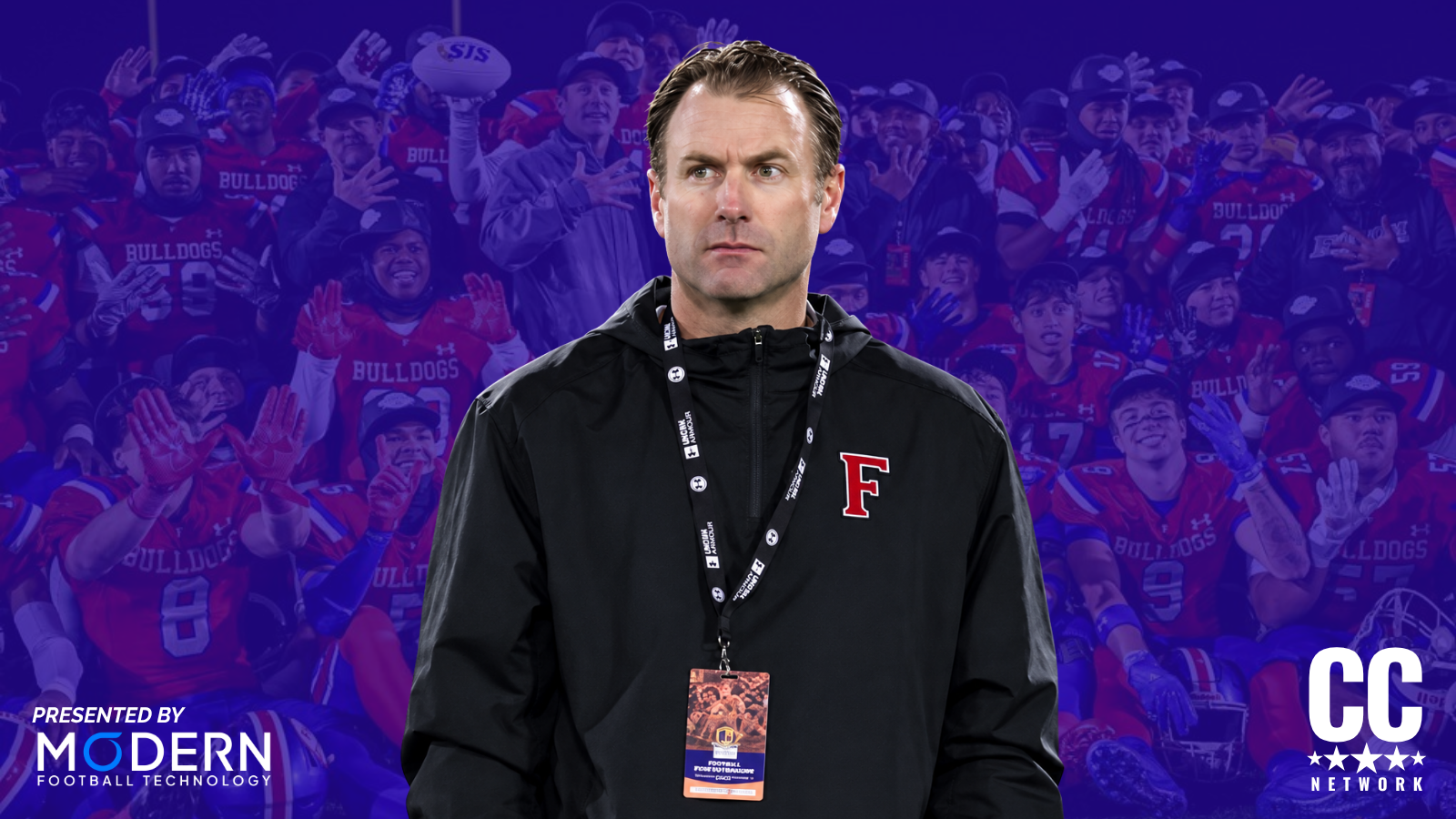
Paul Doherty’s connection to Folsom High School ran through Doug Cosbie. Doherty coached for Cosbie at Sac High. Cosbie had been the offensive coordinator at Cal in 1998, when Troy Taylor coached for him, and Taylor was doing big things at Folsom. Cosbie introduced the two, and because Doherty was “Doug’s guy,” Taylor welcomed him in.
One visit stayed with him. On a Wednesday in January, Doherty walked into a Folsom PE class and found 11-on-11 football going up and down the field.
“It looks like spring ball at the University of Oregon,” he said. “But that’s what they were doing. And it was quarterback driven.”
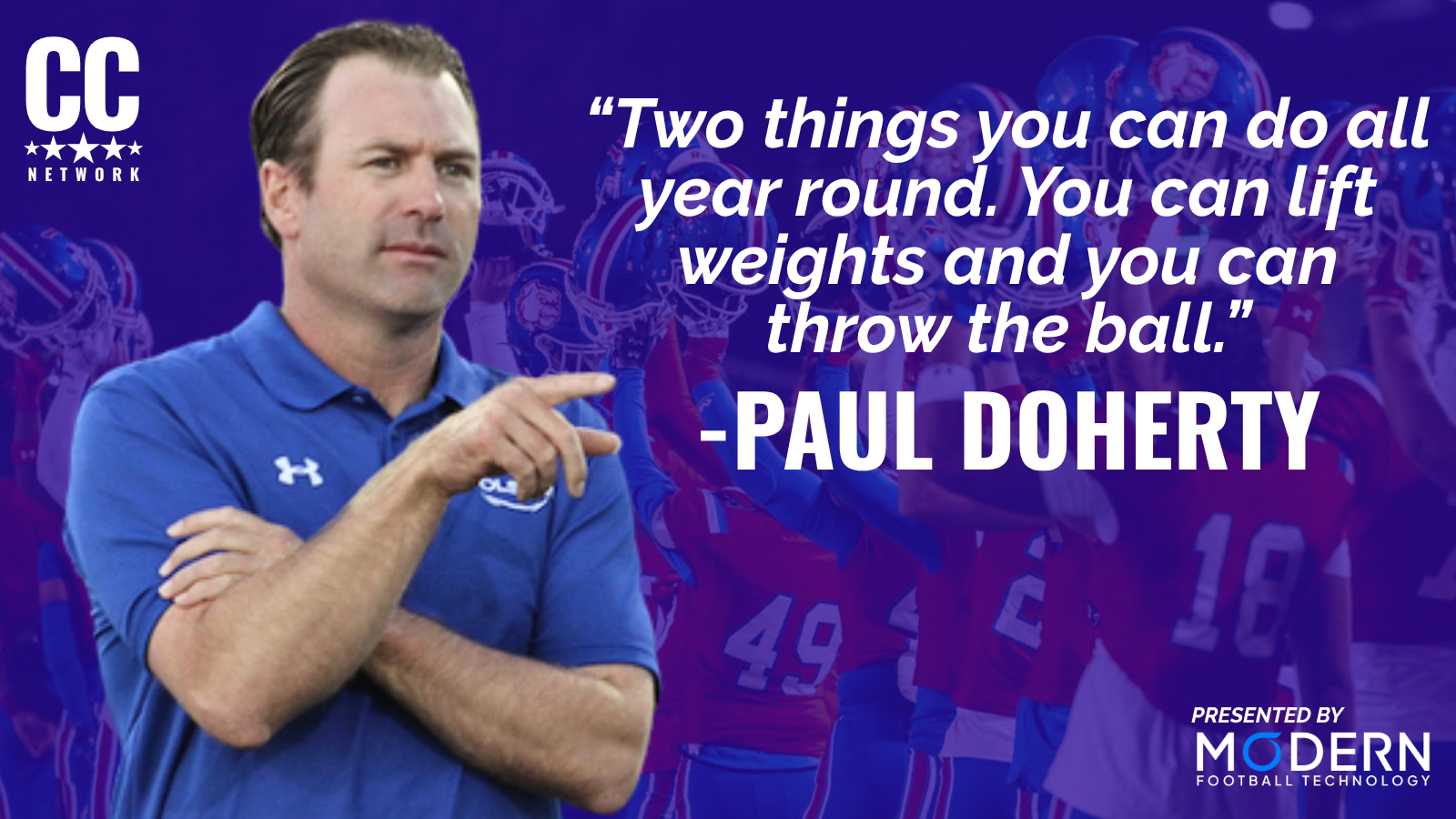
He drew a simple lesson from that class, at least for football in California: “Two things you can do all year round. You can lift weights and you can throw the ball.”
Doherty is now Folsom’s head coach, and he has built the program around those two things. Asked what he would tell a first-time head coach who wants to build something like Folsom, he opened with a joke: “Get out of coaching. It takes way too much time, energy, and effort.” Then he got specific. Number one is the weight room. Next is quarterback development. Those two priorities run through much of what he describes at Folsom, from 9-year-olds watching varsity film to the Sunday passing academy.
A different formula
Doherty doesn’t claim there’s only one way to win in California. He points to De La Salle, a Catholic school with what he calls the best history in high school football, which draws the best players within a 50-mile radius. He also points to programs built on transfers and high-profile players, closer to a college or JC model.
“We’re not gonna do it that way,” he said. “We can’t. We can’t sustain it that way. For us in Folsom, the blueprint’s got to be K through 12. We’ve got to be good at eight years old, 10 years old, 12 years old.”
He credits the junior-program work of Troy Taylor, Kris Richardson and that era with getting Folsom to where it was in 2010, 2011 and 2012. He wasn’t on staff then, but from the outside it looked to him like a disconnect grew once those coaches’ own kids aged out and the program moved onto a bigger stage.
The varsity film comes first
At Folsom, K-12 is literal. Junior Bulldog players are nine years old, and they watch film. Their week starts in the weight room at 4 p.m. on Monday and moves to film at 5. The first ten clips come from the previous Friday’s varsity game: outside zone, GY counter, four verticals, whatever the varsity ran.
“It’s the same system, same offense,” Doherty said. “I think that gives the kids confidence. We’re throwing four vertical at the nine-year-old level and we throw it pretty well.”
He says the shared film builds rapport among coaches as well as kids. The 9U staff changes every year because it’s mostly dads. The message to them is to build on the material week to week as their players move from 9U to 11U, and to keep watching the concepts the varsity runs.
The staff is woven together the same way. Doherty coached the 9U team for four years. Associate head coach Jordan Banning, whom Doherty calls probably the most impactful coach in Folsom, coaches the 11U team. Jason Sanchez coaches the varsity linebackers and calls the defense for both the freshman team and the 11U team. Other assistants coach line play or call plays at the 12U through 14U levels.
Anyone who wants a varsity job hears the same condition. “You can be the varsity D coordinator, but you’re gonna have to coach the seventh graders too,” Doherty said. A coach who doesn’t have the bandwidth, interest or availability for that, he said, is in the wrong place at Folsom.
His reasoning is about who needs the development. “The kids will just get better. You can’t screw it up,” he said. “You go from nine to eleven and you’re lifting weights and playing football, like you’re just gonna get better. The guys that gotta get better really are the coaches.” He believes coaches have to be developed as much as players, and probably more.
The barbell club
Doherty calls the weight room probably his strongest quality when he arrived. He had already built national recognition in youth weightlifting before Folsom, and a group of kids who were lifting with him came along. Parent buy-in came quickly. His argument to parents:
“You’re gonna sign your kid up at seven years old to put a helmet and shoulder pads on to go crashing into another kid, but you’re afraid to put a five-kilo barbell over his head. It makes no sense.”
The program uses only Olympic lifting. “We snatch, we clean, we jerk, we squat, and that’s it.” It serves kids from 7 to 14 years old.
There are two indoor spaces. The main weight room has 22 platforms and holds three kids per platform, or 66 kids. A PE classroom next door has 15 platforms for another 45. Third and fourth graders lift on an outdoor blacktop with 18 platforms, where a platform is a piece of rubber on the ground with a bar and weights. On a given night, 150 to 160 kids are lifting, Monday through Thursday.
The room runs on a whistle. Doherty describes each platform as a seating chart: three kids are assigned to it, one lifts and two sit. When the whistle blows, group one is up. In the main room that’s 22 kids lifting and 44 sitting. A set takes about eight seconds, then the whistle sends up group two. “It’s kind of an assembly line,” he said.
The teaching is all progressions and volume. On a snatch day, the bar-only sequence runs overhead squat, drop snatch, snatch balance, then the snatch from first position at mid-thigh, second position at the knee and third position from the shin or floor, then the three positions put together. “It’s just the volume of reps and it’s technically driven,” Doherty said. “They gotta demonstrate proficiency before they can add weight.”
The schedule is designed around Folsom kids who play other sports. Many of them come two days a week, either Monday and Wednesday or Tuesday and Thursday. So the lifts rotate instead of being fixed to a day. One week might go snatch on Monday, clean on Tuesday, jerk on Wednesday and snatch again on Thursday, and the next Monday picks up with the clean. A kid who only comes on Mondays and Wednesdays still cycles through all three lifts.
Front squats are added around February and March, and back squats are rare. Squats are done for three to five reps. The snatch, clean and jerk are always singles, with the emphasis on technique. Doherty says the kids are basically working up to a maximum every day, but he puts that in proportion. “A maximum for a twelve-year-old is thirty kilos,” he said. “So if they go to thirty-one kilos the next day, it’s not that much of a taxing deal.”
Clear on what it doesn’t do
Doherty is candid about what the barbell club leaves out. He says plyometrics, sprints and dumbbell work would probably be better, and adding them would be great, but the program doesn’t have the bandwidth or capacity.
“It is a comprehensive youth strength and conditioning program,” he said. “And it’s very clear on what we do and it’s very clear on what we don’t.”
It’s open to kids who play basketball, soccer, track or anything else. The doors are open, and parents can sit and watch the whole session. Doherty thinks the staff does an even better job in the weight room than on the field.
Quarterback driven, from third grade up
“We don’t shy away from that,” Doherty said. “It’s gonna be a quarterback driven program.”
In practice, that means finding the best quarterback available and building around what he does well, whether that’s RPOs, four verticals, dual-threat play or the run game. The staff develops his other skills too, as completely as it can.
The fundamentals don’t change by age. Doherty credits much of his teaching language to Bobby Fresques, now the quarterbacks coach and passing game coordinator at Sacramento State. “Everything I teach comes out of Bobby Fresques’s mouth,” he said. That language includes “Be quick but don’t hurry,” which goes back to John Wooden. It also includes get the ball to the fast guys, a wide base with the toe open, good eyes and fast feet, and pre-snap, drop, progression. “Keep it simple. And so we’ve done that with the third grader, the fourth grader, the tenth grader, the twelfth grader.”
The reps come from throwing every day. “We practice offense every day all year long,” Doherty said. “And to be quite frank, we probably should be better. And that’s on us as coaches.” He learned the value of volume from the Taylor years at Folsom: according to Doherty, Jake Browning took 10,000 reps in PE class before he took a single snap on a Friday night. On Sundays there is the NorCal Passing Academy, which draws quarterbacks from Northern, Central and Southern California and from out of state. Doherty wants quarterbacks from different programs throwing together as much as possible so they compete.
He explains the quarterback’s priority in terms of everyone else’s jobs. “If he doesn’t play well, I won’t be the only one that loses my job. The D coordinator loses his job, the strength coach loses his job, the secretary loses her job.” In his view, no other position in sports has a bigger impact on the well-being of the whole organization.
“What if Ryder Lyons transferred in tomorrow?”
Where Doherty says he struggled was deciding when to stop installing. When Grabowski asked how he filters a passing game that can grow without limit, Doherty didn’t defend his method. “I do it poorly, if you ask me. It’s way too much install, way too much scheme.”
It came to a head in 2024, in a 28-27 NorCal loss to Pittsburg. Doherty considered that team his best since arriving at Folsom, with talent at every level on defense and a talented offense. He had been coaching quarterback Ryder Lyons since sixth grade, through a state championship in 2023 and into Lyons’ junior year. “We never stopped installing over the course of X years,” Doherty said. In that game, he said, he did a poor job blending the pass game with the run game, and the offense was doing too much schematically.
After the loss, the staff stopped and reevaluated with one question:
“What if Ryder Lyons is a kid that transferred into Folsom tomorrow? He would never play. He’s so far behind. And it’s like, that’s not the way to coach high school football.”
So they started over. Going into Lyons’ senior year, with Brody Rudnicki alongside him, they began with day one install, the same starting point as the junior pee-wees. “We’re putting in hitches. Here we go.” Every year brings new pieces, Doherty said, and the job is to find what the quarterback is good at.
He credits 2025’s offensive success to scaling the offense way back. Part of that came from time with Will Stein at Oregon, which Doherty says led the country in passing while running basic concepts. “Will Stein will be the first one to tell you, like, simple stuff, find what he’s good at, get the ball out quick, get the ball to the fast guys,” Doherty said. “And gotta remember that those guys are on scholarship too. They gotta catch the hitch.”
He says the 2026 offense doesn’t look as crisp yet. Injuries have moved players in and out of the lineup, and he puts the job of getting the kids there on the coaches.
Where he would start
Doherty’s answer to the first-time head coach comes down to two places, and he ranks them by how many people each one reaches.
“So you try to impact as many people in the program, in the organization, as you can. Number one, in the weight room, that’s a hundred and fifty kids every night. And then quarterback development. That’s everybody’s well-being in the building.”
Elevate your game with Modern Football Technology!
Modern Football helps coaches chart and tag in real time, delivers sideline reports to keep the booth and sideline aligned, and makes self-scout faster with on-demand reports.
Related:
Connect on X:
Keith Grabowski: @CoachKGrabowski
Paul Doherty: @Passing_Academy
Jordan Irsik: @CoachIrsik1
Folsom Football: @FolsomBulldogFB
Modern Football: @modernFB
Keith Grabowski (00:00) We’re back for our week. Let me start over. We’re back for our week two national coach of the week show, presented by Modern Football and the Coaching Coordinator Network. And joining me is the head coach at Folsom High School, Paul Doherty, off a big win this weekend, fifty-three to fourteen over mission VA host. So coach, congratulations on the big win and a great start to your season. Paul Dohety (00:24) Appreciate it. Thirty thirty five twenty one was this Keith Grabowski (00:26) Sorry. Paul Dohety (00:27) week’s that’s all good. Last year I think they beat us that bad. Keith Grabowski (00:30) That that’s someone transposed that. Let me say that again. Yeah. Off off a big win over Mission VA Hill, thirty-five to twenty one. So let me put a editor’s note in there. Kim, just reverse that for me, clean it up and and that’ll be fixed. So coach, let’s talk about the the turnaround here. Obviously, you know, you look at the point differential last year to this year and every team is is you know, every season’s a new team. but obviously you guys were able to do a lot here in the past year to be able to make that happen. What are some of the key things you you’d point to and I guess, you know, from the off season to this point, you know, a year later where you guys have been able to to get a big win over a really good opponent. Paul Dohety (01:13) Yeah, I I th I think in high school football there’s so many variables. I think admittedly that’s probably a better team than we are. you know, I’m I’m thrilled that we were able to play better on the day. I I think we we came out aggressive and we went forward on fourth down on the first two drives of the game, like inside our own territory. And I just don’t feel like we had done enough to try to win games of that magnitude. In in in years past or in previous time. You gotta you gotta play to win and we came out real aggressive and you know, we were we we’d like to think we’re a little better this year than we were last year. I think last year it was a little bit of a kind of a high profile deal for us. We were a good team. I mean we won the state championship California. That’s nothing to you know, to omit, but you know, just high profile kids, the quarterback, Ryder Lions, the offensive lineman, Vlad Diakonov, Jason Hill, Jameson Powell, Isaiah Williams, kids of that caliber. But I think overall our roster is probably deeper and better this year. and with those guys last year, you know, Ryder was hurt and didn’t play well. I didn’t manage that well. I should have played Brody, you know, earlier for sure. Ryder just wasn’t up to to to his best and when you don’t play really well right off the bat, like we played p slow and sputtered early last year, then those guys get on you and it’s it’s over. You know what I mean? their quarterback was as good, if not better, than ours. Best in the country. He’s at Ohio State now. Super impressed with him. Graduation hits hard, you know, for everybody, them, us, you know, all around. And so I think momentum is a really big deal in high school football. We certainly didn’t come into the game with a lot of momentum, kind of sputtering in a week one win. I think they came into the game with a lot of momentum, scoring a lot of points and so we try to manage that as best we could early, win the Toss, take the ball, be aggressive, go for it. once our kids got a little bit of momentum, I think they capitalized on more momentum. And you know the travel is a big deal. We traveled poorly last year going down there. I imagine travel was a factor for them this year. It always is. so I think all those things come into play. Keith Grabowski (03:29) Coach, one of the biggest things you you pride yourself on is building a K through twelve program. What does that mean in in high school football today and in the football landscape? I know, man, everywhere it’s it seems changes are made quickly. So build it K through twelve. what does that look like for you? Paul Dohety (03:48) Yeah, I I think that’s a really I think that’s that’s one of the things that got Folsom to where it was in two thousand ten, eleven, twelve. I think the the Detroit Taylors and Chris Richardson’s of that era, they they did a lot with the junior program. They built that thing with those guys. And then, you know, naturally people age out and you know, their kids aged out and and and Folsom was on a much bigger stage in 2014, 17, 18, and so there there started to be a little bit of a disconnect, I feel just from the outside. Looking in I wasn’t here at the time. But for us to compete in Northern California, for us to compete in the state of California, we have a different formula. De La Salle’s done it their way. You know, they they run the Veer, they get the best guys in a 50-mile radius at a Catholic school that’s got the best history of high school football in the country. You know, we’re we’re not gonna do it that way. we can’t. We can’t sustain it that way. You know, modern-day Bosco, they were losing to De La Salle, and then they had to find their own formula, and they’re they’re playing football the way they are down there. And you know, getting a bunch of transfer kids in and really high-profile kids and you know, almost like a college format and or JC format type deal. And, you know, for us in Folsom, the blueprint’s got to be K through 12. We’ve got to be good at eight years old, 10 years old, 12 years old, kind of a maybe a Texas high school football, you know, structure. I mean, I don’t know anything about it, but that’s just what you would hear, I guess. You know what mean? but I feel strongly about it. I got kids in the program that are nine and eleven, so I’ve coached the eight years. U nine U team for four years. in those four years we’ve been to the state championship in twenty-one, won it in twenty-three, we won it in twenty-five, so I don’t think it takes anything away from the varsity deal. The associate head coach at the high school, Jordan Banning, who’s probably the most Most impactful coach in all of Folsom. He coaches the 11U team. I got a kid on that team now. I help him a little bit. So we’ve got the 9U and 11U kind of bookends there. And then, you know, we both coach at the varsity. And so we with success, we get new coaches interested in trying to come coach in Folsom. And that’s great. You can be the varsity D coordinator, but you’re gonna have to coach the seventh graders too. And if you’re not if you’re if you don’t have the bandwidth to do that or the interest or the availability to do that, then Folsom is not the place for And we try to teach those kids young and we try to make it the best program available. We try to make that very clear to parents. Like we have our own facility for the junior program at Livermore Park. Cam Hodson is the president down there. He does a great job promoting our barbell club, youth barbell club. We got these kids lifting weights all year round. My kids are lifting weights from seven, eight years old. We’re traveling to the national championship for weightlifting. We’re winning the national championship for weightlifting. And we treat it as a seasonal thing. There’s a weightlifting season, a junior bulldog season. There’s a high school football postseason. You know, we’re hosting big time playoff games, NorCal games. Those kids are all at the games. They get in for free. try to really make it a community driven program. And it’s it’s it’s it’s growing. It’s getting better. Keith Grabowski (06:49) What what does it look like in terms of mirroring mirroring what you guys do at the varsity level? Is it a is it a focus on the fundamentals? Is there a carryover in scheme? Does the scheme build from year to year? You know, how does that progress for your younger guys all the way through? Paul Dohety (07:06) Yeah, I I think that’s a great point. And I think you know, we we you know Junior Bulldog football in Folsom, they’re nine years old, they’re watching film. We start the week with in film or we start the week in the weight room at on a Monday at four, but then we go into film at five. And the first ten clips they’re gonna see are the varsity clips from the Friday night before. And it’s varsity clips of things that they’re doing, whether it’s outside zone or you know, GY counter or four vertical, whatever. Like, hey, this is and it’s called it’s the same system, same offense. I think that gives the kids confidence. I think it’s pretty cool. Like, you they’re watching Rodney. Lions throw four vertical. And you know what? We’re throwing four vertical at the nine year old level and we throw it pretty well. And I think that builds a rapport, not just for the kids, but for the coaches, because I get new coaches at the nine you level every year. Because it’s usually parents and it’s usually dads. And it’s like, hey man, this is how we’re gonna do it. So as you age out of this thing from nine you to eleven you, make sure you’re building on it week to week and seeing the schemes and seeing the concepts that we’re running. And so, you know, and they might get Me as a nine U coach, it’s a heavy emphasis offensively for the correlation, but then they get Jason Sanchez as an 11U D coordinator. He’s calling it for the freshman. He’s calling it for the freshman. He’s coaching the varsity linebackers. He’s calling it for the 11U kids. And he’s, you know, 28 years old, no wife, no kids, wants to coach high school football. Did everything I could to talk him out of it, but you know, you want to coach, you want to coach. So here you go. So we just we ride that energy level all the way through as long as we can, and he does an incredible job. And we have guys like that at every level. Zach Slater’s coaching midget the the 14U offensive line. Mason Starkey’s coaching the twelve U or thirteen U offensive line. James Griley’s our JVD coordinator. He’s the head coach for the thirteen U and he’s calling it at that level. I mean it’s it’s intertwined as much as we can make it. Keith Grabowski (08:59) How how do you feel that helps the development, especially of your young coaches, to be able to coach, mean, essentially, you know, two two seasons in one year? Paul Dohety (09:09) Yeah, I think it’s you know, you talk about player development all the time and that’s something that naturally happens. The kids will just get better. You can’t screw it up. You know, it’s like ad water. You go from nine to eleven and you’re lifting weights and playing football, like you’re you’re just gonna get better. The guys that gotta get better really are the coaches. And I think you have to develop coaches as much and probably more than players, and you gotta expose them to th so if it’s a if it’s a thirteen U coach that’s, you know, being exposed to varsity football, you know, instant and praxes, it’s open door, here we go. If it’s my varsity coordinators that got to travel to, you know, University of Oregon and we got like carte blanche now. If we have players, you know, anybody and everybody wants Ryder Lions and Brody Renicki playing for them. So it’s like, hey coach, you know, anything we can do for you, Dan Lanning, sure. Yeah, we’d like to come watch spring practice. You know, and we’re, you know, hanging out with those coaches as much as we can, watching them teach, watching them coach, watching them install in the classroom on film at practice. This in walkthroughs, you know, and those those coaches at those levels of college football have been incredibly you know, catered to us and and what we’re trying to do. And we’re going we’re not going to take pictures with Nick Saban at Alabama, brother. Like he doesn’t have time for that. We don’t have time for that. He was doing calisthenics in twenty twenty two right next to Bryce Young. He’s like in his khakis doing the rock and roll on the ground, you that’s how they do it. And it’s like, shit, okay. I mean, I’d never I’d never seen that anywhere else, you know. Sabens doing that, but you know, that’s Bill O’Brien was the O. C. there at the time and in the quarterback room with Jalen Melro Bryce Young and seeing how they do it. And then a couple years later, you know what? Austin Mack’s at Alabama, you know, with Jalen Milro and still there now and playing good football and competing and you just try to develop these relationships with these coaches. and and I think that’s how your coaches get better. Keith Grabowski (11:00) Yeah, for sure. Well you you mentioned the weight room and you mentioned that it’s the young guys on up. What what does that look for you like for you guys? I mean, you know, there’s all kinds of approaches now. I think you go back ten, fifteen years, everything looked very similar. Now you go you could go to one school and look at what they do and another and they’re distinctly different. So what is what’s the approach in the weight room look like for you guys? Paul Dohety (11:23) Yeah, I think the biggest thing is we’re trying to get as many kids involved as we can. So the program is strictly an Olympic lifting program. We snatch, we clear we snatch, we clean, we jerk, we squat, and that’s it. are there better things to do? Probably. Plowmetrics, sprints, dumbbell work, et cetera. But y we literally get seven years old to fourteen years old in there. We have two weight room spaces. There’s twenty two platforms in the main weight room. We’ll get three kids to a platform in there. That’s sixty six kids. There’s a PE classroom adjacent with 15 platforms. Three to a platform in there is 45 kids. We have an outdoor blacktop weight room for third and fourth grade. There’s 18 platforms out there. So three times 18, you know, whatever that is, you know, as the number. And we’ll have 150 to 160 kids on any given night. And we kind of go through the basic progressions of the Olympic lifts. So, you know, if it’s a Monday, we snatch. And everybody’s snatching. And it’s overhead squat to drop snatch to snatch balance to first position snatch from the mid thigh, second position from the knee, third position from the shin or off the floor. They’re doing it with the bar. Go to a three position snatch, first, second, third. And it’s just the volume of reps and it’s technically driven. and they gotta demonstrate proficiency before they can add weight. and that’s really all we do. And we got a bunch of kids here obviously in Folsom. It’s like the youth sports capital of the world. They’re playing basketball, they’re playing baseball, they’re doing other things, soccer and otherwise. So on a four day a week schedule we see them Monday, Tuesday, Wednesday, Thursday. You know, those kids are maybe coming two days a week, Monday, Wednesday, or they’re coming Tuesday, Thursday. So I don’t want them to come every Monday, Wednesday to barbell club and do the same thing. We’re not doing the same thing every Monday, Wednesday, like a traditional college strength and conditioning program. We’ll rotate it. On one week, it’ll be snatch on a Monday, clean on a Tuesday, jerk on a Wednesday, back to snatch on Thursday. So when I see them again next Monday, it’s on the cleans, jerks, snatch again the next week. So it’s always rotating through those three main disciplines of snatch, clean jerk progression. progressions and we’ll do progressions and we’ll do the drills and we’ll do them over and over again. and as they progress into February, March, you know, we’ll add a squat rack to it, you know, and and they’ll do front squats. We don’t really back squat very much at all. we keep the volume pretty high in the squats, three to five reps. But the classical lifts, the snatches, cleans, and jerks are always gonna be done for singles. Just for, you know, technical proficiency, you know, emphasis on technique. and then they’re doing singles. So they’re, you know, call it a Bulgarian style if you want. I they’re going a maximum basically every day, you know what I mean? But a maximum for a twelve year old is thirty kilos, you know what I mean? And so it’s like if they go to thirty one kilos the next day it’s it’s it’s not that much of a a taxing a deal. So that’s kinda how we do it and Keith Grabowski (14:08) Okay. Paul Dohety (14:10) we’ve had a lot of success with it. Keith Grabowski (14:12) Yeah, w was there any pushback? I mean, I I don’t know if this was going on before you started it, but you know, with parents Paul Dohety (14:19) No, yeah. We started it when I got Keith Grabowski (14:21) and and all the you know, ways it’ll get questioned by multiple sport guys, what’s the right age for a kid to lift, all those kinds of things. Obviously everybody’s bought in now. Paul Dohety (14:31) Yeah, I mean I feel like that was probably my strongest, my strongest quality coming in. We had developed a national brand and recognition for youth weightlifting before I got to Folsom. So I showed up and there was a whole contingent of kids that were already lifting that showed up. you know, and y i i it’s it’s clear as day. I mean, you’re gonna sign your kid up at seven years old to put a helmet and shoulder pads on to go crashing into another kid, but you’re afraid to put a five kilo barbell over his head. I mean, you know, it makes no sense. And so the buy in was pretty pretty quick, pretty easy in the success you could see it. The organization, the structure. Parents are parents are impressed and blown away. And I think we do a really, really good job, as good of a job as we do on the football field. I feel like we do a much better job even in the weight room. And it’s evident and it’s open doors and parents are in there. They can sit in there and watch the whole thing. And we’ve had incredible buy-in. And again, it doesn’t matter if you’re playing football, basketball, soccer, track, whatever. It is a comprehensive youth strength and conditioning program. And it’s very clear on what we do and it’s very clear on what we don’t. Okay. Do and there’s other things that could be added and and supplemented, which would be great. We just don’t have the bandwidth and capacity. You know, we kinda have a platform in there and that’s like your seating chart and you have those three kids and they’re there and they sit, two kids are sitting and one kid is lifting, and that’s it. That’s the whole deal. So and it’s on the whistle and group one is up. And so if twenty-two kids are up in the main weight room, that means there’s forty-four kids sitting down. And they’re up and they take their set for eight seconds, and then group two’s up, you blow the whistle, and then there’s twenty-two new kids lifting. And it goes pretty fast in there and it’s kind of an assembly line so to speak and it’s pretty cool stuff. Keith Grabowski (16:16) Yeah, great stuff. let’s talk a little bit about this offense. You guys run I mean definitely a high powered offense, really known for I think elite quarterback play. I’m sure for you this this is much like your your your weight room and the progression there that this is something starting young and and going all the way through. And I know you do some things there in NorCal with a passing academy too. So we’d love here to hear how all of that comes together. Paul Dohety (16:43) Yeah, I think you know, offensively we try to pride ourselves on being quarterback driven. we don’t we we don’t we don’t shy away from that, like it’s gonna be a quarterback driven program. And I think what that means is, you know, you’re gonna find whatever the quarterback does well, and you’re gonna kinda lean on that, whether the quarterback is you know, really good RPO or four vertical or or dual thread or run game, we’re gonna find the best quarterback we can and then we’re gonna lean on whatever he does well. So if it’s Austin Mack one year or Ryder Lyons the next or you know Ari Patu before that or Brody Rodniki now, you know, or Caden Bennett, you know, in twenty seventeen and eighteen winning state championships, you’re gonna kinda lean on what they do well. And you’re gonna develop those skills. You’re gonna develop all their skills. You’re gonna try to develop develop them, you know, as comprehensively As you can. You know, we start pretty young, and that’s just something I took from Troy Taylor. I kind of got to the Sacramento area in 2006. I was coaching at Sack High for Doug Cosby. Doug Cosby was the OC at Cal in ’98 when Troy Taylor was coaching for him. And so I was one of Doug’s guys. because I was Doug’s guy, Troy was doing big things at Folsom, you know, in the early 2000s. Doug introduced me to Troy. And because I was Doug’s guy, Troy welcomed me in. And I was just kind of blown. Blown away at everything they were doing, quarterback wise, football-wise, offensively speaking. I went to visit a PE class on a Wednesday in January. And it was like 11 on 11 football, just up and down the field. And I was just like, I mean, to be quite frank, you know, like I was like, what the fuck is what the fuck is this? You know what I mean? And he’s like, this is PE class. That’s like I Keith Grabowski (18:28) Mm-hmm. Paul Dohety (18:29) mean, it looks like spring ball at frickin’ the University of Oregon. You know what I mean? But that’s what they were doing. And it was quarterback driven. Two things you can do all year round. You can lift weights and you can throw the ball. In California at least. We throw it every single day. And you can develop those skills and you get really good at it. It’s hard to run z ISO every day. It’s hard to tackle every day, although we try to develop skills there, you know, with different, you know, drills and bags and equipment and whatnot, but You know, we practice offense every day all year long. And to be quite frank, we probably should be better. You know what I mean? And that’s that’s on us as coaches. but we get a lot of reps at it. you know, when when Jake Browning was doing what he was doing, you know, he took he took ten thousand reps in P E class before he took a single snap on a Friday night. You know what mean? and I learned the value of that. And then they’re doing that Monday through Friday and then on Sundays it’s you know It’s the Passing Academy and that has since turned into the NORCAL Passing Academy and we attract a bunch of kids and we we coach kids from all over the area and kids from Southern California, Central California, Northern California, out of state, you know, young and old alike and and we coach those guys and we feel strongly about how we coach and how we do when we coach just like if they’re playing for us. And we feel like those reps are incredibly valuable and that thing has grown. and and it’s attracted a bunch of quarterbacks to the area and we’ve had a bunch of quarterbacks out of that. You know, Caden Pinick was playing on in the Apple Cup the other night and Caden Pittock’s a kid that played at Del Oro and he he was damn good at Del Oro and I was been working with him since he was in sixth and seventh grade and he was damn good and that’s why Austin Mag left Del Oro to Come to Folsom because you know Caden Pennick was good. And then Austin Mack was I think it worked out well for all those guys. You know what I mean? Austin thrived here in Folsom and is now at Alabama and still competing. I mean you’re competing with Caden Pennick when you’re in ninth grade and you’re competing with Keelan Russell when you’re in 21 years old and he’ve been in the quarterback room with Michael Pennox and he was playing behind Ty Simpson. First round pick, first round pick. Jalen Milrell, third round pick. You know what I mean? It’s competitive, and I think you have to get those quarterbacks together as much as you can from different programs. so that they can learn like and it br everybody’s a five star. You know, Rider Lyons is put on this pedestal here in Folsom about being this five star and it’s like, you know what? Like, you know, you go visit at Ohio State. Like we went to go see Coach Fessler at Ohio State and Coach Day in the spring last year. And it’s like Julian Sane is is probably the lowest ranking five star in the room, you know what I mean? And he’s the starter. And the other guys that are buying him, those guys are like there’s no egos there. Like, you know, Julian Sane gotta get better. You know, he knows it and he’s it’s like, hey, what’s your name? My name’s Julian, and the guy next to me is a five star, and the guy next to him is a five star, and the guy next to him is a five star. So, you know, and then who’s the new quarterback in the room there? It’s the you know, it’s the it’s the Mission Viejo kid that we saw firsthand, you know, a year ago. It’s like they’re all five stars. You know what I mean? You gotta get better and you gotta compete, and so get those guys together on a Sunday as much as we can in all season and I think has been beneficial for everybody. Keith Grabowski (21:28) Now, your approach to the weight room was very refined and like you said, there’s all kinds of other things we can do, but we don’t have the bandwidth and you’re very disciplined about sticking to it. Now, we all know that offense passing game all of it can just go wild. you know, your your playbook can be as tall as you. How how do you filter all that out? How do you determine, like, hey, here’s the things we’re really gonna work on here at Folsom so we get good at this Paul Dohety (21:54) Yeah, I think I do it poorly, if you ask me. w it’s way too much install, it’s way too much scheme. And I think that kinda came to a head in twenty twenty four when we dropped one in the NorCal game against Pitt. and that’s mostly because Ryder was Going at the end of year two. So like we started with Ryder in sixth grade, you know, seventh grade, eighth grade, freshman year, sophomore year. He’s playing, winning a state championship in 23, rolling right into his junior year. And it’s like we never stopped installing over the course of X years. And then we got to the freaking NORCAL championship game. And I felt like that was our best team that we had had since I’d been in Folsom defensively with guys everywhere, offensively talented. And I feel like me specifically. You know, we did a poor job of blending the pass game with the run game, you know, and we were doing too much schematically, and it was just it was not good. And so I think when we dropped that game to pit 28-27, you know, we had to stop, you know, and reevaluate, start all over again. We’re like, what if Ryder Lyons is a kid that transferred into Folsom tomorrow? You know, like he would never play. Like we have, he’s so far behind. And it’s like that’s not the way to coach high school football. You know what I mean? We gotta start all over again. And so we did. Going into his senior year, Brody Renicki was right along with us there. And it’s like we started with day one install, junior pee-wees. We’re putting in hitches. Here we go. And it’s like we just have to start over and kind of reassess and we have new pieces every year and new guys. And then just again, try to find what the quarterback is good at. And I I I feel good about how we did that in twenty twenty five. And I think we had a ton of success offensively in twenty twenty five because we ski Scaled it way back. Something I learned from Will Stein and spending time with him in Oregon. Like, you know, they were the number one passing offense in the country, I think, in twenty three, went to go where or twenty four, whatever Bonex’s last year was. And they’re running basic concepts, you know what I mean? And Will Stein will be the first one to tell you, like, simple stuff, find what he’s good at, get the ball out quick, get the ball to the fast guys, you know what mean? and and gotta remember that those guys are on scholarship too. I mean, they gotta catch the Keith Grabowski (24:05) Mm-hmm. Paul Dohety (24:06) hitch, you know what I mean? and let those guys play football. And you know, we’re trying to do that going into twenty twenty six year and I think we’ve had guys hurt and it’s been a challenge and we’ve had different guys in and out and so we don’t look as crisp as we have, and I c again that’s on the coaches to kind of get the kids to that point. So Keith Grabowski (24:26) Coach for someone out there who’s looking at your program and saying, This is, man, I want to get my program to a place like that. But st starting out, maybe it’s a first year coach, maybe it’s a a guy, you know, getting his first opportunity Paul Dohety (24:39) Get out of those. Keith Grabowski (24:40) as a head coach. What’s what’s the recommendation? How how do you get it from, you know, that that ground level to where you guys are right now and competing at a high level? Paul Dohety (24:49) Yeah, I To be to like get out of coaching. It takes way too much time, energy, and effort. It takes a lot. And so, you know, I was 10 years into it and I was like, I gotta start finding other guys that’ll do this stuff. And whether it’s Jalen Angel that played for me at Sakai, he’s the best receiver coach in the country, Zach Slater, who played for me at Whitney High School, best O-line coach in the country, Jordan Banning, who’s a lifelong Folsom guy. He’s the associated coach, Jordan Ursick, who you know well is, you know, the best D coordinator out there. Like you you gotta find guys like that that are gonna coach. and match at your level. but you know what I kind of focus on is, you know, number one, the weight room. You know, that’s the first thing we teach and coach, whether it’s varsity football, freshman football, get everybody in the weight room. hundreds of them, you know what mean? you gotta get equipment set up, you gotta get the the station set up, you gotta get enough platforms. The platform is a piece of rubber on the blacktop for the third graders. They got a bar and weights and they’re fine. And so man, you got 150 kids lifting weights every night, four nights a week. Yeah. Yeah, we do. You know, I mean you got to get equipment to service all those kids. And so get the weight room going. Start coaching the quarterback. You know, we coached the quarterback from a young age, fundamentals. I learned that from Troy Taylor. I learned that from Bobby Freskus, who’s the OC at the OC at Sack State now. I’ve learned a ton from him and just developing the quarterback, quarterback development outside of the scheme and offense and football in Folsom. He did a great job just being calm and articulating things to I mean, everything I teach comes out of Bobby Freskus’s mouth. You know, be quick but don’t hurry, you know, is is the language he uses, you know, going back to John Whitten. you know, but he he keeps it simple. It’s like get the ball to the fast guys. Playing a wide base with your toe open, you know, good eyes and fast feet. you know, pre snap drop progression. Keep it simple. And so we’ve done that with the third grader, the fourth grader, the tenth grader, the twelfth grader, you know, and I think that that has the quarterback is the one that has the most impact on the entire organization. You know what I mean? If he doesn’t play well, I won’t be the only one that loses my job. The D coordinator loses his job, the strength coach loses his job, the secretary loses her job. You know, everybody loses their job if the quarterback doesn’t play where there’s no other position in sports that has a bigger impact on the well being of the whole organization. You can watch in the last twenty years that I’ve been, you know, coaching and watching football, the stat line reads, you know, Tom Brady, twenty eight of thirty five for three hundred and eighty yards and four touchdowns. Guaranteed the Patriots win that game. Guaranteed. Right? And you can read the stat line in June where LeBron James goes for 40, 11 assists, 13 rebounds, Cavs lose in overtime. I mean, like Barry Bonds is, you know, two for four and six RBIs, Giants lose in extra innings. Steph Curry hits 11 three-pointers, goes for 45. Warriors who lose a close one. You’ll see that in sports. You’ll never see that in football. You’ll never see Drew Brees throw for four hundred yards and the Saints fall short. Never happens. Never. You could see Randy Johnson strike out fifteen guys. You’ll find it. You can look it up. You know, twenty-eight strikeouts or something crazy, right? And it’s crazy and it’s a stat line because the Mariners lost. You know, that happens in other sports. It doesn’t happen in football. So you try to impact as many people in the program in the organization as you can. Number one in the weight room, that’s a hundred and fifty kids every night. And then quarterback development. That’s everybody’s well being in the building. Keith Grabowski (28:21) Coach, I was going through and listening to you. You know, we obviously have varsity football Monday through Friday, Saturday, your coaching youth program. I imagine that’s on a Saturday. You got Norp Cal passing on a Sunday. I mean, somebody, a couple guys actually going into this as I was prepping for the interview said, you are the hardest working coach in America at any level. I would say I have to believe it with that schedule for one, there’s no other days in the week that you have off. So we really working and grinding, but I could tell your passion for this. I could tell how all of this fits together cohesively for you and really appreciate you sharing the insight in your program and what really makes it go. Paul Dohety (29:02) Yeah, I mean I I appreciate that. I do work really hard, but I mean I mean I’m incredibly grateful for the you know the privilege to coach here in Folsom. It’s an incredible community. It’s a community I’m raising my kids in. My wife is working in the community here. I’m not from Folsom, or I’m not a Folsom guy. You know what I mean? Jordan Banning is a Folsom guy. And, you know, for he and I to work together and for me to get this job way back when in 2018, 19, you know, you know, it’s an incredible privilege and and I want to make sure I I sustain the success that’s been established. Here before. I’m kind of the beneficiary of inheriting this program and I feel really good about what I’ve done, you know, to contribute and add to it and sustain it. But you know, the program’s a lot bigger than me or anybody else. And so I think that that I I’ve worked at a lot of schools and I’ve worked for a lot of people. I’ve worked in a lot of communities, and it’s pretty special here in Folsom. And I’m gonna do everything I can, morning, noon, and night, to to make sure that I can keep working here and keep raising my kids here. I’m not trying to not trying to move those guys. You know what I mean? It takes a lot, it takes a lot of work and Keith Grabowski (30:04) Coach, appreciate you taking the time. Best of luck to you and the Bulldogs the rest of the way here. Paul Dohety (30:08) All right, appreciate it. Thank you.