
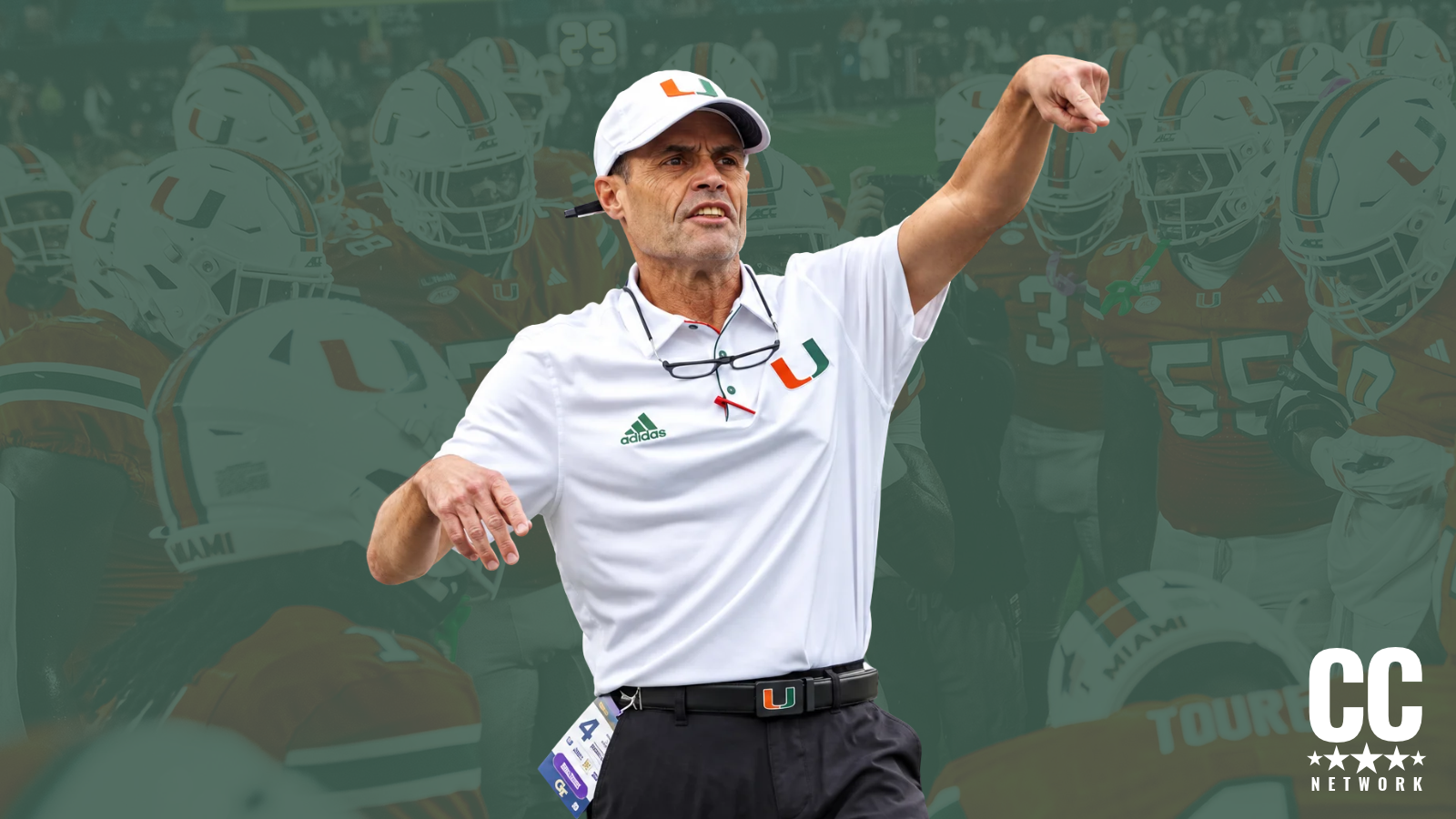
Miami is ranked No. 1 in the country, and its offensive line coach used to teach high school American history and U.S. government. Alex Mirabal, the Hurricanes’ assistant head coach and offensive line coach, spent 16 years as a high school teacher and coach before moving to college football. He still describes the two jobs as the same one.
He laid out how he teaches the position in a three-part conversation on the Coach and Coordinator podcast ([Part 1], [Part 2], [Part 3]), released in July 2022 before his first season at Miami. The conversation starts with a coaching point every line coach has shouted.
“Get your hands inside.” Offensive line coaches yell it at every level of football. When Mirabal hears it, he answers with a question.
“I always think to myself, well, why don’t you teach them? Teach them to get their hands inside. How are they going to get their hands inside? It just doesn’t happen. You can’t yell stuff. You can’t yell stuff into becoming a technique or a fundamental. You better be able to teach it. You better be able to coach it.”
He gives recruits the same test to use on the college coaches recruiting them: “Ask them, hey, tell me how you do it. How do you do it? You know, show me how to do it.”
Mirabal began as a volunteer assistant at his alma mater, Columbus High School in Miami. He moved into college football at FIU and coached at Marshall and Oregon before following Mario Cristobal to Miami. People still ask him whether he misses teaching.
“I said, what do you mean? I said, yeah, do you miss being in the classroom? Do you miss being around the kids? I said, heck, that’s what I do every day. And I think shame on us when we think it’s different.”
His answers to the yelled coaching point show up all through the conversation. A technique gives the cue a how. Every lineman repeats the same few words back. He spends 45 to 50 minutes planning each individual period. And every play gets a written comment rather than a grade.
Part 2 & 3 of Coach Mirabal’s Interview:
Give the coaching point a technique
Mirabal’s answer to “get your hands inside” is the double under, which he credits to Jim McNally and Bill Callahan after watching them at the COOL Clinic. Defensive linemen shoot their hands out. If the offensive lineman shoots his hands out too, Mirabal says, “you’re constantly going to have to be refitting your hands.” So his linemen bring their hands under. At Miami, leverage has a working definition, taken from Callahan and McNally: “getting my hands under your hands.”
He hears the objection that the technique only works in college because the players are strong. “I said, oh yeah, true. But I used it when we were in high school.” His high school linemen used the double under over his last five or six years there.
The technique also decides what equipment his linemen use. His linemen work on med balls rather than shields because they use the double under. “If we were an offensive line that believed in shooting our hands straight out, then we would use shields,” he said. “The equipment that we use is a reflection of the techniques that we use.” He has watched groups work on med balls while shooting their hands straight out, which defeats the purpose of the ball. With the ball, a cue like “use your hips” becomes something a player can feel. “Drive your hips through your hands,” Mirabal tells them. “Drive your hips through the med ball.”
He uses the same method when a lineman stuffs a pass rusher and the rusher leaves his feet to bat the ball. Line coaches yell “punch him.” Mirabal built a drill instead. In his jumper punch drill, a blocker is already engaged with a teammate playing defensive lineman. On Mirabal’s command, the rusher jumps with one hand still on the blocker and the other raised as if batting a pass. The blocker then punches, which Mirabal says doesn’t mean punching. “We’re literally power cleaning through the guy. We’re trying to get his hands down.”
“You can’t just talk it into existence,” he said. “You can’t just yell it into existence. So we have a drill.”
Words that paint a picture
Once a technique exists, it needs words the players can carry onto the field. “You got to paint a picture,” Mirabal said. “Your words got to paint a picture.”
On wide zone, a covered lineman’s technique comes in one sentence: backside foot to crotch, backside hand to sternum, head to the play-side armpit. “If you grabbed any of our guys at Miami right now or any of the guys that we had at Oregon and you ask them… they’re going to go backside foot to crotch, backside hand to sternum, head to the play-side armpit. And I don’t say other things. That’s what I say.”
An uncovered lineman’s assignment works as a call and response. Mirabal says “speed to the crease,” and the players answer with the three-step decision that follows: “knock it over, take it over, climb.” “Repetition is the mother of learning,” he said.
Some terms are useful only inside his room. A “heavy three” means a 3-technique with his inside hand right through the crotch of the guard. “It might not mean something to you if you’re in the Cincinnati Bengals O-line room,” Mirabal said. “But it means something to us at the University of Miami.” The rest of the staff has to use the same words. That includes Cristobal, the graduate assistant and the analysts. “We can’t be talking four different languages to our guys.”
Mirabal says his “whole time” goes to getting five linemen to act as one body. Part of that is all five seeing the same front. If the center calls an odd front and another lineman thinks it’s four-down, the center’s call stands. “Guess what? It’s odd front,” Mirabal tells them. “We’ll fix it when we get to the sideline.”
The players have to produce those words in meetings too. When Mirabal stops a clip and asks a lineman what he’s doing, he expects the technique back word for word. “I make them spit that stuff out. And I make them spit out their line of scrimmage calls in the O-line room. Just like I do when they’re out on the field.”
Teaching when: choosing the double team
Mirabal believes “all double teams are not the same.” He described two. In the Crowther angle drive, the covered lineman uses Crowther technique and the uncovered lineman angle drives. In the double under gallop, the covered lineman uses the double under and the uncovered lineman gallops. How the defensive lineman aligns decides which one his linemen use, so they might run inside zone with one double team and run the same play on the next snap with the other.
Teaching both techniques is the easy part. “My job as a coach is to teach them when to use what double team to the point when they’re out there on their own, you know, and it’s weapons free,” he said. If a loose 3-technique calls for one double team and a heavy 3-technique calls for the other, “you better define what you define as a loose three. You better define what you define as a heavy three. So again, to me, that’s teaching.”
He wants his players doing that thinking before he does it for them. On the Sunday after a game, walking out to practice, he expects them to ask, “Hey, coach, is this going to be a big double under gallop game? Or is this going to be a big Crowther angle drive game?” The defensive personnel can change the answer. A very big 3-technique playing heavy, who would normally get the double under gallop, might have to be angle driven that week. In an Ohio State week, Mirabal told his linemen it was going to be “jump set city.”
“There’s an art to teaching. There’s an art to coaching. There’s an art to playing,” he said. “There is science involved to it. When that science comes to life, that’s the art of it.”
A lesson plan every day
As a high school teacher, Mirabal had to write a lesson plan every day and hand it in. In college nobody collects them, but he still writes them and keeps them for himself. His meeting cut-ups run in “a specific order as to what, why and how I’m teaching stuff.” His practice plan covers the drills, the order, and how the group will be organized. “You can’t be doing that on the fly.”
He starts with the people who are available that day. “I tell the trainer all the time, don’t tell me. Just give me the number.” With 14 linemen he might work two pods of seven. With 12 he might run three pods of inside zone combos. “I might be pissed off that I only got 10, but I’ll figure it out.”
Planning the next day’s individual period takes him 45 to 50 minutes, partly because he doesn’t run the same drills every day. He rotates through a catalog that changes with what the offense is running. He chooses drills with a rule from Cristobal: “If it happens in the game, it deserves a drill.” His linemen don’t go over bags or do agilities during individual. The offense runs counter at certain points, so the linemen get a counter kick-out drill against shields, for two minutes.
The clock decides when each drill ends. “As I’m drilling, I’m looking at the clock. Boom. Five minutes are up. Boom. I’m going to the next drill. I don’t care how many reps we got or didn’t get.” He says it “creates a sense of urgency for me and our players.” It also fits how he wants the unit to play. “I try to teach fast, coach fast, because that’s how you try to play.”
Practice organization is what he most wants to pass on to his graduate assistants and analysts, and he calls it “kind of a lost art.” He has no patience for the idea that it matters less at a lower level. When he sees high school practices with players standing around and people tell him it’s only high school, his reply is blunt. “Well, BS, because I was a high school teacher. But when I was a high school teacher and I was a high school coach, you couldn’t convince me that I wasn’t coaching the Dallas Cowboys offensive line.”

Comments instead of grades
“I don’t want to hear myself in the O-line room,” Mirabal said. On every clip, a lineman has to answer: what’s the front, and what’s your call? If the center calls it four-down, Mirabal asks why it’s odd. “Every play should be critiqued on the field and off the field. I mean, I’m not talking about a dissertation.”
He doesn’t like grading, and he didn’t like it as a classroom teacher either. “I think then grading becomes more important than the teaching part of it.” His linemen are still graded after games because the head coach wants it, but Mirabal hands that job to the graduate assistant and analysts. He writes comments on every play himself.
He explained the choice with Penei Sewell, his left tackle at Oregon. If Sewell graded out at 62 percent against Auburn, “guess what? Penei Sewell is still going to start the next game.” A note like “you got to stop false stepping,” or a reminder of when to jump set a certain rusher, would do more for both of them.
He says the players read the comments differently. “They immediately go, hey coach, what did you mean by this? You know, as opposed to when you give them their grades, they just fold it up and put it in their inner pocket.” When two linemen do one thing and three do another, the comment reads: “Five men, one mind. Minus.”
Game day is the same classroom
Before the coaches leave the locker room, Cristobal tells them to keep teaching throughout the game. The staff tells the players to keep learning. “If you put them in that setting,” Mirabal said, “they kind of relax more and they’re not as uptight.”
He splits the line the same way on game day as in practice. Mirabal takes the linemen closest to him on the sideline, and the graduate assistant upstairs watches the far side. When the players come off the field, he coaches in sound bites. The vocabulary from the meeting room means he doesn’t need to draw anything up. “You don’t have a chalkboard on the sideline at practice. What the hell are you drawing up?” A single call like a “B throw” already gives his linemen the picture: “You guys beat that. You shouldn’t beat that. B throw that thing.”
Believing in the footwork
Asked what he does that gives his players the winning edge, Mirabal said: “Believe in them. I believe in them. I believe in them and if I believe in them, then they’re gonna believe in themselves.”
He learned that from Dennis Lavelle and Fred Boyle, his head coach and offensive line coach at Columbus. “They believed in me. And then I thus ended up believing in myself.” He doesn’t assume a 6-foot-5, 315-pound lineman already has that confidence. “A lot of them don’t,” he said. For Mirabal, building it means getting players “to believe in the technique, the fundamentals, the footwork that we’re teaching.”
“And when you see a guy get that aha moment, aha, I got it. That to me is what fires me up.”
Access Coach Alex Mirabal’s 2026 COOL Clinic Presentation:
