
Chad Owens didn’t have a scholarship offer. He walked on at Hawai’i. In 2012, playing for the Toronto Argonauts, he set the professional football record for combined yards in a single season with 3,863. When June Jones talked about the players who did well in his offense, Owens was the one he named.
“Those were the type of kids that excelled in our offense,” Jones said. “They got overlooked a lot because they weren’t 6’2 and ran 4.4. We took their undersized guys and made them players.”
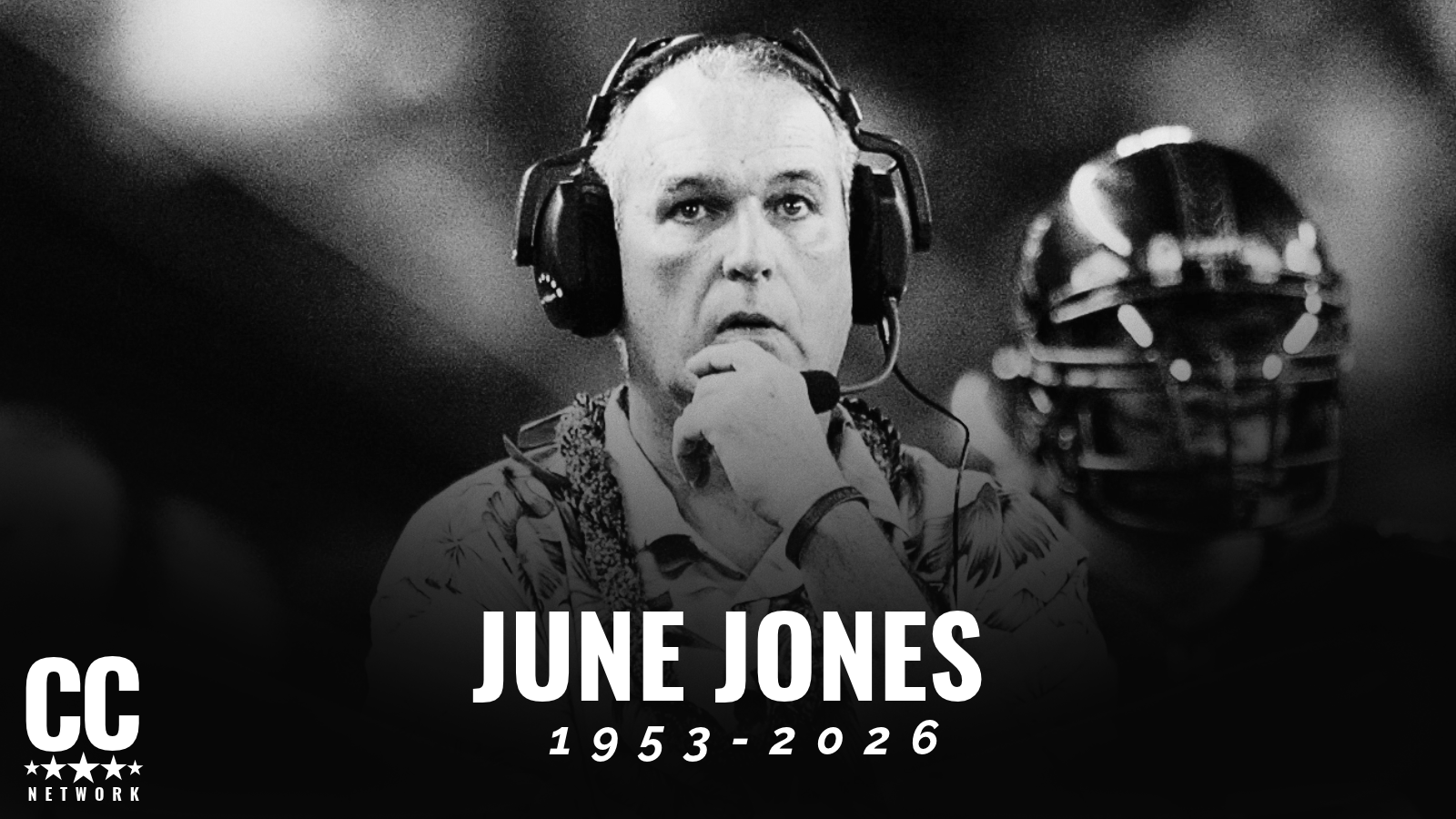
Jones said that in December 2024, in a conversation with Keith Grabowski on the Coach and Coordinator podcast. He died Oct. 29, 2026, in Oregon, according to the University of Hawai’i. He was 73.
Kids nobody else wanted
Jones grew up in Portland, Oregon, and played quarterback at Oregon, Hawai’i and Portland State, where Mouse Davis introduced him to the run and shoot. He signed with the Atlanta Falcons as an undrafted free agent and played five seasons there, then one in the CFL.
He coached for more than four decades. He started as a graduate assistant at Hawai’i in 1983. In the NFL he coached quarterbacks for the Houston Oilers and Detroit Lions, then became head coach of the Falcons, whose 1995 team made the playoffs. He returned to Hawai’i as head coach in 1999.
The Rainbow Warriors had gone 0-12 the year before. In his first season they went 9-4, shared the WAC title and won the O’ahu Bowl. The university calls it the greatest single-season turnaround in NCAA history at that time. Over nine seasons he went 76-41, the most wins of any coach in program history. The 2007 team went 12-0 in the regular season and played in the Sugar Bowl with Colt Brennan, the school’s first Heisman finalist. Jones also coached Timmy Chang, who became the NCAA’s career passing leader in 2004 and is now Hawai’i’s head coach.
At SMU he took a program that hadn’t played in a bowl since the NCAA’s death penalty to four straight. Later he coached the CFL’s Hamilton Tiger-Cats, led the XFL’s Houston Roughnecks to a 5-0 record before the 2020 season was canceled, and went back to high school football in Hawai’i.
Jones said he had built his teams on players other programs passed over, particularly in high school and at Hawai’i.
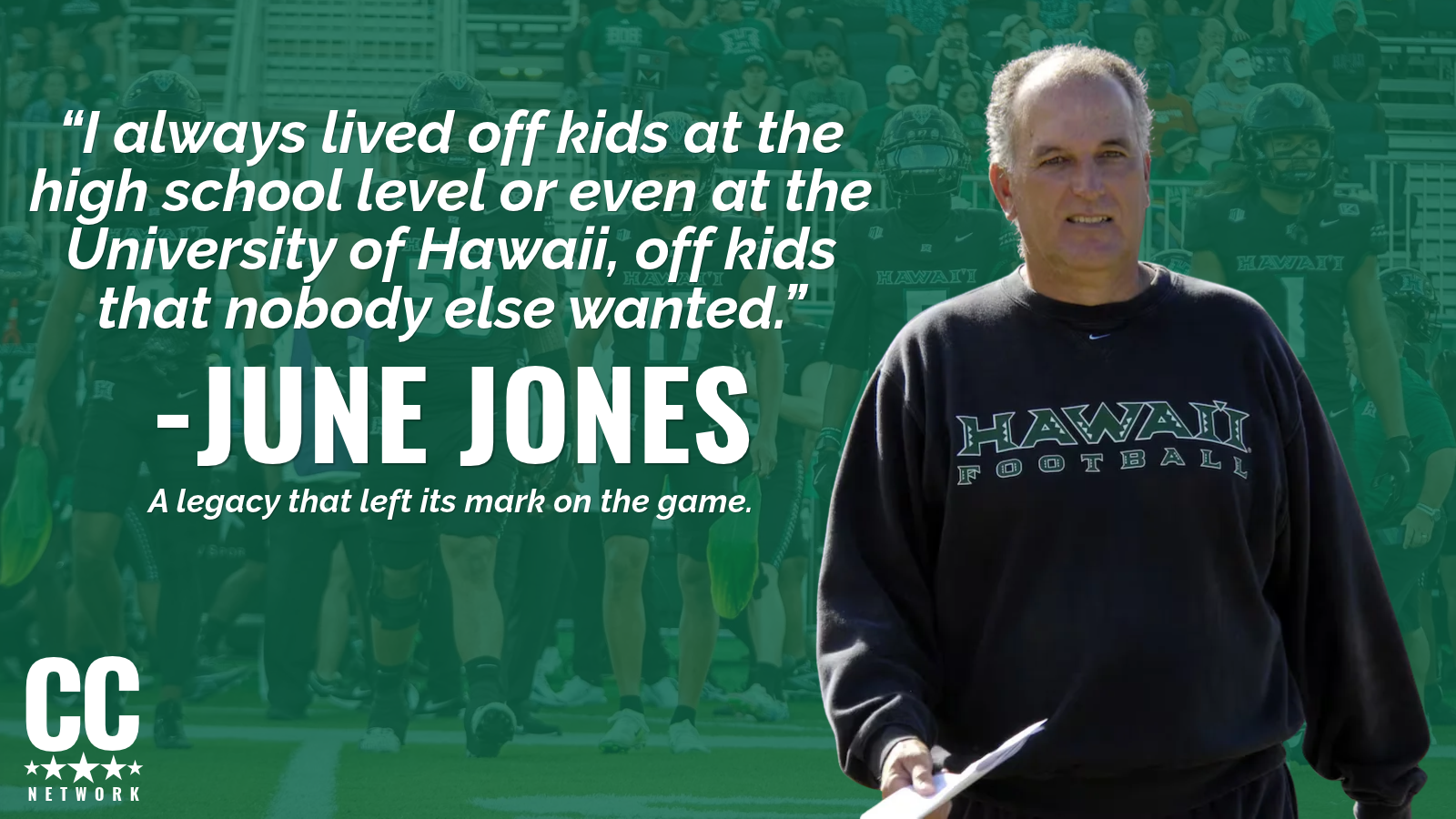
“I always lived off kids at the high school level or even at the University of Hawaii, off kids that nobody else wanted,” he said. “They weren’t being recruited by the other big school. Usually, we were the only ones that came.”
He never stopped adding to it
Jones credited the run and shoot to the coaches before him. He traced it to Glenn “Tiger” Ellison, the Middletown, Ohio, high school coach whose Lonesome Polecat let receivers run to open space, and to Davis, who built on it.
“I think all the original concepts that Mouse and I ran were from the Tiger Ellison book,” he said. Davis, he said, took the pass concepts and the receiver variations and “grew it to a huge level in the 70s.”
“I think if you’re not tweaking and adding and moving forward in the 15 to 20 percentile range every year,” Jones said, “that the defenses can catch up with you.”
Some of what he added came from coaches who had once come to learn from him. He remembered Hal Mumme and Mike Leach visiting him in 1984 to study the offense. Years later, when Mumme joined him (Jones placed it around 2011 or 2012), they added mesh concepts. He was still running mesh with run-and-shoot concepts at Mililani High School in 2024. “I think it just keeps getting better and better and harder to defend.”
The offense put the reading on the receivers. That, Jones said, was why his quarterbacks “always had the best seasons statistically in our offense.”
“The reason for that is because I didn’t have them reading the whole field,” he said. “The receivers were reading the field, the whole field, whereas the quarterback was focused on one particular guy.”
On the choice route, the quarterback’s first read after the snap was the corner to the single-receiver side. If that throw wasn’t there, he went to a simple backside progression: two, three, four. “And so it became a real easy one, two, three, four progression,” Jones said.
That much reading meant a lot of practice. As head coach, Jones said, the offense spent an hour by itself throwing and catching. “Everybody always asked me, how do your receivers catch the ball so good? They don’t ever drop the ball. We do it repetitively for hours and even after practice to stay up and just catch.”
During routes on air, he yelled out coverages and receivers had to adjust. Against the defense, nothing was scripted. He told Jerry Glanville, his defensive coordinator for many of those years, to run whatever he wanted. “We had to be able to read that. We also had to be able to protect it. And so from that standpoint, practice was exactly like the game.”
He also built the offense from what his players could see. When four-deep coverage arrived in the NFL, he asked receivers whether they could recognize it. In one game, working through corner-route angles against different coverages, he put the question to Terance Mathis.
“I can remember during the game saying, can you see this?” Jones said. “And he said, yeah, absolutely. I said, okay, then run this and this angle. And he did it.”
The next year, that became part of the corner-route read.
“The player’s input really was a part of it as well,” Jones said.
Still looking for what came next
Late in his career, Jones was still finding things he hadn’t known. In the XFL, he could talk to players through their helmets before the snap. If he saw a safety outside on a streak read, he could tell the receiver to run the post. He said it let him play fast players who otherwise might have struggled with the reads.
“I could get players that normally 20 years earlier couldn’t have played for me because they couldn’t read coverage,” he said. He wanted the same technology at every level, including high school, because it would “make the opportunity for players tenfold more.”
The XFL also changed what he thought his linemen could handle. He went empty with five receivers, which meant five linemen had to account for six rushers.
“I just had no idea that the kids were this smart and could do what we did blocking in the XFL,” he said. He had film of five linemen blocking six and giving the quarterback more time than he had ever had in empty. One game, they stayed in empty the whole way.
He took it to Mililani. The team lost its first two quarterbacks and had to scale back. In December 2024, he was preparing to teach empty protection at an upcoming clinic and was still open to coaching again.
“I still have my ideas if I get back into coaching, which I might,” he said, “and then we’ll see where it goes.”
Of the Mililani linemen, he said:
“I was kind of excited about the future of those kids being able to block it the way we blocked it in the pros.”
Listen to Keith Grabowski’s December 2024 conversation with June Jones on the Coach and Coordinator podcast.