
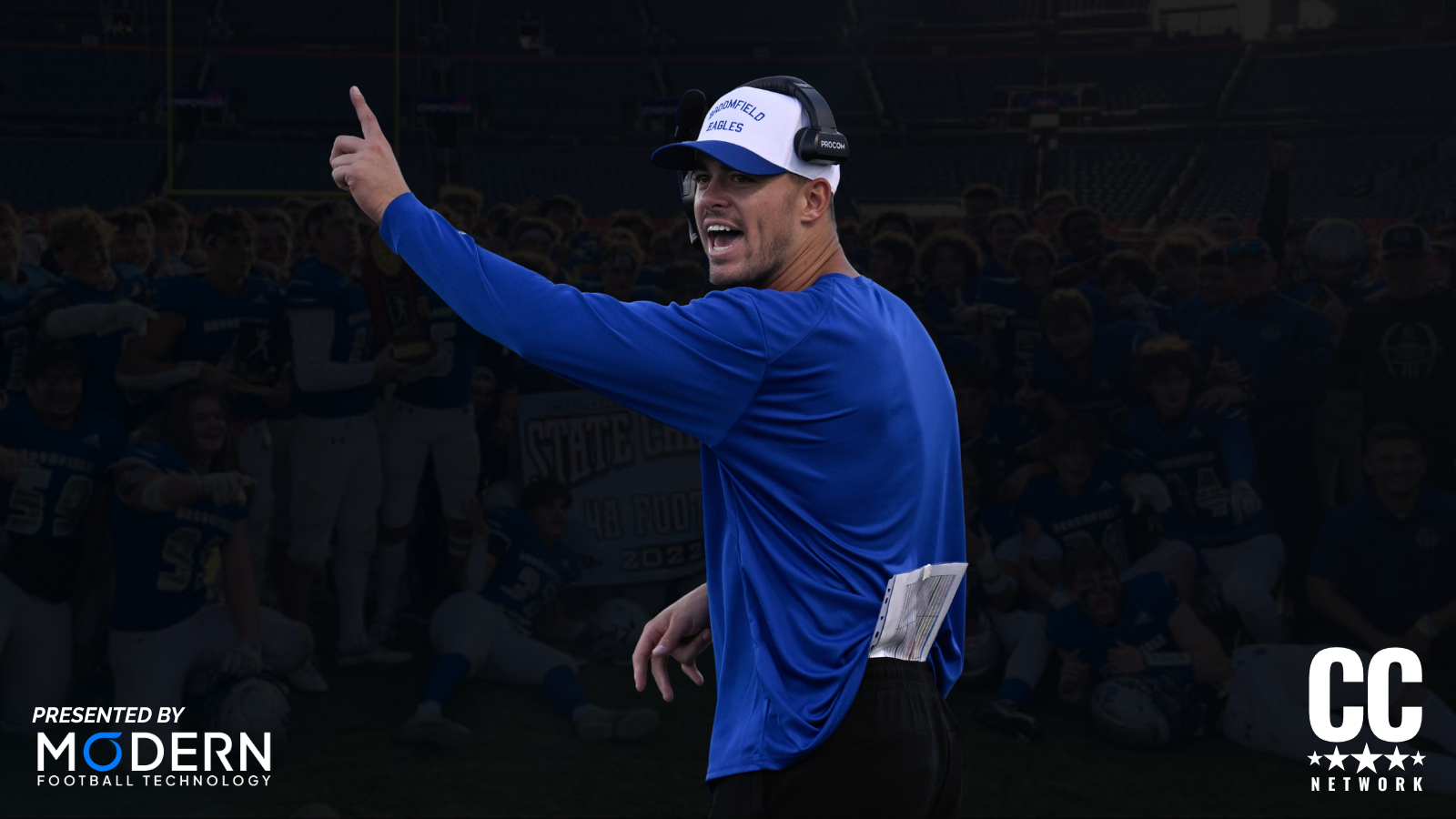
Chris Helbig, head coach at Broomfield High School in Colorado and this week’s National Coach of the Week presented by Modern Football, tells Keith Grabowski how a program built on tempo, fundamentals, and culture beat his own high school alma mater in his Broomfield debut.
Chris Helbig is only in his second year of coaching, but his first head coaching job already produced a league title Westminster hadn’t won in twelve years. His second, at Broomfield, opened with 600-plus yards, 70 plays run, and a 62-43 win, earning him this week’s National Coach of the Week honor, presented by Modern Football.
What Was Chris Helbig’s Path to Becoming a Head Coach?
Helbig played football in Europe, a career slowed by a string of injuries. Playing for Rip Scherer, a coach with deep NFL and college experience, and offensive coordinator Dave Warner, Helbig says the football education was valuable, but he also learned a tremendous amount about leadership and culture from those two coaches. After his last injury overseas, he decided to bet on himself. He grew up in Thornton, Colorado, with Westminster right down the road, and when the head coaching job opened there, he applied despite having no coaching experience, leaning on thorough preparation for the interview itself as something within his control.
How Did Chris Helbig Turn Around Westminster Football in One Year?
Westminster’s program had been through rough stretches before Helbig arrived. In his first year, the team won its first league title in twelve years, made the playoffs, and posted the program’s highest GPA, alongside a new standard of discipline.
The work started in the weight room, with controlled reps, down when the coaches say down, up when they say up, aimed at building what Helbig calls a no-quit mentality and a standards-based culture. He credits Rip Scherer with a line that shaped his early approach: players don’t care what you know until they know that you care. Helbig got into the school building early as a substitute teacher specifically to build relationships with players before asking anything of them on the field.
How Did Helbig Build a Standards-Based Culture Through the Weight Room?
Helbig’s staff stayed on top of class and grade checks, working from the belief that how a player does one thing is how he does everything. A player who’s lazy in the classroom or with his parents, in Helbig’s view, is likely to be lazy later in life and on the field too. The staff leaned heavily on individual fundamentals before moving into team concepts, and that held true even after Helbig arrived at Broomfield, an established, high-level program. They still started back at the fundamentals rather than assuming existing talent meant skipping the basics, since Helbig believes the small details, how a player gets from point A to point B, define a program’s identity in football and in life.
What Does Chris Helbig’s Practice Structure Look Like?
Practice always opens with good-on-good, the best eleven on offense against the best eleven on defense, tracking a winner between the two sides to raise the overall level of competition. No practice, freshman, JV, or varsity, goes past an hour and 45 minutes. Within that window, the pace stays fast, moving from drill to drill in five- and ten-minute periods. Every day includes 15 to 20 minutes of individual period for both sides of the ball, and a 10-minute special teams period that Helbig wants treated with the same weight as offense or defense.
There’s no separate conditioning period tacked onto the end of practice. If the team is running full speed for the entire hour and 45 minutes, Helbig considers that conditioning enough on its own. The offense’s tempo identity naturally carries into practice, and while scout team periods are harder to keep at full speed, the staff tries to align the scout look consistently across a handful of reps to preserve some structure. Corrections happen after practice rather than by re-running a play in the moment, both to protect the pace of practice and to teach players to respond to a mistake and refocus rather than dwell on it mid-drill.
How Did One Year as a Head Coach Lead Chris Helbig to Broomfield?
Helbig credits authenticity for the jump. As a younger coach without kids of his own, he could be fully present in the community, attending players’ baseball games and track meets in the spring and getting to know the athletic director and the broader school throughout the process. He leaned into his own relative youth as an asset, since he’d been in a similar position himself not many years earlier, and believes that gives him real insight into what the area’s players and community need.
Why Was Chris Helbig’s First Game at Broomfield So Meaningful?
The opponent was Holy Family, Helbig’s own high school alma mater, about five minutes from Broomfield. Holy Family’s head coach was Helbig’s coach when he played there, his mother is the school’s assistant principal, and he’s spent roughly the last twenty years around that program, including working with their quarterbacks before taking the Broomfield job. Much of the city of Broomfield turned out for the game, and Helbig points out what made it especially meaningful: many players on both sides had played youth football together for years and were hugging and taking pictures together once the final whistle blew.
How Does Broomfield Use Tempo as a Program Identity, Not Just an Offensive Strategy?
Tempo isn’t something Helbig turns on only for Friday nights. It shows up in the weight room, where players don’t walk from station to station, and it ties directly to attack, one of the program’s core pillars, a mindset he wants applied to everything from chores and homework to football itself. In his view, tempo has to be trained as identity and practiced consistently all week, not something a team can simply switch on for a game.
How Does Broomfield Use Modern Football to Scout Opponents and Make In-Game Adjustments?
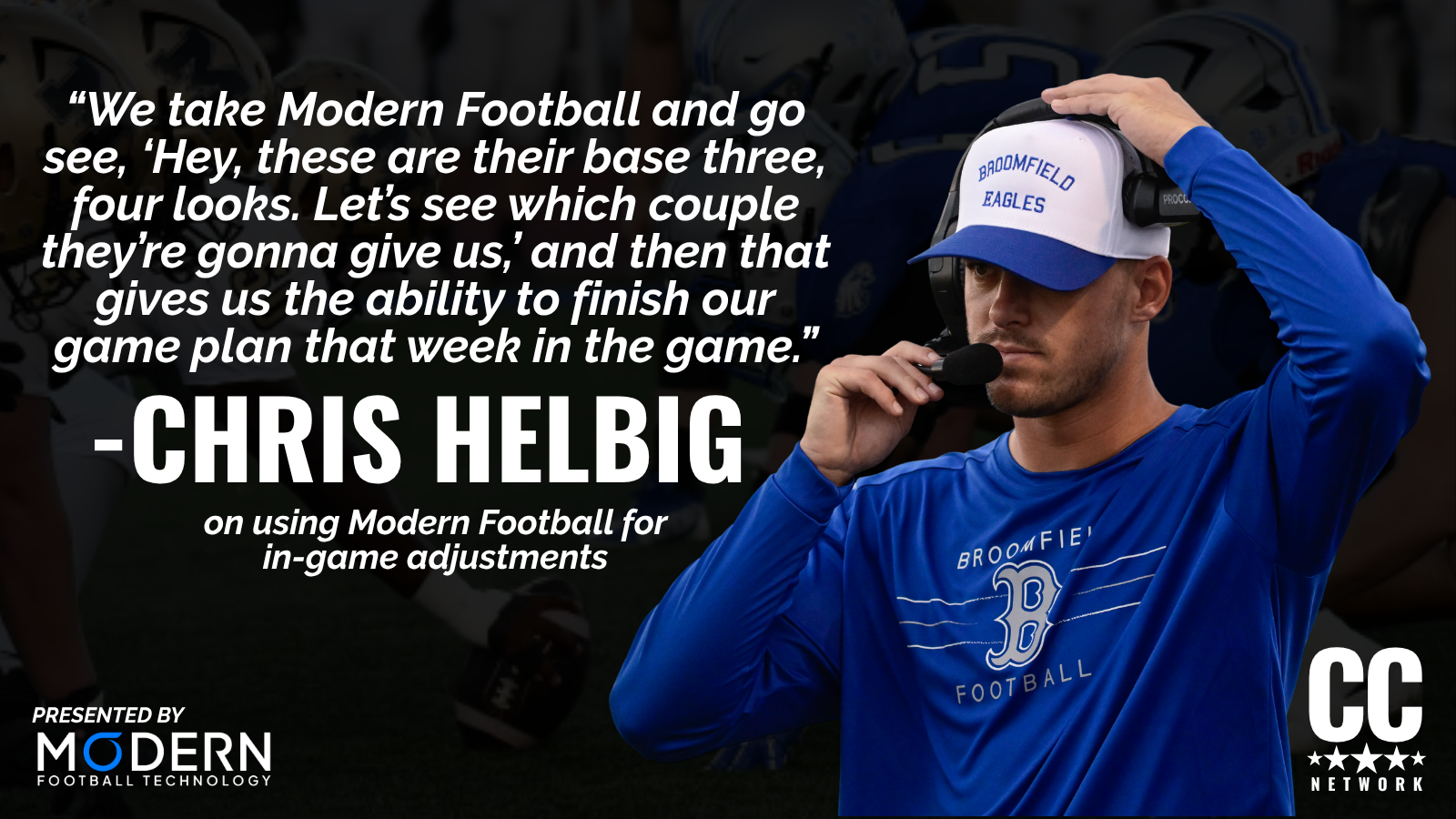
Helbig’s staff uses Modern Football throughout the week to identify an opponent’s tendencies and likely base looks on both sides of the ball. Broomfield’s tempo then gives the staff an early-game confirmation of which of those looks the opponent is actually willing to play. Because defenses facing tempo have to prioritize getting aligned, Helbig says they tend to show a smaller set of base structures before getting into more exotic pressures. That lets the staff see how an opponent is handling a particular formation like a 3×1 or 2×2 set and finish the game plan on the fly.
Helbig believes alignment issues hurt a defense facing tempo more than exotic pressure packages do, and that what actually stalls his own offense tends to be procedural, incomplete passes and penalties, rather than being schemed up by an opponent.
What Are the Keys to Playing Fast on Offense?
Getting the opening drive started matters more than almost anything else, since a three-and-out gives a defense both rest and confidence. Simplicity is the top value in Helbig’s system: a deliberately small installed package, varied through formations rather than an expanding play menu, so players know their job on every snap without having to think it through, which lets them play at full speed.
How Does Broomfield Make Halftime Adjustments as a Tempo Team?
Helbig treats the first half as an opportunity to wear an opponent down, since tempo is difficult for most teams to truly replicate against in practice. The goal for the second half is to dominate physically, banking on being in better condition than the opponent from the pace built into practice all week. Real halftime adjustments still happen, Helbig specifically praised his own defense’s second-half adjustments in the Holy Family game, paired with a mental cue reminding players that they’ve spent the week practicing looks the opponent hasn’t seen.
How Can a Tempo Offense Manage the Clock Late in a Game?
In those situations, Helbig’s team still huddles, using what he also calls a sugar huddle, but doesn’t signal in the play call until about ten seconds remain on the play clock. That preserves the mentality that the offense sprints to the ball the moment the huddle breaks, while still allowing the staff to manage the game clock and give their own defense some rest. Keith Grabowski connects this directly to the previous week’s National Coach of the Week episode with Josh Floyd at Hewitt-Trussville, who described a nearly identical approach, a sign the sugar huddle is becoming a common tool among tempo-driven programs.
Why Did a Clean Locker Room Matter So Much to Chris Helbig?
Two weeks before the Holy Family game, at a three-team scrimmage, Helbig’s players stayed to help clean up trash for the hosting team. After beating Holy Family, Helbig deliberately didn’t instruct players to clean the locker room, half expecting to walk in and use the mess as a coaching point. Instead, he found it spotless, without a single word said by any coach, something he calls the moment he was most proud of that week. His belief is simple: the program will keep progressing as long as the culture stays in the right place.
How Does Chris Helbig Keep His Team Even-Keeled Through a Tough Schedule?
Helbig is direct about what’s ahead: one of the best teams in the state the following week, then a program Broomfield hasn’t beaten in four years the week after that, framing the season’s first three weeks as a real test. His stated philosophy is to stay even, never too high or too low, avoid being purely outcome-oriented, and focus on winning the individual play in front of the team, repeated over and over, trusting the scoreboard to take care of itself. He notes that Holy Family punched Broomfield in the mouth early in the actual game, and that his players responded without panic, which he takes as evidence the culture is headed the right direction, while acknowledging there’s still plenty of room to improve.
Quick Answers About Tempo, Culture, Practice, and In-Game Adjustments
What is a sugar huddle and how do tempo teams use it late in games? A sugar huddle has the offense gather but wait to signal in a play call until close to the end of the play clock, letting a team manage the game clock and rest its defense while preserving the habit of sprinting to the line the instant the huddle breaks.
How can a fast-tempo offense help a coaching staff scout an opponent in real time? Because a defense facing tempo has to prioritize getting aligned correctly, it tends to reveal its true base looks earlier in a game before bringing out more exotic pressures, giving a coaching staff real data to finalize game-plan decisions as the game unfolds rather than only during the week leading up to it.
Why do some coaches deliberately keep their offensive install simple? A smaller, deliberately simple set of core plays, varied through formations rather than expanded with more plays, lets players know their assignment instantly on every snap, which is what actually allows a team to play at full speed without hesitation.
How can a new head coach build trust quickly with a team? Investing time in relationships before asking for results, such as being present at players’ other activities and getting to know a community directly, helps players believe a coach has their best interest in mind, which is often what makes a team willing to buy into a new program’s demands.
Why might a coach avoid conditioning players separately at the end of practice? If practice itself is run at full speed and tight pace throughout, the physical demand of practice can serve as conditioning on its own, without needing a separate period tacked on at the end that risks losing player focus during a long practice window.
Elevate your game with Modern Football Technology!
Modern Football helps coaches chart and tag in real time, delivers sideline reports to keep the booth and sideline aligned, and makes self-scout faster with on-demand reports.
Related:
Connect on X:
Keith Grabowski: @CoachKGrabowski
Chris Helbig: @ChrisHelbig3
Modern Football: @modernFB
Keith Grabowski (00:10)
Back for week two of our National Coach of the Week, presented by Modern Football on the Coach and Coordinator Network. And joining us today is the head coach at Broomfeld High School in Colorado, Chris Helbig. Chris, been been excited. Chris, I’m excited to have you on the show. You and I have talked before. I’ve heard your story and I’m excited to share that with our listeners as well. And congratulations on a great win.
Chris Helbig (00:36)
Awesome. I appreciate it and thank you for having me.
Keith Grabowski (00:38)
So Chris, before we get into all the great things you do, you guys rolled up over six hundred yards of offense, over sixty points in game one. And I I want our listeners though to understand a little bit about you. This is your second year in coaching and you’re you’ve been able to take over a a really good program in Broomfield. one that’s won some state championships here recently and you know, you guys go into the season ranks somewhere between two and seven in Colorado, but
it’s been an interesting path for you as I I’ve learned. played some ball in college, played overseas, and now you’re on the coaching side of it. So let’s talk a little bit about that and I guess your your path to being the head coach at Broomfield.
Chris Helbig (01:24)
Yeah, so I was playing in Europe. unfortunately had a few injuries. career was kind of injury ridden. after my last injury in Europe, I was playing for Rip Schreyer. spent a lot of time in the NFL in the college world. I just wanted to soak in as much as I could from him and our offensive coordinator Dave Warner.
Football was great, but I really learned a ton about leadership and and culture from those guys. and I knew I wanted to bet on myself, so got home and grew up in Thornton and Westminster is right down the street and the job came open and even without coaching experience wanted to apply and I pride myself on even f for interview’s sake being the most prepared. I think that’s something that you can handle. so really, really started early and walked into it with with the mindset of playing for college and
NFL guys and that’s kinda how we ran our practices and and the s success showed last year.
Keith Grabowski (02:21)
There’s not a lot of guys that we talk to who
in their in their first year in coaching, get a head coaching job. So Westminster’s program that saw some rough times. you know, the first time for a league title for Westminster for you in in in year one of of your coaching, in twelve years, made the playoffs, did things like instilling discipline within the program, having the highest GPA. So maybe a job that you know you have to take young and and ha that opportunity’s there.
Tell us about you know that and what you were able to do there in just one year of coaching.
Chris Helbig (02:59)
Yeah,
I mean it was really the kids were awesome. They wanted someone to come in with structure and and some culture and discipline and that’s where we started. We started in the weight room and we controlled reps, down when we say down, up when we say up.
just to kind of build that that no quit mentality and and the standard based culture. And the kids bought in. They loved it. Rip Schreer always used to tell me they don’t care what you know till they know that you care. So for me it was really important building relationships. I got in the building right as I started coaching as a sub and really just spent my day trying to communicate with the kids and get to know them. I think that I we built some great relationships as a coaching staff with players and and when you do that with high school kids, I think you have an opportunity.
to be to be very successful. When you have kids that know you have their best interest in mind and it’s not all about winning football games but becoming better people, you got you got a chance to do things at a lot of different places.
Keith Grabowski (03:56)
Yeah,
it’s it’s a tall order to move a program like that to to be able to win the championship. What what things as you guys moved it from the weight room out onto the field, what things made a difference for you there in being able to win ball games and being able to to take the culture out onto the field and perform like that in year one?
Chris Helbig (04:17)
Yeah, so
I was class checking, grade checking, so we stayed on top of those things. I’m a firm believer in how you do one thing is how you do everything, and we try to instill that in the kids that if you’re lacking in the classroom, you’re lazy in the classroom, you’re lazy when your parents are asking you for help, you’re probably gonna be lazy later in life. And for us on the football field. so we tried to really instill the no quit mentality, the lead from the front group. and then we really just focused on individuals. I know we were chatting a little bit before this and I kinda giggle because we did
More than anything else, just to teach the kids the basics of football. and that translated over. When we felt comfortable with that, we moved into a team setting. I think you gotta start at the base level. Even when we got here to Broomfield, a s a super high level program, we started back with the fundamentals. those those will define kind of who your program is and it lets the kids know that there’s
The small things matter. The little things, the details, how you get from point A to point B, all those things make a difference not only in football, but life.
Keith Grabowski (05:20)
I’m interested in that practice
structure. You know, Westminster and you said you carried it over here to Broomfield here as you started, really more focused on the fundamentals. And I know as as coaches, we you know, we we want to get to the to the scheme and start putting it together pretty quickly. What what was what was the practice structure like early on, you know, to to
Chris Helbig (05:42)
Yep.
Keith Grabowski (05:43)
be able to instill those fundamentals?
Chris Helbig (05:45)
So we always started with good on good. So we put our best eleven on offense, best eleven on defense to try to raise the bar of practice. there was a winner offense and defense. And we only practice for an hour forty-five. I don’t let our freshman team, JV or varsity, go past that. And but we practice fast. So we run from drill to drill. We have our five minute, ten minute periods. for us we make sure we get indie every single day O and D. I think fifteen to twenty minutes of indie so you can really focus on those details in in your individual group or
super important. Then we kind of get to our tackling and team stuff. Special teams are an important piece. So we always every single day have a 10 minute special teams period. I want the kids to treat that just like offense and defense. But we practice fast. We kind of have a rule with the kids that if we are flying around running full speed, we don’t really condition at the end of practice. I think if you’re moving and you’re running for an hour and 45 minutes, you’re going to be in great shape for the game. We play with tempo so our offense is kind of getting that in practice anyways and we try our best to
practice with tempo. Obviously in scout periods things get a little tough, but we’ll try to align in the same look for a few plays. So scout team just kind of moves with the ball and and keeps that same base structure. So it’s really about speed, speed and focus. We want to practice fast. We want to be focused for an hour and forty five. And I think the longer you keep kids, high school kids out on the practice field, the more opportunity you kind of have for kids to lose focus and and get disinterested. And we haven’t had a problem with it for
last two years just practicing fast and making the deal with them. I promise we’ll never go over an after four an hour forty five if you guys kinda give me everything you got for that time. So it’s a good little good little situation we’ve put ourselves in and the kids have bought into it.
Keith Grabowski (07:30)
No doubt.
Yeah. It’s football practice can grind on if you’re not intentional and you you don’t be disciplined as coaches, right? To be able to stay on task. It’s it’s easy to run it again and then run it again turns into five extra minutes here and there and before you know it you’re over two hours.
Chris Helbig (07:47)
Yep. Yep. Nope. We we save those for after practice. Tell the D coordinator and then I run the offense. So any corrections we have we’ll just line up after practice and walk through it. That seems to be kind of the best way to keep pace and also teach the kids that mistakes are gonna happen. How do you respond the next play? Not everything’s gonna be perfect. Does that affect you your next play, or can you refocus and go get the next one?
Keith Grabowski (08:11)
So year one, an incredible year one, doing some things that hadn’t been done in a long time at West Westminster and it opens the opportunity at Broomfield, which is you know, a premier job in Colorado. So how were you able to rally that f one year of of head coaching experience into a job like Broomfield?
Chris Helbig (08:29)
I think the biggest thing is being authentic. I’m younger, I’m a younger guy and I kinda buy into that. I don’t have kids, so I’m here for everything. I was at baseball games in the spring, track meets, just trying to get to know guys and getting to know the school.
Getting to know the the athletic director and all those things just kinda throughout the process. For me I wanted to be a people’s person. again, I think high school kids are gonna buy into what you’re doing if they know that you have their best interest in mind. So for me it was coming in and kind of using my age as as an advantage of, hey, I’m young. I was in this situation five minutes down the road ten years ago. so I know a lot of what these kids are going through and I know what this area lacks in terms of of recruiting and things like that.
I think that we can provide something to this community that can last for a long time.
Keith Grabowski (09:19)
So your game one wasn’t just any opponent for you. This is also a a a special opponent. Talk to us a little bit about that.
Chris Helbig (09:27)
Yeah, it was it was actually my high school where I went to high school. Broomfield and Holy Family are about five minutes apart. their head coach was my head coach in high school. my mom is the assistant principal there. Spent kind of the last twenty years at that high school just watching games and have worked worked worked with their quarterbacks before. So it was awesome. It was really special. The environment was awesome. I think most of the city of Broomfield was there. and just just to get to see
I don’t think there’s anything better for this community. they’re a really, really good program and and for us to be battle tested week one is awesome and it’s even better when it when it’s kids that played youth football together and after the game can can shake hands and hug and take pictures because they’ve spent the last twelve years of their life together. I don’t I don’t think it gets much better in high school football.
Keith Grabowski (10:23)
So let’s let’s dig into this game a little bit here. As I mentioned, sixty-two points over six hundred yards. You guys ran seventy plays. You’ve already mentioned tempo being a big part of what you do. let’s dig into that tempo part a little bit. And what do you feel are the keys to truthfully being able to run the a fast paced offense? I know a lot of guys try to be no huddle.
but I think, you know, and you see it in college football team. There’s there’s no huddle and then there’s the teams who play with their hair on fire and you guys seem to be more like that playing with your hair
on fire
Chris Helbig (10:55)
Yep.
Keith Grabowski (10:55)
out there.
Chris Helbig (10:56)
It’s part of your culture. It’s everything you do. It’s it’s in the weight room. You guys are not walking from station to station, drill to drill. We’re running and everything’s time so that we can get through it. I want our kids to play fast. It’s one of the pillars of our program is attack. I want these kids, whatever it is in life, taking out the trash, homework, football, I want them to tack. And that’s something that we kind of have built a a pillar of our program on is leaning from the front. and I think that that has created the opportunity for tempo. for
us is you can’t just turn it off and on. It it has to be kind of part of your identity. And we practice fast. We we teach our kids to do everything they do as leaders from the front and that’s something that’s helped us kind of instill this tempo in our program.
Keith Grabowski (11:41)
Part
of your approach to this, I mean, you’re gonna scout things, you’re gonna break it down. I know y you mentioned you use modern football in your scouting too. but early in the game is when you really learn about what an opponent’s gonna do. And I think I think this is right. You pointed out correctly that being a fast paced team, you’re gonna see those things early. You’re gonna see how are they gonna play with us. And so you look at it as that opportunity to to get some data, to get some analytics early in the game and then
almost a adjust or even, you know, come up with that final game plan on the run right there, you know, in the tent in front of Huddle Cylon.
Chris Helbig (12:20)
Yeah,
so we we use it throughout the week to scout our opponent and kinda get what they do defensively and offensively. We’ll use that then too early in the game, playing with tempo.
We’ve we’ve kind of been able to narrow down each week that teams are gonna give us a couple looks as as they’ll prioritize getting aligned, over sending any special pressures or things that they maybe did in previous weeks. So we kinda take modern football and go see, hey, these are their base three, four looks. Let’s see which couple they’re gonna give us, and then that kinda gives us the ability to finish our our game plan that week in the game, and say, Hey, this is what they’re kinda giving us against three by one or two by two. This
is how we’re going to attack it.
Keith Grabowski (13:04)
Yeah, I think that’s an important note. I mean, when you are playing a fast paced team, alignment is so important. Alignments will blow things more than than maybe those like you said, exotic pressures will help you.
Chris Helbig (13:18)
Yep. Yep. And that’s something we’ve kinda bought into is again, we’re gonna you’re gonna give us your couple of looks early and you y if you’re well coached you’re gonna make some in game adjustments.
Sorry, timer lights. but we’re not gonna get those crazy pressures as long as we’re completing the football and I mean we’re handing the football to the officials, lining up, things that kill us are incomplete passes and penalties. So as long as we can keep kind of the ball going forward, whether it’s for one yard, three yards, we know that we can kind of assume a base look out of teams and and know how to attack those.
Keith Grabowski (13:52)
Yeah, you mentioned there just some things procedurally, handing the ball to the officials, et cetera. I think there’s some common things that you hear from teams who go super fast like this. wha what are those things that you’ve learned and like this this has to if we’re gonna be up tempo, if we are gonna play it f as fast as possible, run seventy plays, mechanically, procedurally, these are the non negotiables.
Chris Helbig (14:14)
Yeah.
You gotta get drive started. there’s nothing worse for a defensive coordinator than being three and out and and twelve seconds comes off the game clock. so for us it’s really getting the drive started. Get that first first down and then we can really push the tempo. simplicity is king, I think. We are we are super simple. We’re gonna change it up with formations. but what we do is what we do. and we try to get really good at the few things that we do and and be able to play fast off of being simple. We don’t want kids thinking too much.
We want kids knowing exactly what they’re doing every single play so that they can play fast and at their best.
Keith Grabowski (14:51)
As as a game rolls on, you you know, you hit half time, do you expect, you know, maybe another adjustment? You talked about like really looking at the beginning of the game. how do you approach the second half as an up tempo team?
Chris Helbig (15:06)
Yes,
so that’s kinda where we wanna win the football game. So our first half we kinda wanna wear you down and we know we’re gonna be in a battle. but second half we practice with tempo every week and and and most teams don’t and I think it’s hard to replicate even in practice when you’re playing against an opponent that’s playing fast. So we really wanna dominate that second half with physicality and and we can control if we’re in better shape than other teams. so that’s really where we wanna start to kind of physically dominate when we can in the second half and and
And dig deep and and battle through fatigue and and dominate up front. So we’ll make some adjustments at halftime. I think our defense did an awesome job making adjustments at halftime this last week. And that’s just we stay on the kids that, all right, we’ve been practicing this, they haven’t. This second half we need to come out and and dominate.
Keith Grabowski (15:59)
In looking at, you know, you’re in a shootout here, sixty-two to forty-three. How do you handle that later part of the game when you know obviously you still I mean that’s a nice margin at the end, but at that point, you know, playing fast isn’t necessarily to an advantage. but you’ve you’ve trained that into your players, how do you handle, I guess
intentionally being able to slow down, manage the clock, run out the clock for the win.
Chris Helbig (16:30)
Yep,
so we’ll huddle in those situations, but we’ll just kind of sugar huddle because I want our kids to have the mentality every time we break that huddle we’re sprinting to the football. so we won’t signal in or call in a play until there’s about ten seconds left on the play clock. I think it’s a happy medium for our kids to know, hey, we’re trained, when that huddle breaks we are sprinting to the football. but also give our defense kind of some help and and wear that clock down.
Keith Grabowski (16:57)
Yeah, that’s I think the sugar hudd is huddle is an incredible tool. We talked about it last week actually with Josh Floyd at Hewitt Trussville. Same same kind of thing is something that they use as well. an up-tempo team like you guys. So definitely some common things there. as you look at, you know, this is week one and it’s a long season. The season moving forward, for you I know culture is such a big part of this. So it’s great to say, yeah, we rolled up six hundred yards, but how are you gonna continue to build
Culture as the season wears on, and you know, whatever you might face, whether it’s just smooth sailing or there’s adversity and bumps along the road.
Chris Helbig (17:35)
Yeah,
I think what I was most proud of this last week. two weeks ago at our scrimmage I had our guys there’s a little three three team scrimmage and our guys stayed and helped clean up the trash for the hosting team.
On Friday, I purposefully didn’t tell the guys to clean up the locker room after we won just because I wanted to use it as a coaching point, hoping they’d leave a mess. And I walked in and it was spotless. And that’s probably what I was most proud of, is we we swept our own shed even after we just beat our rival and coach didn’t have to say a word. so for me I know that that we’re gonna keep moving forward as long as our culture’s in the right spot, and and for me to walk in the locker room and see that after the game, I that was what I was most proud of.
Of is our guys are headed the right direction culturally. We’re gonna go through some adversity. We play against one of the best three 4-A teams this week, have Erie next week, who we haven’t beat in four years. So we are gonna be battle tested after these first three weeks, and it’s just staying the course. Never too high, never too low. we will we don’t want to be outcome-oriented. We want to win each play, line up and do it again. We need to win each play and do it again. the score will take care of take care of itself, but we really preached, especially.
Especially last week is we’re a repetition team. We got to line up, win a play, line up, win a play, and then eventually we’ll end up where we want to. so we’re we’re in a good spot culturally, but we can improve. I think Holy Family punched us in the mouth early, and it was cool to see how our kids responded. There was no panic. we’re headed in the right direction, lot a lot to improve on still. but again, if if we have high school kids that are cleaning up the locker room without being told to after the game, I think we’re headed.
Keith Grabowski (19:19)
Chris, it’s been great to catch up with you here. I enjoyed meeting you in the past. I think we met at AFCA the first time and talked a lot there. But great job in what you’re doing here. I’m not surprised. I was I’ve always been impressed with, you know, your football knowledge and just your approach
Chris Helbig (19:35)
Thank you.
Keith Grabowski (19:36)
to leadership. So best of luck to you and your team as you continue the season.
Chris Helbig (19:40)
Thank you. I appreciate it and thanks for having me.