
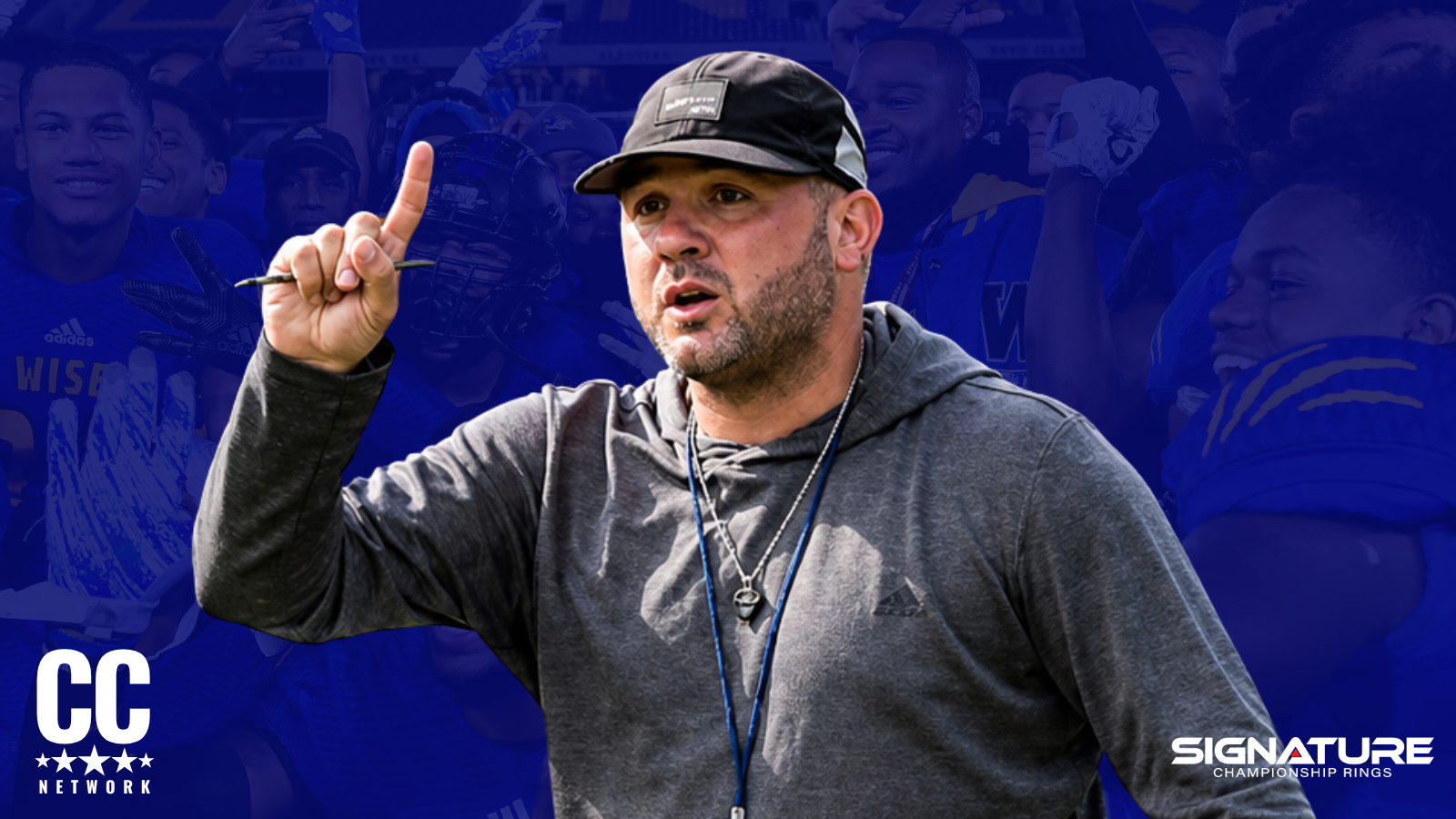
Steve Rapp, head coach at Henry Wise High School in Maryland and a five-time state champion as an assistant before taking over the program, tells Keith Grabowski on Champions how he built his own coaching staff, the accountability system he calls the fourth-and-one mentality, and what he’s doing differently this year to finally win it as the guy in charge.
Taking over a program that’s already winning at the highest level is its own kind of pressure. Steve Rapp spent more than a decade as an assistant, offensive coordinator, and assistant head coach at Henry Wise High School under DaLawn Parrish, part of five state championships along the way. During that stretch, Wise put together a 44-game winning streak. Since taking over as head coach, Rapp has taken the program back to the state championship game twice and was named the Washington Commanders’ Coach of the Year in 2024.
How Do You Put Your Fingerprint on a Successful Program You Already Helped Build?
Rapp didn’t approach the transition like a rebuild. He compares it to renovating a house rather than tearing it down: “I didn’t have to knock the house down to start over. Really just had to rip up the carpet, put some hardwood down, change the countertops.” Having already spent years helping build the program before becoming head coach, he felt like he was renovating something he’d helped construct rather than starting over.
The clearest change he made was staffing. Under Parrish, the head coach was the only football coach working inside the school building. Rapp has expanded that to seven coaches, specifically alumni who played at Wise at a high level, in college, or professionally. He brought in his former quarterback Quinton Williams, who started at Howard University for five years, to coach quarterbacks, something Rapp himself had done every year of his career until last season.
Why Does Steve Rapp Build His Staff Around Former Wise Players?
Rapp’s reasoning comes down to investment. “Because I feel like that’s what our society right now is, right? Our society right now is a see it, not say it,” he said. Coaches who came through the program and put in the work themselves are personally invested in Wise, and Rapp believes that’s exactly why they hold him accountable: “they won’t let me fail,” in his words.
That’s tied to a phrase Rapp repeats constantly with his staff and players: culture is a verb, not an adjective. It’s not a t-shirt or a sign on a wall. It’s what a program does when nobody’s watching.
What Is Steve Rapp’s Fourth-and-One Mentality?
Rapp’s clearest articulation of accountability is what he calls the fourth-and-one mentality. The idea starts with a simple observation: everybody tightens up on fourth and one. Rapp uses everyday discipline as a preview of how a player will perform in that moment. In his county’s public schools, players are required to be in uniform, and hoodies aren’t allowed in the building. A player out of uniform in the hallway, in Rapp’s view, is the same player who’s going to jump offside or blow an assignment on fourth and one. If a habit isn’t being held to a standard in the classroom or hallway, it won’t hold up when the game gets tight.
Why Is Structure and Accountability So Important in High School Football?
Rapp connects this directly to what he sees happening at every level of football. Players are skipping developmental steps, expecting to start and receive offers before they’ve built their bodies or learned the game, and transferring at the first sign of adversity instead of working through it. Keith Grabowski pointed to a stat from the NFL Combine, that only one player there had played at the same school for all four years, as evidence of how far the sport has drifted from development and loyalty.
Rapp’s response is that he won’t change how Henry Wise operates because of it. Players are held accountable or they don’t stay in the program, and he’s at peace with that trade-off. “Rome wasn’t built in a day,” he said, describing the process of learning to be non-transactional even when it costs the program a player. He believes football’s value is in preparing players for life after the game ends, teamwork, leadership, and structure, and that removing accountability removes the entire point of playing.
How Does Rapp Build Structure and Discipline Into His Program Every Day?
Rapp models the standards he expects. He doesn’t wear a hat in the building because he doesn’t allow players to wear hats. He shows up five minutes early to meetings because he expects players to be five minutes early. He always carries a pen, because a note-taker, in his words, changes the world.
Because most players at Henry Wise are issued Chromebooks and don’t naturally carry pen and paper, Rapp created his own daily install book for the program, with offensive and defensive sections, a notes section, and a daily goals section, so every player has a physical notebook and pen with them at all times. He frames it as preparing players for college meeting rooms, where showing up without a notebook isn’t an option, while also acknowledging that players learn differently, so the staff tries to reach audio learners, visual learners, and hands-on learners at the same time.
What Is Rapp Doing Differently to Win a State Championship?
Since December, Rapp has sent his coaching staff a daily group message with the same question: what are we doing today to create an advantage? Looking back at the analytics from both state championship game losses, Henry Wise turned the ball over twice in each game and fell short of its target of three to four explosive plays per quarter, some of it because of a good opponent, and some because of mistakes like receivers being covered up, holding calls, and false starts that killed momentum.
This year, the program added GPS tracking through Titan and Hudl, which lets Rapp post player top speeds on a board and track practice workload with the training staff. He’s also added a Breakfast Club, morning lifts before school in addition to lifting after school, built around getting players around each other and the coaching staff more often to strengthen the bond he wants driving the team. He doesn’t see this year’s difference as schematic. It’s discipline, detail, and the daily habits the program has built around structure.
Quick Answers About Building Culture and Accountability
How do you take over a program that’s already successful? Steve Rapp treats it as a renovation rather than a rebuild, keeping the foundation that already worked while changing specific pieces, starting with building out a full coaching staff of alumni who played in the program at a high level.
What is the fourth-and-one mentality in coaching? It’s the idea that a player’s everyday discipline, whether he follows uniform rules, shows up on time, or takes accountability off the field, predicts how he’ll perform in the tightest moments of a game. If a habit doesn’t hold up in the hallway, it won’t hold up on fourth and one.
Why does Steve Rapp value former Wise players on his coaching staff? Coaches who played in the program at a high level are personally invested in its success and, in Rapp’s words, “won’t let me fail,” since they helped build the culture they’re now coaching within.
How can coaches build structure for players without pen-and-paper habits? Some programs create their own physical install books, combining offensive and defensive install, notes, and daily goals into one notebook players carry at all times, reinforcing a habit that prepares them for college meeting rooms where handwritten notes are still expected.
How does Henry Wise track player performance in practice? Rapp says Wise uses GPS tracking, including Titan and Hudl, to monitor metrics like top speed and practice workload. He posts top speeds to create competition among players and works with the training staff to monitor how much players are running in a given practice.
Presented by Signature Championship Rings

Signature Championship Rings has helped more than 10,000 teams celebrate their championships with custom designed rings over the past 20 years, creating lasting reminders of the culture and work behind every title.
Related
Become the Mountain – Steve Steele, Head Coach, Riggs High School (SD)
Connect on X:
Keith Grabowski: @CoachKGrabowski
Steve Rapp: @CoachRapp_O
Signature Championship Rings: @signaturerings
Keith Grabowski (00:01.305)
back for another episode of Champions presented by Signature Championship Rings. We have a guest who’s with us before, first time in 2020. I went and looked it up. It was on January 14, 2020, my birthday, and he and I talked about
the power run game and definitely something you want to check on. Get back to that one. And then he joined us last summer to talk about how he’s building culture in his program. He’s a five time state champion from Maryland, the head coach of Henry Wise High School, Steve Rapp. Steve, great to have you back here on the podcast again.
Steve Rapp (00:39.254)
Thanks, Keith, man. One of my favorite things to do.
Keith Grabowski (00:43.703)
Yeah, it’s always great to talk ball with you. You guys have had a heck of a run. I think when we first talked, you guys were in the middle of a 44 in a row winning streak.
And you’ve been able to take over coach DeLon Parrish did an incredible job there leading the program and now you’ve taken it over and anytime you look at a program like that and it being taken over you want to see is this programs right where they need to be and I think the proof is in you’ve been back to the state championship twice and that’s always a hard game to win but you guys are still performing at a very high level.
In a time of change, we’re going to talk about some of those things today. But really happy to see what you’re doing. You were the Washington commanders, coach of the year in 24. Two incredible seasons, the head coach going into year three. So congratulations on all that.
Steve Rapp (01:37.997)
Thank you.
Keith Grabowski (01:41.049)
So let’s dig into this a little bit here, Steve. Let’s talk about that transition first. 13 years at Watt, became the offensive coordinator, assistant head coach, part of five state championships. When you had the opportunity to take it over, what were some of the first things that you thought about as the head coach to what you’re gonna do to put your signature on the program?
Steve Rapp (02:08.5)
Hey Keith, you pause, man. I don’t know what happened.
Keith Grabowski (02:15.417)
There you go. Yeah, it’s clear. So whatever you did, I don’t know if you heard my question. You froze for a minute. You want me to go?
Steve Rapp (02:17.28)
You’re good now. got you.
Steve Rapp (02:22.891)
No, I didn’t. I didn’t. didn’t. Yeah, I didn’t get your question. What’s up?
Keith Grabowski (02:26.593)
Okay, let me restart this part. So coach, 13 years as an assistant at WISE, you have the opportunity to take over the program and that’s not always an easy thing to do. You’re stepping into some big shoes, but also
that transition does mean it’s your program. I’m sure there’s a lot of things foundationally that are the same, but also Steve Rapp can’t be DeLong Pairs. So what was your fingerprint really that you wanted to put on the program early?
Steve Rapp (02:58.697)
I think this is a really interesting question. And the reason why I say that was prior to being the head coach, I had already been in the program for 11 years. So, feeling like that I helped Coach P build the process to where we were at that point in time. It was almost like, if you think about it in terms of the house, right? Like I didn’t have to knock the house down to start over. Really just had to rip up the carpet, put some hardwood down, change the countertops.
You know what I mean? There you go. You know what I mean? So it was kind of that, that piece right there wasn’t a start from the bottom, if that makes sense. So I, you know, I felt so really good about that. think a couple of things that I had checked that were different than him were first, we started with the coaching staff guy. The coaching staff, I wanted alumni that played at the school at a high level, that played in college, that played in the pros.
Keith Grabowski (03:29.667)
Cosmetic change.
Steve Rapp (03:57.915)
things that add nature. So we went from when Coach P was the head coach, we had just him. He was the only coach that worked in the building. Now we have seven coaches that work inside the building. I went and got some of the former guys that I coached outside of Wise or whatever. I went and got Trayvon Sullivan, who started at the Eagles for three years. I coached him as a player and now that’s my DC. So we got, I’m going to say we got younger.
And we got more in tuned into the building and the culture. I think that was the first thing. For the first time ever, I didn’t coach the quarterbacks last year in my coaching career, which was tough, but went and got my former quarterback, Quinton Williams, who started at Howard for five years. Me, I cleared a year, won championships, did the whole thing. So guys that are seeing it through my process, if that makes sense.
Now the biggest thing is getting this monkey off our back, right? We’d have been to the big game twice and they haven’t figured it out. you know, I think like anything else, right? Rome wasn’t building today. So you got to kind of go through the process and learn how to be non-transactional. Just understanding that sometimes you’re to do everything right and you’re still not going to So it’ll all work itself out. But I think
That is the biggest thing. You know, obviously guys, any high school coaches that’s listening, man, the most important thing in all of this is to have men’s support. Having a principal that is, is going to help see your vision, help support your culture. Athletic director, right. That’s going to do the same. And I think at Wise High School, man, I’m blessed to have both of those. And, you know, because of that, our culture leads right through the building and
And I think that’s that is a big part of our success.
Keith Grabowski (05:53.933)
Yeah, I want to dig into that a little bit more because I think it’s interesting when I hear that Coach Parrish was the only guy in the building and you your focus was let’s really get into here. But you had a profile of what you wanted as a coach. Why was it so important to you that these guys were alums but also alums that had reached those higher levels? Why did you want to bring those kind of guys back in?
Steve Rapp (06:17.464)
Because I feel like that’s what our society right now is, right? Our society right now is a see it, not say it. So because of that, when you bring in alum and you get guys back into the building working every day, teachers and support staff and things of that nature, they’ve been there. They put their blood, and tears into it. And it means a little more to them. So.
Because of that, I know that they love the program so much that they won’t let me fail, if that makes sense. So I think that accountability is huge. And when somebody’s personally invested in it, right, it becomes even more accountable. So, and I just, I stand on every day culture is a verb, not an adjective, right? It’s not a t-shirt. It’s not signs you put on the wall. It’s how you live your life. It’s what you do.
When nobody’s looking, it’s, I call it the four-on-one mentality, right? Where if you’re gonna do it on four-on-one, you should be doing it every day. So essentially that’s, know, and I just feel like it becomes super, super, super vested when you got guys that’s came through the program, right? And have done it that way, seen it done that way, won it at a high level and they know what it takes both mentally and physically. So that was huge for me.
And I felt like that’s once again, that’s given us an edge daily in our program.
Keith Grabowski (07:49.334)
the fourth in one mentality. Where does that come from?
Steve Rapp (07:52.505)
boy. That’s a because as we all know, you know, you get a little tight on fourth and one. Okay. So therefore, you know, I feel like the guys that you’re going to catch in class, I mean, the guys you’re going to catch in the hallway, not in class and in our County, you got to be in uniform. All right. In the public schools. So if you’re out of uniform, you’re probably going to jump off sides on fourth and one, right? You can’t wear hoodies in our building. If you got a hoodie on, you’re probably going.
You know, you’d probably go and blow the assignment. Something’s like it’s a trust factor and an accountability factor, right? That if you ain’t going to do it on fourth and one, right, then don’t do it in regular life. So always is just, you know, trying to loop football into society where, you know, we’re in a place now, man, where our game is, I think we’re getting to, we’re getting back in good graces, but our game’s under attack in a sense of, you know, I just, I’m not sure how much people love it anymore.
I believe they love the fame. They love the Instagram likes. They love the post, but I’m not so sure how much they love ball. So if you’re just doing it for two days, I mean, two hours a day or whatever time you spend with them, it’s not enough. It just isn’t. Like no millionaire has ever spent two hours a day on their little deal and then been a millionaire. So we try to link everything to football when we’re talking, if that makes sense. So it just kind of comes to that.
Keith Grabowski (09:17.26)
Yeah, I mean, that’s a great point about society. It’s something I hear from college coaches all the time, know, saying a lot of these guys just aren’t coming to us with the football IQ that they used to have. And we live in this world now where it is the surface stuff, right? What can I show off or whatever, but not that deeper understanding. Plus just the nature of how we consume content now is…
you know, guys not necessarily watching full games. They’re watching it, you know, a clip at a time, which the game is always played in context, right? So, I mean, this is one of the reasons we had a series called Football IQ, right? And talk to guys about how important it is to be learning the game and thinking of ideas of what coaches can do to get these guys learning and understanding the intricacies of this game. You know, yeah, it’s blocking and tackling and we could go to the fundamentals, but how you apply those things, when you apply those things.
You know, what the situation dictates, that’s a little bit different. But going back to the fourth in one mentality, I love that. That’s something that drives the culture both on the field and off the field for you guys. I think that’s so important, you know, and I’ve been in those same kind of situations where I had to look at, you know, our biggest issues aren’t on the field because the kids are talented. Our biggest issues are there’s the character that’s showing up in other places that, like you said,
When it’s fourth and one, it will show up on the field.
Steve Rapp (10:45.446)
Yes, sir. Yes,
Keith Grabowski (10:48.258)
So coach, let’s talk a little bit about what we need to do in general as coaches. You bring up an interesting issue of where society is at with things. And a lot of you see what’s going on in college football. There’s an interesting stat I heard at the combine. I’ve shared this a couple of times that there’s only one guy at the combine who played at the same school for four years, right? So.
The part of our game that we all love, the loyalty, the discipline, the development over a period of years and pouring into this person isn’t there. And we’ve seen it filter into the high school level. I think it’s probably one of the reasons why you said, I need seven guys in the school, right? I need guys there. We got to keep our guys. It’s not going to happen. Coach Parrish did an incredible job with that, but things have rapidly changed.
Steve Rapp (11:43.021)
rapidly. Boy, this is so deep, Keith. It’s so deep and so much to unturn because it’s structure. That’s what it is. It’s structure. It’s literally everything that we stand on as a unit. What I mean by that is you understand that you come in as a freshman, you’re a highly talented player, whether this is high school or college.
Now all of a sudden it’s, I got to play varsity. So I’m already skipping the JV step of, all right, I could be developing, getting every rep right, going through the process. So I come to varsity, boom, I practice every day. All right. Then I start as a sophomore. If I start as a sophomore, then I’m upset if I ain’t got 12 offers. But you’re a sophomore, dude. Like you got time, there’s a process.
Right. You got to develop your body. You got to your speed. Right. You got academically, you know, it’s usually a little funky after the freshman year. And this is 100 % what we’re watching happen in college. Okay. Where, um, what made college football so great was, I mean, five-star deeds were redshirt. Right. And, you know, it’s kind of like, it wasn’t that they couldn’t physically do it. It just was getting their body right now. Right. We’re not seeing.
great product to me because that what’s happening is there is no development. It’s throwing them out there on the field, right? And we’re getting blown coverages, missed tackles, MAs, like where you’re just looking in the quarterback play at the elite level versus everybody else is so bad. Like, and when you’re, when you’re seeing these things, it’s all because of the process.
Keith Grabowski (13:10.849)
All right.
Steve Rapp (13:32.377)
and everybody wants it, the microwave, right? Everybody wants it right now. And, you know, I just, it’s watering down our game in a sense of you’re just not willing to work for it. And what does that ultimately do, right? It ultimately takes that we’re building young men to be successful people in the community, husbands, fathers.
You can’t go to your regular job as soon as you graduate and be the highest paid person there. You got to start somewhere and work your way up to the top. And we’re removing that whole piece out of our game. Like, cause now the deal is, well, if I just don’t play, I’m just going to transfer, go to the next place. And then you go play, then it doesn’t work there. Then it doesn’t work there. Then it doesn’t work there. Now we got four years done. You’re not going to graduate. And now you’re back to.
the bottom of the totem pole and you’ve never really been there. And it’s kinda, as all of these things roll through, we’re preparing them for life, right? Football, that’s like, it’s a tool to get you there and we love it. This keeps us connected, but ultimately it’s gonna be over. And when it’s over, right, you gotta know this why this is the greatest sport in the world, because it takes a team to be successful at it. It’s not.
And through teamwork and leadership and bonding and all of that stuff, you learned all of the traits that you need to be successful out in the world. And we’re like literally taking that piece of it away from them. And it’s like, I always felt like high school was the last place that it was pure, right? And it’s not even that anymore. The tough part is, right, that they need structure. Young men need structure. I need a structure.
Right? We need, hey, this is what time the wait room is. This is what time study hall is. This is what boom, boom, boom. Give me your grades. Let me make sure you were in class all day. Like we need that. And we’re trying to skip steps in the process, right? We’re making it a hundred percent transactional and that’s what’s bordering our game down. Right? And if I hold you accountable today, then you go to your parents and your parents say, well, I’ll just take you to the next school then. And then you go do whatever you want. But I’m gonna tell you Keith, for me,
Steve Rapp (15:49.141)
And at WYSE High School, it’s not going to change us, man. I’m still going to be the same guy, right? You’re going to be accountable for me or you just won’t be here. And that’s okay, right? Because I know that you look at the college level, there’s coaches that are doing the same thing. You go into transfer portal, you’re not coming back, period. Like it just, it is what it is. So when you’re willing to deal with that, right? Then at some point, and I see that now we got all of this stuff going on. I’ve been kind of following on Twitter with Coach Saban and
Keith Grabowski (16:04.92)
Mm-hmm.
Steve Rapp (16:17.238)
I saw the aid from Notre Dame and we’re kind of different. People are getting to say their words and what it is. I just feel like we’re actually moving in the right direction. We were trying to get some rules in place. We’re trying to get things kind of structured more so that we can hold it all together. And whichever way they go go is alright, but it’s just, it comes back to structure and accountability. We just, we got to hold each other accountable. And I think that’s the piece that we’re missing.
Keith Grabowski (16:47.402)
Yeah, I mean, I go back years ago when I first started at USA football, the big focus at the time was the safety of the game. We being attacked because of concussions. And the one thing when you look at our game and it’s mostly our games always really been attacked because of safety. We solve those problems. We’re not really talking about safety anymore. And, you know, in general, I think it’s the coaches talking about how do I
you know, be somebody who’s transformational when everything’s turning transactional. That’s the challenge right now that you remain that way. I mean, you know, this is a common thing. I talked to a friend of mine in Georgia a few weeks ago. They’re starting spring ball. He’s got a phenomenal sophomore coming. He’s got two guys who are upper class men who should be competing for the job. Nothing is guaranteed. Nobody said this is the starter, but they saw, yeah, this guy’s probably going to be the starter. Transferred out,
before spring ball, he had one quarterback in spring ball because these kids just left the district. Like, and to me that’s crazy. Like, what are we doing? I mean, what are we teaching our kids? And to me, this goes more to on the parent side, what are we teaching our kids about the future that if it’s too tough, just change. mean, life doesn’t happen that way. You’re gonna sit around unemployed for some time. It’s like you said, Steve, ball will end.
Steve Rapp (17:47.486)
There it is.
Keith Grabowski (18:12.086)
no matter how good you are, ball will end, you have the rest of your life. And it’s not about sitting back, well, I got a great signing bonus, I made a lot of money in the game. That’s not the reality for anybody out there. What just is, to me, kind of heartbreaking is, you look at the transfer portal every year, and everybody thinks the grass is gonna be greener. They give up an academic scholarship and have nothing.
You worked so hard for four years to get that scholarship and then you think I’m gonna improve my situation by jumping in the portal and you end up with nothing. mean, ball’s gonna end sooner than you want. For most of your life, you’re not gonna be playing ball. And you gave up a valuable education for it. one, it’s just, it’s disturbing that that’s where we’re at. And two, like,
It’s like I said, it’s filtering down to the high school level. We’ve said this is the purest part of the game. I always have said that. And we’ve got NIL money now in some states, a lot of states actually. just, the courts will not, as soon as there’s a case brought against one of the state associations, they fold. It’s not a battle they’re gonna win. And so we’re dealing with the exact same things. We might not be to that level.
It might not be as accelerated as they’ve seen it, but we’re there. We’ve got to do something. But I I applaud you on saying we’re not going to change. We’re going to be transformational in how we run this program. you know, it’s obviously it’s working for it. I know you want two more rings for it, but you’ll get those. You’ll get them. You’ll get them. I mean, hey, Steve, you got a good problem because everybody else just wants to get to that game. They have a chance to get the thing. So you’re doing well. But I mean, really good points, Steve, about
Steve Rapp (19:38.578)
Yes, sir.
Steve Rapp (19:51.35)
That’s like the best question.
Steve Rapp (19:58.59)
Bill point.
Keith Grabowski (20:05.048)
What are we doing? Where are we going with our game? And, and I don’t know what the answer is. I know every college coach who I hear on a clinic or I talk to on the podcast doesn’t want to change from how they’re doing and being transformational and developing guys, but they recognize like my development now has a one year window in developing this human being. And you know, we’ve got to fix that one. But I think we’ve, we’ve got to stick to our guns in
How do we develop people? I think the challenge is, okay.
As part of my transformation, as part of my development, can I be good enough that I get to the light bulb to click that maybe staying here is the best thing for me?
Steve Rapp (20:51.089)
I you’re right. I think you’re right, man. think that, once again, it’s the structure. Like I said, it’s the structure, it’s the process, whatever words you want to use, accountability. And mean, the truth is that everybody can’t be the same, especially in a high school, because I feel like, unlike college, in high school, you got all different types of…
situations, right? Like you got some high schools that have 3000 people, you got some high schools that have 250 people, like you got some, some schools are going to dress 100, some schools are going to dress 27. Like there’s just, there’s so many different variables that I feel like you can’t be the same everywhere, but whatever it is you want to be, just dig your feet in it and be it, right? Like, and live it in whatever, you know, just kind of.
Trying to be there and to me, I feel like when you provide structure and structure is nowhere near the gray, like it just sits in black and white. And when you do that, that lets you be accountable and hold people accountable. So like that’s one of the biggest things for me as the head coach, like I gotta live this, right? Like, so, hey, if you see me, I don’t have a hat on when I walk through the building because I don’t allow my players to wear hats. All right, when I come in the meeting, I’m five minutes early because I’m expecting them to be five minutes early.
Wherever I go, I got a pen. Why you have a pen? Because you never know what you might miss. Note takers change the world. So, hey, you got to get them to know that, hey, I give everybody a book. You got to walk around with your book. If we’re doing something, your book and your pen is with you. I just believe like anything else, your train habits. So what you are and what you do is what they’re going to do. So when I lead it from that point, it’s extra for me, but it’s okay.
you get for being the head of the snake, right? So I think whatever you want to be, you just dig your feet in and be that 100%.
Keith Grabowski (22:53.442)
Yeah, well, and I think, you know, going back to maybe where the program was before you took over that being that it was only coach perish in the school, right? At least they had someone there. Some schools don’t have anybody, but I think what you just said, there is the key to, okay, what if I don’t have, I have one guy in the school, I don’t have anybody in the school. What do you do? Well, it goes back to like, we’re training habits when they are with us, when it is our classroom, which is football.
Like that still has to be the standard. We might not see it in school. I think that goes to, you better get eyeballs in the school. Like who are the teachers you know who can help you out? What can the administration do to help you out? Like there’s ways around it. It’s not the easiest. It is the reality for most places. I would say you’re in a small percentage outside of Texas where they have to be there that you have people in a building. Like I’m thinking in our area just here, like
Steve Rapp (23:36.054)
Yeah.
Keith Grabowski (23:51.937)
If you get two, three guys in a school, you’ve done a good job because it’s just very difficult to do with getting people into a building. But what you said there, I think is the key, right? Train those habits, have a pen and a book every single time. Whatever it is that your standards are, got to hold true to them.
Steve Rapp (24:12.076)
Yes, I mean, you’d be as crazy like, cause you know, I don’t know how it is like in Ohio where you are, but like here in Maryland, right? Everything they give the kids, um, Chromebooks. So everything’s done on the computer or whatever. So they don’t have pen and paper ever. Like, I’m not okay. No problem. We’re going, we’re going, we will create, we’ll create that. Right. So, we created a book, um, that is a, you know, a, you know, kind of a daily install book or whatever that offensive section, defensive section.
Keith Grabowski (24:26.422)
No, no.
Steve Rapp (24:41.644)
A note section, a daily goal section, like it gives you everything that you need, right? To just be able to say, hey, here you go. Carry your book with you wherever you go. Anything you need. You got a pen, you got paper. As much as we move into new age stuff, man, there’s still something to say about some of the older stuff that is just going to make you better as a player and as a person.
Keith Grabowski (25:04.802)
Well, there’s the science behind writing things down. And I mean, I’ve thought about that a lot, because I was a guy always an early adopter of the technology and whatever. And I realized though, you know, and we’re going to use technology as we teach the game to these players at Bay High School. But I am going to make them have a notebook and a pen as well to write it down. There’s the transfer of when you’re doing it, that’s just, you know, the science is proven that works better for retention.
And it’s something I’ve seen, you know, me making a switch over, it’s like, I don’t always, know, usually I’m putting it in my computer, which means it’s going to get lost. But I think a lot of kids are open to it. Like my son, he did it, and I never told him to, but he did it all through like his baseball career, right? That was what he wanted to do. He wanted to play in college. He wanted to play in the pros. And, you know, to this day, he’s out playing independent ball.
in Kansas right now, getting paid something for it. Not going to get rich, but he does it like, you know, after a game, he’s writing in his notebook. He’s constantly, you know, writing things down that he can go back to and refer to. And it’s helped his development tremendously. Like I can’t emphasize it enough. Like that is an incredible idea that you have your kids do that. I think it’s it’s needed because we do live in most schools are like that around us. The school I’m at is
is Chromebooks as well. And that’s a great tool, but the best tool is the brain. And so how do you make sure what you’re learning connects and writing it down is incredibly helpful. Take a picture of it, put it your phone if you need to, but that process of writing it down is incredible.
Steve Rapp (26:51.015)
I also think, you know, just coming from a teaching perspective, is that you got to attack learning however you learn and everybody learns different, right? So you have audio learners, right? You have visual learners, you have doers, you have guys that, you know, you write it down or whatever, you’re in business. So when we’re doing things, I just want to attack every style of learning because, you know, once again, I’m trying to prepare you for college. So when you get to college, you’re going in the room, the meeting room with the notebook.
Right? There is no hands, if hands or butts about it. We’ve all been there. Like this is what it is. So if I prepare you for it now, once you get there, I’m going to save you extra conditioning or the breakfast club for not having your stuff. But as a, you know, a sophomore or a ninth grader, whatever it is, you might not understand that yet. Right. But understanding that all the guys that are on this staff have been there, done that. Right. And these are the things that we got to do to kind of add in.
what it is that you’re doing, if that makes sense.
Keith Grabowski (27:50.263)
Yeah. Well, to wrap this up, a little play on words there with Steve Rapp. I’m going to ask you a tough one because I know in talking to you, it’s eating at you. So what are the things this year do you feel? What are the things you can do that’ll get you guys that ring? You walk off the field with the ring this time.
Steve Rapp (27:55.208)
You
Steve Rapp (28:12.708)
Yeah, they keep what you know, we want to know what’s crazy. So since since December, right, that has been my daily group message in our coaches group chat. What are we doing today to create an advantage? Right. What does that look like? Now I got a I got a bunch of things that I think that we’ve done from since January to now that I think is going to is going to help that. But it’s you know, I’m not sure if it’s one thing. Right. Like it’s been, you know, I think
Both years, if you go and you look at the analytics, right, because I know you’re getting into that. right. Here you go. Analytics say both years, OK, we turn the ball over twice in both games. All right. So, hey, easy to say you cut the you cut the two turnovers in both games. It’s probably a different deal. All right. That’s that’s one to. All right. I would tell you that lack of explosives.
in both games offensively, right? Where we want to get three to four a quarter and in both games we ended up with probably three or four in the game. And some of those are them being good and some of them are us with bonehead stuff, getting things called back, the receivers covered up, holding calls, false starts, things like that, you know what I mean? That just take away from the momentum of where we are.
Once again, that’s a discipline issue for me, right? Where I just got to be tighter and more detailed in practice, which is kind of where we’ve been at lately. We’ve had a GPS. All right, man, shout out Titan and Huddle. Man, I think that has been really good for us, okay? Like, cause I can physically put it on the board and it’s a competition every day about who hit the highest miles per hour. Or I’m able to get with the trainer and track who’s ran.
8,000 miles, I mean 8,000 yards in a practice and things of that nature. I think that’s added an advantage.
Steve Rapp (30:21.313)
what else that I can just kind of come off the top of my head and say, yep, I think that’s good. So we’ve added breakfast club where we’re lifting in the morning before school and then turn around and lifting again after school. know, just things to where it’s forcing our guys to be around us and the coaches more, right? And with that creating a stronger bond and understanding that, you know, like
This is your brother, man. I’m to be in a foxhole together. You got to look over there and say, I need it. And he’s got to respond back like, I got you. And the mission is the mission, right? Like, and we’re going to do whatever it takes to complete the mission. So I don’t think it’s a big schematical thing for us. I think it’s, you know, I just think it’s us, right? Like, I think it’s, you know, we got to dot some I’s and cross some T’s. And I think we’ll be okay with that.
Keith Grabowski (31:18.68)
Yeah, well, it’s never just one thing, but you you did a good job, I think identifying what are the things that are going to make the difference for us and attacking it, right? It’s, it still goes down to putting the work in and you guys are certainly doing that. And you know, it’s been great to catch up with you, Steve. Great to get you back here on the podcast. You always offer some, some insight to us, whether it’s been about offense or building culture and love to see you in the head coach seat now.
Best of luck to you and your team here as you go for that ring in 2026.
Steve Rapp (31:51.58)
Yes sir, man. Keith, always a pleasure. I’m always here, man. Anytime you need me, please don’t hesitate to call on me. I’ll crack a joke or two, but hopefully we can get some good information.
Keith Grabowski (32:06.073)
awesome.