
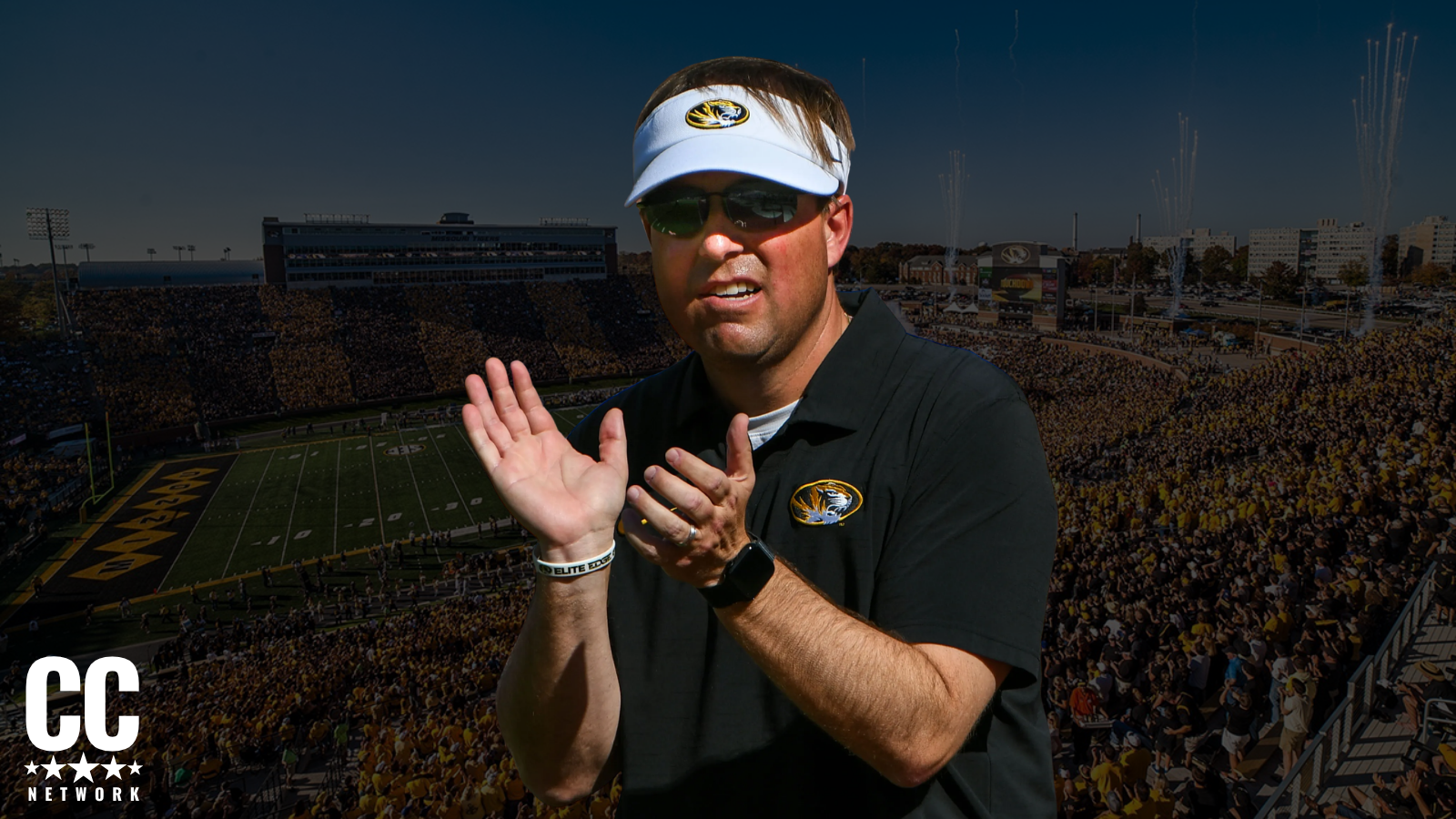
Editor’s note: Eli Drinkwitz recorded this conversation with the Coach and Coordinator Podcast in the spring of 2020. He had just finished his season as head coach at Appalachian State and had not yet coached a game at Missouri. We’re bringing it back after No. 25 Missouri’s 45-17 upset of No. 8 Florida.
When Eli Drinkwitz’s staff went looking for new ideas that spring, they split up the NFL. One coach watched the Chiefs and the Saints. Another took the 49ers, the Bucs and the Patriots.
“And they’re all going to come back with ideas,” Drinkwitz said.
Before any of those ideas went in, it had to get past three words: rhythm, attack, execute.
“Rhythm, attack, execute is the filter,” he said. “So they bring ideas to me, the first thing I say is, well, can we do that with rhythm? I mean, are our guys going to be able to handle that, call it, and execute that with rhythm? Number two, does that attack a defense? Like I really don’t need another three-yard gain or a four-yard gain. I need something that’s going to keep them up at night… And then the last thing is, can we execute it? Can we tag it, call it, execute it? And if we can do those three things, then let’s add it.”
Drinkwitz made the point behind it twice in the conversation. The first time, he put it this way:
“Everybody’s got great plays. It’s not about the plays. It’s about the plays that you can run and execute.”
Pro style concepts, tempo based
Drinkwitz said his offensive philosophy became “crystal clear” around the 2017 season. He had been calling plays for a while by then, working through different structures at different places with input from different people. What he wanted was a pro-style offense that could play with tempo.
He credited three sources. The philosophy came from Gus Malzahn. The framework came from Bryan Harsin and the Boise State model. At NC State, offensive line coach Dwayne Ledford was “really instrumental” in building the pro-style run game.
One day the two of them landed on the name.
“Why wouldn’t we just call this pro tempo offense? And it’s pro style concepts, tempo based.”
Naming it came with trimming it.
“How do we trim this thing back and make sure that we really know who we are? We know our strengths, our weaknesses, our DNA.”
That is where the three words came from.
Rhythm: as fast as we want, as slow as we need
For Drinkwitz, rhythm meant the offense set the tempo of the game instead of the defense. In 2020, he described his offense as based out of no huddle, with several tempos available.
“We have the ability to play as fast as we want to, as slow as we need to in order to protect our defense in the third and fourth quarter,” he said. “I think the one thing that when you ask defensive coordinators about playing against us, they’re going to tell you that you’re never quite sure if we’re going to go fast, if we’re going to go slow, or how we’re going to get there, whether or not we’re going to huddle.”
He compared it to the rhythm in a golf swing, something that happens naturally. He wanted players who could move in and out of tempos without it bothering them, and he described the two teams he didn’t want to be.
“You’ve seen those teams that want to play fast and when they can’t play fast, they’re just all out of sorts. We don’t want to be that team. You’ve also seen that team that plays slow and then all of a sudden they get in a two-minute drive and they can’t play fast.”
That is also why he counted conditioning as part of rhythm. The team had to be in shape to go fast whenever the call came.

Start with your foot on the gas
Drinkwitz agreed with the host that a multiple-tempo team has to install fast first.
“It’s always easier to say, whoa, than sic ’em.”
He traced that to an Oregon-TCU game he remembered as 2015 or 2016. Oregon led 31-0 at halftime, and TCU came back to win.
“That’s a five possession lead, okay? If you’re really doing your job offensively in the second half, I don’t know that a team should get five possessions,” he said.
In his reading, Oregon only had the ability to play fast. When it needed to slow down, it kept playing fast, TCU’s defense caught up, and the game turned.
“For me, I never wanted to be in a situation where I couldn’t slow it down and it freaked my guys out.”
The fire alarm
Being able to huddle was part of the same idea. Drinkwitz’s offense had a quick break from the huddle he called the fire alarm, and he thought plenty of no-huddle offenses had lost the thing no-huddle was supposed to give them.
“No-huddle was about lining up fast and executing a play before the defense could line up and necessarily recognize it. And now what’s happened is we’re going so slow, defenses are actually waiting to see the formation and then send in their call based on our formation alignment. And when you huddle, you can’t do that.”
He pointed to a game against Clemson a couple of years earlier. His team lost but played well on offense, and part of the reason was huddling and then using “crazy shifts” so Clemson couldn’t see the pre-snap formation.
“We’re still running our same plays, but we weren’t giving that pre-alignment tip.”
He put it as a question for any coach running a slow no-huddle:
“If you’re not going to go fast and you’re going to snap the ball between, let’s say, 18 and 23 seconds, then what advantage have you really gained that you wouldn’t have if you weren’t huddling?”
He also had more respect for the other side of that question than he used to.
“Defense is complicated. I didn’t know that until last year when I became a head coach and I sat in those defensive meetings.”
Shifts and motions, with a reason
Drinkwitz put pre-snap shifts and motions under rhythm too, and his case for them started with how defenses operate.
“Defenses have tried to become less and less complicated. But in order for them to all get on the same page, they have to communicate. And if you can get one person to break down the communication chain, then you’ve got a bust on defense.”
The movement also gave his quarterback tells.
Against a field-and-boundary defense, motions and shifts could create numbers into the boundary. Against what he called a no-hash defense, one that puts its nickel or overhang player to the strength of the formation even when the strength is into the boundary, putting the strength into the boundary opened up a lot of space to the field.
He said his offenses had been good for three or four years at deciding how a defense would have to line up, whether that meant an extra gap, an extra surface or an extra player into the boundary.
What he wouldn’t do was shift for its own sake.
“Too many times now what’s happened is people want to put a shift or a motion on it and your O-line coach doesn’t understand it because it’s going to create a different look and there’s uncertainty for the offensive line.”
He worked that out with Ledford. On third downs, Ledford liked three-by-one sets because it was easier to tell where the blitzes were coming from. Drinkwitz needed to start in two-by-two and get to three-by-one.
“As long as he understood the purpose and he could explain it to his guys why this might happen, then he was good. When it was, well, we just want to do it just to do it. Okay, well, then let’s not waste our time.”
Getting to empty without giving them the check
Drinkwitz described a weekly checklist his staff used to study how an opponent defended different looks, including motion, unbalanced and empty. He kept most of it private, but he walked through the empty example.
Say the opponent has an empty check. Maybe they show zero and bail out, or they blitz everybody and drop the defensive line.
“So as a coach, do you just say, hey, we’re not going to do empty all week? Well, if that’s an important part of what you do, then they got you.”
His answer was to get to empty a different way.
“Can we get a tight end? Can we motion the tailback out? Can we start the tailback out in everything and make it always look like empty and then motioning back and now they have to go from their empty check to their base check?”
“Once you can make the defense become reactive, which by very nature, they have to be defensive, then you’ve got a chance.”
Attack: offense by nature
The second word started with the run game.
“To be an attacking offense, it starts with a dominant downhill run game. We base out of the outside zone and then we complement it with the inside zone and some gap schemes.”
He wanted a pass game that was “detailed, discipline and unselfish” and emphasized throwing the ball vertically. On top of that, he wanted unique formations, specials and what his staff called funks, their trick plays, every week.
Drinkwitz saw the game as cyclical, and he thought it had drifted.
“Offenses have become more vanilla and defenses have now become more attacking. And we’re trying to be the opposite.”
He wanted defenses to have to prepare for his formations, his version of the downhill run game and his pass game.
“We want those guys on that side of the ball to think, okay, what is this guy capable of trying to do next? And we’re going to use all 53 and a third of the yards width on the football field to try to create vertical seams.”
Execute: every player, every play
Drinkwitz called execution the most important of the three words.
He defined it as every player, on every play, doing it exactly the way his coach wants it done. The second half of his definition was playing well under pressure, and he got specific about where the pressure is: red zone, third down and two-minute drives.
“We really emphasize what’s our red zone plan, what’s our third down plan, and what are we going to do in the two-minute scenarios, whether that’s the middle eight or whether it’s the last two minutes of the game.”
What doesn’t get in
The filter matters most when an idea fails it.
Drinkwitz gave two examples of what got turned away.
One was a play that doesn’t attack anybody:
“It’s a two-by-two, everybody’s running hitches. I mean, you know, I don’t know. There’s probably a better call than that.”
The other was an idea that only added another version of something already in the offense:
“It’s just another way to run three-by-one outside zone. Well, you know, we’ve got four ways to do that right now already. We don’t need another way.”
“That for us is our filter,” he said. “We clear out the clutter of the offense, focus on what we’re really going to be good at, and then execute those ideas.”
Related:
Connect on X:
Eli Drinkwitz: @CoachDrinkwitz
Keith Grabowski: @CoachKGrabowski
Keith Grabowski (00:30.616)
Today’s episode is from our archives with Eli Drinkwitz, head coach of Missouri. They’re having an outstanding season, which after listening or re-listening to this episode will come as no surprise. We talk about his start in coaching, the sacrifices to be able to achieve career goals, running a pro-style tempo offense, and more. This is one of my favorites and one I’ve listened to several times myself. Enjoy.
I’m excited to be joined today by the head football coach at Missouri, Coach Eli Drinkwitz, and we’re gonna talk about a lot about what’s going on with Tiger football and coach, wanna welcome you here to our podcast.
Eli Drinkwitz (01:09.294)
Appreciate it, man. I’ve I’ve wanted to be on the show for a long time and so appreciate the invite. Appreciate us working our schedules out to make it happen.
Keith Grabowski (01:17.578)
Absolutely, coach. Well, you know, we’re we’re in an interesting time here and I guess what this has done is afforded the opportunity for number one our listeners to get a little bit more interactive and share some questions. So we’re gonna get around to their questions a a little bit later in this episode. But as I do with all coaches, I think our journey through this game to where we are takes a lot of interesting paths and that’s something we want to learn about with yours. So, coach, just thinking about
You know, the beginning of this for you. When when did this desire to be a football coach start for you?
Eli Drinkwitz (01:54.422)
You know, I the desire to be a football coach, I I distinctly remember my senior year in high school, you know, my high school football coach coach Frankie Vines called me in and we were talking. I was I was one of those guys that always hung around, loved football, was you know, always around the the facility and he asked me if I ever wanted to be a coach. And I said, No, not really. I think I want to be a lawyer and he just said, I think you’d be a good football coach and that stuck out to me. I I went to school, still thought in my mind I I’d be a lawyer.
You know, there’s a verse, Proverbs sixteen three, the minds men play in the ways, but the Lord directs her steps. And my steps just started to be directed towards coaching. And I’ve got a chance, you know, to do my student teaching with a a g a guy who become later become very influential in my life with Gus Malzon at at Springdale, Arkansas. And I had to work a few things to be able to do that, but was able to get it situated where I would do my student teaching for a year at Springdale. later went on to coach high school football.
you know, in two thousand five my my high school football coach hired me as the head seventh grade coach at Alma Middle School. We had two teams. I was the head coach for both of I was the eighth grade defensive coordinator, the ninth grade wide receiver secondary coach, and then would scout, you know, on Friday nights and on Saturdays would be responsible for inputting all the data into the to the computer. So, you know, two thousand five was a heck of a year as far as just me learning to to coach and be a football coach. You know
I I joke around. I had the best job in the country then. And I really do think back on that and think about how much fun I had coaching football then. We had eighth grade practice in the morning, first thing before school. we would go and bust up the dew off the grass to make sure that that the the players wouldn’t get all wet. And then we would d then I went and taught class second period. Third period I came back and coached the seventh grade team, had lunch, drove over to the to the high school
coached junior high football then, drove back, taught class, and then after that would drive back to the high school for our afternoon ninth grade class and football. And I it was twenty four seven football, Monday night, J V Tuesday night, seventh and eighth grade games. Wednesday night was church. Thursday night was junior high night and then Friday night was Friday night lights. And you know, that’s really where the foundation for me of just coaching and caring about our kids and
Eli Drinkwitz (04:17.964)
You know, that that that’s really where it started. I I I’ll never forget my my my my boss, Coach Vines, told me my number one job as a seventh grade coach was to make sure every kid that played seventh grade football played eighth grade football because he wanted you know, kids develop differently over time. And I say that because that sticks out to me right now. You know, so many times in college football we recruit players and when they get on campus then they don’t always turn out to be exactly what you expected or or their developmental, you know, curve is different.
And I tell all my coaches, the number one job of us when we get a kid on campus is to make sure he comes back his sophomore season. And especially this day and age with the transfer portal, I think that’s that’s so important. But but rewind, so two thousand five I was junior high coach, two thousand six I went actually went to Springdale, Coach Malison left to go to Arkansas as the offensive coordinator and I went to to coach high school at Springdale and was there up until two thousand and ten.
And just you know, another one of those deals where like a junction point. So in two thousand and ten the head high school job at Springdale came open and I applied for it and I really thought I should get it and I didn’t and I was crushed. I mean I was I was absolutely crushed, thought about every way in the world that I could leave Springdale and just felt like that the the right thing to do was to try to stay and not be that person that if you didn’t get your way just took your ball and went home. So I stayed.
And in May, Coach Malzon reached out to me about an opportunity to become a quality control at Auburn. And he came over to my house at that t time. I had a two month old daughter and my wife. We’ve been married for five years and he sat in my living room and said, Hey, this is a once in a lifetime opportunity. You know, you can come be a quality control and it pays fifteen thousand dollars a year, no benefits. And I was like, Wow And when he left, you know, my wife asked me what what did I thought and I I just
I I was like, Babe, you know, I would love to, but I just don’t think we can make this work. And she said, I I remember she said, Eli, we gotta do this ’cause you’ll always regret it if we don’t. And that was really the first step of our college football journey and and we did. We sold our house, moved into a nine hundred square foot apartment called the Greens in Auburn. And I was a Q C the first year and then the GA the second year at Auburn. The first year was fortunate to w you know, be a part of a team that went
Eli Drinkwitz (06:40.92)
fourteen and unanimous number one Heisman Trophy winner, national champion. Thought college football was easy. Next year found out it was a little tougher without the Heisman Trophy winner, but but still won the Chick-fil-A bowl and and had a great year. And and then that next after that bowl game, Coach Mazon got hired at Arkansas State and he offered me the special teams coordinated running back’s job. And the unique story about that for me is that I knew he was getting a job you know, I knew he was getting the job and and he he
sent me a text and said, Hey, be ready to answer your phone call after this press conference and and so after the press conference he calls me and he says, Hey, I need you up here tomorrow. And I’m in Auburn and he’s in Jonesboro and I’m like, Okay, what time? He said, eight A. And I said, Coach, that’s a eight hour eight and a half hour drive. He said, Okay, make it eight thirty. And so I woke up at three in the morning and and left and drove and and made it there by eight thirty and in and that was the kind of the thing that
coach even to this day would talk about, you know, his he would call us what we would call getter dunners. Just he we would he would give us a job and we would find a way to get it done. And I’ve always thought that was a a unique way or a characteristic to describe somebody who just has urgency about what they do and and that really paid off well for me. Coach took the Auburn job and then I w again had another junction point. Brian Harson came in and had offered to keep me, which was you know, I’m indebted to Brian for doing that. and then he gave me a unique opportunity to co offensive coordinator.
And I felt like at this moment in time I had to make a decision. I could either spread my wings and fly a little bit and see if I could make college football on my own, or whether or not you know, I should continue with Coach Mallison. And another verse that sticks out to me just is commit your ways to the Lord and he’ll establish your plans. And that’s really what my wife and I did. We just said, you know what, if Lord, if this is what we’re supposed to do, we’re gonna do it the right way and and view this as our ministry and view this as, you know, us living for you in in our way. And so
We said we would do it. End up coach got the Boise State job, won conference championship, coach got the Boise State job, went there for two seasons. Twenty fifteen got an opportunity or actually after the twenty fifteen season got an opportunity to go to NC State for three years and had some some really good offenses. And then another one of those unique moments in time got an opportunity, get got a phone call out of the blue, said
Eli Drinkwitz (09:00.226)
Hey, some things have fallen through in this coaching search for the App State job. Would you be interested? And and I said I’d take a skateboard up to Boone, North Carolina right now. And they said, Okay, well if you can get up here tomorrow, then we’d like to interview you. And there was at I mean, it was at least twelve inches of snow on the ground. It was crazy. Got the job and, you know, to took that challenge. And then this the Mizzou thing kinda’s
the unique thing too. I mean, we we were having a successful season. The Mizzou job came open. I really wasn’t on their list. Wasn’t wasn’t even really a priority. And then Friday afternoon their search had taken a different direction and my name had gotten to and and they had started doing some research about me and and had reached out and said they wanted to to visit with me after the PowerPoint championship game. And, you know, I think the thing that keeps me grounded is, you know, I have a at that time she was three months old, but I have a five month old daughter at home.
And it’s you know, it’s about four forty five in the morning and she’s had one of the worst blowout diapers that you could have. And my my wife says, Hey, I need you to change the diaper. And I’m thinking to myself, you know, it’s it’s one of the biggest days of my life. I’ve got a conference championship game. If that goes well, I’ve got an interview with an SEC school and I’m sitting here changing diapers. And it just puts everything in perspective ’cause at the end of the day of all this conversation, I think what I hope everybody takes from this is football coach is what I do, it’s not who I am.
the most important thing that I’m ever gonna be is a husband and a father first. And then from that I’m gonna be an influencer of of men and people. And it’s just so happens that football is the way that that I get to do that. And that really was etched in my brain at that moment in time was like, Yeah, that you’re you’re doing exactly what you’re supposed to be doing at four forty five in the morning and then the Lord took care of the rest of the rest of the day. And so that’s really my journey. So every step’s you know, every day’s a new day as far as experiencing new things, but
It’s been a wild I I would say a wild fifteen years and even ten years to now be the youngest head coach in the SEC. You know, I was around I was we were at our winter meetings the other day and I was looking around the table thinking, I don’t think there’s a coach in this room that has a child under five and I’ve got or or even a child under six and I’ve got three under six and four under ten. And so it gives me a unique perspective and balance, I think, to my life.
Keith Grabowski (11:23.914)
Well, it definitely and thank you for sharing that story. It was it was great and just some of the things you talked about, you know, even starting in your your high school days, like I’m not sure of very many young men who are getting in this game now even know what it’s like to have have to go and live scout a team ’cause, you know, back back in the day, I mean well shoot my dad was a high school football coach, so I remember they’d have to go
take film to get developed and then, you know, when I started coaching it was the VHS tapes and you you know, you’d meet in a parking lot somewhere with the with the opposing coach to exchange a stack of those, but you still sent your guys out, like, ’cause the quality on those wasn’t great. You know, sent your guys out on on a on a Friday night to live scout. And like, I mean, you know, the the pressure on you as a young coach, as a a live scout to make sure you get that right and you can say something intelligent when you come back to those varsity coaches.
That’s definitely a lost art and practice right now.
Eli Drinkwitz (12:22.274)
Yeah, I I you know, I think all a lot of the different things that were taught to me as as a high school football coach. Like I I talked about one, you know, making sure your kids have a great experience, two is just the flexibility of coaching multiple positions and then three seeing the football game a different way. But yeah, I mean I I you have to have a plan. I mean you gotta watch both sides of the ball. You gotta try to catch on to what they’re trying to do and and it it was definitely a challenge, but it definitely it taught me a lot and I actually
think I see the game better from the box because of my time experiencing that as as a high school football coach and a scout. And I think the other thing I take away, you know, I think most people think, you know, everybody talks about the GA years or whatever from a from a college, you know, perspective. And I think, you know, there’s a lot of high school football coaches who absolutely want to coach, you know, in the college game and there’s been some guys that have been able to make that jump from
coaching high school to coaching college on the field. but the reality of it is when you think about just guys out there right now like the and I think about Dan Lanning, the DC of Georgia, his story and my story about the sacrifice that we had to make. Everybody wants the Saturdays. Everybody wants to see us running out on the tunnel, you know, in in front of these big stadiums. But they don’t they don’t ever count the cost is kind of the best way to say it, of what what has to go into getting there. And, you know,
taking a pay cut, you know, my wife and I were making daggum near a hundred thousand dollars. She was a teacher and I was a coach. To go to fifteen thousand dollars a year with a two month old child, I mean that’s a heck of a risk. And you gotta be willing to bet on yourself and make that risk and make that jump. And I think again, this day and age, everybody wants it right now. You know, there’s a there’s an element of sacrifice that that has to be made in order to get, you know, to where we’re at. I think about Rick Jones, you know, a guy that I just hired from Greenwood, Arkansas
Who’s taking that risk, you know? He never once asked me what it was gonna pay. He never once asked me about you know what the benefits were for him. He he wanted the job, you know, and that’s that that’s you know, I tell the our staff all the time, you know, we don’t give out positions, we give out jobs. You know, we don’t we don’t hand out positions. You got a job to do and you gotta do your job. And and that’s what I really appreciate about Rick and somebody who’s trying to make that jump too.
Keith Grabowski (14:46.604)
you brought up and a a couple of times now and I I kinda wanna touch on it again ’cause I think it’s so crucial to the future of of our game, right? And and the first time you mentioned it was, you know, getting those seventh graders to be eighth graders and, you know, for me it’s it’s like
you know, our introduction to the sport now around a lot of places in the country is flag football, right? And then to be able to get those kids from flag football maybe to some kind of limited contact. I know like in our area a padded flag is like taking off and helping the game, you know, teaching it in a different progression and then getting them to maybe a smaller side of game where they’re tackling. And then eleven man football, like the whole idea, right? And I think as adults we mu we mess this up and sometimes
You know, it’s it’s what we learn having played the game, the competitive nature is sometimes we we get focused on the wrong things with especially our younger levels and and even these kids as they’re coming up through high school is like we want them to get through our program, and see them develop and have an influence on them and and have them experience all those lessons that the game teaches. And to do that, we gotta be focused on that individual first and make sure we’re
We don’t wanna run kids off, we wanna raise them up through our
Eli Drinkwitz (16:02.584)
I mean I think I’m not gonna go as far as to say our game is under attack, but I think sometimes there’s a complacency that happens when your game is as successful as it’s been. And if we don’t make sure that as coaches we grow the game from a younger sport, you know, then the quality’s not gonna be as good and I think quite frankly our game could our game could end up being in danger. And I do think that we have to do a great job of
Trying to find ways for the game to be safe, but also to take the misconception of the danger out of the game too. And I think that’s you know, you see people running full speed and making contacts and collisions at at a high level, you know, that trickles down. I I don’t know that I’ve ever seen those type of same kind of contacts and collisions at the younger ages. And so I think we’ve got to do a great job of teaching safe tackling. I think the way USA football has really attacked safe tackling and teaching tackling and teaching the game.
is the way that we should all adapt and and make sure that we’re doing our best to pass this game along. Because I do think it’s the greatest game in the world. You know, I I I I fundamentally think that no matter what the plan is, it always comes down to execution, right? So let’s talk COVID nineteen, right? Well our leaders have decided the best course of action is for us to either s practice safe social distancing or stay at home, right? As best as possible.
Well, that plan only works if we execute it. And in college football and football, we understand that it’s this one eleven model that the the one is only as good as the other eleven and the other eleven is only as good as the one that does it, right? That’s Eric Link, our special teams quarter coordinator’s deal. Well, that’s the same thing with this social distancing. Like it it’s it’s all good if everybody practices it. But if you go out and look at the beaches in Miami and all those kids on spring break are going nuts and partying with you know partying like crazy.
And then they go back into their cities, then they’re spreading the C V nineteen. And all of us who’ve been been doing it right, it doesn’t matter. And I think again, football teaches you that. I I would venture to say that most college football teams who are out right now are saying, you know what, I understand what it means to be a part of a team and I’m gonna do what the people under authority tell us to do because whether you’re you know, I I our offensive line coach says, you know, if we’re all wrong, but we’re all wrong together, we got a chance to be right. You know what I’m saying?
Eli Drinkwitz (18:24.834)
And that’s kinda how I feel about this COVID nineteen deal. Like no matter which way y you believe, whether you believe it’s overblown or underblown or the curves going, you know, middle of June or next week, it none of that matters. It just matters do we execute what we’ve been asked to do.
Keith Grabowski (18:41.708)
Yeah, I couldn’t agree with you more, coach. It it is so much about teamwork right now and like I said, this probably isn’t the first time this happens now. I think now, you know, we might see this again when there’s there’s a threat and try to step things up to stave it off quicker, whatever. But whatever happens in the future for us is is is about teamwork, right?
E exactly like you said here. So coach, you know, taking a look at this opportunity, I know a lot of our coaches out there got to know you in the coaching world for what you were doing as an offensive coordinator, and we certainly wanna touch on some offense here, but you you know, you went into App State and you know, had a a great year there and now you’ve been called on to step up here in the SEC and all this is really built around
You know, the culture. The culture is what’s gonna set you up for success. So as you look at Menzu football and you guys getting your start there, what are the things that you’re building around? What are the pillars of your program?
Eli Drinkwitz (19:40.332)
Well, you know, for us we really have four core values that we live by every day. Number one is to always compete. You know, we firmly believe that the only thing better than a little competition is a lot of competition. and so we want to create a competitive culture that that thrives on. You know, the thing about c the word compete, when you actually dig it down it yi it says to strive against, but when you dig it down to the root of the word, it actually means to strive together. And always competing, you know, there’s this
sometimes it’s well it’s always a winner and a loser. And I I believe there’s always a winner and a loser, don’t get wrong. But I also believe there’s a the ability to compete to be your personal best. And that’s that’s the competition you have to have to be better today than you were yesterday, be better tomorrow than you were today. And I think that for us is our constant battle as as players and as a program. Are we always competing to be the best version of ourself today? And if we’re not, then we’re not doing what we’re supposed to be as a team.
And how do you do that? You strive against each other to strive together to be become the best version of yourself. And so we want to create that atmosphere of competition. Number two, we want to build an atmosphere of trust and respect. And, you know, especially when you’re coming in new, the only way that you can build trust and respect is investment over time. And that’s not gonna happen just because you put it on a wall and say it’s a fancy term. You gotta invest in each other, whether it’s player to coach, coach to player, coach to coach, player to player.
We all have to build a relationship where we respect the work that each other’s doing and that we trust that each person has the best interest of the other person at heart. So, you know, I I don’t I’m not a one of these guys that demands respect because I’m in the position I am. I I I ask for respect because I’m gonna give you respect. And I’m gonna try to develop trust so that when I criticize or am critical of the technique that you’re playing, you understand it’s not from a standpoint of being personal or picking on you.
is from a standpoint of you believe that I have your best interest at heart and I’m trying to get that out of you to develop you to the very best player that you can be. And so that’s what we believe in trust and respect. The next is to always do more than what’s expected. You know, I tell our team all the time, if you do what everybody else does, then that’s the definition of average. So if if you’re only willing to do what the what we asked of you within the the framework of the r the rules, then then we’re gonna have an issue of
Eli Drinkwitz (22:00.512)
of being average and we don’t nobody came to to Misso to be average. We came here to win. And then the last thing is enjoy the journey. You know, football is not a destination. It’s a journey. And it’s only a short period of time that we have our guys. And and we talk about during our journey, we want to chase two dreams, a life with football and a life after football. We know that this game can give you so many highs and lows and so many thrills and and it can be an avenue for a a successful start to your career.
But at some point the air comes out of the football and you can’t play. And we want our guys who’ve been to this program to be become a Mizzou made man and to be a functional contributor to society. And so in order to do that, again, we gotta teach them that this is not just a destination, that it’s not destination NFL or bust. It’s we wanna chase both of these dreams simultaneously and we’re gonna give you everything you can to be successful,
on the football field with athletic performance, with nutrition, with coaches, with schemes, but we’re also going to give you that same amount of detail and and emphasis on life after football. And you know, the last thing for me on the the enjoy the journey piece is, you know, this day and age it’s so hard to know how long our times, you know, coaches come and go all the time. Players come and go ’cause of transfer portal. And I can’t sit here and and say that over the next five years,
This building’s gonna be the exact same with the same people in it. But what I can tell you is while we’re here every single day, we’re gonna do our best to enjoy the journey together.
Keith Grabowski (23:36.29)
Coach, the the winning culture sets you up for a winning strategy, winning execution and and all those kinds of things. And I know a few of our our coaches who are are listening here and and I’ll list these guys in the show notes and thank them for their questions. But you know, as I said, everybody knows you for what you’ve done on offense. So could you outline for us your offensive philosophy?
Eli Drinkwitz (23:58.646)
Yeah, yeah, that’s for me. And and really it became really crystal clear for me in about the twenty seventeen season. You know, I’ve been calling plays for a while and and had been going through some different structures, different places, different different inputs from different people. And really what happened was I wanted to develop a pro tempo style offense. And this had been something, you know, I take I take really the
the philosophy of what we do from Coach Malison. I take the framework of what we do from what we learned from Brian Harson and the and the Boise State model. And then with that NC State, Dwayne Ledford was really instrumental in helping develop this pro style run game. And so Dwayne and I were sitting there one day and we were saying, you know, why wouldn’t we just call this pro tempo offense? And it’s pro style concepts, tempo based. And and again, I firmly believe that no matter what you do on offense,
Everybody’s got great plays. It’s it’s it’s not about the plays, it’s about the plays that you can run and execute. And so as we were deciding, okay, how do we trim this thing back and make sure that we really know who we are, we know our strengths, our weaknesses, our DNA, we we decided that it was gonna become there were three words that were really gonna be the hallmark of our offense. And then the first one was rhythm, the second one was attack, and the third was execute. I’m gonna break those down. So
rhythm for us is we’re gonna dictate the the tempo of the game to the defense. We base out on no huddle. We have the ability to play as fast as we want to, as slow as we need to in order to protect our defense in the fourth third and fourth quarter. And we’ve got variances of tempo is how we do that. Just like you’ve seen throughout the the the film, I think the one thing that when you ask defensive coordinators about playing against us, they’re gonna tell you that you’re never quite sure if we’re gonna go fast, if we’re gonna go slow, or how we’re gonna get there, whether or not we’re gonna huddle
w we’re gonna constantly keep them on edge. The second thing is I believe in shifts, pre snap motions and and the ability to change the look for the defense. And that’s really just a a fundamental belief that I think defenses have tried to become less and less complicated, but in order for them to all get on the same page, they have to communicate. And if you can get one person to break down in the communication chain, then you’ve got a bust on defense. And so we’re still gonna have pre shat snap shifts motions
Eli Drinkwitz (26:20.586)
And give our quarterback tells, which again gives us lends us to the pro style concepts. You know, and then the last thing is from a rhythm standpoint is we wanna be a well conditioned team because we wanna be able to play fast whenever we want to. So that when we talk about rhythm, just like in life, rhythm in a golf swing, you know, it’s just something that just happens naturally and our team can can be in and out of tempos and it doesn’t phase You know, you’ve seen those teams that wanna play fast and
when when they can’t play fast they’re just all out of sorts. That we don’t want to be that team. We’ve also seen that team that that plays slow and then all of a sudden they get in a two minute drive and they can’t play fast. We want to be able to do all those. So that’s rhythm. The second thing is attacking. We want to be an attacking offense. And to be an attacking offense it starts with a dominant downhill run game. We base out of the outside zone and then we complement it with the inside zone and some gap schemes. We want to have a detailed discipline and unselfish pass game that emphasizes throwing the ball vertically down the field.
And then we want to have unique formations, funks, what we call functions or trick plays and specials every week in order to keep the defense off balance. And so again, offense by nature needs to be attacking. And I think what’s happened, you know, football’s always evolving and and as it’s evolving it becomes cyclical. You know, offenses have become more vanilla and defenses have now become more attacking.
And we we’re we try to cr we’re trying to be the opposite. We want them to have to defend our unique formations, our versions of dominant downhill run, our version of the detailed discipline and unselfish pass game. We want those guys on that side of the ball to think, okay, what is this guy capable of trying to do next? And we’re gonna use all fifty-three and a third of the yards width on the football field to try to create the vertical seams. And then the last thing, the most important thing, so it it’s rhythm, it’s attack, and then the last thing is execution.
Again, I believe it doesn’t matter what plays you call, it’s about what plays you execute. And execution is every player, every play doing it exactly like their coach to do it. And then the last part of execution is playing well under pressure. And for me, playing well under pressure is red zone, third downs, and two minute drives. And we really emphasize what’s our red zone plan, what’s our third down plan, and what are we going to do in the two minute scenarios, whether that’s the middle eight or whether it’s the last two minutes of the game. And
Eli Drinkwitz (28:43.246)
So as we got those things down, you say, Well coach, those are just a bunch of words. No, it means like this. So when a coach comes in and he has a new play, like I’ve our staff broke up and I got one coach watching the the Chiefs and the Saints and another coach watching the forty niners and the Bucks and the Patriots and and they’re all gonna come back with ideas. But rhythm attack execute is the filter. So they bring an idea to me, the first thing I say is, Well, can we do that with rhythm? I mean, are our guys gonna be able to handle that.
Call it and execute that with rhythm. Number two, does that attack a defense? Like, I really don’t need another three yard gain or a four yard gain. I need something that’s going to keep them up at night that says, okay, are they really throwing the screen here or is this a boot or what are they trying to do? is this really attacking them? And then the last thing is, can we execute it? Can we tag it, call it, execute it? And if we can do those three things, then let’s add it.
But if anybody sits there and says, Hey, I I don’t know that that’s really attacking the defense enough. It’s it’s two by two, everybody’s running hitches. I mean, you know, I don’t know. there’s probably a better call than that. Or or hey, it’s you know, it’s just another way to run three by one outside zone week. Well, mm, you know, we’ve got four ways to do that right now already. We d we don’t need another way. So th that for us is our filter and that helps us again make sure we don’t have we clear the clutter, so to speak. We clear out the clutter of
the offense focus on what we’re really gonna be good at and then execute those ideas.
Keith Grabowski (30:17.122)
Yeah, coach, I wanted to to touch on a couple of those, just some follow up questions there. Number one, just starting with the rhythm. And I I really like that aspect of you know, you controlling the game and being able to do what you need to do. That also takes into account, you know, everything else going on in in defense and special teams. And you know, we when I coached we took that approach.
I I believe at least, I’m not sure what your feeling is, that you probably gotta start if you’re gonna be a multiple tempo team, the place to start is to start with fast because it’s easier to scale back the other way. W what are your thoughts on that?
Eli Drinkwitz (30:54.06)
Yeah, I think that it has to be an element of those guys have to understand how fast you wanna play. And so yeah, you you absolutely gotta start with your foot on the gas. It’s always easier to say woe than sick right? And so absolutely think that’s the way you have to start it. You know, and this this idea really became cemented in my mind when I watched I I I wanna say it was twenty fifteen, but it may have been twenty sixteen. Oregon was playing TCU, they were up thirty one nothing.
at halftime and coach Patterson goes in and changes his shirt and ends up coming back and beating him 34 31. And what what struck me on that is that’s a that I mean that’s a four that’s a five possession lead. Okay. If you’re really doing your job offensively in the second half, I don’t know that a team should get five possessions, right? If you’re milking the time, I I would almost venture to say you could have taken a knee five straight times and probably milked the clock.
But Oregon was only had the ability to play fast. And when they really needed to slow it down, they were playing fast. C C U’s defense cut up three and out, three and out, three and three and out, three and out, turnover, whatever. All of a sudden the game spun on them. And so for me, I I never wanted to be in a situation where I couldn’t slow it down and it freaked my guys out. And so that’s what we did. And and you know, I think you have to start fast. You know, we we we we have temp you know, we we run plays
We call it team tempo against our defense. We’re trying to run five plays as fast as we can and moving the ball down the field and and we’re simulating to the defense. They have to get a call, get lined up and execute the call offensively. We gotta get lined up and and execute the call and and we do those things. But our tempo in practice is not that gassed out. It’s it’s more reserved and making sure we execute the play.
Keith Grabowski (32:40.536)
With you know, being able to to huddle a little a little bit and it’s you know, we we looked at this and studied all kinds of tempo and what everybody was doing and we came to a realization i in a it was in a game in two thousand twelve, you know, we’re trying to run the clock out there and you know, we’re operating all no huddle and so now we’re standing up at the line of scrimmage for
you know, twenty some seconds, watching the clock roll down, letting the defense get aligned and look at our formation and losing the the power of, you know, essentially tempo here right at a critical time of the game, right? Now fortunately we had some tools in for our guys where we gave them the ability to to check a couple of things and our quarterback he checked to a fade here, which, you know
I like, geez, when I saw it go in the air I’m like, Well, this is gonna work out good or it’s gonna be really bad. We caught the ball and on the next play then we actually were on the one, took a knee and ended the game. But we realized after that like not having the ability to huddle was maybe a detriment in certain times where you wanna do it. And so I think it was not long after that. We did some things with a regular huddle, but then we saw Coach Malzon’s use of the sugar huddle. And being able to get in that huddle explode out of it and we just you know, anything I do when I study it, I always
study with a stopwatch, so put it on the clock and they’re they’re snapping the ball out of a huddle in about three point five seconds, including motion. And I thought, you know, this is actually brilliant because at that time the the officials started standing over the ball if you exchange personnel. I’m like, shoot, if we’re gonna exchange personnel, change personnel in a drive, this is the way to do it. Because we’re even though we’re huddling, you know, three point five seconds with a motion,
doesn’t really give the defense much time to much time to adjust and it goes back to that, you know, super high speed tempo that you might run to try to get a defense to play a vanilla. So I know you know, you having been with Coach Melzan and I’m sure doing some of those things as well, your thoughts on, you know, utilizing a sh sugar huddle like that?
Eli Drinkwitz (34:47.115)
Yeah, we we absolutely do that. We call it a fire alarm, which is, you know, the ability to break out of the huddle. And I think you hit it on the head. I think what what’s kinda happened with with with no huddle teams is they’re losing the element, you know, no huddle was about lining up fast and executing a play before the defense could line up and necessarily recognize it. And now what’s happened is we’re going so slow defenses are actually waiting to see the formation and then send in their call based on our formation alignment.
And when you huddle you can’t do that. I I I know a couple of years ago when we played Clemson, we didn’t beat but you know, we played pretty well offensively against them and one of the areas that we did a great job of was limiting their ability to see our pre snap formation by huddling and then having, you know, crazy shifts or whatever so that they weren’t we’re still running our same plays, but we weren’t given that pre alignment tip. And I think that was something that
sticks out with me still to this day if is if you’re not gonna go fast and you’re gonna snap the clock the ball, you know, between, you know, let’s say eighteen and twenty three seconds, then what advantage have you really gained than that you would know if you weren’t huddling? Because again, if you break a huddle and the defense doesn’t know what alignment is, there’s some uncertainty about where they’ve got to line up to execute. Because I’m telling you right now, defense is complicated. It
I didn’t know that ’til last year when I became a head coach and I sat in those defensive meetings. I’m thinking, my gosh, you know, this this this deal is it’s different, you know.
Keith Grabowski (36:22.146)
Yeah, for sure. You know, along those lines you mentioned the shifts and motions and you know, thinking again you see the the game continue to evolve and this pendulum swings back and forth and so we get into this era, I don’t know, I’d call it maybe ten, twelve years ago where everybody got into the ten personnel and you know, tight ends kind of got phased out for a little bit and but everything was static. Like you’d line up in that formation, you go, or you might use some kind of one, you know, simple
motion one guy to the other side. It’s decent things to adjust to. I mean easy things to adjust to. A lot of coaches are wondering now how do they put that back in with a a no huddle system? I mean I I I’ve always done it. It was an important part of an offense for me, so what we’ve found ways to do it. But you know, you see the advantages. For example, you know, you go to the highest level and Kyle Shanahan’s, you know, seventy three percent of their plays have some kind of pre snap movement.
I mean you saw the success of of that offense throughout the year. So your thoughts on being able to add that back into an offense and I guess, you know, what you feel is the best approach to do that.
Eli Drinkwitz (37:31.35)
Well, I mean, I think it just has to be a part of your DNA and that’s you know, every day we have a shift in emotion in our in our offense and in in our install so that again we can hide hide looks, give our quarterback a tell on on you know, what they’re gonna do and and sometimes now, you know, teams have become field and boundary defense or they’ve become no hash defense. So if it’s a field and boundary defense, emotions
And shifts can give you the ability to create numbers into the boundary. If they are a n what I consider a no-hash defense, which means, you know, if the strength of the formation is into the boundary, then they’ll put their nickel or overhang player into the boundary. Well, then you can create a lot of space to the field. And so you can really, again, dictate to the defense what you want them to do. And I think for us, that’s that’s been something that we’ve have been good at for the last three to four years is creating that.
advantage or number advantage we’re dictating to the defense how they’re gonna have to defend us based off whether or not we’re gonna create an extra surface area, extra gap into the boundary, or an extra person.
Keith Grabowski (38:40.81)
as you’re looking at those kinds of things you can do it with coach from from week to week, are you looking to try to do all those things? Are there certain things that maybe you’ll rely on more than than another as as you create a game plan?
Eli Drinkwitz (38:54.264)
Well, I think, you know, I was actually gonna interrupt you. What I was gonna say is I think when you’re doing it, you have to do it with a purpose. And I think too much too many times now what’s happened is people wanna put a a shift or emotion on it and your your O line coach doesn’t understand it because it’s gonna create a different look and there’s uncertainty for the offensive line and and so then well do we have to do that? You know, well, do we have to do that because it’s gonna create what what everybody’s gotta be on the same page is why are we doing it?
Why is it imperative that we’re doing this? And this was something that again, me and Coach Ledford, I think, really got onto the same page was. It was, Hey, I need, you know, i on third downs, he he likes three by ones ’cause it was easier to tell where the blitzes were. Well, I needed to start two by two and get to three by one, you know, just because whether or not it was a man’s own read or or what we were trying to do. And so as long as he understood the purpose.
And he could explain it to his guys why this might happen, then he was good. When it was, well, we just want to do it just to do it, okay, well then let’s not waste our time. But if you can create a a shift or emotion that create that that is for a purpose, I think that’s where you start. And every week we want to see y you know, that we’ve we’ve got a couple of different checklists and I don’t really want to get into it too much because I you know, I’m sure I’m sure there’s
There’s there’s people on here that might be interested. Yeah, but but there is a checklist of things that we wanna do. How do they defend speed sweep motion? How do they defend, you know, unbalanced? How do they defend empty? You know, what are those things that we know they’re gonna defend? And then well, how can we get there and then how can we get to that if it’s a part of who we are? How can we get to that but not do it the same way that we’ve always done it? So
Keith Grabowski (40:21.826)
Doing recon, yeah.
Eli Drinkwitz (40:46.86)
You know, it does a team have an empty check? This is a easy one. Does does a team have an empty check? Okay, what is it? it’s they’re gonna look like they’re bringing zero and they’re gonna bail out. Or they’re gonna blitz everybody and the D line’s gonna drop and it’s gonna look like, you know, it’s gonna be zero across the board. Okay, so they have an empty check. So we just can’t line up an empty. So as a coach, do you just say, Hey, we’re not gonna do empty all week? Well, if that’s a important part of what you do, then they got you. So for us it’s
Okay, how can we get to empty and not let them get into their check? Can we get a tight end? Can we motion the tailback out? Can we start the tailback out in everything and make it always look like empty and then motioning back? And now they have to go from their empty check to their base check and then so what what are the games that we can play to them? And I think again, once you can make the defense become reactive, which by very nature they have to be defensive.
then you’ve got a chance. And for me that’s I I think that’s the best way to do it.
Keith Grabowski (41:49.154)
So coach flipping to the other side of the ball, you know, you obviously have been on the offensive side, that’s been your thing. As the head coach, though, you certainly have to give attention and you know be up to speed with what’s going on with the defense. As a head coach who again has that offensive background, what’s been your approach to how how the defense is gonna work for you guys and and and work, you know, with with you as the head coach?
Eli Drinkwitz (42:19.596)
You know, I think that’s a that’s a interesting question for me. You know, for me coaching defense, i I I think I have to be I have to play to the strengths that I have. I I obviously know that for me the strengths that I have as a is a connector with our team, I have to recruit at a high level as the point man. And then I I coach quarterbacks and coach offense. And I can’t neglect the defense. You know, I’ve got to be a part of that. I can’t neglect special teams. But for me what it was important to do is hire people
who have those credentials, who have experience and knowledge and have done it at a high level, and then I let them do their jobs. Again, I don’t give out positions, I give out jobs. And they have a job to do. And if I have to be over there, you know, telling them how to do their job, I’ve hired the wrong person. And that for me is that’s where it it it begins and ends. I I I really want to see three things on defense. And
If we can do these three things, how they do them again doesn’t matter to me. It’s just I want to see these three things. I want to see number one, confuse, harass, and hit the quarterback. This is still a quarterback driven game and and I want to see that aspect of what we do. There’s all kinds of ways to confuse, harass, and hit the quarterback, whether or not you confuse him with multiple coverages, coverage looks, whether you confuse him by different fronts and blitzes, but you still have to get hits on the quarterback and he’s gotta be unsure of what his protection is.
Two, it’s about tackling and turnovers. I believe if you can be a great tackling team, if the first person there can make the tackle, you got a chance to be a good defense. And if you can force turnovers or takeaways, as we call you’re always going to give your offense a chance to win the game for you. And then the third thing is I want a team to always play left-handed.
So it used to be for me, I’ll stop the run and have some fun. And I do think there’s an element to that. I think i you know, most teams are gonna be run oriented. But y y you always look back to w to you know, when Coach Belichick played the Buffalo Bills and he said, Hey, Thurman Thomas rushes for a hundred yards, we’re gonna win the game. I don’t know how many people in the w right mind would have thought about that, but he’s he was absolutely right. He didn’t want Jim Kelly to beat him throwing the football. And so, you know, I think about that too. It is
Eli Drinkwitz (44:33.164)
you know, w we played a team last year who we knew that if the quarterback was rushed, i if we could force internal pressure out of the pocket and move him to his left or the right, his completion percentage was twenty four percent on the season. So that was the game plan. I I you know, don’t don’t make it more than what it is. It’s hey, don’t let him run the football and we want to bring internal pressure and force the quarterback to move. And if we do that, then then we’re gonna win a football game. And that’s what we did. And so again, make the quarterback play
Or make the the offensive coordinator play left handed, take away what he thinks is his strength and make him play with his weaknesses and see if he’s able to account for that. And so again, when I talk about defense, that’s really the three things that I just go in and say, hey, you know, on Monday nights, what’s the game plan? And they say it’s this, this, and this. And all I want to know is okay, how are we practicing tackling and turnovers this week? Does this plan confuse her ass and his quarterback? And are we taking away their strengths?
And if we do those three things, then we’ll then we’ll be fine. And that’s really the the amount that I’ve put into it. You know, we meet again on Thursday morning and go over our checklist of the final forty eight and talk about, you know, all right, what are the last forty eight hours, what are we doing that that we need to do and and but that that’s I don’t have time to be in there every day doing all that stuff.
Keith Grabowski (45:55.82)
Well coach, I I really appreciate you taking the time and you know, on behalf of me and and our audience who who loves to listen to this stuff, thank you. And a last question. You mentioned so many great things here today, but you know, if we we were boil it down to one, what’s the one thing you do that really gives your team the winning edge?
Eli Drinkwitz (46:17.056)
Obviously if you could just boil it down to one thing. You know, I think every year every team is totally different and you have to to try to find the us in the team and really create that us identity. And I think whether or not it’s been an offensive coordinator, a position coach, or a head coach, what I’ve always tried to do is find the us identity for each team. And
Each team it starts totally over. And and this probably comes from my high school background. Each team’s totally different. And no matter what you accomplished last year, this year’s team is gonna be a an a a new team, a fresh start and a fresh identity. And what you did last year doesn’t count this year. And what you think you’re gonna do next year doesn’t count this year. And so you have to just stay in the moment and create that us identity and and if you can do that, then I think you got a chance to be the best team.
The most talented team doesn’t always win. The best team always wins. And for a place of that whether or not we were high school or in college or whatever, I really still take that philosophy and thought to heart that you still gotta create the best team. And the most talented team doesn’t always win, it’s the best team. And so there’s still a strategic advantage of becoming a team and winning as a team.
Keith Grabowski (47:42.286)
Well coach, as I said, I really appreciate you taking the time. this was great to be able to talk ball with you here today. And best of luck to you and the Tigers when everything gets rolling again here in twenty twenty.
Eli Drinkwitz (47:54.636)
Yes, sir, brother. Appreciate you. See you soon.
Keith Grabowski (47:58.776)
Thank you again for listening to Coaching Coordinator Podcast. We finish up our season episodes this week with more of a focus on season wrap-up and getting you started and focused on your work for next season. Please go to CoachingCoordinator.com and sign up for our weekly tip sheet, which shares the best ideas from each week.