

Brian Sheehan at the 2026 LFG Clinic
At the 2026 LFG Clinic, Brian Sheehan’s tight end pass fundamentals centered on one core idea: vision drives production. In critical situations, the tight end often determines the outcome of the drive. Separation and finish are not accidental — they are coached with intent.
“In critical situations, who’s on the field? If you want to elevate your offense this season, pour into the development of your tight end.”
Third down. Green zone. Two-minute. When the margin tightens, the tight end can determine the drive.
Sheehan’s opening framework focuses on how to build that player.
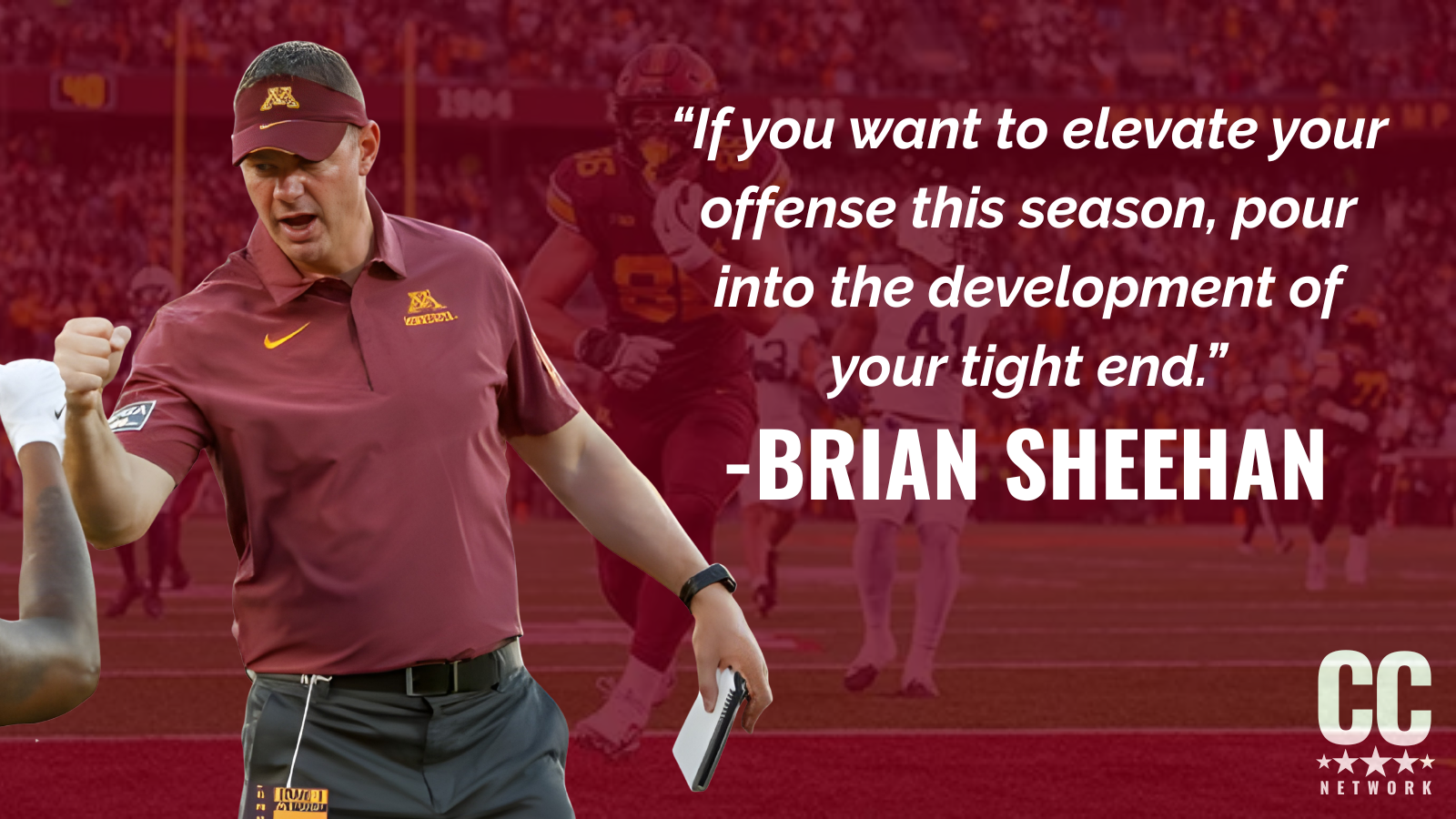
The Tight End as a Personnel Problem
Tight ends add a gap in the run game. They create matchups in coverage. They often force defenses to declare personnel.
Sheehan points to a common coaching belief: two of the most difficult matchups in football involve mismatches at running back or tight end. If the tight end can separate and finish, the offense controls the leverage battle.
Minnesota’s production at the position reflects that emphasis. Players such as Ben Utecht, Max Williams, and Brevin Spann-Ford developed into NFL contributors.
Sheehan defines the job in three parts:
- Win the play-side gap.
- Win route-side space.
- Win the contested catch.
His session centers on the second and third.
Clear Roles: Teach and Demand
Sheehan simplifies the coaching relationship.
The coach teaches and demands.
The player prepares and performs.Brian Sheehan TE in Pass Fundam…
The goal is to teach players what to do so they can play fast and aggressively.
Fast without understanding leads to wasted steps. Aggression without detail leads to missed windows. Preparation eliminates hesitation.
Eyes First
Sheehan builds pass fundamentals from the top down.
“As a player, if my eyes are right, my hands and my feet will follow.”
After each rep, tight ends answer three questions:
- Where did you look?
- What did you see?
- What does that mean?
Those questions create accountability. They also sharpen anticipation.
He describes a pre-snap process that starts with the situation, moves to coverage and alignment, identifies the front, and then isolates the primary challenge and secondary threats.
That sequence organizes the play before the ball is snapped.
Situation Dictates Intent
Every snap exists inside a situation.
Score, time remaining, down, distance, and field position define the purpose of the call. A concept like Y-Cross has different goals on first down in the middle of the field than on third down in the green zone.
Sheehan reinforces a standard inside the building: a smarter player is a better player. In practice, the reminder is constant. Play the situation, not just the play.
Understanding the objective changes how the route is run.
See Coverage Like the Quarterback
The tight end room must process coverage the same way the quarterback does.
Sheehan streamlines identification. Safeties are the deepest defenders. Corners are the widest. The alley player sits inside the corner. The next second-level defender fills the structure.
Eyes go to the safeties and alley first. How many safeties are there? What is the relationship between the safety and the alley? What is their depth and leverage on the number two receiver?
In three-by-one formations, the weak-side defender completes the triangle. Alignment and demeanor offer clues.
Anticipate coverage. Confirm it post-snap. Adjust within the route.
In zone, Sheehan gives a simple directive:
If you’re open in the zone, stay open in the zone.
That mindset prevents drifting into coverage and keeps throwing lanes intact.
Release Rules That Hold Up
Once identification is complete, the tight end must win at the line.
Sheehan teaches three release rules:
- Have a plan
- Hit the gas
- Work low to lower
The plan depends on leverage and desired direction.
“Gas” stands for grounded, attacking, and staggered. One powerful foot stays in the ground. Steps attack leverage or vertical space. Feet remain staggered to maintain force.
Working low to lower keeps energy loaded in the hips, knees, and ankles.
The Release Toolbox
Sheehan divides technique into uppers and lowers.
Uppers control contact.
Wipers, chop, and shed defeat jams and redirects. Hands target the wrist. He emphasizes attacking joints rather than muscles. The tool is used only when necessary and typically once during the release phase.
Lowers control space.
Half steps manipulate leverage. They are short and violent. The vertical express step drives the tight end downfield immediately after leverage is secured.
Young players often widen themselves out of their own route. Sheehan demands an immediate vertical push to preserve the line to the break point.
From that toolbox come three primary release plans: two halves, three halves, and press stretchBrian Sheehan TE in Pass Fundam…. Leverage determines the choice. Execution determines the separation.
See the Entire Clinic at LFGClinic.com
This segment lays the foundation. The full 2026 LFG Clinic session includes detailed game film cut-ups, additional NFL examples, and full teaching progressions that connect vision, leverage, and finish.
With the Premium Pass at LFGClinic.com, coaches receive:
- Full HD clinic presentations
- Complete game film breakdowns
- Year-round access to the clinic library
- Structured learning tracks for position coaches, coordinators, and head coaches
If you are building a tight end room that must produce on third down and in the green zone, access the complete session and study the film in detail at LFGClinic.com.
About Brian Sheehan
Brian Sheehan serves as Offensive Quality Control at the University of Minnesota. He works closely with the offensive staff in game planning, opponent breakdown, and tight end development.
Sheehan’s coaching background includes experience at multiple collegiate levels, where he has worked with tight ends and offensive skill positions. At Minnesota, he has helped develop a line of tight ends who have transitioned to the NFL and played key roles in the Big Ten.
His teaching blends film study, coverage identification, leverage-based releases, and detailed skill development. The emphasis remains consistent: disciplined eyes, precise technique, and production in critical situations.
Related:
The Give – NFL Style Choice Routes – Jack McDaniels, Sr. Analyst, Central Michigan
Joe Moorhead on Dropback Pass Game Structure at LFG Clinic