

Great offenses don’t start with trick plays or a massive playbook. They start with clarity. For Mark Carney, the head football coach at Kent State, clarity is the foundation. This idea has guided him from quarterbacks to coordinator to head coach, and now shapes how his teams create explosive plays without confusion.
While many offenses try to be complex, Carney’s teams play fast, stay in control, and attack without being reckless. He focuses on teaching, clear communication, and building quarterback confidence, giving coaches a plan for lasting offensive success.
Offensive Clarity as a Foundation for Explosive Play
Early in his career, Carney saw how confusion can hurt a quarterback’s performance. When he first learned complicated coverage ideas, he noticed something many coaches miss: players usually don’t lack skill; they lack clarity.
Looking back, Carney explained that being taught things he didn’t fully understand shaped how he coaches today:
“I think as coaches sometimes we assume that people know things… so that was an early lesson for me—no matter what, always start from scratch.” (06:12)
Because of this, clarity is the system in everything his offenses do. He builds attacks around clear rules, simple language, and repeatable principles. Rather than overwhelming players with volume, Carney teaches them how to interpret defensive structure and respond decisively and fast.
As a result, quarterbacks make quick decisions. Skill players know where to go and when to be there. This shared understanding helps the offense attack defenses better.
Why Motion Creates Quarterback Confidence
Motion and shifts are common in football, but Carney uses them with purpose. Instead of just looking flashy, movement helps the quarterback read the defense.
At Charlotte, Carney used this approach with a veteran quarterback who wanted information before the snap. Motion revealed how the defense talked, lined up, and followed its rules.
As Carney described:
“Shifts and motions help quarterbacks be certain about what they’re seeing.” (12:37)
He also stressed the need to adapt. Not every quarterback is ready for constant movement, so motion should fit the player, not just the playbook.
Carney starts with simple motions and gradually adds more. This way, motion helps players see things clearly instead of causing confusion.
Keeping the System Learnable and Likeable
“Keep it simple” is a common coaching rule, but Carney adds an extra element. A system has to be easy to learn and enjoyable if it’s going to work under pressure.
During the conversation, he referenced advice that stuck with him throughout his career:
“Keep it learnable and likeable.” (Mark Carney, 08:31)
Since players remember what they enjoy, Carney explains the reasons behind every concept. This way, quarterbacks don’t just memorize plays; they understand why they run them.
This teaching style also builds trust. When players see their coach taking time to help them, they buy into the system. Over time, that trust leads to faster execution and better decisions during games.
Building Explosive Offense Without Sacrificing Control
Statistically, Carney’s offenses stand out for combining explosive plays with strong time of possession. Although those traits rarely coexist, clarity is the system that allows both to thrive.
Instead of chasing big plays without a plan, Carney focuses on being efficient. Short, accurate throws help the running game. Spreading out the players also puts the ball in the hands of the best athletes.
Big plays come naturally from this approach. When defenses adjust too much, the offense takes advantage. In this way, efficiency leads to explosive plays.
As Carney put it, success comes from identifying where the ball should go most often:
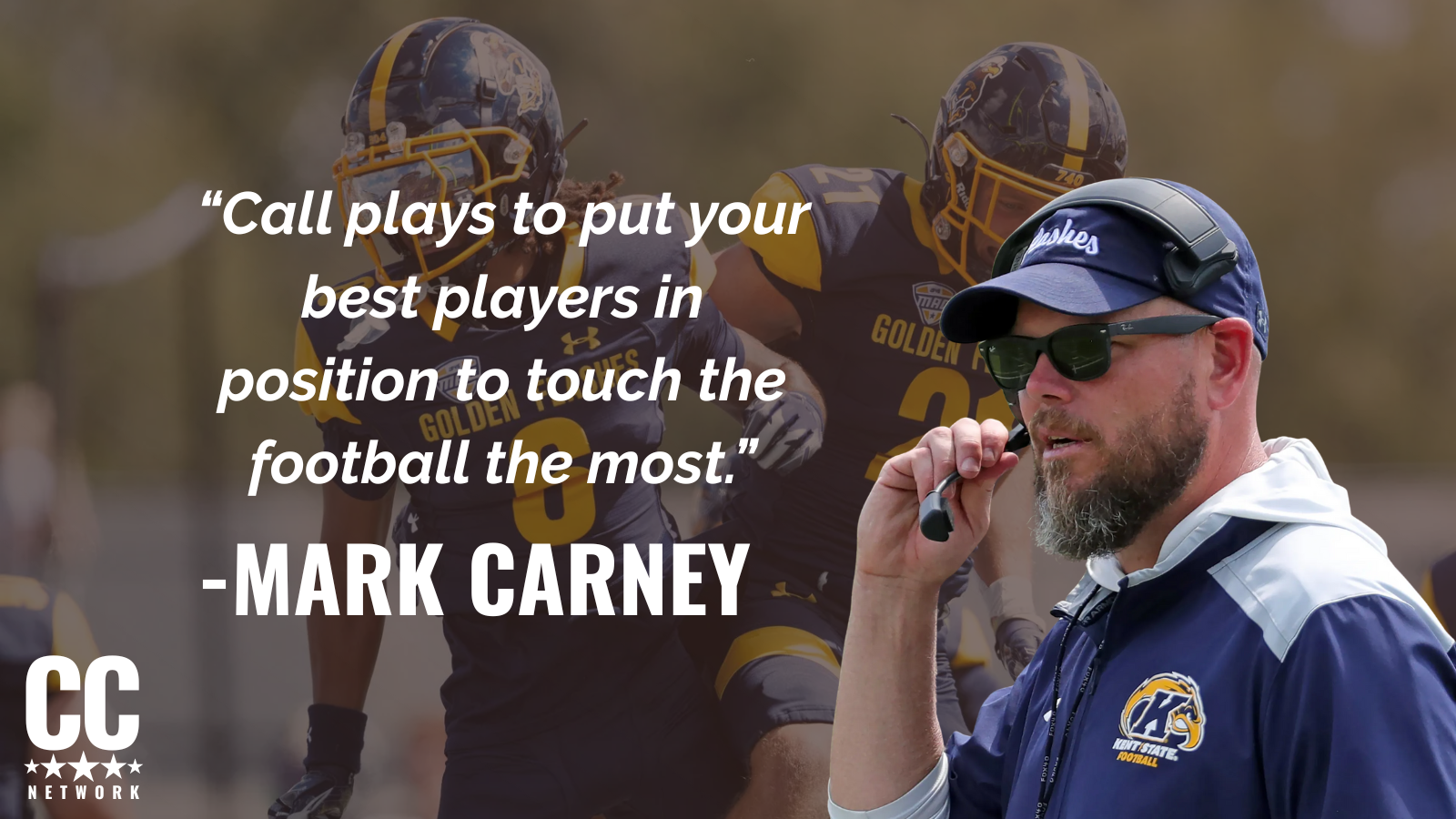
“Call plays to put your best players in position to touch the football the most.” (25:55)
Because clarity guides these choices, quarterbacks stay calm even when the offense goes deep.
Clarity Is the System at the Program Level
Now, as a head coach, Carney uses the same philosophy for the whole team. Instead of micromanaging the details, he looks at the program’s energy, engagement, and daily improvement.
When Carney took over at Kent State, helping the team heal was just as important as strategy. He set clear values and expectations, bringing everyone together.
Carney’s core values focus on steady, 1% improvement. This matches his offensive approach: small, clear steps add up to real progress.
For Carney, clarity isn’t just for game day. It’s part of the program every day.
Lessons for Coaches at Every Level
For coaches who want to build an explosive offense, Carney’s approach offers a clear lesson: clarity leads to speed. When players know the structure, purpose, and their roles, they play better.
Instead of following trends, Carney shows that clarity works at every level, from quarterback to program leadership. His system stays flexible, strong, and always focused on the players.
In the end, when clarity is part of the system, explosive plays come naturally.
Access the Coach & Coordinator AI – Clarity Creates Explosives Companion

What This Companion Does
- Grounds every response in the Mark Carney episode transcripts
- Helps football coaches evaluate clarity versus confusion in offensive teaching
- Organizes how shifts and motions are used to support quarterback decision making
- Connects offensive structure to leadership, communication, and program culture
- Supports self-evaluation of system simplicity and player readiness
What This Companion Does Not Do
- It does not design plays, schemes, or game plans
- It does not introduce concepts outside the episode
- It does not speculate or use outside football knowledge
- It does not evaluate film, opponents, or personnel
- It does not provide step-by-step installation plans
If a question goes beyond the episode, the companion will state that clearly.
How to Use This Companion
Use this companion to slow down and audit your offensive teaching. Ask questions that help you assess clarity, communication, and structure rather than searching for new concepts to install.
This tool is most effective:
- After listening to the episode
- During offseason planning or offensive self-scout
- When quarterbacks are hesitating or playing uncertain
- When aligning offensive philosophy with program leadership
Conversation Starters
- Where does confusion most often show up in my offense based on this episode?
- How do shifts and motions help quarterbacks be more certain before the snap?
- What does a learnable and likable offensive system look like in my program?
- How does teaching clarity show up in both offensive structure and culture?
Related:
Game Planning Tips: Utilizing Shifts and Motions to Benefit Your Offense
Breaking the Huddle to Breaking Records: Why Details and Tempo Trump the Spread Offense