

University of Missouri
Lauren’s First & Goal Foundation
A Sideline View of Analytics in Action
At the 2026 LFG Clinic, Rick Jones brings a perspective few coaches ever experience. He stands on the sideline in front of 70,000 fans with the analytics book in his hand, advising the head coach of the University of Missouri in real time. Before arriving in Columbia, Jones spent 31 years as a high school head coach in Arkansas and Oklahoma. He understands Friday nights, game flow, and how pressure feels when one decision changes everything.
When Missouri’s head coach asked him to take ownership of analytics in 2020, Jones did not approach it as a math project. He approached it as a competitive advantage. His message to coaches is clear. Use analytics to help you win football games. If you cannot apply it to practice plans, call sheets, and game management, it has no value.
This clinic session translates complex data into coaching decisions that matter on first down, third down, fourth down, and in the final minutes.
Early Down Efficiency Drives Winning
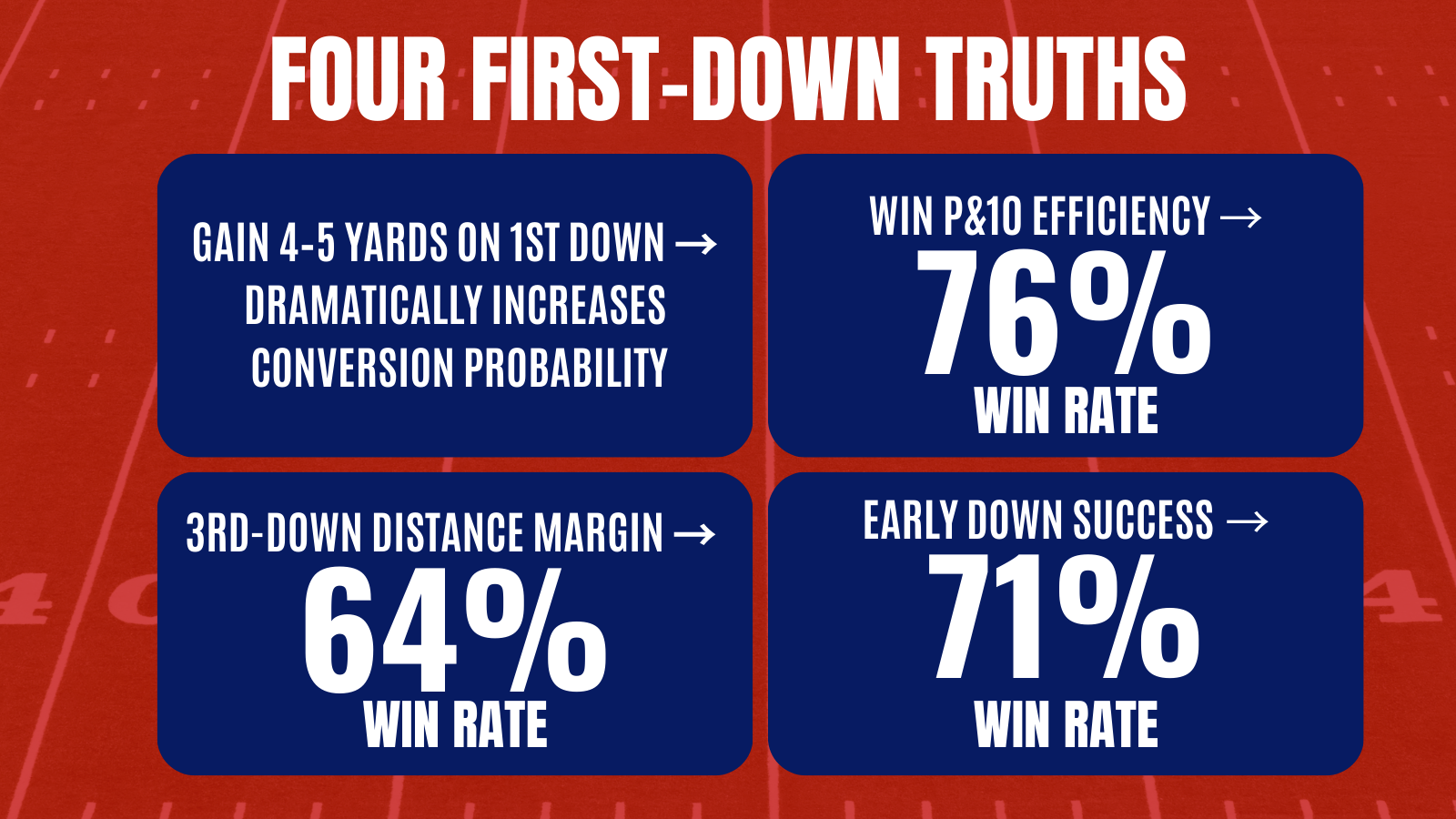
Jones challenges coaches to rethink how they evaluate third down. Most staffs obsess over third-down percentage. He asks a better question. How far are you from the sticks on third down?
Elite offenses reduce the average yards needed on third down. That outcome starts on first down. According to the analytics data Jones presents, gaining four to five yards on first down dramatically increases the likelihood of converting the series.
He emphasizes two connected ideas:
- Avoid third-and-long at all costs.
- Script and protect your best four-yard plays.
Jones explains how he built “openers” into his game plan. These were not gadget calls. They were the most reliable plays to secure efficient yardage on first down. If you gain four yards on first down, the math shifts in your favor. If you fail and face second-and-10, you invite predictability, pressure, and negative plays.
Practice design must reflect this reality. First-and-10 accounts for roughly 40 percent of snaps in a typical game. Coaches who overload third-and-long periods while neglecting first-down efficiency misallocate practice time.
Explosive Plays Change the Scoring Equation
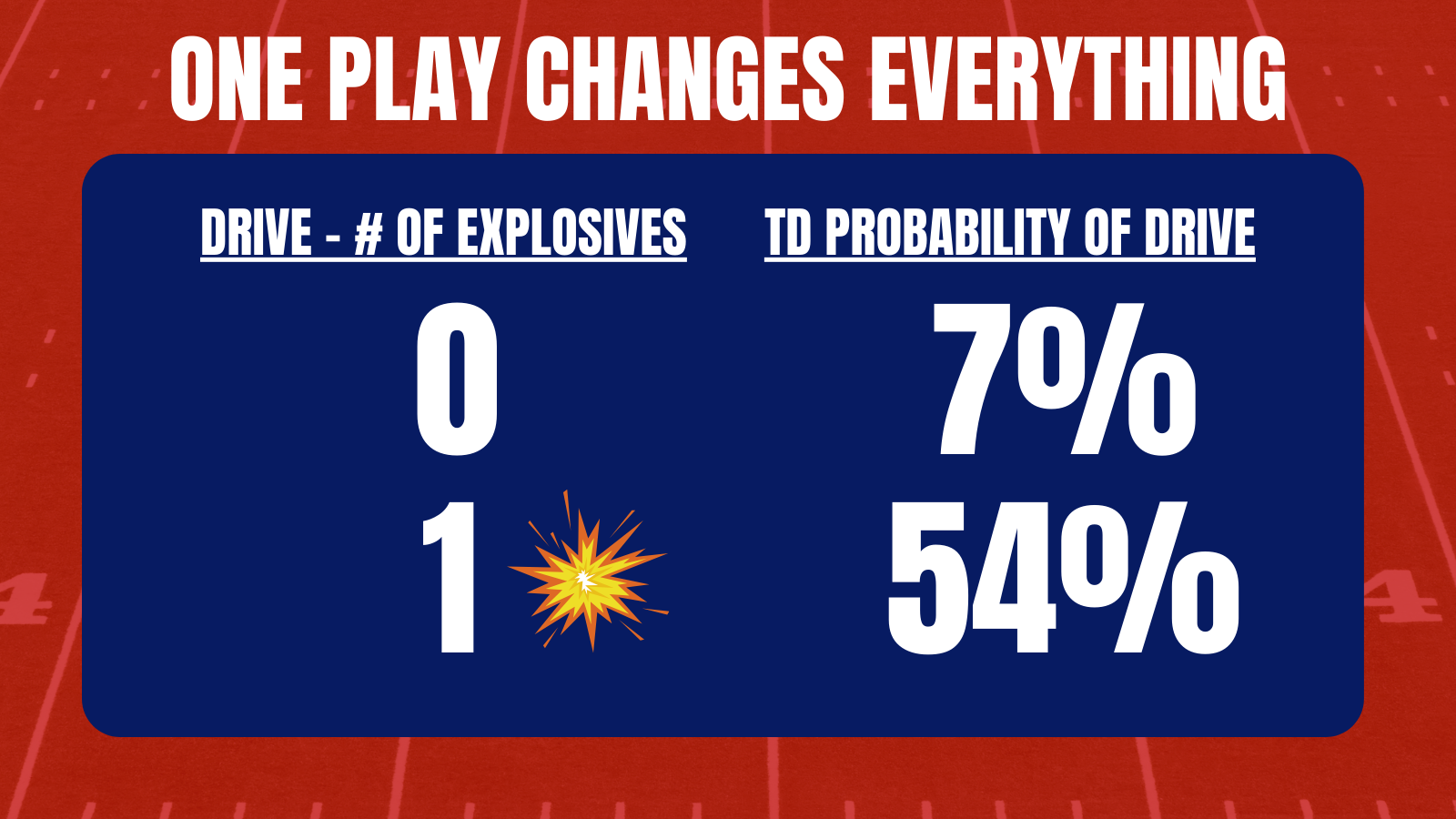
Jones presents one of the most powerful data points of the session. Drives without an explosive play result in touchdowns less than 10 percent of the time. Add one explosive play and touchdown probability jumps dramaticallyrickjones_analytics_lfg2026.
He defines an explosive play as a gain of 20 yards or more. The takeaway is not simply “call more deep shots.” The takeaway is structural:
- Create space for your best players.
- Block perimeter screens with urgency.
- Design shot plays off the advantageous down-and-distance.
Explosive passes occur roughly twice as often as explosive runsrickjones_analytics_lfg2026. That reality must shape play design. If your roster lacks elite speed, Jones encourages flawless execution and using advantages to generate explosive plays.
He also connects explosive opportunities to situational math. Draw a defense offsides on first down and convert first-and-10 into first-and-5. Your odds of converting the series skyrocket. That may be the moment to attack vertically.
Turnovers Are Situational, Not Accidental
Every program drills ball security. Every defense works on takeaway circuits. Jones does not dismiss those efforts. He reframes them.
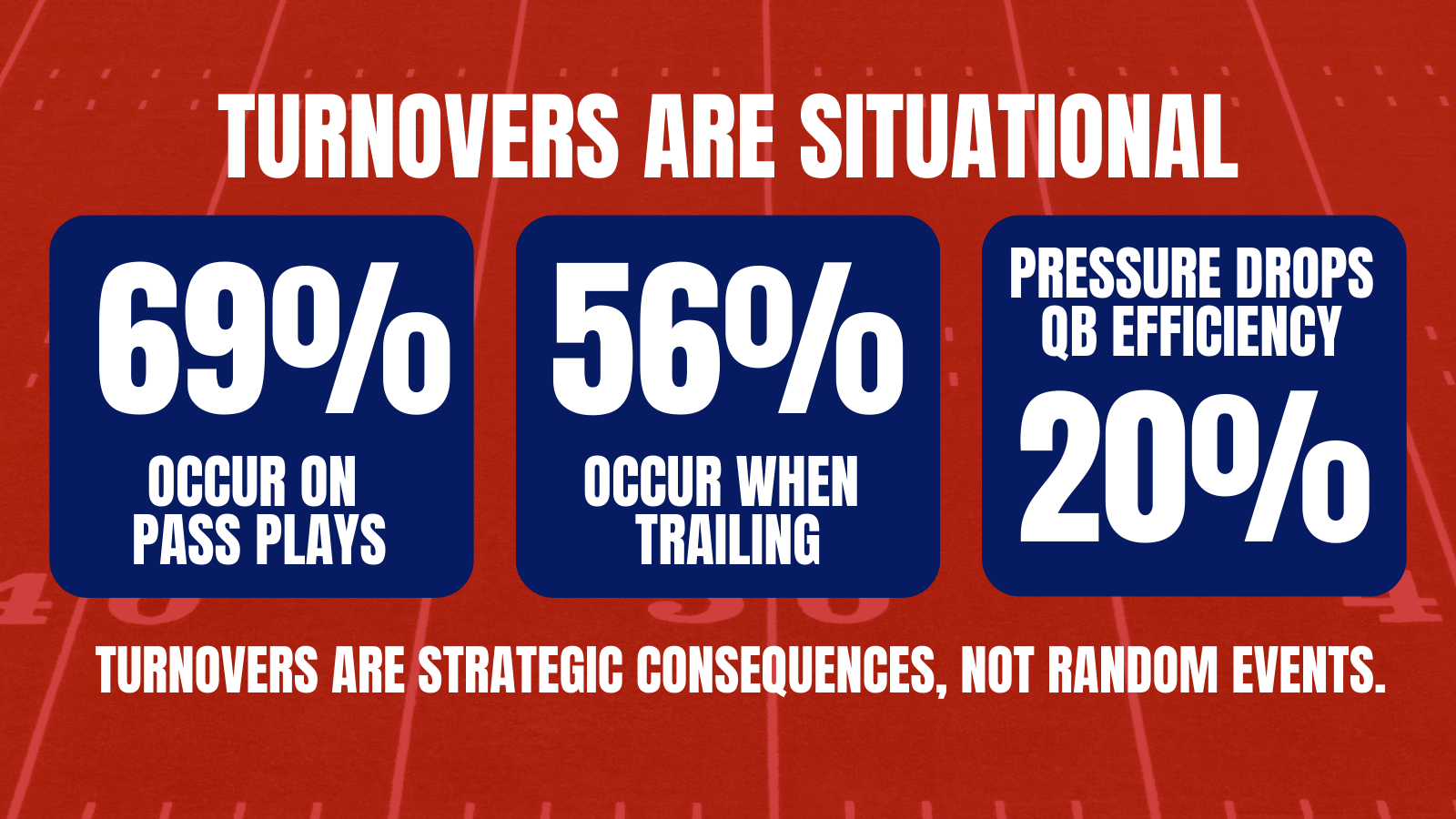
Most turnovers arise from situation and predictabilityrickjones_analytics_lfg2026.
Passing plays carry nearly triple the turnover risk of handoffs. Third down increases interception probability. Pressure drops quarterback efficiency by roughly 20 percent at the professional level.
Coaches must ask deeper questions:
- Are we predictable on second-and-long?
- Are we inviting pressure on third-and-obvious?
- Do we increase risk unnecessarily when trailing?
More than half of turnovers occur when teams are behind. That fact should influence tempo, call sequencing, and risk tolerance.
Jones additionally highlights the value of pressure and negative plays. Sacks and tackles for loss consistently correlate with winning teams. Analytics does not replace physicality. It clarifies where to apply it.
Fourth Down Strategy Requires Honest Self-Scouting
Few topics generate more debate than fourth down. Jones grounds the discussion in percentages.
Across Division I football, teams convert fourth-and-one roughly 70 percent of the time. The rate drops sharply on fourth-and-two. Analytics strongly favors aggression in the plus territory, especially in short-yardage situations.
He adds a critical qualifier. Your decision must reflect your own data. If your team converts fourth-and-one at 55 percent, the equation changes.
Jones openly reflects on his high school tenure. Operating exclusively from shotgun hurts short-yardage efficiency. In hindsight, he would install an under-center package dedicated to gaining inches. Analytics exposed a structural weakness, not just play-calling.
That is the purpose of the data. Identify the structural edges that tilt close games.
Middle Eight and Possession Value
The “middle eight” refers to the final four minutes of the second quarter and the opening four minutes of the third. Teams that win this segment win at a high rate.
Jones connects this concept to possession math. You cannot score without the ball.
Finishing the half with possession and receiving the second-half kickoff can create back-to-back scoring opportunities. Coaches must think past immediate points and consider total possession advantage.
He urges staffs to manage the clock with intent. Timeout usage, spike decisions, and end-of-half strategy require preparation during the week. Late-game chaos punishes unprepared teams.
Road Performance Magnifies the Details
One of the most striking segments of the presentation focuses on home-versus-road splits. Conference home teams win at a significant rate over the multi-year period.
On the road:
- Turnovers increase.
- Third-down efficiency declines.
- Points per possession dip.
Small margins compound away from home. Winning the turnover battle on the road dramatically increases the probability of victory. Losing it nearly eliminates margin for error.
Analytics does not blame crowd noise. It measures execution degradation. Coaches must prepare players for silent communication, composure, and ball security long before boarding the bus.
Applied Uses for Coach Education
Rick Jones does not present analytics as theory. He challenges coaches to:
- Audit the average yards needed on third down.
- Chart down-and-distance frequency across a full season.
- Track fourth-and-one efficiency honestly.
- Study turnover context, not just totals.
- Design practice to match actual game distribution.
He invites coaches to think critically about assumptions. Not every field goal is automatic. Not every two-point conversion succeeds. Overtime is not a coin flip in your favor.
Analytics reveals the margins where disciplined programs separate themselves.
Continue Your Learning at LFG
The 2026 LFG Clinic continues to serve coaches at every level through detailed, real-world teaching. Sessions like Rick Jones’ reflect the clinic’s commitment to practical development rather than conceptual theory.
Proceeds from LFG programming support the mission of the Lauren’s First & Goal Foundation, funding pediatric brain tumor research and services for families in need.
Coaches who want structured growth can access full clinic replays and curated learning tracks inside the LFG platform. Study the numbers. Refine your structure. Apply it on Friday and Saturday nights.
Winning still requires players and execution. Analytics sharpens the edge.
Get Your LFG Clinic Premium Pass – Access to Entire. Library 2021-Presents (600 Clinic Presentations and Growing)
Related:
The Analytics Behind Defensive Game Planning
Moving at the Speed of the Game: How In-Game Analytics Are Changing Friday Nights
From Dipping Your Toe to Sideline Confidence: How Coaches Can Win With Analytics
Analytics, AI, and In-Game Usage- Johnny Ulibarri, Asst HC/QB Coach, Union HS (OK)
The Coach and Coordinator Podcast- The Future of Football: How In-Game Analytics are Transforming Coaching- Vince Sciano, Waukesha North HS (WI)
Coach’s Guide to Getting Started with In-Game Analytics—One Data Point at a Time