

It’s February in the weight room. Your athletes come in before school, and you’re facing the same question every football coach has: How do you build a program that leads to real development, not just more weight on the bar?
This question is central to the 111% standard, the philosophy strength coach Justin Loudon uses at Ezell Harding Christian School in Tennessee. Loudon’s system focuses on daily improvement, physical literacy, and building athlete confidence.
As a result, his program develops athletes over six years from seventh grade through senior year, while preparing them for long-term success in sport.
Building an Athlete Development System That Lasts Six Years
Many high school programs focus mainly on short-term results. Loudon takes a different approach.
At Ezell Harding, he organizes athletes into a structured system that moves through four levels:
- Block Zero – Seventh-grade beginners learning movement fundamentals.
- Block Zero Intensified – Eighth-grade progression and skill refinement.
- Block One – High school athletes focusing on hypertrophy and strength.
- Block Two – Elite juniors and seniors preparing for college athletics.
Because Loudon works with athletes from 7th through 12th grade, he builds a program that focuses on steady improvement instead of rushing development.
At first, athletes work on moving well. As they grow, they gradually build strength and power.
“Our goal is to get them to move well really early… and then as we progress, we can add some more layers to it.” (03:07)
The 111% Standard: A Daily Improvement Mindset
The core of Loudon’s program is a simple idea: the 111% standard.
Athletes often hear coaches ask for 100% effort or the usual ‘give 110%’. Loudon encourages his athletes to take take it a step further.
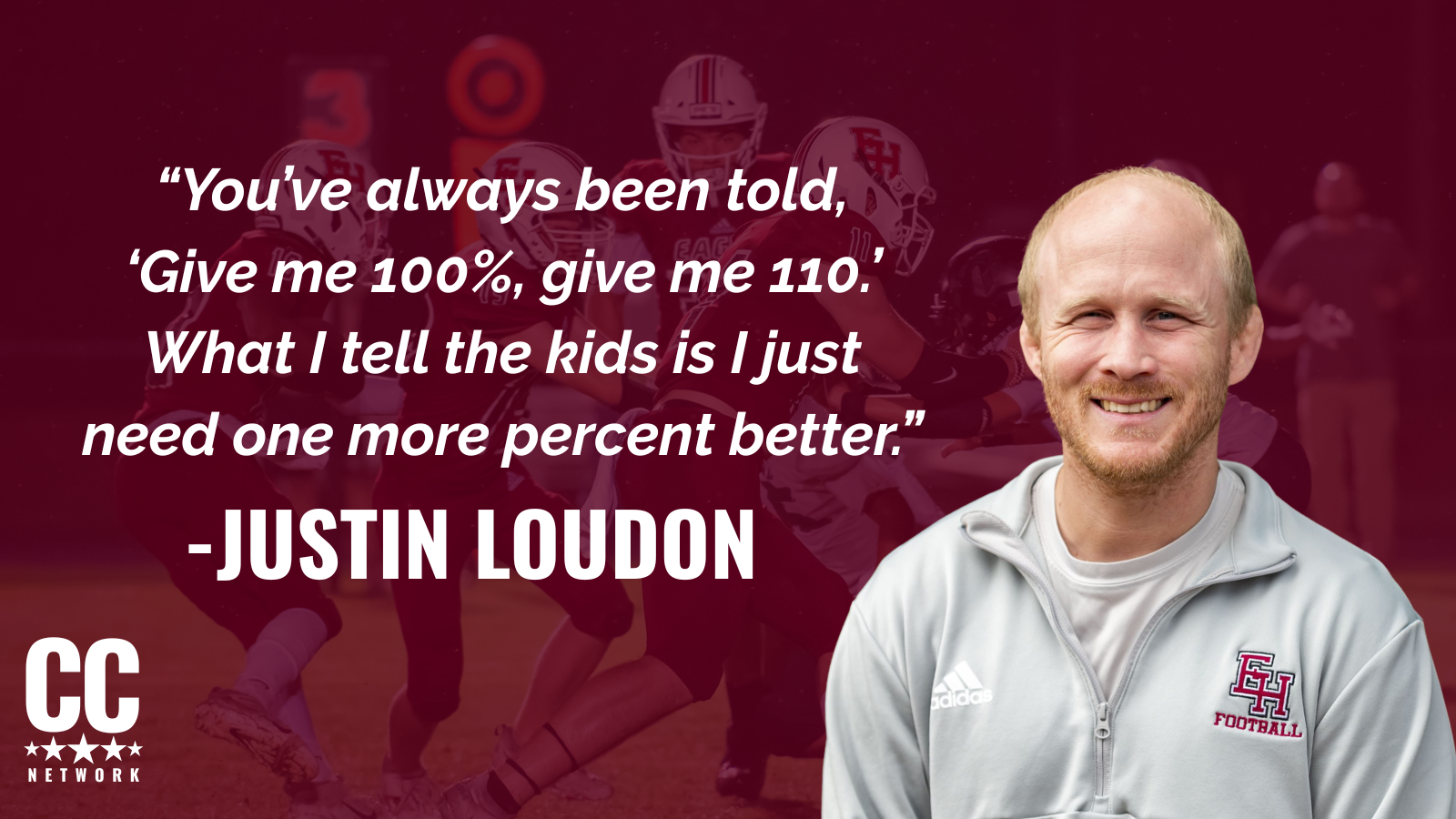
“You’ve always been told, ‘Give me 100%, give me 110.’ What I tell the kids is I just need one more percent better.” (04:21)
This philosophy encourages athletes to focus on improving each day rather than aiming for perfection.
Every training session is a chance to move a little better, lift a bit more, or use better technique.
Consequently, the 111% standard creates three powerful outcomes:
- Consistent effort
- Long-term development
- Personal accountability
For football coaches with large teams, this mindset shifts the focus from comparing athletes to helping each athlete grow and develop within the program.
Teaching Physical Literacy in the Weight Room
But Loudon believes great programs need more than just training plans. Athletes should understand why they train.
So, he includes physical literacy as a key part of his strength program.
Athletes learn concepts such as:
- Muscle groups and movement patterns
- Training terminology
- Recovery principles
- Energy systems
- Velocity-based training
Older athletes also do projects to reinforce these ideas. For example, Block One athletes learn about velocity-based training, and Block Two athletes study bar paths during Olympic lifts.
Loudon believes that education helps athletes long after their playing days are over.
“It’s great to understand how to lift, but if you don’t know why you’re lifting… then I feel like I’ve failed you as a strength coach.” (04:55)
Because of that focus, athletes leave the program capable of training with purpose throughout their lives.
Why Athlete Confidence Matters More Than Weight Room PRs
Strength numbers often get the most attention in football programs. Still, Loudon puts confidence first.
He evaluates program success through indicators such as:
- Reduced injuries
- Improved athletic performance
- Increased training attendance
- Athlete self-confidence
When athletes feel stronger and ready, they bring that confidence onto the field.
This confidence naturally leads to better sports performance.
“If I get them more confident in themselves, then they play better.” (11:14)
For football coaches, that perspective reinforces an important truth. Strength programs should ultimately improve performance, not simply produce impressive numbers in the weight-room.
Balancing Data and Coaching Instinct
Today, modern strength programs often rely on data. Loudon embraces performance tracking but takes a different approach to using the metrics.
Loudon uses data to identify trends in athlete development.
If an athlete’s performance drops consistently, he evaluates potential causes such as:
- Increased game workload.
- Recovery issues.
- Stress outside the program.
However, he still prioritizes coaching intuition when interpreting those trends.
“Are you more worried about the KPIs or are you more worried about the performance?” (21:52)
That question reflects a key challenge for football programs today. Data is valuable, but it is still only as effective as the coach using it.
The Simple Truth About High School Strength Programs
After more than a decade in strength coaching, Loudon has learned that successful programs master the fundamentals.
Athletes must first:
- Learn to move correctly.
- Develop strength the right way.
- Build speed and power gradually.
Coaches should only add complexity after these basics are in place.
So, Loudon tells young coaches not to rush into advanced training methods too soon.
Middle school and underclass high school athletes don’t need complicated systems. They need consistent fundamentals applied over time.
Why the 111% Standard Works for Football Programs
Football programs succeed when athletes develop gradually, stay healthy, and trust the process.
The 111% standard creates that environment.
The 111% standard focuses on daily improvement, helps athletes understand their training, and most importantly, builds confidence that shows up in games.
Over time, those elements create stronger athletes and more resilient teams.
For football coaches looking for lasting development, the lesson is simple:
Build athletes one percent at a time.
Track and improve your athlete’s progress with Tully!
Schedule a meeting to learn more about Tully today!

Related:
Teach Tapes with Steve Hauser (Week 2): Take Care of Technique
Creating Roles For More Players – Justin Hamilton, Defensive Coordinator, Virginia Tech