

In American football, success often gets measured in reps, plates, and pounds. Most programs spend the offseason chasing max numbers and filling out charts in modern weight rooms. But one small-town program in Idaho took a different route—and kept winning.
At Carey High School, Coach Lane Kirkland built a championship machine without ever relying on a formal weight room. He leaned on grit, rural work ethic, and creative thinking. Under his leadership, the Panthers won seven state titles, proving that raw effort and smart coaching can still outmatch fancy equipment.
Building Strength Without Steel
Kirkland stepped into the role after his father’s 19-year run as head coach. He inherited tradition—but no strength facility to speak of.
“We really never had a weight room in the 80s and 90s that was worth anything talking about,” Kirkland recalled (2:26).
He didn’t dwell on what the program lacked. Instead, he turned to what his players already had: hard-earned strength from working the land. Most of his athletes spent their summers hauling pipe, moving hay bales, and grinding through long days on local farms.
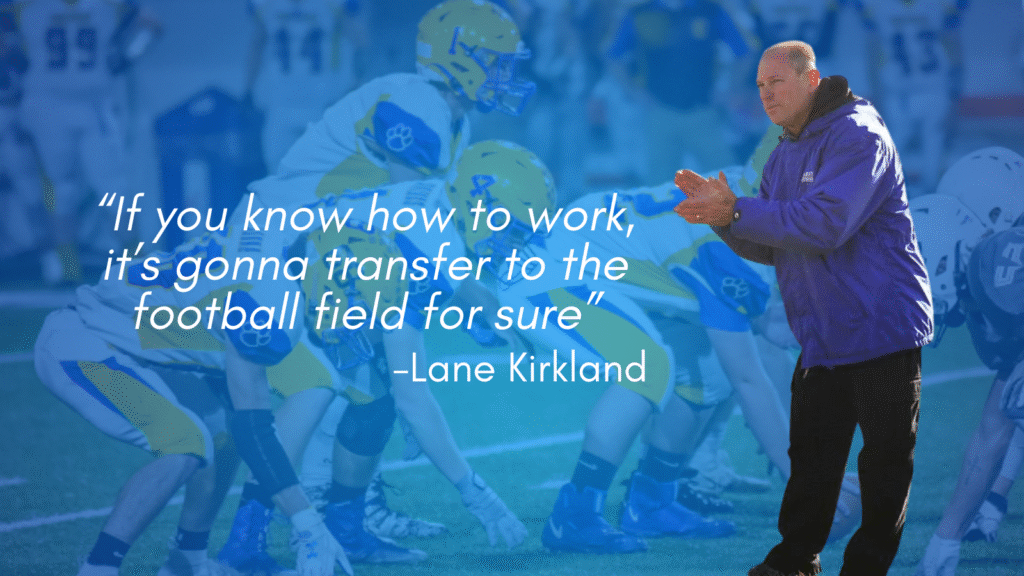
“If you know how to work, it’s gonna transfer to the football field for sure” Kirkland emphasized (2:50).
That work became their training. No squat racks, no platforms—just real labor that built real toughness. Kirkland didn’t reinvent the wheel. He just recognized that football shape doesn’t always require gym memberships.
Innovation in the Snow: The Sandbag Revolution
Even with a system that worked, Kirkland kept searching for ways to push his team further. In 2017, a snowstorm and flood offered an unexpected spark.
As he watched locals stack sandbags to control flooding, an idea hit him. Why not use sandbags for training?
He put together a simple but brutal program using 35- to 40-pound bags. Players carried them on alternating shoulders, sprinted laps, hammered overhead burpees, and partnered up for resistance drills.
“We got kids jacked. We got kids aggressive. Their grip strength increased by holding onto that thing” said Kirkland (7:14).
The Panthers responded with two straight undefeated seasons in 2017 and 2018, then returned to the title game in 2019. Just as impressive, injuries stayed almost nonexistent.
“We did not have a single knee or ankle injury for 2017, 2018, and 2019,” Kirkland proudly noted (6:27).
In a sport where lower-body injuries are common, that kind of durability stands out—especially for a team training with zero formal equipment.
Culture Over Equipment
The sandbags turned into more than just weights. They became part of the team’s identity. Every player named their bag and kept it throughout the season. Before the championship, they’d scatter the bag’s “ashes” on the game field—marking the end of the journey.
These small rituals built deeper buy-in. Players didn’t just train—they believed in the work.
Even after Kirkland stepped down, his culture kept rolling. A former player took over the program and led Carey to another state championship in 2024. The weight room still isn’t the focus. It doesn’t need to be.
Farm work. Sandbags. Sweat. That’s been enough.
Kirkland’s legacy proves a simple truth that too many overlook: effort matters more than equipment. And when your players believe in that, you don’t just build strong teams—you build lasting programs.
Related:
How Mark Carey Empowers Players to Think, Adapt, and Dominate
Mid-Season Workload: Understand Player Needs