

“Coaching is caught, not just taught.” That’s not just a phrase—it’s a reality many veteran coaches live by. One Missouri staff member drove that point home during a recent Coach and Coordinator podcast. While breaking down film and drawing up schemes matter, the biggest growth for many coaches doesn’t come in a dark office. It comes from standing on the sidelines next to greatness.
His story is a reminder that if you really want to elevate your craft, don’t just study the game—go study the people coaching it.
Learning Happens on the Sidelines, Not Just in the Film Room
When he started coaching in Oklahoma City, he made one decision early on: he wasn’t going to wait for knowledge to come to him. Living just 20 minutes from the University of Oklahoma, he took full advantage.
“I could hop in my car. Be there in 20 minutes. I’d walk out with my little pad… I would go probably at least five, ten times a year, just watch it. Watch the best coaches in America.” (38:44)
He didn’t sit back in the stands and half-watch. He locked in. While others stayed home or watched tape, he studied how Barry Switzer, Gary Gibbs, and Merv Johnson ran their practices—up close, in real time.
At times, he was the only outsider on the field. That always shocked him. Why weren’t more coaches showing up? It didn’t cost anything but time—and the return was massive.
Watching how elite staffs moved through drills, corrected players, and ran meetings gave him a real blueprint. He didn’t just learn plays. He learned how to coach.
The Best Coaching Lessons Happen in the Lobby
Coaching clinics are packed with sessions and speakers, but he found that the real value came from what happened in between.
“If I wasn’t going to a speech, I went to the lobby and tried to sit as close as I could to great coaches and just listen.” (39:19)
That’s where the real stuff came out. The unfiltered conversations. The off-script gold. While others waited for a microphone, he sat nearby and soaked up everything—details about practice structure, discipline, culture, and game management.
It wasn’t flashy, but it worked. The clinic lobby became his classroom. He asked questions when the timing was right, and more often just listened. Over time, those small moments added up to a deeper understanding of how to run a program.
From Film Study to Field Study: Why You Must Go Watch Coaches
You can break down all the film you want, but if you’ve never seen high-level coaching in action, you’re missing part of the picture. For him, those sideline experiences changed how he ran practices, built staff roles, and called games.
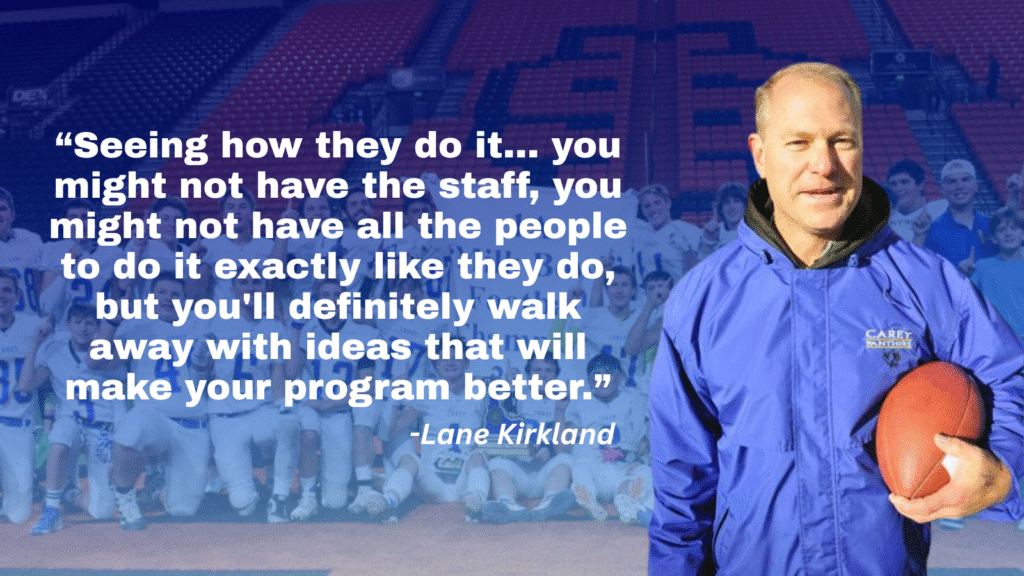
“Seeing how they do it… you might not have the staff, you might not have all the people to do it exactly like they do, but you’ll definitely walk away with ideas that will make your program better.” (37:56)
He didn’t copy everything. He couldn’t. But he adapted what worked. Whether it was how to split practice groups, set up walkthroughs, or keep a quarterback engaged between reps, watching elite staffs gave him ideas he would’ve never pulled from film alone.
Plenty of college programs—especially in spring—open their doors to high school and small-college coaches. The ones who show up consistently walk away sharper.
Conclusion: Coaching Wisdom Is Everywhere—If You Go Look for It
Film study matters. So do clinics. But nothing replaces the perspective you gain from standing behind a coaching staff and watching them work. That Missouri coach’s story drives the point home: some of the best coaching knowledge doesn’t come from a screen or a podium—it comes from being present.
“Watch the best coaches in America.”
That advice still holds. So next time you reach for the remote to watch film for the fourth time, think about getting in the car instead. Go visit a nearby practice. Strike up a conversation at a clinic. Be where the coaches are.
Because if you want to coach at a higher level, don’t just watch the game. Go watch the people who teach it.
Related:
Building Your Coaching Network: How to Connect, Learn, and Grow in the Profession
Insight into the Preparations and Teachings of a Top Defensive Passing Game Coordinator
Adding Multiplicity and Flexibility with the Counter Play
More Coach Kirkland content
Lane Kirkland- Winning Without a Weightroom: Building Champions Through Farm Strength and Sandbags