

High school football coaches know this truth: what happens at the banquet echoes long after the final whistle. For many players, the end-of-season awards represent more than just hardware—they define what the program values most. And in the words of Coach Joel Nellis of Brookfield Central High School, “What you reward gets repeated” (04:40).
As coaches, we spend months drilling fundamentals, refining schemes, and building team chemistry. But when it comes to recognition, are we reinforcing what truly matters? Are we celebrating stat sheets—or character?
Coach Nellis decided to rethink his team’s approach to awards. The result? A culture that honors sacrifice, commitment, and leadership—not just touchdowns.
Why Awards Should Reflect Culture, Not Just Performance
For years, traditional awards like “Most Valuable Player” or “Top Offensive Player” dominated football banquets. But those accolades often leave out the role players, scout team standouts, and behind-the-scenes grinders who fuel a team’s identity.
Coach Nellis flipped the script by aligning his awards with the five core values of his program: discipline, relentlessness, trust, sacrifice, and unity. At season’s end, players don’t just hear who scored the most—they learn who best embodied the culture.
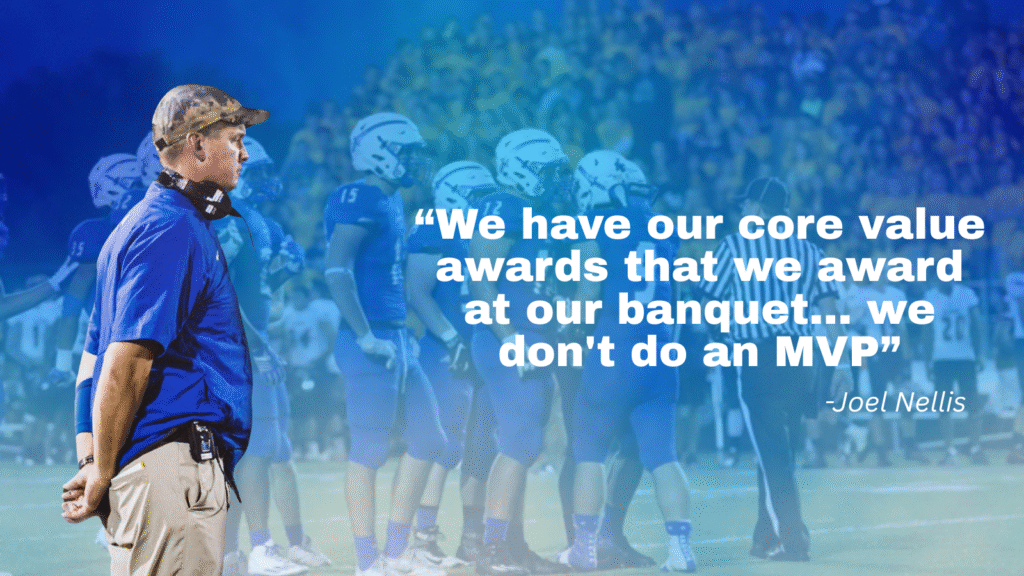
That shift makes a lasting impression. In his words, “We have our core value awards that we award at our banquet… we don’t do an MVP” (04:40). Each player walks away knowing that effort, attitude, and unselfishness matter just as much as athletic performance.
Recognize Sacrifice to Reinforce Team-First Behavior
Take the story of Evan Lyakopoulos, a senior who didn’t start but became the heartbeat of the scout team. When given the chance to intern at the Medical College of Wisconsin, Evan still came back to practice fully dressed—even if only for 15 minutes.
After losing his dog one afternoon, he showed up to practice that same day. “I was more than willing to give him the day off,” Nellis recalls, “but he said that it was gonna feel better for him to be there” (02:20).
Evan earned the Sacrifice Award at the banquet. More importantly, his actions became the gold standard for what the program values. That kind of recognition tells every player that there’s honor in doing the hard, thankless work—and that everyone has a role to play.
Create Visible, Lasting Reminders of Your Culture
Recognition doesn’t stop at the banquet. Coach Nellis plans to “put together a board that lives in our locker room that shows those core value winners year after year” (04:40). That physical presence keeps the message alive: character counts every day, not just on game day.
Visible reminders serve two purposes. First, they motivate current players to embody the values they see celebrated. Second, they build legacy—tying generations of athletes to a shared standard of excellence.
Consistent storytelling around awards—through meetings, messages, and signage—cements those values even deeper. As Coach Nellis wisely says, “Don’t be afraid to repeat yourself.”
Final Whistle: Awards Are Culture in Action
When coaches align recognition with values, they don’t just hand out plaques—they build a foundation. What you reward gets repeated. So, reward the effort that leads to long-term success. Celebrate the unsung players. Make culture the MVP.
The Joe Moore Award Process for Determining the Best OL – Lance Zierlein, NFL Analyst
Clinic Series: QB Coverage Recognition – Kirk Campbell, QB Coach, Michigan