

Most coaches spend hours breaking down opponents—but overlook the one team they should study most: their own.
Continuous self-scouting doesn’t just clean up tendencies—it sharpens your teaching, clarifies your identity, and helps you make smarter decisions week to week. For Hayden Thomas, the offseason wasn’t about reinventing the offense. It was about dissecting what they already did, and doing it better.
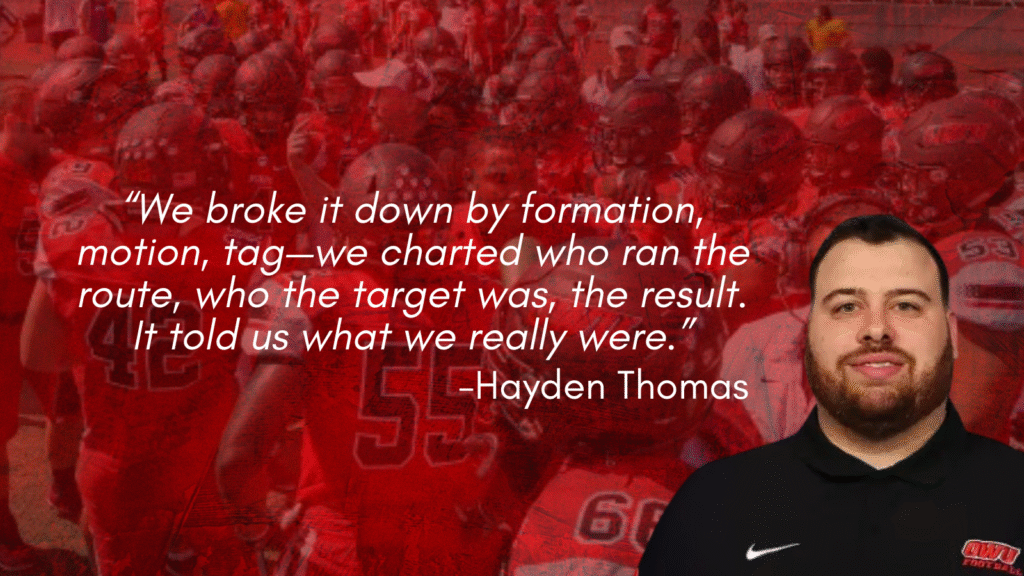
“We broke it down by formation, motion, tag—we charted who ran the route, who the target was, the result. It told us what we really were.” — Hayden Thomas (39:01)
This detailed self-study provided more than stats. It gave Thomas a lens to evaluate structure, tendencies, and staff communication. In this article, we explore how continuous self-scouting empowers coaches to refine their system and coach with greater clarity.
Look Inward First: Offensive System Evaluation
Instead of chasing the next trend, Thomas turned the microscope inward. He examined not just plays, but how they functioned within the offensive system. Was the concept being called from multiple looks? Did the tag add value—or just add teaching?
“A big thing for us was: Do we need that tag? Does it really do anything we can’t already do?” — Hayden Thomas (37:55)
This forced the staff to trim the fat. If a play or tag didn’t increase efficiency, they cut it. That process made their offense leaner, faster, and more teachable.
Cutups and Tags: Tools for Real-Time Adjustments
Effective continuous self-scouting relies on detailed film work. Thomas’s staff tagged everything—from motion to personnel to route runner. This gave them the data to answer questions like, “Who’s our best isolation guy?” or “How effective is this play in the red zone?”
More importantly, those insights helped inform real-time coaching decisions during the season.
“I was able to make decisions in-game because I’d already seen it tagged and re-watched it a dozen times.” — Hayden Thomas (41:30)
By investing in their own data, the staff stayed one step ahead of the opponent—and of their own blind spots.
From Scouting to Coaching: Sharpen Your Voice
Continuous self-scouting isn’t just for game planning. It’s a tool to elevate how coaches teach. After reviewing cutups, Thomas refined the way his staff explained concepts, cleaned up install language, and gave players clearer answers.
This disciplined process helped create consistency across the board—whether it was QB footwork, WR splits, or how the OC described a boundary tag.
Conclusion: The Most Valuable Film is Your Own
Studying your opponent might help you win this week. But studying yourself will help you win for seasons to come.
Continuous self-scouting gave Hayden Thomas and his staff the ability to make sharper calls, teach with more precision, and evolve their system with intention. If you’re not turning your own film into your greatest tool, you’re missing your best source of growth.
Related:
The Mushroom Society with Bob Wylie: A Healthy Player-Coach Partnership, Featuring Joe Thomas