

It’s third-and-6 in the fourth quarter. The defense knows your favorite concept is coming. Your sideline knows it. The crowd knows it.
Now what?
The Switchblade Offense provides a solution. Rather than adding new plays every offseason, the Switchblade concept builds depth within core concepts and puts pressure on defenses without overwhelming players. It gives coordinators a compact system that adapts each week without becoming a random collection of plays.
As Caleb Corrill explains, the goal isn’t expansion. It’s evolution.
“It’s evolution within what you understand and what you believe.” (04:25)
A Versatile Offensive System, Not a Bigger Playbook
Many coordinators think growth means adding more plays. The Switchblade Offense takes a different approach. Instead of piling on new installs, it focuses on mastering the basics.
Corrill uses a powerful metaphor to explain the philosophy:
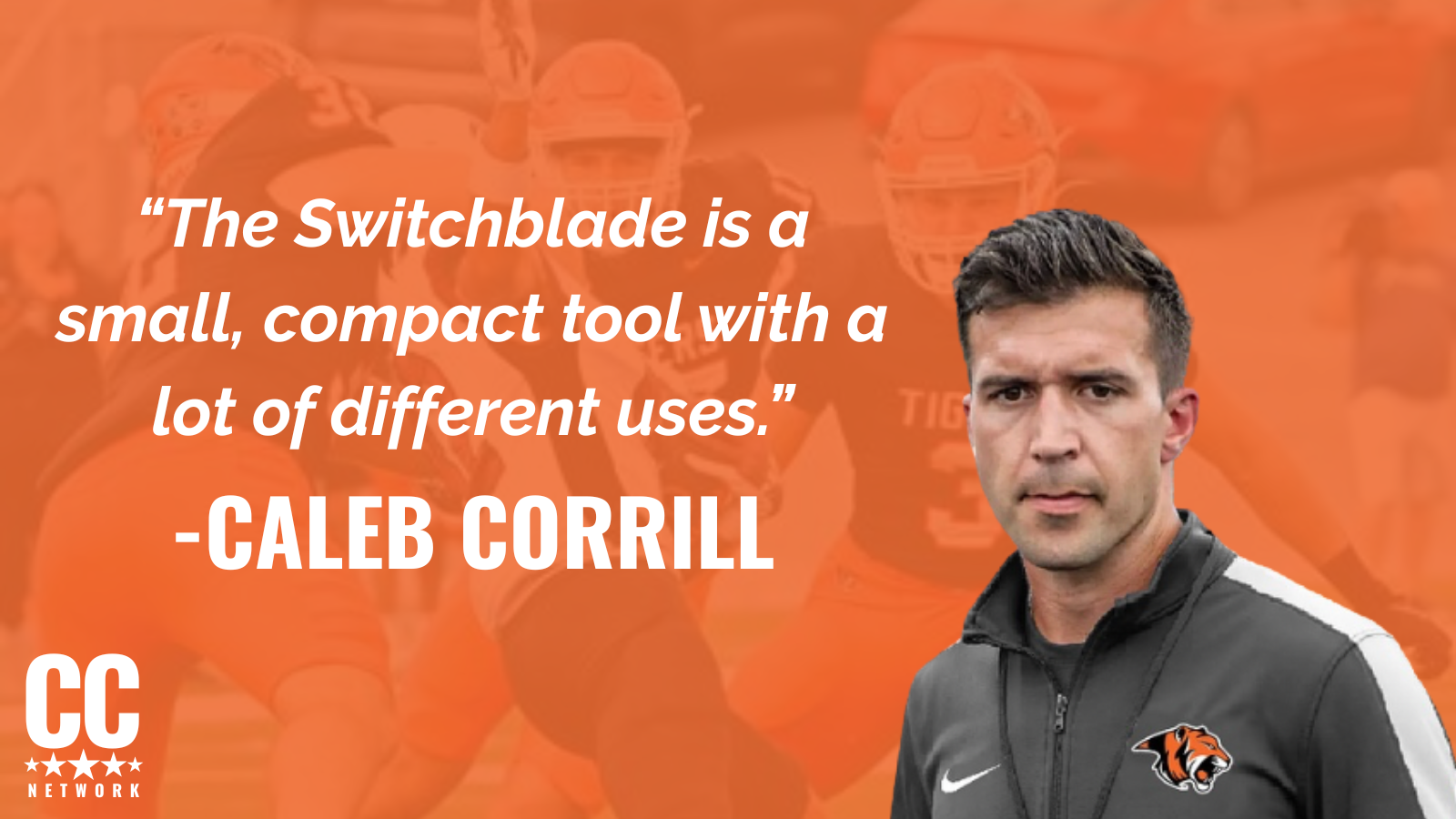
“The Switchblade is a small, compact tool with a lot of different uses.” (17:15)
For example, consider Smash. Most coaches treat it as just one page in the playbook. The Switchblade approach, however, builds several chapters within that page. You can adjust launch points, motions, formations, and route stems. You can add vertical stress, horizontal stretch, or backfield action.
As a result, the defense prepares for Smash, but rarely sees it presented the same way twice.
Instead of asking, What new play should we add? The better question becomes:
How many ways can we stress this concept?
Layering Stress Within Core Concepts
Defensive coordinators like structure and repetition. If you show them the same look over and over, they will figure it out. The Switchblade Offense combats this by applying layers of stress to a single idea.
Corrill describes the shift clearly:
“Everybody’s got the same plays.” (21:32)
That statement changes everything. If everyone runs similar concepts, what sets you apart is how you present, sequence, and adjust, not invent new plays.
The Switchblade philosophy focuses on:
- Formational stress
- Motion and shifts
- Launch point variation
- Personnel flexibility
- Constraints that protect the base concept
This layered approach turns a single concept into a multidimensional problem. It also helps you stay disciplined in your installs while giving you more strategic versatility on game day.
Teaching Players to Understand the Switchblade
Versatility only works when players truly understand the system. That’s why the Switchblade Offense focuses on teaching concepts in more depth.
Corrill reinforces that reality:
“The film is your resume.” (13:52)
That quote sets the standard. Drawing plays on a whiteboard doesn’t win games. Executing them on film does.
Because of that, coaches must:
- Simplify language
- Emphasize repeatable fundamentals
- Invest time where the system is built: the core ideas
When players understand why a concept works and what challenges it presents, they adjust more quickly during games and play with more confidence.
Less “Stuff”, More System
Every coordinator has seen it happen: the playbook slowly becomes a collection of random ideas. The result is your team losing its identity.
The Switchblade Offense acts as an operating system. It defines:
- What you believe
- What problems do you solve best?
- How do you evolve within those beliefs?
Rather than expanding horizontally, you grow vertically. You build depth instead of width. You refine what you have instead of replacing it.
As a result, your offense is ready for the future. Even when defenses change, your core ideas stay the same; the way you attack the defense evolves.
Built for Modern Football
Coaches are flooded with content every day. Without applying it, it’s just noise.
The Switchblade Offense filters that noise. It asks:
- Does this strengthen a core concept?
- Does this add meaningful stress?
- Does this fit our teaching model?
If the answer is no, you discard it.
If the answer is yes, you refine it inside your system.
Why the Switchblade Offense Wins
When the defense overloads your base look, you counter within the same family. If coverage rotates late, your quarterback understands leverage rules and reacts accordingly. Even when personnel changes midseason, your structure can adjust without a complete revamp.
That adaptability is what sets the Switchblade Offense apart. The system stays compact but can be used in many ways. It is simple but has layers.
Most importantly, it shows up on film.
At the end of the season, no one judges your creativity. They judge your results and what your game film shows.
Related:
Alex Gray, The Top 22 Strategy: Depth and Flexibility- Defensive Coordinator, John Carroll
Accelerate Everything – JT O’Sullivan, Former NFL QB, Creator of The QB School