
Football is full of coaches who can talk ball.
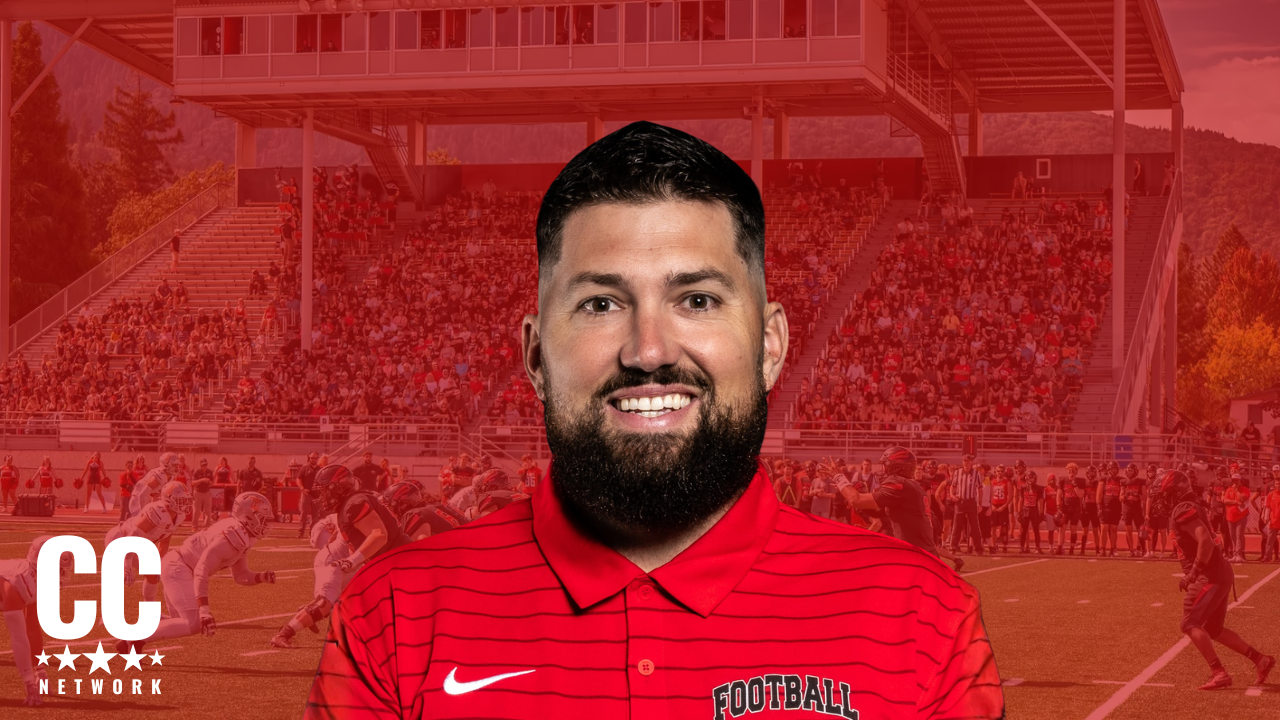
Tim Souza leaves a different impression. His football starts with teaching. It moves through structure. It ends with players who can make sense of what they see and respond within the framework they have been given. That identity shows up again and again in the way he talks about the game, the way he studies it, and the way he develops around the people in the room.
A Background That Shaped the Way He Coaches
Souza did not come through one narrow track. He played at Humboldt State, worked in strength and conditioning, taught physical education, coached high school football for more than a decade, worked with USA Football, coordinated the offense at Luther College, and now coaches at Southern Oregon. That range shows in his approach. He has taught different age groups, coached in different environments, and learned to carry ideas across roles rather than treating each stop as a separate world.
That is why his line, “Everything’s training for something,” feels like more than a nice phrase. It reads like a summary of his development. The volunteer work, the classroom years, the weight room, the coordinator role, the college transition, all of it shaped the coach he is now.
Teaching Sits at the Center
The strongest theme in Souza’s work is not a scheme. It is teaching.
Souza talks about learning with a teacher’s mindset, then studies to transfer knowledge rather than collect it. He thinks about progression, sequencing, and how players actually absorb information. His desire is for concepts to travel from install to practice to game day without getting lost in translation. That point comes through plainly when he says, “Coaching is the highest form of teaching.”
There is a reason coaches connect with that. A lot of football language gets trapped on the board. Souza keeps pulling it back to the player. Can they process it? Can they recognize it? Will they use it when the picture changes? His answer is not to simplify football into something empty. He builds a framework that helps athletes handle more because they understand more.
Curiosity Is Part of His Edge
Souza does not talk like someone protecting a fixed system from outside ideas.
He talks like a coach still seeking better answers.
Souza says, “You have to love discovery,” and that line fits everything around it. He describes a coaching life built on asking why, finding the right resource, studying the people who do something well, and reaching out with direct questions. He is not looking for noise; he is looking for usable ideas and a better way to teach them.
That mindset gives his work substance. He is not borrowing ideas to sound current. He is looking for tools that solve actual problems. When he studies, there is always a need for coaching behind it. When he talks about growth, he is usually talking about how to turn that growth into something players can carry.
He Builds Systems, Not Grab Bags
One reason Souza stands out is that he does not chase concepts in isolation.
He wants an operating system.
He speaks often about language, structure, order of operations, and the difference between a true system and a collection of plays. That distinction matters to coaches because plenty of offenses look good in fragments. Fewer hold together when personnel changes, when defenses adjust, or when players have to make decisions under stress. Souza wants the whole thing tied together so the teaching can stay consistent even as the details evolve.
That is a big reason his presentations hit with coaches without needing to hand over every answer. The useful part is not just the concept. It is the thinking behind the concept and the framework supporting it.
His View of Players Tells You Who He Is
The line that says the most about Souza may be this one: “Our system belongs to them.”
Souza is not trying to build an offense that keeps players dependent on the sideline. He wants them equipped to make sound decisions inside the structure. He wants them to understand the rules, recognize the problem, and respond with confidence. The coach still builds the framework. The player still has to operate inside it. What changes is the level of ownership.
That player-centered view runs deeper than a slogan. Souza talks about giving athletes the tools to solve problems and the teaching needed to make those tools usable. He is willing to put that burden back on the staff, too. When players do not understand, he does not present confusion as a flaw in the athlete alone. He treats teaching as the first place to look.
Why Coaches Keep Listening
Tim Souza appears as a coach who has done the hard part of the profession. He has built from different roles and worked through different environments. He has kept learning without becoming scattered. The result is a voice coaches trust because it sounds lived-in, not borrowed.
That is why this feature is really about more than offensive football. It is about the kind of coach Souza has become. He teaches with intent and builds with structure. He wants players to leave the meeting room with more than assignments; he wants them to leave with ownership.