
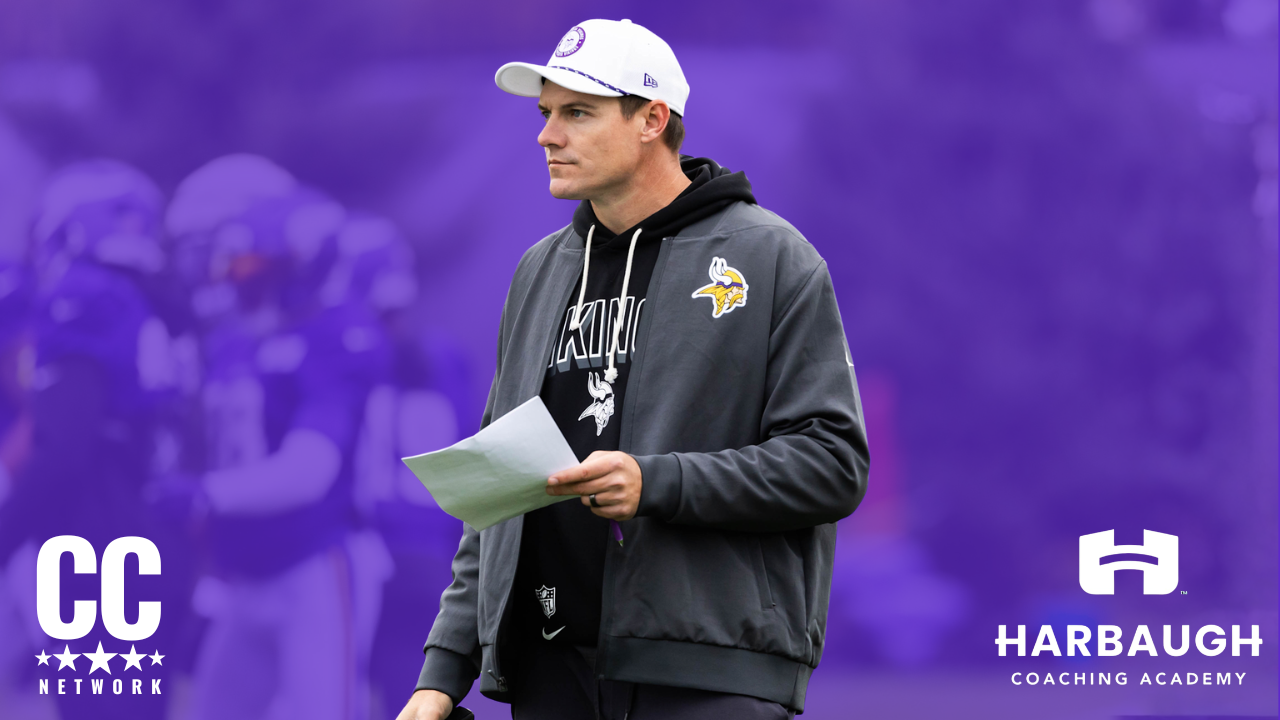
There’s a tendency in offensive football to start with the system.
Formations, concepts, sequencing, tendencies. Coaches spend hours organizing it, tagging it, building it out so it all fits together cleanly on paper.
Kevin O’Connell works in the opposite direction.
He starts with the quarterback, and more specifically, with how the quarterback experiences the offense. What he sees, how he processes, and what he’s confident executing when the game speeds up.
That perspective shapes everything that follows.
“Part of my framework… is through the lens and the eyes of the quarterback.”
It’s not philosophical. It’s practical. If the quarterback can’t clearly see and own what you’re asking him to do, the rest of the structure doesn’t matter.
Building the Offense Through the Quarterback
One of the more useful points O’Connell makes is about how differently quarterbacks take in information.
Early in his career, he recognized that what made sense to him as a player didn’t always translate to others. Some needed to see it. Others needed to hear it or talk it through.
That forced him to expand how he teaches.
He talks about reaching every quarterback in the room, not just the starter, and doing it through different methods—film, conversation, walkthrough, repetition. The system stays consistent, but the delivery adjusts to the player.
That’s a detail that often gets overlooked. Coaches will say they want players to “understand” the offense, but they don’t always change how they present it.
O’Connell does.
And it shows up later in the week when decisions have to be made.
The Call Sheet Is a Filter, Not a Showcase
By the end of the week, the emphasis is no longer on adding ideas, but on settling the quarterback into the calls he believes in.
He describes sitting down with the quarterback and working through the call sheet together, not just to review it, but to refine it.
Anything that creates hesitation gets addressed immediately. If the quarterback doesn’t feel right about a call, it doesn’t stay just because it looked good earlier in the week.
“What I think… means absolutely nothing when those 11 guys jog out there.”
The line says a lot about how he sees his role as a play caller.
There’s a difference between knowing a play should work and having a quarterback who believes it will. O’Connell leans heavily toward the second.
For coaches, that’s a useful checkpoint. The goal of the call sheet isn’t to hold every answer. It’s to give the quarterback a group of answers he can execute without doubt.
Building the Head Coach–Quarterback Relationship
O’Connell also spends time on something that goes beyond scheme: the relationship between the head coach and the quarterback.
He sees the quarterback as an extension of the head coach on the field. Not just in play execution, but in leadership, communication, and how the team responds in critical moments.
That relationship isn’t passive. It’s built through consistent interaction, trust, and accountability.
“The success of the quarterback… has positive impacts on every layer of your organization on and off the field.”
What stands out is how he balances that relationship. He’s clear that the quarterback needs support, but also needs to be coached hard, and publicly at times, so the rest of the team sees the standard.
It is a dynamic sets the tone for the entire offense.
Using Your Background to Develop the Quarterback
One of the more practical takeaways, especially for defensive coaches, is how O’Connell suggests approaching quarterback development.
He doesn’t see it as limited to offensive coaches.
Instead, he encourages coaches to lean into their expertise. If your background is coverage, teach coverage structure and disguise. If it’s pressure, teach how blitzes develop and where the problems show up.
That information gives the quarterback tools he can use immediately.
It also creates buy-in. Players respond when they feel like they’re gaining an edge, not just being told what to do.
Designing Offense Around Defensive Responsibility
When O’Connell talks about scheme, he doesn’t start with the offense.
He starts with the defense.
What is each defender responsible for? Where can that responsibility be stressed? How do you force a player to be wrong?
From there, concepts are built to create conflict like run versus pass, leverage versus spacing, initial picture versus final result.
The goal is to create gray for the defense, not more detail for the offense.
O’Connell’s approach keeps the system grounded. It’s not about collecting plays. It’s about understanding how those plays affect the defense.
Listening to Players as Part of the Process
Another detail that stands out is how often O’Connell references player feedback.
He actively asks player, especially experienced ones, what they’re seeing and what’s actually difficult to defend. If something isn’t stressing a defender the way it’s supposed to, he wants to know.
The feedback loop helps clean up ideas before they ever show up in a game.
It also reinforces something important for coaches: players aren’t just executing the system, they can help refine it.
The Shift From Knowing to Teaching
Late in the interview, O’Connell makes a point that ties everything together.
Early in his career, he focused on what he knew. Over time, he realized that knowledge doesn’t carry much value if players can’t apply it.
So the focus shifted.
- How do players learn it?
- How do they retain it?
- How do they take it to the field without thinking?
His approach comes through in every part of the teaching process, including film, meeting questions, walkthroughs, and post-practice review.
By kickoff, the work should already be settled so the players can cut it loose.
Final Thought
There’s nothing complicated about the core of O’Connell’s approach, but it’s disciplined.
- Start with the quarterback.
- Teach until it’s clear.
- Trim what creates hesitation.
- Build around what players can execute.
Everything else fits inside that.
How to Apply This
- Build your install from the quarterback’s point of view. If he can’t see it clearly, it won’t show up on the field.
- Teach the same concept in more than one way. Don’t assume every player processes it like you do.
- Use your end-of-week meetings to narrow the call sheet, not expand it. Keep what your quarterback trusts.
- Start game planning by asking what the defense is responsible for, then design ways to stress those rules.
- Ask players what actually gives them problems. Use that feedback to adjust before it shows up on Friday or Saturday.
- Make sure your teaching carries to game day. If players are still thinking, you gave them too much or didn’t teach it well enough.
Watch the full Kevin O’Connell interview free at Harbaugh Coaching Academy and hear him break down quarterback development, teaching, and offensive structure in his own words.
Related
Harbaughisms: Coaching Standards That Build Tough, Grateful Teams
Coach and Coordinator Network Partners with Harbaugh Coaching Academy
Mike Macdonald Built a Head Coach Long Before He Had the Title