
What’s Shaping Offensive Line Play Right Now
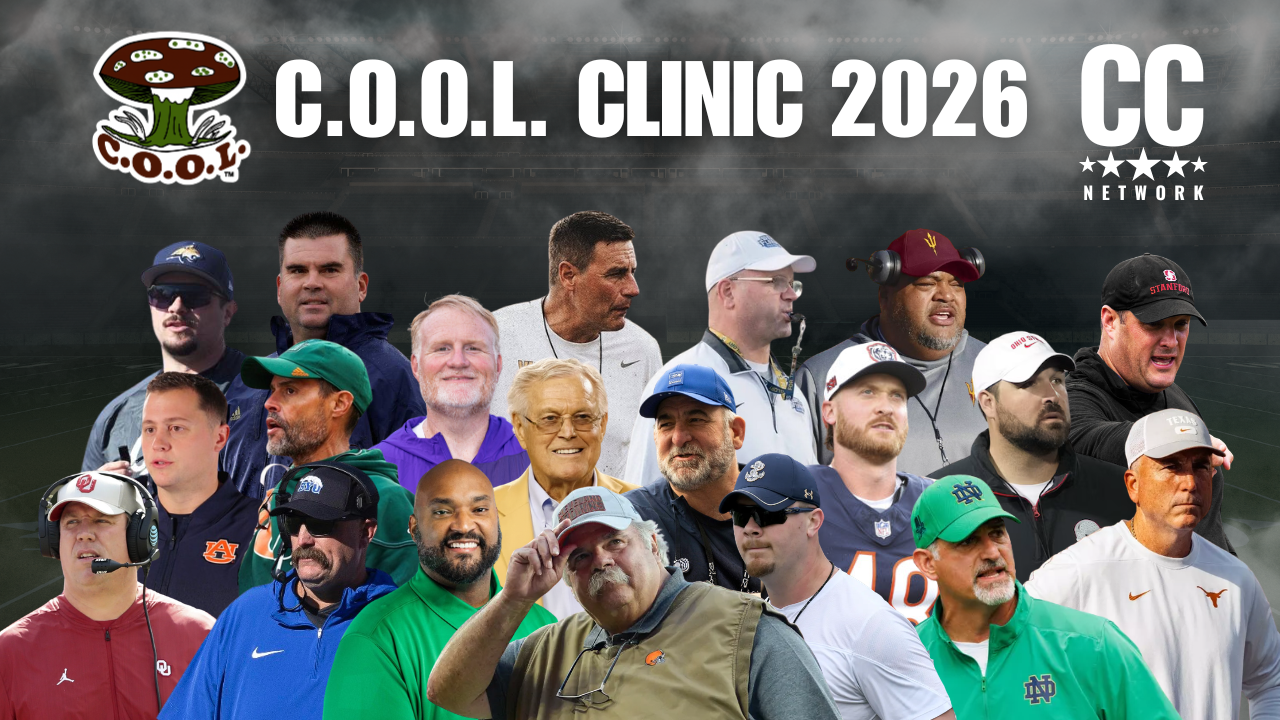
The 2026 C.O.O.L. Clinic delivered one of its strongest and most diverse lineups to date. NFL veterans, Power Four position coaches, Group of Five and FCS innovators, the first high school coach ever to present, the first long snapper, the first analytics CEO, and 89-year-old Dick Vermeil closing the week. It was a true cross-section of modern offensive line coaching.
Across more than 20 presentations, eight clear themes emerged. These aren’t passing trends. They’re the concepts, techniques, and philosophies that top coaches are emphasizing right now. Here’s what stood out most:
1. Counter is the play of the moment
More dedicated counter talks than any other scheme. Tyler Hudanick (Auburn) ran ten variations at USF for 500+ yards. Geep Wade (Nebraska) ran “a version of counter 427 times for 6.74 yards per carry” in three years at Georgia Tech. Brett Shockley (Ouacita ) averaged 8.0 yards per carry on the Q-counter. Chris Klenakis (Vanderbilt) calls counter “body blows” — “dirty runs, four, five, six yard runs… eventually we’ll wear him out.” Counter is mechanism (mid-line shift through pulling action), philosophy (downhill, defined run lanes, attacks overhang conflict), and weapon (multiple variations off identical mesh look).
2. Wide Zone and Tight Zone are now two different houses
Tyler Bowen (Ohio State): “Same house, two different rooms.” The rules sound similar; the mentality is different. Matt Smith (Montana State) is emphatic: “By no means should this play look like inside zone. Absolutely not.” The wide zone teaching is built on velocity, angle, “every inch is a mile” (Bowen), and “the number one killer of wide zone is penetration” (Smith). Tight/mid zone is rooted, second-step-into-the-ground, “play balanced” (Bowen); aim for “two inches past the midline” (TJ Woods, BYU) or “one inch playside of midline” (John Benton, NFL). The footwork principle that holds across both: the first step is a position step, the second step is the power/attack step, and it cannot cross the midline.
3. The pass-pro hand revolution is consolidating
Terry Heffernan (Stanford) rebranded the jump set as the “crowd set” — “like you’re on a crowded train” — to kill the cushion without lunging. Alex Mirabal (Miami): “We don’t do punch drills. We do drills on grabbing handles.” Jeff Stoutland (Eagles) via the NFL/Biocore talk: “We use the technique of killing our hands in protection.” Bill Bedenbaugh (Oklahoma) preaches the outside-hand strike followed by inside-hand clamp, with hands carried “right below my chest. I’d rather have my hands lower than higher.” Underneath the divergent names, the consensus is: get to the breastplate first, keep elbows tight, anchor with feet and hips, don’t lunge with the head.
4. Pullers don’t log — they kick, and “logs just happen”
Near universal. Klenakis: “We do not use the word log in our vocabulary. It is not used here. We are gonna dig your rear end out.” Guillermo (Navy): “We kick out, and logs just happen. They happen.” Shockley: “I never teach log anymore. It’s always a kick.” Hudanick teaches “pull left, hit left” — same shoulder as pull direction. Hands low to high on contact, hat inside, strike on a stagger. The puller who tries to read kick/log on the fly gets spilled.
5. The yoga ball, the hurdle, and the moving target
A few drill tools surfaced repeatedly. Hudanick and Bowen both teach pulling and zone follower technique against partially deflated yoga balls — the bounce-back exposes any blocker who stops his feet. Klenakis built fifteen 54“x60” PVC hurdles to mechanically force pad level. Saga Tuitele explicitly trades sleds for medicine balls held against a partner’s chest: “I like moving targets. I don’t use sleds a lot.” And there is a real divide in the room — Geep Wade rejects gallop/high-leg on the deuce in favor of a “square shuffle,” while Klenakis and Shockley still teach high-leg gallops with cross-shoves.
6. Analytics quietly arrived in the OL room
This was the year the data was undeniable. Lorrissa Horton (Sumer Sports CEO) demonstrated automated, frame-level CV tracking of all 22 players with run-concept and protection tagging available roughly an hour after the game. Coach Wylie’s longtime snap-by-snap OL grade sheet is now produced automatically. Kevin Boothe (NFL) and Chris Sherwood (Biocore) showed that helmet impact rate has no correlation with run scheme — “a wide zone team will not automatically be at the bottom there” — but high correlation with technique. Joe Rudolph (Notre Dame) narrated a scheme-review framework — attempts, average per attempt, percent efficient, percent explosive, percent TFL — to decide when a scheme has earned a complementary call. The toolkit is here. The coaches who study it will find a real edge.
7. Simplicity, repetition, and “out-technique-ing” people
The most-repeated philosophical statement of the clinic was some version of “do simple better.” Tuitele (via John Baxter): “Do simple better.” Wade: “Simplicity equals physicalness. Same thing over and over and over.” Guillermo: “Simple with the illusion of complexity.” Benton: “Just the illusion of complexity.” Klenakis: “Football’s not about outsmarting people. It’s about out-techniquing them. It’s not the scheme, it’s the technique within the scheme.” The undertone of every successful program represented at the clinic was a small core of plays, drilled relentlessly, with rules that scale.
8. The culture conversation is louder than ever
Dick Vermeil, 89 years old, closed the clinic with his “Common Sense Principles of Coaching” and the through-line was relational: “Players don’t care how much you know until they know how much you care… If you care, they will care.” It echoed across the week. Rudolph: “Coach the whole person. We don’t need a million problem identifiers. We need people who can solve problems.” Guillermo: “Some people think it’s strange, it’s soft, whatever, to talk about love — but we don’t think that and that’s who our kids are.” Klenakis’s 37-year-old “Union” tradition with hard hats and union cards. Mirabal’s scrum runs in team periods “to install DNA.” Saulnier’s wall-glossary so the room speaks one language. The technique was good. The culture was loud.
Two presentations worth a separate watch
- Pat Scales delivered the first long-snapping presentation in C.O.O.L. history. Most relevant for OL coaches: he recommends every lineman learn to snap (“Swiss army knife”) and shared a complete drill progression — Pistol Pete (named for Maravich), the ladder accuracy drill, wet-ball pre-snap pressure for rain games, the “tailbone anchor” leg-drive cue for the snap-to-block transition. Luke Rhodes is now a Pro Bowl snapper because he taught himself the position from a practice squad linebacker job.
- Vermeil ended on this: “Be a good example. Convince your team that hard work is not a form of punishment. Build relationships as you implement your plan. When it’s appropriate, be willing to say, ‘Love you, buddy.’ If you have integrity, nothing else matters.” The full coaching reference includes the verbatim of each principle.
The full clinic reference document breaks down every coaching point by topic with verbatim quotes and includes a convenient per-coach appendix. This document will be available inside The Mushroom Society
This year’s C.O.O.L. Clinic made one thing abundantly clear: the best offensive line coaches are combining timeless technique, modern tools, relentless repetition, and strong culture — all built on a foundation of simplicity.
Related:
Mushroom Society – Five-Man Protection with Long-Time NFL OL Coach Joe Philbin
The Mushroom Society – Find Solutions – Bobby Johnson, Cleveland Browns
The Mushroom Society – When Drill Work Shows Up on Film – Dan Larsen, OC, North Dakota State