
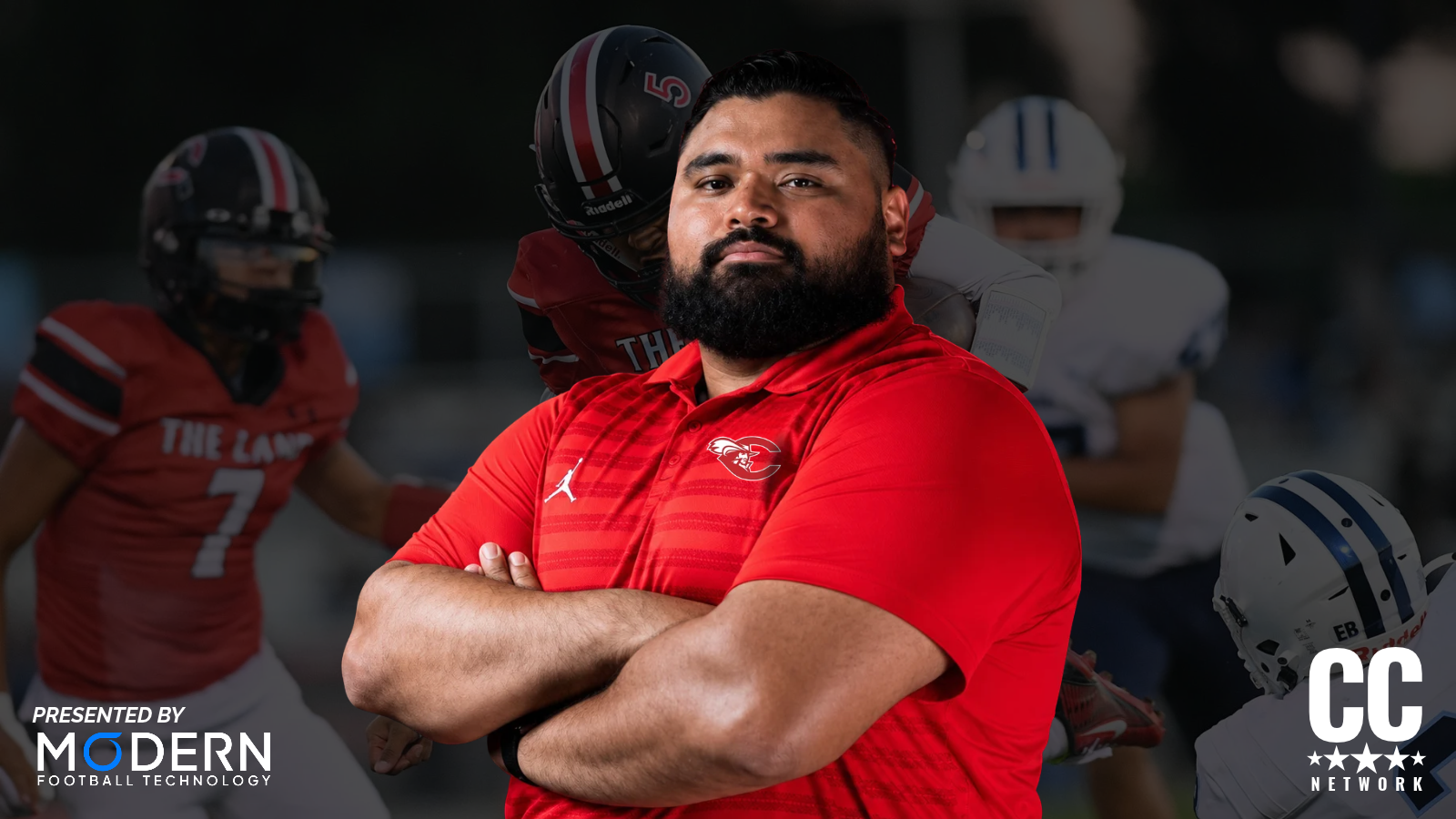
Ask Mario Guzman to name the milestones in building the culture at Cleveland High School in Reseda, California, and the first one he gives has nothing to do with a scoreboard.
“As far as milestones go, the biggest one for me, believe it or not, it’s gonna be everybody dressing the exact same way,” Guzman said. “Once we saw that all these kids are dressing the same way, not complaining about accessories and gloves and all that, we knew we have a special team. Our program is where we wanted it to be.”
Guzman, head coach of the Cleveland Cavaliers and a CCN National Coach of the Week, is three years into that work. Matching attire became the first major milestone Guzman pointed to, a sign that the rest of the program was starting to take hold.
Starting at the very bottom
Cleveland finished last season with a playoff run. Guzman and his staff carried that into winter and spring ball by rebuilding the standards from the ground up.
“We started at the very bottom, right? From attire in the weight room,” he said. “Everybody wore all black from head to toe, including socks.”
There were no individual touches. The same went for spring 7-on-7s. “We don’t go to seven on sevens with ski masks and sunglasses and towels hanging out of our backsides,” Guzman said. “We all look the same, we look uniform.”
He knows how it lands with teenagers. “As small and as annoying as it might be to the kids, they’re seeing how that discipline is starting to pay off.”
Don’t make the program look bad
Guzman repeats a few standards with his team. The one he calls the number one rule covers everyone in the program.
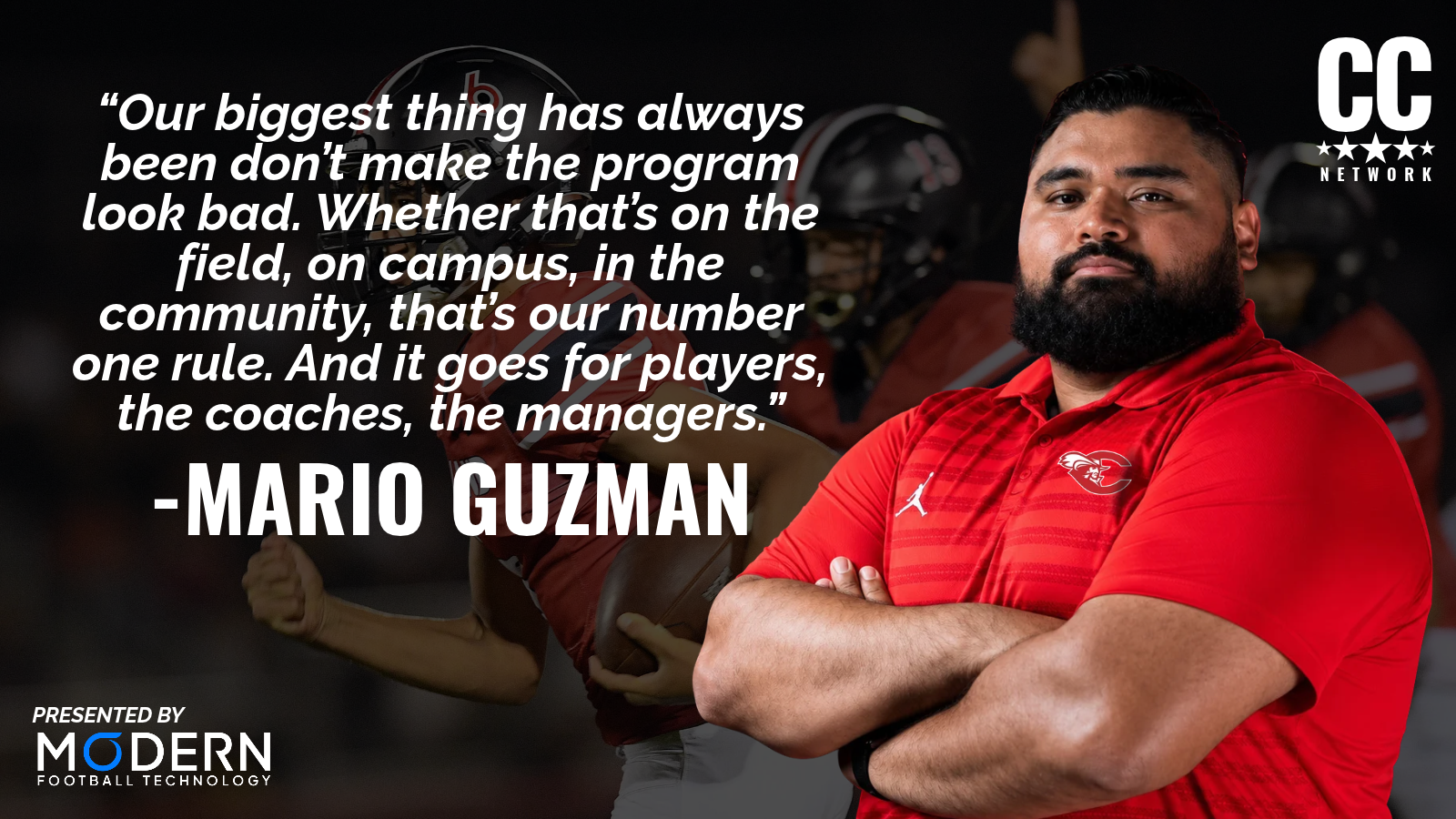
“Our biggest thing has always been don’t make the program look bad,” he said. “Whether that’s on the field, on campus, in the community, that’s our number one rule. And it goes for players, the coaches, the managers.”
Another standard is that no one is above the program, coaches included. Guzman also uses a phrase with his players: we over me. “I’m not a fan of individualism,” he said.
Cleveland’s setup lets the staff enforce those rules well beyond practice. Guzman and the coaches who work on campus clock in at 7:30 a.m. and don’t go home until 7 or 7:30 at night. “We’re with these kids twelve plus hours a day,” he said. Players know that a missed homework assignment or getting loud in class means “coach is gonna get the phone call,” and Guzman can send an assistant to check in on them.
“We’re one unit”
Guzman traces the idea back to his own Pop Warner days, when he played for a defensive coordinator with a military background.
“His thing was always, ‘We’re gonna look the same, we’re gonna play the same, we’re one unit,’” Guzman said.
He also says it isn’t only his voice. “My staff enforces these rules for me at times. So we all understand we want to be one program, one standard, look uniform.”
At 7-on-7s, his players have started to see the difference for themselves. “We look across the field. Other teams don’t look as uniform. And the kids see it too. They’ll look at us like, ‘Coach, look at those guys.’ Okay, there’s a reason we have a standard and the reason we do things the way we do.”
Three years of pushback, then less of it
None of this went smoothly at first. In Guzman’s first year, the pushback came mostly from the older players. The class behind them was more bought in. After last season’s late run, the players “truly bought into what we were saying and what we wanted to do,” and that carried into spring.
“This spring was probably the least amount of pushback we’ve had from any kids,” he said. There are still one or two who “pop their head up.” Now, though, someone else often gets to them before the coaches do.
“I also have leaders in the locker room and in that weight room that are like, ‘Hey dude, you’re wearing white socks. Go find black socks and come back.’”
Captains who held it together at 2-8
Guzman has about eight captains, and he says they were “the first ones to truly understand the message.” He has coached two of them for three-plus years. One is on track to be a four-year varsity player and “bought in from the moment he arrived at Cleveland.” With him as “the leader of the pack,” Guzman said, “everybody kind of just fell in line.” His best friend on the team followed and took on a captain role too.
Those two were tested last fall. Cleveland went 2-8 in the regular season. The Cavaliers lost their first game, won their second, went on a three- or four-game losing streak, and ended the regular season on another one.
“It was super easy for these kids to pack it up,” Guzman said. “But these two captains are the ones that kept things together, kept the glue together.”
That stretch is when he started doing regular temperature checks with his captains. They gauged the locker room and reported back to him. He kept doing it through the spring, and gave captains more of the work in front of the team: leading certain conditioning drills and weight workouts.
The second milestone is the why
Matching gear was the first milestone. The next one, Guzman said, was players understanding the reason for it.
“Them being able to see and understand the reasons why we do it would be the next milestone,” he said. “Okay, coach wants us to be in all the same attire so we don’t look like the Bad News Bears.”
Once the players had both, Guzman found he could build on it. “Since then, it’s kind of been like, all right, let’s add this sprinkle.” If he needs players to pick up trash on campus after lunch, “there’s no pushback, there’s no talk. ‘We got it, coach, let’s go.’”
What you hear at practice now
Asked what a visitor would hear first at a Cleveland practice, Guzman described players checking each other.
“The first thing you actually hear are the kids checking each other for knee pads and making sure their cleats are tied,” he said. Covered knees and tied cleats have been a focus since the summer. After that come the familiar standards: no walking, jog from station to station. “It never feels like enough time, so we gotta take advantage of every second we have on the field.”
Matching on the blacktop
Cleveland’s athletic director tells Guzman every year that football sets the tone for the school year, both the climate on campus and the other sports. Guzman’s staff uses that “as a chip on our shoulders to set that example.”
Coaches from other Cleveland programs have come to ask how he did it. “I see you guys on the blacktop, in the weight room, you’re matching head to toe. What did you do?”
His answer is that it took time. “For sure it did not happen overnight. It took a couple of years to really get it going.” He now sees other sports at the school adopting the same philosophy, and that consistency from sport to sport “makes things so much easier for all sports on campus.”
Even now, Cleveland keeps the extras to a minimum. “The kids are starting to wear gloves,” Guzman said, “but they’ve earned that to this point.”
Elevate your game with Modern Football Technology!
Modern Football helps coaches chart and tag in real time, delivers sideline reports to keep the booth and sideline aligned, and makes self-scout faster with on-demand reports.
Visit ModernFootball.com for more information.
Related:
Connect on X:
Keith Grabowski: @CoachKGrabowski
Modern Football: @modernFB
Keith Grabowski (00:01.336) I’m excited to be joined by our national coach of the week, Mario Guzman from Cleveland High School in Resita, California, the Cleveland Cavaliers. that’s definitely near and dear to my heart, Mario being from Cleveland, Ohio, but a different Cleveland Cla Cavaliers. So congratulations on the honor and and on a great start to the season. Mario Guzman (00:19.771) Thank you, Keith. Truly appreciate it. very grateful for the the award. but again it as I’ve said before, it’s a testament to my kids and my staff for sure. But thank you. Keith Grabowski (00:31.246) Yeah, I want to dig into the the culture that you’re building. And I think for you as as I read up and we did our research on this, so it is a unique situation in your area that you’re able to one, be a head coach who’s in the school, but two, also have assistance in the school. So you guys are really building your program not just from three o’clock on, but throughout the whole day, able to keep keep kids accountable. Mario Guzman (00:50.225) Mm. Mario Guzman (00:58.437) Yeah, you know, we’re we all my myself and the coaches that work on campus, we clock in at seven thirty AM and we’re not going home till seven, seven thirty. So we’re with these kids twelve plus hours a day. add that up by the end of the week. So they’re with us all day long. We’re with them all day long for the most part. So they know, you know, if they don’t do a homework assignment or they’re getting a little loud in class, that coach is gonna get the phone call. And when I get the phone call, I’m able to send my assistant coaches to go check in on them and make sure Everything’s the way it’s supposed to be. And we’re as you put, you know, they’re living up to the standard that we’ve set, you know, on and off the field. our biggest thing has always been don’t make the program look bad. Whether that’s on the field, on campus, in the community, that’s our number one rule. And that’s, you know, it goes for players, the coaches, the managers. We just our number one rule is don’t make the program. Keith Grabowski (01:53.566) I you guys have a lot of momentum. You had a deep playoff run last year, five and on the season this year. And really it’s you know, you people have talked about it’s the standards that you’re setting. What are the things that you build on? What are the things that you guys are constantly saying, This is what our program is about, these are the standards you guys have to hold. Mario Guzman (02:11.012) Biggest thing is that no one’s above the program. Again, goes from players to coaches. No one’s above no one single person is above the program. And we started this again after that championship run we had last year going into the winner and spring ball. We started at the very bottom, right? From attire in the weight room. Everybody wore all black from head to toe, including socks. There were no you know, individuals. Even now we don’t really do the accessory stuff. The kids are starting to wear gloves, but they’ve earned that to this point. You know, during the spring, we don’t, you know, we don’t go to seven on sevens with yeah, you know, ski masks and sunglasses and towels hanging out of our backsides. we all look the same, we look uniform. And that as small and as annoying as it might be to the kids, they’re seeing how that discipline is starting to pay off by our start. Keith Grabowski (03:04.11) It’s funny that you bring that up. I was just talking about that this week with the head coach I work for now, who’s one of my former players. And we were going back to when he played in high school and kind of remembering all that, that we didn’t let him wear gloves, right? That there were no wristbands. They wore you know, they all wore we had pro socks, everybody wore the same socks. He even brought up, you know, the head coach who I worked for and they Mario Guzman (03:11.184) Yeah. Keith Grabowski (03:26.732) he played for is like black shoes that I’m like, yeah, I remember that. Like you you don’t see that now. Like we we have kids out on the field. I I saw the other day, like one of our linemen has these highlighter orange shoes on. I could spot them everywhere. And you know, we’ve we’ve seen that individualism, I guess, really just become part of the program. Why do you feel that’s so important today? Like to be able to set some of these standards and be able to see these have these kids see that, guys, this is Not about you, this is about us. Mario Guzman (03:57.103) Yeah, it’s another thing we preach, right? It’s we over me. again, we don’t I I’m not a fan of individualism. You know, we’re all look the same, we all look uniform. And this goes back to when I first started playing pop warner football. I had a a I played for a defensive coordinator who was a military guy. And his thing was always, “we’re gonna look the same, we’re gonna play the same, we’re one unit.” and that’s kind of the what we’ve been and I say we, ’cause it’s not just me, right? My staff enforces these rules. for me at times. so we all understand we want to be one program, one standard, look uniform, all that good stuff. And again, it just it sets us apart. Again, I go back to the 707 stuff. We do our you know handful of seven all sevens here and there. But when we’re there, we look uniform. We all look the same. We look across the field. Other teams don’t look as uniform. And the kids see it too. They’ll look at us like coach look at those guys. Okay, there’s a reason we have a standard and the reason we do things the way we Keith Grabowski (04:56.428) Now that’s not necessarily an easy thing to put in place and I’m sure there were some growing pains with that. When you first started, I guess when you introduced that, that concept of of how you’re gonna do, was there was there pushback, was there guys constantly testing the limits, you know, how did you go about making that something that now your kids really believe in? Mario Guzman (05:13.135) Yeah. This is you know, three years in the work. But three years in the work, you know, just when I first took over, again there was more pushback from the older guys. once that year was done, the next class came up, they were they were a little more bought in. But this year for sure, the kids again, I and a lot of this goes based off our run at the end of last year. They truly bought into what we were saying and what we wanted to do. so that carried over into the this spring. And this spring was probably the least amount of pushback we’ve had from any kids. Right, of course you’ll have your kid you get or you know, one or two pop their head up. But I also have leaders in the locker room and in that weight room that are like, “Hey dude, you’re wearing white socks, get the black top. Or go find black socks and come back.” Keith Grabowski (05:59.426) Yeah. how do you make that transition to the player led part of it? Like when you get when you can get your team to that player led where they’re doing it and it’s not always coming from the top, I think that’s when you start to have some things that are special, but it’s not always easy to get you there. What things did you do along the way to be able to turn this over to them or really f you know, have them buy in to take ownership in it? Mario Guzman (06:22.948) The thing is our captains were the first, really I have like eight captains, but they were the first ones to truly understand the message of what we’re trying to do. two of I’ve had for three plus years. One of them he’s gonna be a four-year varsity player. And he bought in from the moment he arrived at Cleveland. So having him this is his senior year, having him be kind of the leader of the pack, everybody kind of just fell in line from there. And from there, you know, his best friend on the team started, you know, fell in line and be took that captain role. So it was really thankfully, thankful excuse me. Thankfully, I’m thankful because of them that they were able to buy in and truly carry our word and our message down to their Keith Grabowski (07:07.192) When you’re going through your off season program, what kinds of things are you doing to train that leadership? Is it a formal program for you? Is it just, you know, constantly talking to them? How does it go about that you’re developing the leaders in your program? Mario Guzman (07:20.442) constantly talking to them, doing check-ins with my captains, just you know, get a a feel for the culture, kind of a temperature check of everything. Last year was super tough and we went two and eight in the regular season. we won our we lost our first game, won our second, and we went on a three game, three or four game losing streak. And then we ended the season a losing streak. So it was super easy for these kids to pack it up. But these two captains that I’ve been talking about are the ones that, you know, kept things together, kept the glue together. and they just made it easy for me to start doing those temperature checks last season, especially when again we’re we’re two and eight. So not much to be happy or positive about, but you know, they were able to kind of gauge the locker room, let me know, report back to me, let me know how things are. And it’s been the same thing this this past spring. check in with them, have you know, talk to the team, have them lead certain conditioning drills, have them lead certain weight workouts. Stuff like that. Keith Grabowski (08:22.232) Being in the school and and the influence that you guys have across your team, what kind of I guess an impact does it have overall on the the student body? Is it something that you’ve received feedback that what your guys do is trickling into other areas of the school? Mario Guzman (08:37.526) It is. it’s funny. Our athletic director says that every year that football kind of sets the tone for the rest of the school year as far as that, you know, the climate on the campus and the other other sports. And we kind of we we use that as a chip on our shoulders to kind of set that example and that standard for the rest of the school. we’ve even had coaches from other programs come and, you know, have these conversations like, Hey, how did you guys get your kids to buy in? I see you guys on the blacktop in the weight room, you’re matching head to toe like What did you do? What did you make it happen? And we tell me what it didn’t happen overnight. For sure it did not happen overnight. it took took a couple of years to really get it going. But you’re starting to see within other sports they’re they have that same philosophy. So when we have that from sport to that consistency from sport to sport, it makes things so much easier for all sports on campus. Keith Grabowski (09:27.886) Do you have a lot of multi sport guys? Mario Guzman (09:30.897) I have a good amount. my guys will play football, then they’ll transition to wrestling in the wintertime. Some of them will run track, some of them will play baseball. I have about two or three basketball players also that that’ll go play basketball in the wintertime. So that’s something we preach, you know. Everybody says it, but it’s like we love multi sport athletes. I have a couple of soccer players, all my kickers are soccer players. So it’s it’s fun being able to during our off season go support them and their other sports too. Keith Grabowski (10:03.27) I I love being able to go to practices, coach. I think when you w go and watch a practice, you can learn a lot about a team, their culture, what they believe in, the standards that they hold. If I was to show up at practice, what are some of the things that I would see consistently? What are some of the things I would hear and and understand that these are the expectations or this is how these guys go about doing their business? Mario Guzman (10:25.24) It’s funny, the first thing you actually hear are the kids checking each other for knee pads and making sure their cleats are tied. make sure knees are covered. That’s, you know, been a focal point for all our rest this year. And we’ve been instilling this to the kids since the summertime. So that’ll be the first thing you hear. Make sure your knees are covered, make sure your cleats are tied up. and then from there, you know, just stuff I’m sure you hear at other sports, no jog, you know, walk no walking down the field. Let’s jog from station to station. Let’s just work. Take advantage of every minute we have out here. You know, it’s it never feels like enough time, so we gotta take advantage of every second we have on the field. Keith Grabowski (11:01.336) What what does a typical practice look like for you guys? What’s the structure? Mario Guzman (11:04.954) For us, we’ll so we get six period football, which is the last period of school. So we’ll start in the weight room. We’ll take a break because at dismissal, some of my coaches have to go supervise dismissal. Come back, we finish in the weight room around 4 30. From there, we give the kids about 10 minutes to get their stuff, get dressed, get going. And then once by the time us as coaches get out on the field, the kids are already stretched, warmed up, get ready to go. So we start with conditioning every day. we don’t want we don’t Have the luxury of having, you know, 60 plus kids on the varsity roster. So a lot of our kids do play both ways. So we need to make sure those gas tanks are ready to go Friday night. So we condition every day. with the exception of our walkthrough days. We still run a little bit, but we keep it light. so we’ll start with conditioning and from there, whether if it’s if it’s an offensive emphasis day, we’ll split into endow time, where we do a majority of our teaching in indel time. Right. My line coach takes the big guys. Goes over the scheme for that week. My running back coach takes his guys, same thing. and then so we go indo time for about 30 minutes, maybe a little longer. In between there, we have our water breaks, of course. And then we f we always finish with a team period. Team period and some sort sort of special teams. Keith Grabowski (12:21.442) Now, your guys being in in school all day, what’s the I guess the work you do with these guys academically? Is there study tables? Is it just, you know, something built into the day? how do you guys keep on top of the academic side of things? Mario Guzman (12:38.45) being on campus, I have access to pretty much everything when it comes to the academic portion of it. So I’ll do weekly check-ins on my guys, their grades, and make sure they’re not missing any assignments, things like that. I’m actually super blessed with true, you know, student athletes. They’re able to handle their stuff. at Cleveland, we have a very strong magnet that really asks a lot of some of our kids and they’re able to balance that workload. And again, it’s a testament to them. When needed, I’ll have my classroom open at our nutrition at lunch breaks so they can come in and have a quiet place to work if they need it. But again, like it’s it’s truly a blessing to be able to to count on these guys to go home and take care of their classwork or take care of it during class so they don’t have to worry about it after. But it’s something we preach to them from you know the beginning of every week. Let’s take care of our c of our school stuff, our assignments, so that Friday, all you gotta worry about is football. Keith Grabowski (13:35.576) Coach, you mentioned that you know you have a lot of people coming to talk to you about how you guys are getting it done. for s for somebody out there, obviously you could see where things are now. That’s that’s what it looks like as you get to this point. What does it look like along the way? You know, what what are the milestones you started to see, like, hey, you know, this first year, this is what it was like, this is was was year two, et cetera. Mario Guzman (13:59.715) It’s definitely tough. you know, it doesn’t start off, you know, rainbows and sunshine. there’s the dark days, there’s a hard days, the days where you’re there and it’s like, you know, you’re starting to question like what are we what are we doing here? What are we trying to do? And then you’ll ha once you start seeing that that buy-in and the results of it all is when you start to really enjoy the fruits of your labor. and as far as milestones go, the biggest one for me, believe it or not, it’s gonna be, you know, everybody dressing the exact same way. Right. Once we saw that all these kids are dressing the same way, not complaining about accessories and gloves and all that, we knew we have a special team. We we our program is where we wanted it to be. So since then, it’s kind of been like, All right, let’s add this sprinkle, all the kids buy in. You know, if I need the kids to go pick up trash on campus after lunch is over, there’s no pushback, there’s no talk. we got it, coach, let’s go. You know, it’s a true again. Buy, I keep saying buy, but it’s a true buy into what we’ve been trying to do. And so as far as milestones go, I think getting them to all dress and act the same was probably the first biggest milestone. And them being able to see and understand the reasons why we do it would be the next milestone. Okay, coach wants us to be in all the same attire because so we don’t look, you know, like the bad news bearers for you know what I mean? so it’s It’s little milestones here and there. those two are probably the biggest ones. Keith Grabowski (15:30.168) For you, what’s the vision for the future? What what do you see that you wanna get to, let’s say, you know, two, three years down the road to r raise the bar even higher? Mario Guzman (15:40.509) continuing to win, you know, obviously we’re off to a great start this year, but it’s consistency consistency that matters to me, right? Everybody could have one good year and then the next couple you’re kind of drop you kind of drop off here and there, but it’s the consistency of it. and making sure our JV kids are continuing to be built so that it’s a continuous flow. It’s not we’re not, you know, it’s not like a mountain range where we hit our we hit our peak and then we we come down a little bit, then we go up. Come down a bit. I just, that consistent flow of building our talent so that we’re a consistently good team every year. Keith Grabowski (16:18.326) Now, y your athletic director was quoted as saying this is the the the greatest win he’s had in his fourteen year tenure, you know, in football, right? What what made this win so special? What what’s the perspective he had on that? Mario Guzman (16:32.316) Coach Vanger, our athletic director, has been a huge fan of, you know, football and what we’re doing. So for him, I mean he’s been at it a long time. I think the fact that really nobody outside of Cleveland gave us a shot last Friday night to go down to Crenshaw. higher ranked teams, you know, they were open division finalists last year. so the you know, having to go down to Crenshaw in the middle of the day, stuff like that. So the the odds are stacked against us. So for us to be able to pull this out as an upset, he was super excited about it. And I think that’s what, you know, where the comment came from because up until now, looking, you know, past at past W’s and max preps, like this would be the biggest one when it comes to beating a top city team. Keith Grabowski (17:19.896) Coach, I really appreciate you taking the time. I know it’s been a busy week for you and you guys continue to to go after the goals that you’ve set for this season. Congratulations on that big win and congratulations for being recognized as our national coach of the week. Mario Guzman (17:29.392) Thank you. Mario Guzman (17:33.691) Thank you, Keith. Really appreciate it. again, it’s it’s not just me, it’s a testament to my kids and my assistant coaches. I I say it all the time, you know, I get the recognition as, you know, the head coach, but I wouldn’t be able to do any of this or look, you know, this could without any of them.