
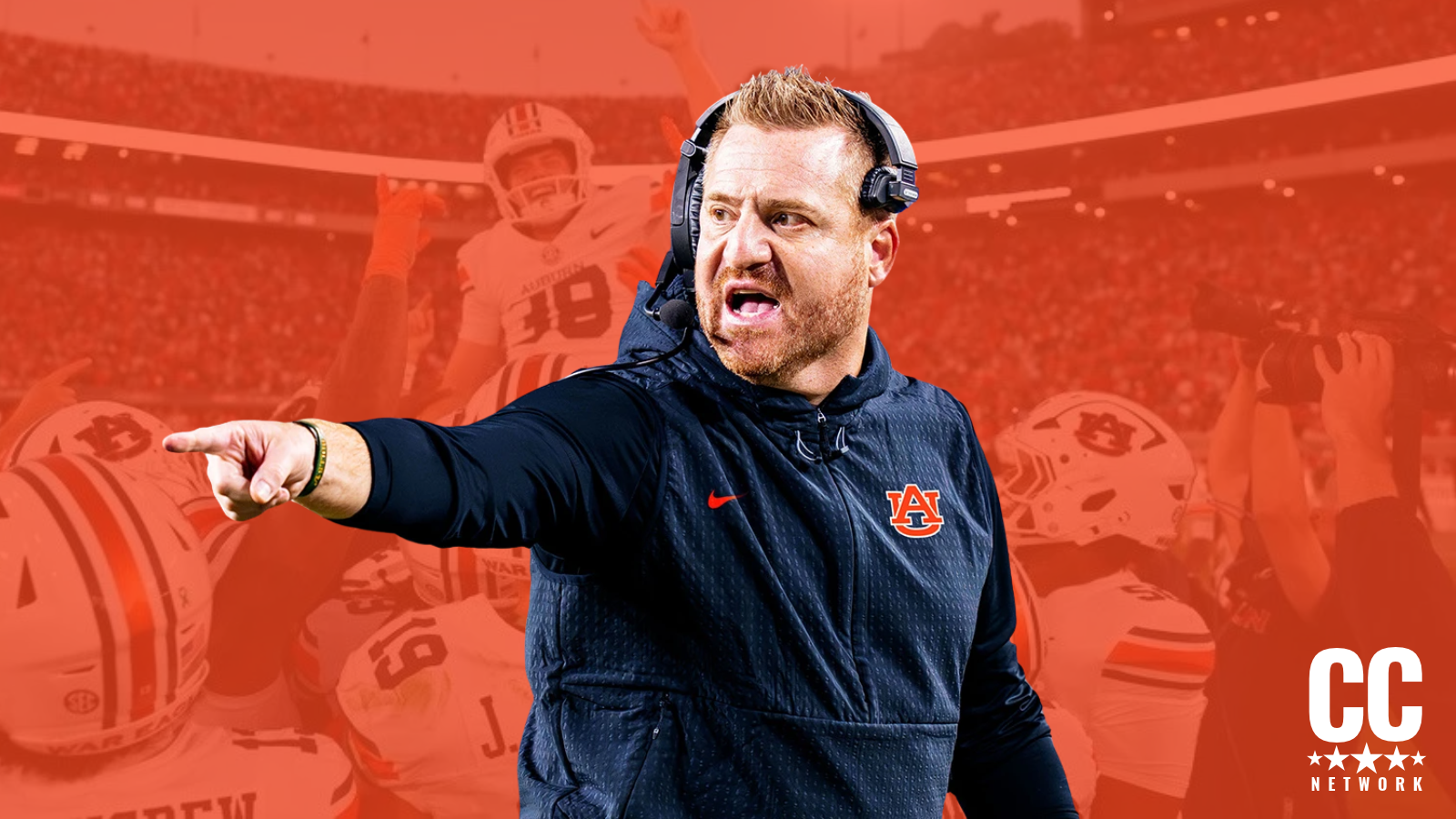
Auburn beat No. 1 Georgia 27-24 in Athens on October 17, 2026. The Tigers came back from 14-0 down and won on a field goal as time expired. It was the biggest win of Alex Golesh’s first season as Auburn’s head coach. Two days later he called his mood “highly guarded.”
“Good win, bad loss; it has to be the same,” Golesh said, according to Yahoo Sports. His staff spent that Sunday on “fundamentals, technique, process,” watching film that showed, in his words, “here’s fundamentally where we suck, here’s our pad level, here’s our missed leverages, here’s our hat placement.”
He had described the same approach more than two years earlier. In a March 2024 interview for Coach and Coordinator Network’s Culture OS series, recorded after his first season as head coach at the University of South Florida, Golesh told series guest host Rob Pomazak, head coach at St. Charles North (Ill.), how he builds a program where a result, good or bad, doesn’t decide what happens next. The interview came at a different school, long before Georgia, and it doesn’t explain how one Saturday in Athens was won. What it lays out is how Golesh says he runs a program.
Why Golesh won’t let results run the building
Golesh doesn’t pretend the scoreboard is irrelevant. “I understand I’m evaluated on wins and losses,” he told Pomazak. “I’m not naive to that point.”
His concern is what happens when that pressure gets inside the building. “As soon as the players or the staff feel that, the focus and the pressure shifts to something that you can’t control,” he said. “You’ve got to be so process driven that the result itself, which you truly have no control over, doesn’t matter to anything other than the true end of the year evaluation on me.”
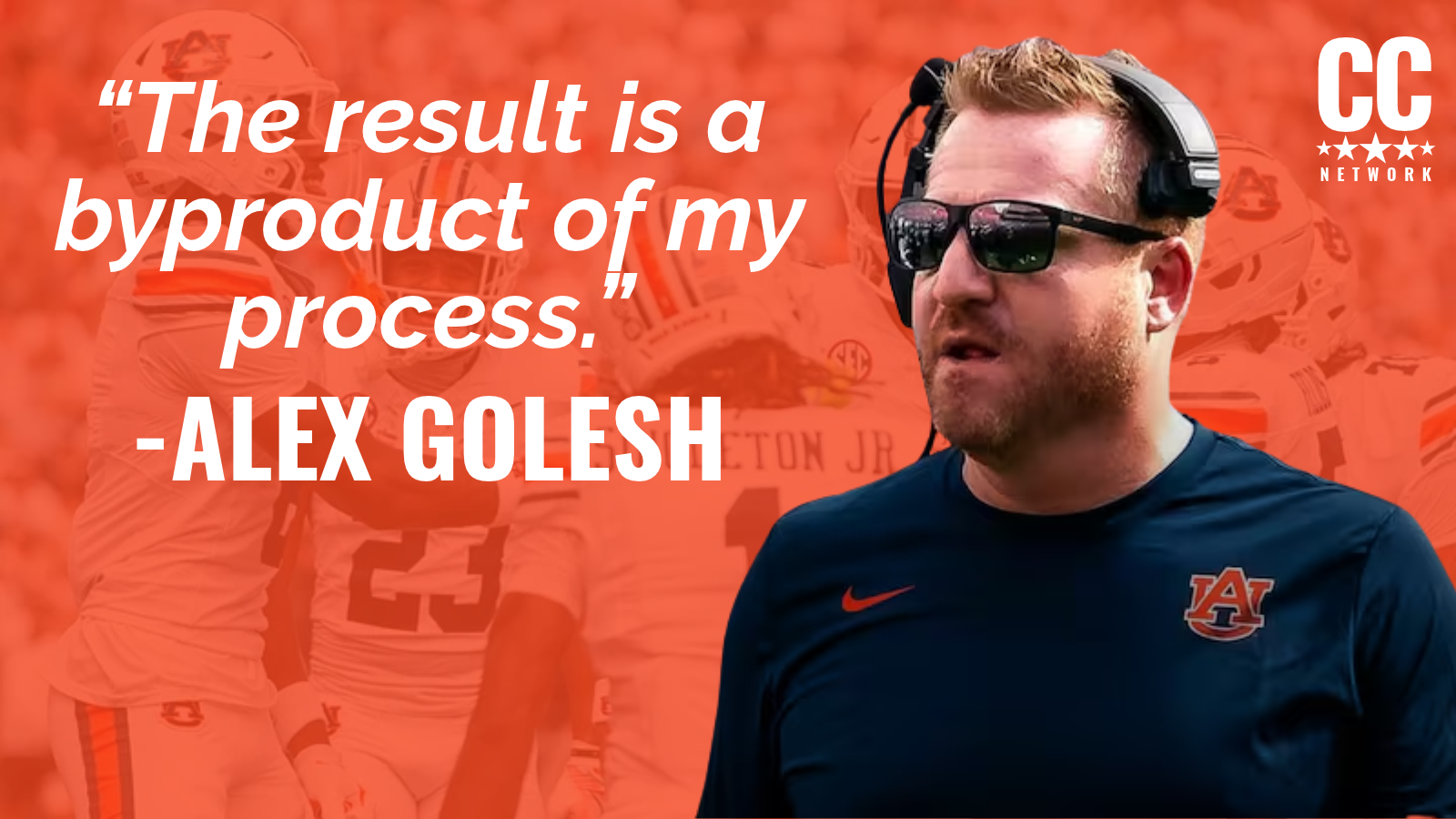
He calls that a process-driven program, as opposed to a result-driven one. In practice, everything the program talks about, works on and builds into its schedule is the daily process: what a player does in the offseason and during the season “to give myself the ultimate opportunity to be successful.” In Golesh’s words, “the result is a byproduct of my process.”
He also places the game itself further back on the calendar than game day. “You don’t truly control the outcome of the game on game day. You control the outcome of the game based on what your off-season looks like.”
At USF, he applied that in his first year to every part of the operation: the weight room, how players were fed, how the staff’s day was organized, and recruiting from evaluation through a recruit’s time on campus. “I said, I don’t care about wins and losses. I don’t care what people outside of here think. All we care about is our process.”
Standards, not goals
Golesh separates a standard from a goal. “I’m not a big goal person. I think you set goals, you reach them, you don’t reach them,” he said. “I believe in setting standards, achieving the standard, and then raising the standard from there.”
At USF the standard for every department was the same word, and he defined it: “Elite means the best in the country.” He applied it to sports medicine, nutrition, academics, community outreach and player development. “That’s all before you ever get to football.” In football it started with the coordinators and what they demanded of their staffs and players.
Recruiting shows how literally he means it. USF had just signed what Golesh called the best class in the Group of Five, and a top-50 class for the first time in school history. “Awesome. Well, the standard is to be the best in the country. We fell 49 spots short of that.”
He knows the obvious answer is that South Florida will never sign the No. 1 class. “Okay, cool. Then what are we doing here?” he said. “If we can’t sign the number one class in the country, then how do we work like crazy to get there? And again, what’s our process? Is our process right? If it’s not, we got to fix it.”
A historic class and a 49-spot miss lead to the same next step: checking the process.
From 117th to No. 1 at Tennessee
The clearest example from his career came at Tennessee, where he was offensive coordinator before USF. He looked at who had played there, naming Peyton Manning, Alvin Kamara, Jason Witten and Reggie White. “If these guys were the best at their job ever, we should have the top offense in the country. And we were 117th when I got there.”
He told the offense they were going to be the best in the country and that he would work harder than anybody to get them there. After the first year they finished seventh. He stood in front of the offense again: “Man, we fell short. And here’s where we fell short.” He named specific areas, including the red zone, and repeated the same commitment. “We got to number one in the country.”
He brought the same pattern to USF, a program with four wins in the previous three years. The standard was the College Football Playoff and a chance at a national title. If someone said that was too hard to do from the American Athletic Conference, he pointed to Cincinnati: “Cincinnati just did it. So you can’t say it’s that hard to do.” USF didn’t get there in his first season. “We fell short last year. Awesome. Where did we fall short? Why? How? Let’s go fix it.”
His summary of the job: “All I feel like I do is set the standard and hold people accountable to that standard.”
Be who you say you are
Golesh says he isn’t a slogan, wristband or signage coach. The program has one motto, “be who you say you are,” and to him it covers trust. “Just do what you say you’re going to do, man.”
He gave a player example. A receiver says he wants to be the best in the country. “Awesome. I’m going to give you every tool imaginable to do that. I’m going to try to get your process so perfect that you can do that. And then if you are, awesome. If you’re not, let’s reevaluate the process.”
The motto works as an audit. If the program says something about itself, every part of its process has to match. “We say we want to be tempo offense. How do we practice it? How does the weight room allow for your offense to be tempo? Do we train that way? Well, we know our skill guys are basically running a marathon every Saturday. Do we train that way? Do we eat that way? Do we make sure we’re hydrated? Are we sleeping enough?”
“When you become process-driven as a program,” he said, “you can truly evaluate every single aspect of it.”
Above the standard or below it
Pomazak asked the question every head coach runs into: how do you keep pushing people who are already making real gains, without being, as Pomazak put it, a bull in a china shop?
Golesh’s answer starts with rewarding behavior that meets the standard. In practice that means pointing it out every day: “We keep guys up. We stay off the quarterback. We take care of each other.”
He takes it down to individual fundamentals. With ball security, the staff shows clips that meet the standard: “It’s high and tight. It’s wrist above the elbow. Man, here I am through contact. I’ve got two hands on it. Like this is elite behavior.” Then they show what doesn’t: “Here’s being reckless with the ball. Here’s reaching it out.” In his words: “You love up the positives. You show the negatives. And again, you point it out as it’s above the standard or it’s below the standard.”
He uses the same grading in recruiting, and that’s where the result drops out of the evaluation. A coach who calls a recruit, connects with the player’s champion, his high school coach, position coach, trainer and seven-on-seven coach is showing elite behavior. “If that kid chooses to go somewhere else, but your process was elite, I’m not mad about the end result. We can’t control that.” The reverse is graded too. A coach who learns the seven-on-seven coach was making the decision, and talked to that coach once, gets this: “That is below the standard behavior. And that will not be rewarded.”
Put it back on them
The standard covers the staff and administration as well as the players. Golesh’s phrase for holding them to it is putting it back on them, and he pairs it with a responsibility of his own: giving people what they need to meet the standard.
His example was the program’s dietitian. “Man, our dietitian, he’s phenomenal. Man, are we feeding our players the best food and supplements you could possibly feed them? Man, we’re not. And here’s the reason why. Awesome. Then it’s my job as the head coach to give them the resources they need to go achieve the standard.”
When people around him fall short, he doesn’t “go in guns a-blazing and be a complete jerk.” He puts the standard back in front of them: “You hired me to get this program to a national championship status, but we are missing this, this, and this to get there.”
He treats it as coaching. “Our job is to take players where they don’t think they could take themselves. Well, it’s the same with administration. It’s the same with your assistant coaches.”
The question he asks at the end of that conversation is about process, whatever the outcome: “Did you do everything you could to get to that standard? If you did, then man, the end result wasn’t what we wanted, but our process was right. If it wasn’t, if our process wasn’t right, man, now I got a problem.”
The process stays under review even after it’s built. The morning of the interview, Golesh had met with USF’s scouting department about the transfer portal. “Man, is our process right with how we’re attacking it?” The staff, which he called “some really sharp cats,” talked it through and came up with “a collective process that we thought was better than what we did.”
Building or sustaining, it comes back to the process
Pomazak’s last question was whether building success or sustaining it is harder. Golesh said both. Building means “you’re establishing processes nonstop and reinforcing them.” Sustaining means fighting complacency, the person who says, “I’ve done a good job. What else do you want me to do?” It also brings expectations, “and most of those expectations come from the outside.”
His answer to both problems was the same. “If you’re constantly attacking the process, then it doesn’t matter whether you’re building or you’ve already gotten there. The sustainability all depends on what your process really looks like.”
“I think if you enjoy the process and the journey more than the end result,” Golesh said, “I think you can feel fulfilled in either way.”
Listen to the full Alex Golesh interview on Culture OS, part of Coach and Coordinator Network’s series on how coaches at every level build program culture.
More from the series: Every Culture OS episode
Put the series to work: The Culture OS Companion is built from these conversations to help coaches plan culture, staff alignment and accountability in their own programs.
Connect on X:
Alex Golesh: @CoachGolesh
Keith Grabowski: @CoachKGrabowski
Alex Golesh (00:15) As I’ve gotten older and as I’ve gotten deeper into the into my career, the most rewarding times and it hasn’t been the wins. There’s some really cool highlight moments in terms of wins and losses, but my favorite part of this profession is getting the invites to guys’ weddings, getting the texts of like, man, coach, my my wife is pregnant. We can’t wait. And I’m so grateful for for the lessons you taught me. All those same reasons that I got into it and wanted to be a high school coach to start with. are the same reasons why I still enjoy the day to day. Host – Keith Grabowski / Rob Pomazak (00:49) We’re back for our final interview in our Culture OS series with head coach Rob Pomazak, the head football coach, at St. Charles North in Illinois. This has just been a tremendous series where we’ve been able to look into the mind of some of the best culture builders. And Alex Golesh (01:07) Mm-hmm. Host – Keith Grabowski / Rob Pomazak (01:08) so we finish it up with a very strong one with Alex Golish, who is now the head coach at the University of South Florida. I had the opportunity to meet Alex. Years ago when he was the position coach at Toledo. And I remember him just being a guy who would hustle around during their satellite camps when they were at BW. And you saw high energy, you saw a guy wanting to do things right. And he’s just carried that through this journey and building his career. And now it’s afforded him the opportunity to be a head coach. And just a ton of takeaways from this one in this podcast. But Rob, tell us a little bit about. This final episode you’ve put together here with head coach Alex Golish. Thanks, Keith. Coach Golish is a a friend of mine who I again like you, Keith, I’ve seen him rise through the ranks and it’s a great thirty-five forty minute listen on how staying dedicated to your process and taking the next step in your career, but also taking those little steps within the position that you’re at. So Coach Golish talked about That transition from being the offensive coordinator at Tennessee to being the head football coach at USF and one of the big changes for him was just having all eyes on him and every decision that he’s gonna make is gonna react sixty two to a hundred different lives that have made the choice to be y at his institution and and taking part in this journey. So that was something that he’s been navigating through, which I thought was really appreciated, and that vulnerability. And then he continues to go on and talk about his journey and and more specifically about the process that they’re going through over at USF and be who you say you’re gonna be and what is your daily process and how they use that really to evaluate everything from going from good to great. It’s a great half hour to forty five minutes again, and I really appreciated Coach Gollis spending time with us and giving us some insight into what it’s like to be a head coach at that level. Yeah, it’s a very Interesting in being able to hear from a guy who’s made that move from offensive coordinator at a high level to now head coach because I think that’s a a tough change for everybody to move from just one side of the ball the whole team and I think you hear in this one exactly how to get that done. So here’s Rob’s interview on Culture OS with head coach of USF, Alex Golish. Super excited to have our next guest on Culture OS. And this is such a privilege. A gentleman who I’ve kind of had the privilege of knowing along his journey. And now we have Alex Golish, the head coach of the University of South Florida, coming in and probably one of the best recruiters in the game, best offensive minds in the game. And now he’s at the helm at South Florida doing amazing things. Coach Golish, thank you for joining us on Culture OS. It’s a great privilege to have you on. Alex Golesh (04:00) No, I appreciate you having me on, man. It’s an honor and and I’m excited. Hopefully somebody gets something out of this. Host – Keith Grabowski / Rob Pomazak (04:06) I think people will get a ton out of it. We’ve kind of dabbled in the high school realm. We’ve talked to Brad Spencer to division three level, but nobody at the FBS level. So I’m just gonna jump right into it. Coach, you’ve had this amazing journey from high school, you know, I believe it was Brooklyn, correct? If I’m not mistaken. Dublin High School, all the way through from a high school coach, all the way through the ranks of division one and now sitting at the top at South Florida. But Along that journey, what is your personal mission, vision, and purpose? Like what do you want to bring day to day as a coach? What’s the long term vision for you? And then what’s your personal why? Alex Golesh (04:46) Yeah, I think the biggest thing that for me and trust me, when you take a job like this, it kind of gets questioned on a on a daily basis early on, especially in my tenure. But I think the one thing I learned early and and probably because I started out as a high school coach, the whole reason I wanted to get into coaching still holds true today, which is the players. I think amongst all the craziness that’s going on in college football, you can get caught up. really, really quickly in whatever. You can get caught up in a lot of different things, ego probably being one of them. But I’ve always thought if I could keep the main thing, the main thing, I would be able to navigate through the craziness. And and I think that that more than ever holds true right now, which is honestly the players. Every morning I wake up and and I had to get to this point, especially early in my tenure as a head coach. And to be honest with you, my last stop when we took over the Tennessee program, which was in shambles, you had to wake up every morning and you’d be why am I doing this? And it can’t be money, it can’t be notoriety, it can’t be ego, because that’s short lived. And I think y that’ll get that’ll come to fruition really, really quickly amongst today’s young people. And so I’ve always kept the main thing, the main thing, which is the players. And that that’s to be honest with you, Also my why, and it’s also the reason I come in and work the way that I do. It’s because I want to see these guys be successful. And and as I’ve gotten older and as I’ve gotten deeper into my career, the most rewarding times and it hasn’t been the wins. It hasn’t been certain moments. There’s some really cool highlight moments in terms of wins and losses, but my favorite part of this profession is getting the invites to guys’ weddings, getting the texts. Of like, man, coach, my my wife is pregnant. We can’t wait. And and I’m so grateful for for the lessons you taught me. All those same reasons that I got into it and wanted to be a high school coach to start with are the same reasons why I still enjoy the day to day. And you hear so much negativity around our profession right now. And I kind of laugh at it. And it truly is, you know, amongst again, there is a lot of craziness and there is a lot of things going on. that are really good off season topics, but the reality of it is every single decision that I try to make every single day is about the kids first. Host – Keith Grabowski / Rob Pomazak (07:21) I’ve I’ve noticed that with you. I’ve had the privilege of seeing you on the recruiting trail and you’re a player first person. And you actually always have taken the time to get to know the school that you’re going to, the people that you’re meeting. And I think that’s what makes you such an infectious leader, in my opinion. But you hit on some great things there. You talk about ego, you talk about the money, you talk about self-doubt or the questioning. When you switch that hat from assistant, offensive coordinator at a major program, doing great things. And now you come in at USF and you’re you’re the head guy. How does that change your perspective? And did you feel like you were prepared for that change? And how have you navigated that as you exited your first year? Now you’re entering your second year here with a great head of steam? Alex Golesh (08:07) Yeah, I I think the biggest thing that I’ve had to get used to is that everybody’s watching. Everybody’s looking at your reaction. I mean, you you’ve been a head coach for a long time. You know every single thing you say, every single thing that decision you make affects people uniquely different when it says head coach in front of your title, because you’re essentially determining the fate of a lot of people. And when you get to this level Every single person that comes and works for you, and I always say they work with me, not for me. And that gets questioned a lot too. But every single person had an option to come here or not. You know, you get to this level and there’s so many things involved in it, but everybody that came here left a job to come here. And so now your people are deciding, just like recruits are deciding whether they want to be here, coaches are deciding, and staff members. And, you know, we’ve got sixty-two people here that work with us. That means there’s whether they’re married or not or have kids, but there’s 62 families that daily are counting on you to make decisions that are in the best interest of everybody involved. And so that’s the one thing I learned is where I used to sit at at a table and be like, Man, I wonder why we do this or I wonder why we do that. Can you believe he said this or did that? Now I also understand that people are doing that with me. And so I’ve had to learn that every single hire matters. I’ve had to learn that every single person you bring in this program affects the entirety of the program. More than anything else, every single thing I do and say affects a lot of people. Over 200 people in our organization are affected by every decision I make, which has made me think twice about every decision. And again, goes back to your first question. If I can make every decision with our players in mind, I can’t be wrong in the decisions that I make. And so that’s the biggest thing that that I learned. The perspective changing, man, i you start to understand that every single decision you make trickles down in some way, shape, or form. The other perspective that I think has changed is that everybody has value in some way. I’ve I’ve started to see more the positive in what people can do rather than harp on the things that they can’t do. Players and staff included, knowing that it’s never going to be perfect. And you’re just trying to get it to as perfect as you can. I think the other thing you had asked, man, like what made you know you were ready to do it? Man, the the two years at Tennessee and that was kind of like the last straw, the sitting at the head of the table and knowing that my decisions affected at least a side of the ball and really being in what I would consider a fish tank where where at a place like that where everything you do is is talked about on twenty five different podcasts and you know, ESPN radio on in six different markets. That’s all they talk about. And so you gotta be more, I don’t want to say calculated, but calculated probably is the word with what you say, who’s in your circle, who you allow to help you make decisions. But I think that experience, amongst the others, you know, I’ve been a this was my sixth time coming in year one of a program, good or bad, year one. And so I I feel like I’ve just put together a plan of the things that I felt like worked and the things that I felt like didn’t work. But college football is so different today than it was 15 years ago that the last two years, right in the epicenter of the NIL era, in the epicenter of the most elite coaches in the country, learning what that was like and actually being involved and making decisions prepared me for this opportunity. Host – Keith Grabowski / Rob Pomazak (12:02) It’s such a unique perspective that I I I cannot again, I’m so humbled that you’re on here because you’re really the scope that you’re talking about, I don’t think a lot of people truly understand. Like we we look at a high school coach and it’s your community, right? But you’re talking about the nation and you’re talking about a major position. And I appreciate you kind of giving us that look into the the thought process. You said a few things that really struck me. You’ve got 62 families that are that are depending on Coach Golish to be his very best. The media, the calculations that you have to have with your circle of friends, decision making, all of those things can be really, really stressful. How do you find the time for Coach Golish to be Alex? Where does that happen? Does it happen? Or is it, you know, I’m always curious, like how do you guys turn it off when it’s constantly moving forward? Alex Golesh (12:54) Yeah. I think part of it is the hiring, part of it is hiring people that you truly trust, guys that have been a l with you along on the journey. And you look at it as a journey. You know, you you look at it as part of the next step of my life more than anything else. And and I say that, you know, I talked about the humility part of it or I I talked about ego, but the remaining humble through all of it, and I think. One thing I learned from Matt Campbell, the humility part of it, one with your players, they can see when it’s not real or when it’s about you. But I think your coaches too, the humility that it takes to say, Man, I don’t know. I don’t know the answer to that. But somebody in here should, and let’s talk about it. You know, we talk so much with our players about trust, and that word is so so strong. Well, it’s the same amongst the staff. And the only way you can have trust is if you can show vulnerability as a leader. And and I think the me, if I have any strength that I would consider a strength as a leader, is simply the ability to show vulnerability, the ability to trust people unless until they show you you can’t trust them. And, you know, part of being ready to be a head coach and you know, I look around the country and I see Hires being made, and you’re man, I wonder how that’s going to work. Having a pool of people that are going to come work for you. And having a pool of people that are willing to leave really good jobs to come with you is a huge part of it. I think it it’s it’s what determines the success or the lack of success because you’ve got to be ready to hire people that in a lot of ways are better than you at certain things and then trust them to go do their job. But I think the biggest part of being able to turn it off. I think in year one, it’s virtually impossible. Like I said, I’ve been a part, this is my sixth time being a part of year one because there’s no time where you’re like, man, we’re good. But I think in year two, you start to understand, all right, like how our coaches live, how our coaches are able to enjoy it. You know, like I got here and everybody asked me this entire first year, man, coach, how are you enjoying Tampa? Well I can tell ya, and this is this is one of the best places in the entire world to live, but this entire first year, I don’t know that I like even know I I experience Tampa more recruiting down here than I have living here. Because to me it’s like I whether it’s Tampa or it’s Ames, Iowa, like outside of the weather, it don’t matter. Like I haven’t been to a beach, you know, like so That’s where it’s like year two, man. Can we actually enjoy part of where we live? And so it’s finding the time to be off and being around your families and being around, enjoying what this is, the beaches, the the seat city that this is, the fact that Disney and Universal are right down the street, like Busch Gardens is literally across the street, like actually giving everybody enough time to go enjoy it is really, really important. Understanding that. about fifty percent of our job can be done on a cell phone. And then being able to trust that others around you are doing their jobs to where you can go play catch with your kids and you can go see a baseball game and these things that are critically, critically important. I think as I’ve gotten older, just having the comfort level to say, man, like it’s okay right now to put your phone down, go play catch with your kid. I think if there’s anything that’s been hard, it’s been that because again, there’s a lot of people counting on you. But The h the humil that’s a long winded answer to your question, Coach, but well. Host – Keith Grabowski / Rob Pomazak (16:41) it’s it’s gr it’s great like I I think it’s it’s absolutely spot I mean like when you say like how’s the tamp area well that’s great for everybody else to enjoy but I’m here laying the foundation for a program here you know and and when you talk about the next step of your of your journey that’s such a I think it’s it’s a really unique perspective that people can look at and relate to because we all have that next step of our journey whatever that’s going to be and and for you it’s at this you know, unbelievable opportunity at a great institution that you’ve earned through hard work. The question I have now kind of transitioning is you you had really successful first year. What were some of the things when you came in that you needed to assess culturally? And what did you do to implement your culture? And now that we’re moving into year two, what is the new version of USF look like going into this second season? Alex Golesh (17:38) Yeah, I I I think the biggest thing that I learned throughout my journey is that if you make it all about wins and losses, it’s gonna be really, really short lived. And and I say that in this sense, I understand I’m evaluated on wins and losses. Like that it’s not I’m not naive to that point. But as soon as the players or the staff feel that, the Focus and the pressure shifts as something that you can’t control. And so I’ve learned from an earlier age in this whole thing that you’ve got to be process driven. You’ve got to be so process driven that the result itself, which you truly have no control over, doesn’t matter to anything other than the true end-of-the-year evaluation on me. And so what we’ve worked extremely hard to establish is a process driven program rather than a result driven program. And so all we ever talk about, work on, implement through our through our programming is process. What is my day-to-day process in the off season, during the season, to give myself the ultimate opportunity to be successful. We all understand that that the result is Is a byproduct of my process. But we also, the longer we do this, we understand that you don’t truly control the outcomes of a lot of things. And you don’t truly control the outcome of the game on game day. You control the outcome of the game based on what your offseason looks like. You know, I think it’s very cliche to say, man, like you win games in February, March, April, May, June, July. But it’s so true. The culture that’s set. within your program during those months is what the culture that’s going to carry you through a what a week looks like. And so all we ever did when we got here was, and we we talk about establishing winning culture, but what that actually looks like is what is my day to day process look like. And starting with accountability to your teammates, starting with trust within the program. And and and I think trust goes four ways. That’s player to player first. Like if that trust isn’t there, it nothing can be can ever be achieved. But the coach to coach trust, the players see all of it. They know. And then the coach to player and the player to coach, at the end of the day, the player to coach is so, so important that they trust their coach. That’s why I I’m not a big slogan guy or motto guy or wristbands or signage all over the place. We have one. I guess slogan you could say or motto, and that’s just be who you say you are. And to me, that co kind of encompasses the trust factor. Just do what you say you’re gonna do, man. Like at the end of the day, be whatever you say you are. Man, I want to be the best wide receiver in the country. Awesome. I’m gonna give you every tool imaginable to do that. I’m gonna try to get your process so perfect that you can do that. And then if you are, awesome. If you’re not, let’s re-evaluate the process. And so I think when you become process driven as a program, you can truly evaluate every single aspect of it. And you can look at it very big picture and say, man, like we say we want to be tempo offense. How do we practice it? How do how does the weight room allow for your offense to be tempo? Do we train that way? Well, we know our skill guys are basically running a marathon every Saturday. Do we train that way? Do we eat that way? Do we Make sure we’re hydrated. Are we sleeping enough? Like all of these things that go into what a process looks like. And it’s we could have a 45 minute conversation on just that what a day looks like. But we what came in and attacked the process in year one. And I said, I don’t care about wins and losses. I don’t care what people outside of here think. All we care about is our process. Process in the weight room, process in how we feed our guys. Our process as a staff and what the functional parts of our day look like. Can we be really efficient so we can get away from here for a minute? And then what does the process of recruiting look like? The evaluation, the the actual recruiting when a kid gets here on campus, all of like every single part of a program. Like I spent my first year just establishing process in every single aspect of what we do. And same thing with our players. And and I think when you attack process daily, you don’t worry about the end result because you don’t control it. And so literally now going into year two, it’s still, man, our process was this a year ago. Now we actually have something something sustainable that we can say, Man, this is how it was. Is there a way to do it better? Man, there’s so many people out there in in our country that we can go and get ideas from. Is there a better way to do this? And even as as late as this morning we met with our scouting department and all we talked about was the transfer portal. Man, like are we is our process right with how we’re attacking it? And you got some really sharp cats in here that sat there, gave their two cents and we came up with a collective process that we thought was better than what we did. So Host – Keith Grabowski / Rob Pomazak (23:11) Just to kind of for those listening at home, talking about being process driven, when when you onboarded this and had to get this message off year one, was this individual meetings with every system, every major system of the program? Like I know at the high school level, you know, there’s a lot of systems, but I can’t even imagine what you’re dealing with. And is that message kind of your your boots on the ground? This is how we’re going to do things, or is this a collective message that you’re giving? And then, you know, you have you’re able to delegate that to other people. Alex Golesh (23:41) Yeah. So I I think you gotta start with what is the standard within the program of at which you operate. I think the easiest thing to say, and I I think so so societal right now, like, man, I wanna be really good or I wanna be great or I wanna be better than our crosstown rival or we just gotta be better than we are. You know, I got here and this is a program that at one time was a top five program in the country, and twenty six years into the program you you feel like you should be at a certain place. Well, we won four games here the previous three years. And so you come in and from an administrative aspect, it’s like, man, we just got to get better. Like, cool. Obviously you can get worse. So obviously you want to get better. But what is the standard in every single thing that we do? And I’m not a big goal person. I think you set goals that you reach them, you don’t reach them, like I think it’s very much depends who you ask. I I believe in setting standards, achieving the standard, and then raising the standard from there. And so to me, the standard was pretty simple in every aspect of our program. And the standard was to be elite in every single thing that we’re doing. And and by that I mean start it doesn’t matter where you you start, but there’s so many departments. And my objective in all of it was we’ve got to be elite in every single area. And elite means the best in the country. And so it was pretty simple. Man, like you look at sports medicine. Are we where we need to be? Are we elite? We’re not awesome. We gotta find somebody that that will hold that standard. You look at at the nutrition side, are we elite? No, we’re not. We gotta hire somebody that is academics, community outreach, player development. That’s all before you ever get to football. And you get to football and it’s like, all right, where does it start? Well, it starts with your coordinators. What is their standard just in general? Man, like for every single part for their staffs, for what would they demand of their players? Man, standard is to be elite. Awesome. That means the best in the country at what we do. You know, you look at recruiting and because I think it what’s really, really simple is, man, we just signed the best class in all of group of fight football. Awesome. We signed a top fifty class for for the first time in school history. Awesome. Well, the standard is to be the best in the country. We fell 49 spots short of that. And and the easy thing to say is like, man, well, you’re never going to be have the number one recruiting class in the country at South Florida. Okay, cool. Then what are we doing here? Like, just we want to be pretty good or do we want to go be elite? And so the standard in every single thing we do, and if we can’t sign the number one class in in the country, then how do we work like crazy to get there? And again, what’s our process? Is our process right? If it’s not, we gotta fix it. And so, you know, I think we got to we got to Tennessee and I’m sitting here looking around, I’m like, man, Peyton Manning played here and and Alvin Kamara played here, and Jason Wenton played here, and name There’s a million of Reggie, Reggie White played here. I’m like, hold on, if these guys were the best at their job ever, we should have the top offense in the country. And we were a hundred and seventeenth when I got there. And I stood in front of our offense and I said, We’re going to be the best offense in the country. And I’m going to work harder than anybody in the country to get that done. And that first year we finished seventh and stood in front of the offense again and said, Man, we fell short. And here’s where we fell short. We were we weren’t right on third down. We weren’t right in the red zone. Whatever it was, I’m going to work harder than anybody in the country to get us to number one in the country. We got to number one in the country. Well I get here and we we’re four wins in three years and I’m like, we’re gonna get our tails to a playoff here. That is what we’re gonna do because if we get to a playoff, we’re gonna have a chance to go win a national title. And you can say, man, that the American, like, that’s really, really hard to do. Well, Cincinnati just did it. So you can’t say it’s that hard to do. And so now here we go again. That’s the standard is that we’re gonna compete for a national title here. We fell short last year. Awesome. Where did we fall short? Why? How? Let’s go fix it. And so you just you set a standard and then you attack the processes within every area of your program. And you take nothing less. Again, all I feel like I do is set the standard and hold people accountable to that standard. If I learn anything in a year, that’s what I do. Yeah. Host – Keith Grabowski / Rob Pomazak (28:28) You talk so extensively about identifying your pain points and making and and making improving. You talked about the recruiting meeting you just had. And I think that’s such a a great insight into what a what a lot of coaches have to continue to do. And it’s it’s not a negative aspect when you talk about you as the head coach constantly having to push people to achieve the standard of elite. A lot of people are happy with where they’re at or the improvement that was made in the program. How do you navigate through when there is great things happening at the university, but it’s not where you want to be? How do you tactfully navigate that without I guess being a bull in a china shop and turning people off to well, look, I’m working so hard and we’re making all these gains, but it’s still not what coach wants? Like I oftentimes feel like that can be a difficult thing for head coaches to work because we all know where we want to be. And 99% of the time we’re not satisfied with where we are. But there’s a lot of people in that room are feeling pretty good about what they’ve done. Alex Golesh (29:31) Yeah, I’ve really tried to do a really good job of rewarding and celebrating the elite behaviors, if that makes sense. The elite jobs being done of coaching. Or in in the player world, man, like this is the standard of how we practice. We keep keep guys up. We stay off the quarterback. We take care of each other. Every day pointing out Man, that was elite. Like that’s the standard. And so we even get break it down all the way to a detail like ball security, right? We all know ball security is is critically important. Keeping the ball or taking it away. Well, how do we reinforce positive behaviors? Well, every single day we show ball security that is achieving the standard. Man, this is how ball security should look. It’s high and tight, it’s it’s you know, wrist above the elbow. Man, here I am through contact. I’ve got two hands on it. Like this is a lead behavior. Here’s behavior that is not. Here’s being reckless with the ball. Here’s reaching it out. Here’s this and that. Man, you love up the positives, you show the negatives. And again, you point it out as it’s above the standard or it’s below the standard. It’s the same thing in recruiting. Man, like we’re we’re saying we want to be the best in the country. Well, here you are calling this kid and Calling his champion and connecting the dots with the high school coach and his position coach and his trainer and his seven on seven coach. That’s elite behavior, man. Like like if that kid chooses to go somewhere else, but your your process was elite, I’m not mad at about the end result. We can’t control that. But was our process elite and everything we did to try to get that young man to come here? It was awesome. That behavior is rewarded. Man, I don’t His seven on seven coach was the one making the decision for him. And I I talked to the guy one time. That is below the standard behavior and that will not be rewarded. So I think you constantly reinforce the positives with your players, with your staff, and you constantly put it back on them. Man, our dietitian, he’s phenomenal. Man, are we feeding our players the best food and supplements you could possibly feed them? Man, we’re not. And here’s the reason why. Awesome. Then it’s my job as the head coach to give them the resources they need to go achieve the standard. And I I think your question at the end of the day was, man, like are you if if others around you aren’t achieving that standard, I don’t think you can go in guns of blazing and be a complete jerk in how you approach it. But I think when you put it back on them, like man, like You hired me to get this program to a national championship status, but we are missing this, this, and this to get there. And you put it right back on them. And you force I think that’s how you force people around you to get to a level where they may be uncomfortable. It’s no different than coaching, right? Our job is to take players where they don’t think they could take themselves. Well, it’s the same with administration, it’s the same with your assistant coaches. But if you put it back on them, you set the standard and you lay the standard out in front. at the beginning of the whole thing and then you put it back on them, man, d w did you do everything you could to get to that standard? If you did, then man, the end result wasn’t what we wanted, but our process was right. If it wasn’t, if our process wasn’t right, man, now I got a problem. Host – Keith Grabowski / Rob Pomazak (33:08) Yeah, that really is a a great insight into how to handle difficult conversations. I know as leaders that can be tough where you’ve got this standard and tactfully going in because you don’t want to you you don’t want to browbeat anybody, but putting it back on them and creating this competitive cauldron and and kind of enticing the competitor and somebody to keep competing, right? And not get complacent. That’s excellent stuff. And I appreciate you kind of sharing that with us. I know our time is running out. coach. So I’m just gonna kinda leave you with this last question. You’ve you’re on your way building a s success with South Florida right now. What in your opinion, in your journey is harder building success or sustaining it? Alex Golesh (33:51) Yeah, I I think both are really, really hard. I I think building is really hard because you’re establishing processes nonstop and reinforcing them. I think sustaining it you’re fighting complacency and you’re fighting I think what you had asked earlier, like, man, like I’ve done a good job. What else you want me to do? Keep doing it. You know, the repeated behavior. But I I think both are equally as hard. I think both present their own unique challenges because once you have success, you’re you’re now dealing with people wanting their own part of the success, people wanting more and bigger things. So I think both are really, really hard. I I don’t know if one is harder than the other, but I think what comes with with sustaining success is expectations, which I think are always harder. And most of those expectations come from the outside. Because I think when there are no expectations, it’s relatively easy. When there are expectations, I I think I think the pressure that mounts could be real on people, which again I go back to. That’s why process driven rather than result oriented is if you’re constantly attacking the process, then it doesn’t matter whether you’re building or you’ve already gotten there. The sustainability o all depends on what your process really looks like. So I think both are tough. I think both are really fascinating. I think if you enjoy the process and the journey more than the end result, I think you can you can feel fulfilled in either way. Host – Keith Grabowski / Rob Pomazak (35:23) What a great way for us to dovetail this and finish off. I know, coach, you have to get on your way. Prior to getting on the air, Coach was highlighting his schedule, which I asked him about a day in the life of a FBS head football coach. And I know you’re busy and I cannot thank you enough, Coach, for spending time. And head coach Alan Skolish of the University of South Florida, wish you continued success. And I from the bottom of my heart, thank you for doing this, man. It’s so generous of your time. Thank you, Coach. Alex Golesh (35:51) I appreciate it. Thank you so much for having me on. Host – Keith Grabowski / Rob Pomazak (35:56) Rob, what an incredible wrap up to the interviews in this series and so many takeaways from this one. I know I really enjoyed what I heard from Coach Golish. I think it put a a lot of focus on the approach that you need to take Alex Golesh (36:10) Take Host – Keith Grabowski / Rob Pomazak (36:11) as a head coach, especially if you are new to a program that has been on hard times. How do you take that and make it something better? What were your takeaways from this one, Rob? I think Coach Golish gave us some great points. to follow regardless of whatever level you’re at. And if you’re taking over a program, I think a lot of this can be relatable to any program that’s at, regardless of high school, college, or major college. And the first point was the players, the players, the players. It can’t be money, it can’t be the notoriety that has you chasing the dream. It has to really always be about the players. And he dovetailed that back to every decision that he’s gonna make as a leader is going to be what is the best for our players and I can relate to that as a head football coach being a person over player program. When you start focusing on the players’ experience and what is best for them, it oftentimes clears up what can be some muddy waters in the decision making process. And then he alludes to how that transition from a really high profile offensive coordinator job prepared him to be the head football coach at University of South Florida. And when you’re making those decisions as the OC at the University of Tennessee and then you step into that new role of head football coach, you’re used to having those eyes on you and understanding that your decisions have ramifications, looking at all the different angles of your decisions, because oftentimes we only see one perspective and as a head coach or even as a leader in general, you have to be able to see four dimensionally often because every decision has a collateral damage or ramification or ripple effect in all directions. His third point, when I asked him, how do you turn it off? And this is something that many head coaches maybe not struggle with, but oftentimes it’s hard to put the phone down, it’s hard to put the computer away because in the game of football, you’re always thinking about what’s next. And he was very honest and I appreciated his vulnerability enabled to being to tell us that the first year when people would ask him, how is Tampa? He was very honest and said, Well, I haven’t seen a whole lot of it because I come into the office, I’m doing my job, and I’ll get to enjoy those opportunities maybe in year two and then hiring the right people so that you can then take that next step as a head football coach and freeing up some time in year two. But it was a really honest look at what really goes into being a high level football coach. His fourth point I think is a great a kind of like a capstone to what the culture OS mission is is when we talk about his process and it’s very simple for him. I’m not a big sign guy, I’m not a big slogan guy, but we’re gonna be who you say you are. And we’re gonna use that to evaluate every process in our program. And he used his high tempo offense as an example, which I thought was great because if we’re going to truly be the fastest offense in the NCAA Are we doing everything from 8 a.m. or 6 a.m. to 7 p.m. when we go to bed to make sure that our players are equipped to handle that workload? It’s a really great perspective when looking at how you develop your overall philosophy and how it can matriculate into every aspect or every system of your program. That’s one that as I listened to for like the third or fourth time, I kept diving back into and writing some more notes down. And then we just talked about. You know, his first year process of how they assessed everything and how they handle those hard conversations of being elite. Alex is an elite coach. If you look at his journey, every stop on his journey, he has done a fantastic job. And now he’s bringing that to the University of South Florida. And how do we have those difficult conversations when maybe something’s falling below the standard? And he talked about turning it back on that person, turning it back on their competitive spirit. And then not only putting it as a posing it as a question to them, but then giving them the resources to get to where you need them to get to. That was a point that as I listened to the podcast again, I I definitely wrote down because it was something that oftentimes we forget to do with those that we are leading is giving them the pr resources that they say that they need. And finally just navigating good to great and celebrating those who are doing things the right way. We’re also going to look at things that aren’t Being done the elite level that we’re asking and just kind of leaning back on that process and being who you say you’re gonna be. All in all, it was just a an amazing opportunity, Keith, and I can’t thank you enough for allowing me to do it. Yeah, it was a great series, Rob. I really appreciate the work you put into it. And you and I will be back one more time next week. Alex Golesh (40:51) Two Host – Keith Grabowski / Rob Pomazak (40:52) Discuss the common threads that you found with these different coaches at different levels because. I guess you could call it the hypothesis of this is that culture works in an operating system, that you have to have a system and subsystems to put it together. And I think that’s what has shown through this series. So we’re gonna take a look at some of those common threads that really need to be a part of every coach’s culture operating system as we wrap this one up next week. So again, thank you for your time and I’m I’m looking forward to one last conversation here on Culture OS. Thank you, Keith. Appreciate it. Be sure to check out Coach Pom he’s put together for building a defense, for utilizing technology, for designing a culture, your program. The link to those will be in the show notes. Follow all we’re doing at coachandcoordinator.com. Sign up for our weekly tip sheet, which shares the best ideas from each. Alex Golesh (41:48) Week. Host – Keith Grabowski / Rob Pomazak (41:48) And follow us on X at Coach K Grabowski.