
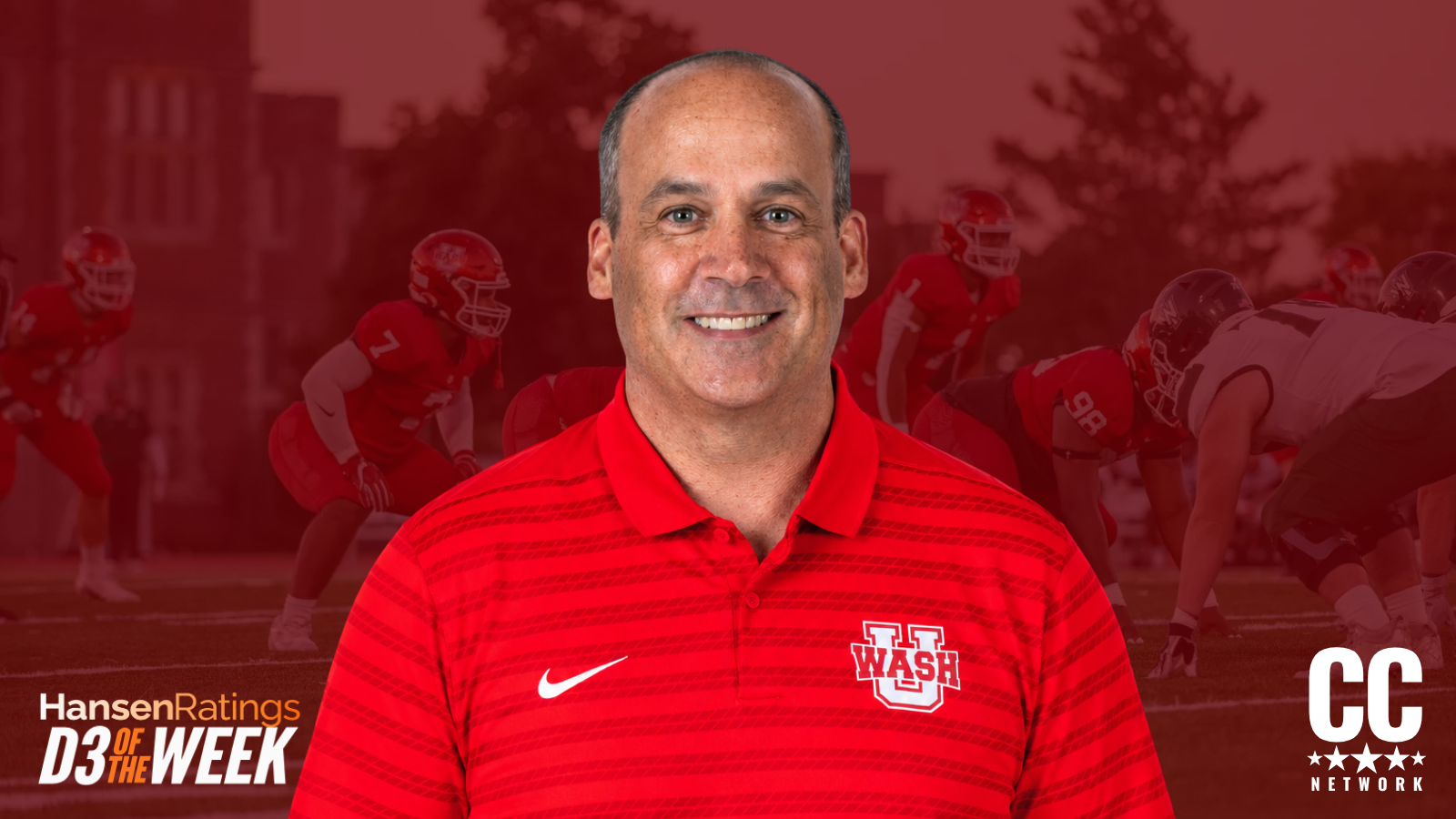
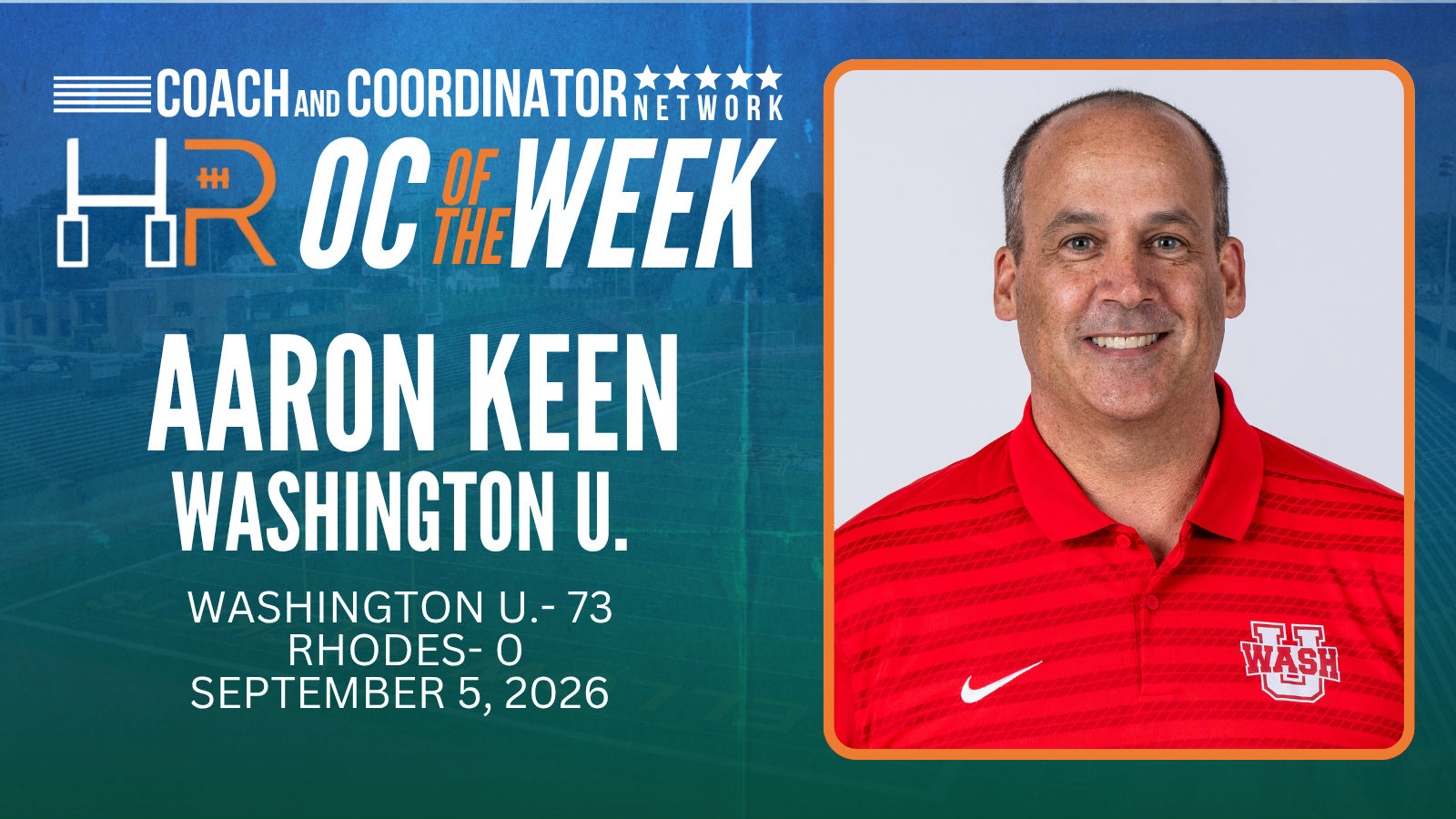
Aaron Keen’s offense at Washington University in St. Louis put up 73 points in a 73-0 week-one win over Rhodes College. By Logan Hansen’s count at Hansen Ratings, the Bears finished with 30 first downs, more than 300 yards rushing, more than 300 yards passing, two quarterbacks who combined for over 14 yards per dropback, five running backs averaging nearly seven yards a carry, and exactly one play that lost yardage all day, a one-yard loss on a rush early in the game. The only possessions that did not produce points were a punt on the fourth series and a turnover on downs on the last one, when Wash U was trying to run out the clock.
So naturally, the first thing Keen wanted to talk about was the punt.
The play that still ticked him off
Keen serves as both head coach and offensive coordinator, and he had already diagnosed the two earlier possessions he wanted to learn from before the conversation started. One ended in a field goal with the backup quarterback in the game. The other ended in the punt, with the starter. Both had the same beginning: an incomplete RPO throw on first down that left the offense in second and long.
“You’ve got to get half of it back and then convert on third downs, typically,” Keen said. “And we were unsuccessful in those attempts.”
He calls RPOs great plays, with a condition attached. “If you throw incomplete, you’ve got offensive linemen who are ticked off that the run game’s going, and I’d rather hand the ball off. So you have to be smart with it and you have to be really good at what you do if you’re gonna throw RPOs.” CCN’s Keith Grabowski put it to his own young players another way: an incomplete RPO throw is a run of zero.
What stands out is who hears that message. Keen addresses it weekly with the whole offensive group in the room together, so the linemen understand the decision process the quarterbacks are going through, and everyone knows that after an incomplete pass “we’re gonna have to rally and find a way to get out of that situation.”
That is one possession out of a 73-point day. The rest of the conversation was about everything that went right, and why.
It wasn’t just the starters who scored 73
Keen’s first comment on the win was not about his starters. It was about everyone else.
“Anytime you’re able to score those points, it’s the vast majority of your roster that’s playing well, not just your starters,” he said. “The starters play the first half, and we had some guys come in and finish the game off the right way, and everybody left the field feeling great about the way that they performed.”
The pattern in Hansen’s numbers supports that reading. Two quarterbacks. Five running backs. Points from the second unit after the first unit sat down. A 73-0 game with one punt is a depth result, and the rest of the conversation was really about how a program with Wash U’s constraints builds that depth during a game week.
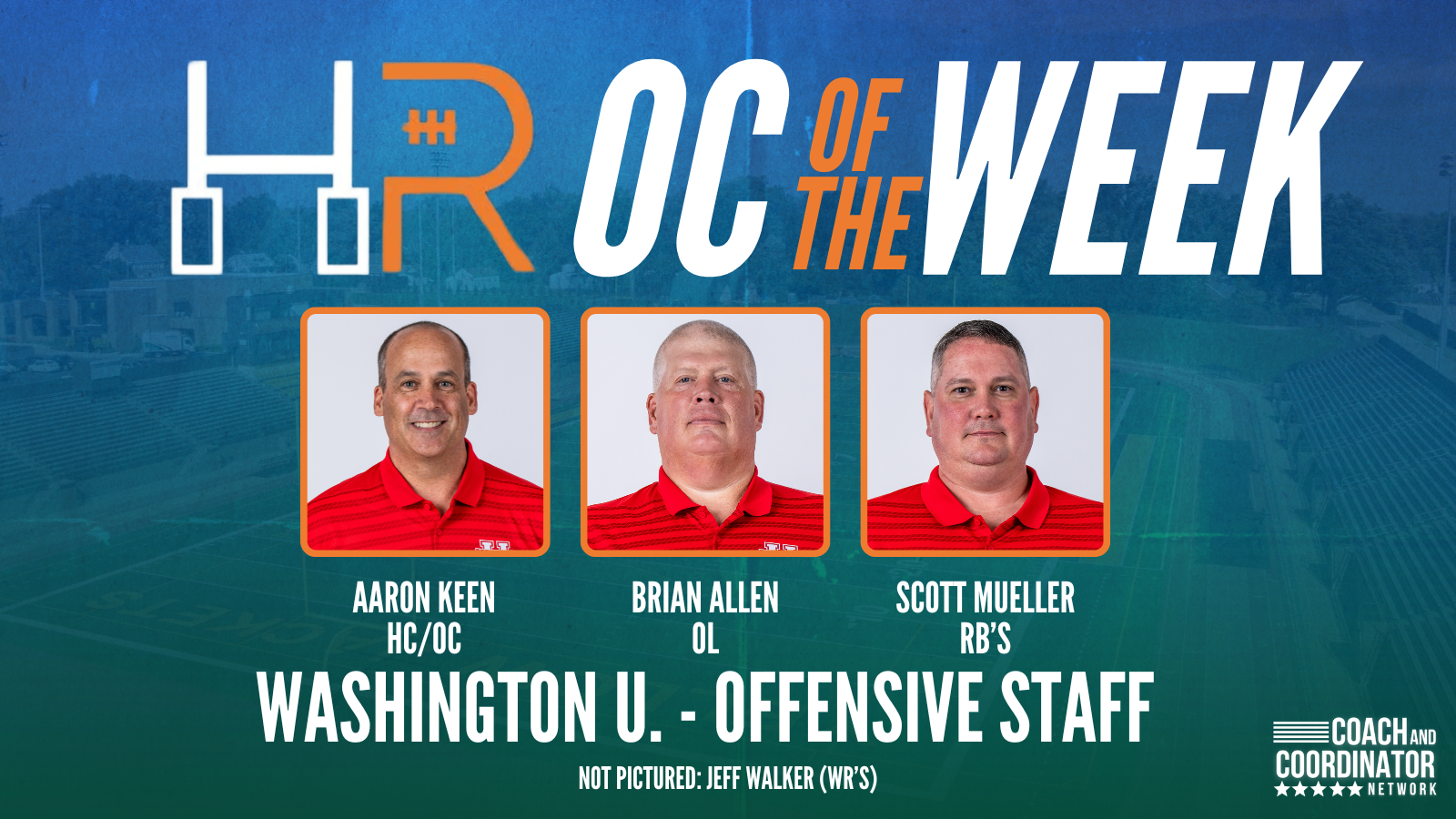
Keen credited his staff first, and it is not a large one. Scott Mueller coaches the running backs and serves as recruiting coordinator. Brian Allen coaches the offensive line. Jeff Walker, a part-time coach, handles the wide receivers. “It’s a small, limited staff,” Keen said, “but they do a great job of preparing their entire room to be able to execute our schemes that week against that opponent. And that certainly showed up on Saturday.”
Everyone who made the trip, in Keen’s telling, had an ample number of reps during the week against the fronts and coverages they were going to face. Getting there is the hard part.
118 players, four divisions, one practice window
The problem at Wash U is not effort. It is the calendar. Keen has 118 players on the roster, and they are spread across four academic divisions at the university, the bulk of them in three: engineering, arts and sciences, and business. Their class schedules do not line up.
“So finding practice time and meeting time and lifting time during the week where we can get everybody there,” Keen said, “we have to prioritize practice.”
The solution is a layered day built around the one thing that has to happen. Position groups meet twice a day, one meeting potentially in the morning and one right before practice, so that every player gets the information regardless of which meeting his schedule allows. A 10-to-15-minute walkthrough as the team takes the field fine-tunes what was covered in the classroom. Then practice, where the goal is multiple reps of the scheme they plan to run, in both the run game and the pass game.
Practice itself is short. Keen acknowledged that short practices are in vogue right now thanks to Indiana, but Wash U did not arrive there by trend.
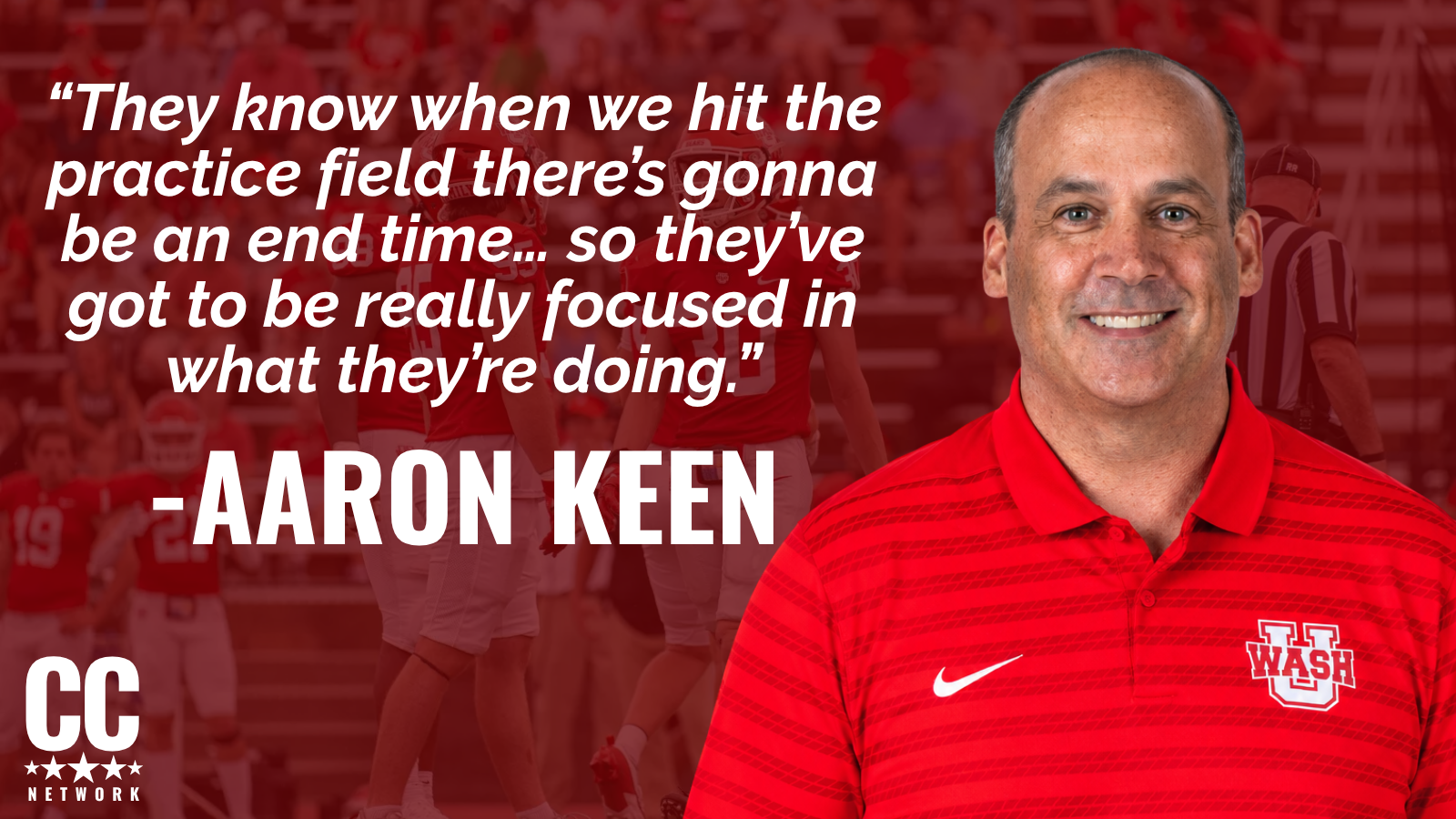
“We’re forced to do it because we just have a lot of things going on academically here and with their lives,” he said. “So they know when we hit the practice field there’s gonna be an end time and we’re gonna be out of there. They’re gonna move on with their lives. And so they’ve got to be really focused in what they’re doing and not make mistakes, right? And if we make mistakes, we’ve got to correct it very quickly.”
One way to read the box score is that this is what a practice week built on a hard end time looks like when it works: a team that cannot afford to waste reps did not waste many on Saturday either.
Eight plays at a time
Wash U runs what Keen calls a pro-style practice, meaning the offense goes against the defense’s scout look and then flips, rather than the college model of dedicated scout-team units he used at Eastern Michigan. He admits the change has been challenging because it produces fewer reps. What it produces instead is quality and competition, especially when the opponent’s defense resembles Wash U’s own, because then the defense can be turned loose.
The mechanics are specific. Defensive coordinator Jeff Fisher runs the scout defense against Keen’s offense in eight-play rotations: five plays with the ones and three with the twos. The defense gets the same eight-play structure when the periods flip. Tuesdays include three rotations; Wednesdays and Thursdays, four.
That is a limited number of team plays, and Keen knows it. Skelly and individual periods have to carry the rest of the preparation.
Layered on top are what Wash U calls unscripted periods, which Keen credits to Chris Creighton, whom he worked with at Eastern Michigan. These are scrimmage-style situational periods, five or ten minutes some days, that can be ones against ones, twos against twos, or a period for the “young guns,” freshmen who may not be playing at the varsity level yet. The situations rotate: red zone, two-minute, two-point plays. The team also runs inside run and team run good-on-good and some team tempo against itself, so the offense gets used to playing fast and the defense gets used to facing it.
Keen’s reason for keeping the unscripted periods is as much about himself as about the players.
“As a play caller, they’re invaluable for me because I’ve got to call the game not off a script, but call situational football even in practice,” he said. “We’re not live during it. We’re still thudding it up or tag tempo. But to have to look at down and distance and make a call, and for our guys to know what I’m gonna call in those certain situational football, I think it’s invaluable for us.”
A coordinator who only calls plays on Saturday is a coordinator who only gets reps on Saturday. The unscripted period is how Keen makes sure that is not true.
Getting the horses to the race
Ask Keen about workload management and he will tell you what he does not have. He believes in wearable technology wholeheartedly. Wash U does not use it, because the staff is too small to manage the data and because Division III budgets are already being stretched by helmet and video technology. The weight room has all the measurement tools you could want. On the practice field, workload is handled the old-school way, by a coach counting.
The counting is deliberate. Receivers and defensive backs run more than other positions, so Keen’s top receiver never goes back-to-back plays in a scripted practice period. In a scrimmage or unscripted period, the receiver gets a set number of plays, and Keen is tracking whether he has gone four, five, or six in a row before a fresh player goes in. The goal, in his words, is to “get the horses to the race in the end on Saturday.”
He is not trying to shield those players from practice. He wants his best receiver running the motion he will run in the game and seeing the coverage looks he will see on four verticals so he can make the adjustments live. The tension is that the same player has to be fresh on Saturday, so the reps have to be chosen rather than accumulated.
That thinking extends to individual periods, where Keen questions drill volume out loud. “Do you really need 10 bag drills to work on a scoop and score? Is it one to two that are gonna suffice with it? How many times do I have to have a receiver going through a box drill and working on 90 degree, 45 degree cuts? Can we work a little more top of the route as opposed to running a full route, and still get him in condition?”
Where the season’s workload starts
The most instructive part of Keen’s approach may be an adjustment he made after arriving at Wash U, and it starts in camp, not in game week.
He came to Washington University with the same camp philosophy he had at Eastern Michigan: two-and-a-half-hour practices and a heavy install fired at the players from day one. That worked at Eastern because the players had been on campus all summer, training with the staff and learning the mental side of the offense. Many Wash U players arrive in camp coming off summer internships, Keen said, not working at the same physical level he would have expected at Eastern and without the same mental grounding in the system.
So he slowed down. Credit for the idea goes to Pedro Arruza, the head coach at Randolph-Macon and a good friend of Keen’s. Wash U’s first three practices of camp run no longer than an hour and a half. Then a full day off from the field, lift only, to rest the legs. Then the practices grow, potentially to 24-period or two-hour sessions, three or four in a row, followed by another break. The reps build gradually, and so does the players’ readiness for the length of a season.
Keen’s examples suggest that his week-one depth was not a game-week product at all. It was built in August, one manageable practice at a time, for a roster that could not be treated like the one he had at his previous stop.
The question for your program
Wash U’s constraints are unusual, but the questions Keen answers with his practice design are not. If your practice had a hard end time tomorrow, what would you cut first, the tenth bag drill or the third team rotation? Who on your staff is counting how many plays in a row your best receiver has taken? And when your first-down RPO falls incomplete, does your offensive line understand why it was thrown?
Keen’s week-one box score is what it looks like when a program has answered those questions for its whole roster, not just the players who start.
About Aaron Keen
Aaron Keen is the head football coach at Washington University in St. Louis, where he also serves as the Bears’ offensive coordinator. A 1994 WashU graduate and former Bears quarterback, Keen returned to his alma mater as head coach in January 2020 after more than 25 years in college coaching.
Before returning to WashU, Keen spent six seasons at Eastern Michigan, including three as offensive coordinator and quarterbacks coach. He previously served as acting head coach at Minnesota State, where the Mavericks went 24-2 across the 2012 and 2013 seasons, and held coaching roles at Nebraska-Omaha and Illinois College. Keen also began his coaching career at WashU, working on Larry Kindbom’s staff from 1994-2002.
As WashU’s head coach, Keen has led the Bears to multiple eight-win seasons and three appearances in the Culver’s Isthmus Bowl. A three-year starting quarterback during his playing career, Keen earned All-American and all-conference honors in 1991 and 1993 and received an NCAA Postgraduate Scholarship in 1994.
Keen and his wife, Michelle, have two sons, Brandon and Cody, and a daughter, Addison.
Related:
Connect on X:
Keith Grabowski: @CoachKGrabowski
Logan Hansen: @LogHanRatings
Aaron Keen: @CoachAaronKeen
Keith Grabowski (00:00.721)
I’m joined by Aaron Keen, the head coach at Wash U. He also serves as the offensive coordinator, and they had a nearly perfect performance this week in terms of being able to convert their series. Only one punt and then one turnover on downs late in the game. So coach, great performance here in week one, and congratulations on this honor as our offensive coordinator of the week.
Aaron Keen (00:24.374)
I appreciate that. You know, the guys played awful well. And I think anytime you’re you’re able to score those points, it’s the the the vast majority of your roster that’s playing well, not just your starters, right? It’s the starters play the first half and and we had some guys come in and finish the game off the right way and and everybody left the field feeling great about the way that they performed.
Keith Grabowski (00:46.363)
Yeah, I think that really comes down to regardless of the opponent, it’s focus and execution. And and I know before we got going you said, you know, geez, that one punt early in the game, that really ticked me off. But you know, I I think, you know, obviously a game like this where everything’s going right, there’s certainly a lesson to be learned from that one that you can use to say, hey, you know, later in the year, maybe even next week, this this one we can learn from here because it might help us.
Aaron Keen (01:15.074)
Yeah. there’s you know, it’s in both of our series. One one resulted in a field goal with your bank of quarterback in, one resulted in a punt with our starter, kind of both started off with RPO throws that we were incomplete and you put your your offense in a situation where you’re second down and long and those are challenging, right? Regardless of opponent, it’s just you you’ve got to get half of it back and then convert on third downs, typically and and we were unsuccessful in those attempts and
And that’s what Eatsuch is a coach, right? But they’re great learning opportunities for our quarterbacks. we talk all the time about, you know, those RPOs are great, but if you throw incomplete, you’ve got offensive linemen who are ticked off that the the run game’s going and and I’d rather hand the ball off. So you have to be smart with it and you have to be really good at what you do if you’re gonna throw RPOs.
Keith Grabowski (01:48.559)
Yeah.
Keith Grabowski (02:02.584)
Yeah, I I try to preach to our young players, you know, in the in the program I’m coaching in this year all the time, like, hey, that’s run game. That’s a that’s a run of zero right there, right? And you know, it gets their attention really quickly. Guys that you know, when we do something like this, whether it’s throw a quick game or throw a a a screen or whatever it might be, like we’re calling that in place of the run, so it better produce.
Aaron Keen (02:25.577)
Absolutely. Yeah, that’s a it’s a key thing. We’re we’re certainly addressing that with our players on a weekly basis. And I like to have the whole group together when I’m talking about that, right? So our offensive line understands that I care about the run game and and this is how I’m communicating to our quarterbacks and this is what they’re hearing and and the decision process that they’re going through so that they understand if there are any errors that happen or an incomplete pass and and then we’re gonna have to rally and find a way to get out of that situation.
Keith Grabowski (02:52.11)
Yeah, nothing worse than getting an offensive lineman angry after he kicked his guy’s butt on an RPO. I remember when we first installed it, I was at BW as a quarterback’s coach that year and our our left tackles, you know, we’re in practice or scrimmage or something like that. Why are we throwing the ball? Like, you know, he’s knocking his guy down the field.
You know, you drop a bubble or something like that and yeah, I mean, those guys are doing some hard work there that you know, we it took us u explaining to this is what it is, this is an RPO and that was in the early days of that stuff at BW. So i it it does emphasize the importance though of like, you know, hey, this is your responsibility. It’s not okay to drop the ball or misfire on that RPO when
We’re giving you the option here of of a play that, you know, hey, if we ran the ball, you know, we’re maybe guaranteed some yards.
Aaron Keen (03:43.329)
Yeah. Yeah. Yeah. E even Jeff Saturday and Peyton Manning got into it on the sideline on a run pass option. So you know, there’s it ev happens to the best of
Keith Grabowski (03:51.953)
Exactly. Well, i in a in a game like this where everything’s going right, the focus as I mentioned, right? It’s easy to for a a first team to go out and do those things and execute. The challenge comes when it’s the guys maybe who normally don’t get that time on the field for them to level up their play and to continue what that first team did.
again, that takes come some coaching, but it takes some maturity on their part to realize their responsibilities that it’s not just, hey, game’s over, mop up time that, you know, we’re preparing you, we’re developing you to do those exact same things.
Aaron Keen (04:30.123)
Yeah. I obviously focus on the players part in their week of preparation to make sure that they’re ready. And we do you know, everybody that was going on that trip had an ample number of reps during the week to prepare to to see the fronts they were gonna face, the coverages they would face and and run those schemes. I have some experience at it. But I think some credit goes to our coaches, you know, Scott Mueller is our running back coach and recruiting coordinator, Brian Allen’s our offensive line coach. and we have one part time coach on the offensive side of the ball.
in Jeff Walker who handles our wide receiver. So it’s a small, limited staff, but they do a great job of preparing their entire room to be able to execute our schemes that week against that opponent. And that certainly showed up on Saturday.
Keith Grabowski (05:15.204)
The the challenge, you know, when you get to the school year in D three football, it’s camp’s great. We have a lot of time and film and we can do all those things, walkthroughs. the challenge is when you do get to the season and and with the limited staff. you know, a lot of times you look at D three staffs, there might be a couple full-time guys there the whole day, and then maybe the part-time guys don’t get there later. So it is trying to find those opportunities to give them the reps, whether those are film reps, walkthrough reps, mental reps.
etc. How do you guys go about that? How do you make sure that, hey, you know, in in addition to what we do on the field, here’s how we’re going to prepare you for game day.
Aaron Keen (05:55.404)
That’s an even bigger challenge at a place like Washu, where, you know, we’ve got hundred and eighteen players on a roster right now, but they’re divided between four different divisions at our university and bulk of them in three. So engineering, arts and sciences, and and business. And their academic schedules are completely different, right? So finding practice time and meeting time and lifting time during the week where we can get everybody there. We have to prioritize practice. We’ll have two meetings per day.
with our position groups, one one potentially in the morning and then one right before practice so that we can get everyone the information they need. We have a 10 to 15 minute walkthrough as we take the field, whether it’s in the morning or afternoon for our practice, so that we can, you know, kind of fine-tune some of the things that we learned in the classroom and and get rolling with it. And then we’re hoping to get you know multiple reps with the scheme that that that we’re trying to execute, whether it’s in the run game or pass game during practice.
But we’re a pretty short practice team, right? I mean, that’s it’s kind of in vogue right now, thanks to Indiana, but we we’re forced to do it because we just have a lot of things going on academically here and with their lives. So w they know when we hit the practice field there’s gonna be an end time and and we’re gonna be out of there. They’re gonna move on with their lives. And so they’ve got to be really focused in what they’re doing and not make mistakes, right? And if we make mistakes, we’ve got to correct it very quickly.
Keith Grabowski (07:13.624)
What what’s the mix look like for you as you get into like team periods or group periods between the ones and the twos?
Aaron Keen (07:20.885)
Yeah, so we we’re a pro style practice team here, which has been interesting, right? I’ve I’ve came from Eastern Michigan where it was completely scout team units and the college style practice. And so going back to pro style practice has been challenging somewhat because you get less reps. but we get really quality reps. it’s very highly competitive, especially if we have a defensive scheme that’s very similar to our defensive scheme because we can kind of turn those guys loose a little bit.
So our defensive coordinator, Jeff Fisher, is out there running our our scout team defense against us offensively. And then, you know, eight plays later, we’re we’re flipping it around and running two huddles against him. so we go eight play rotations and we get five with the ones and two with the or excuse me, three with the three with the twos, and and eight total plays, and then we’ll get the same with the defense. And then, you know, it’s like on Tuesdays, we get three rotations of that. on on Wednesdays and Thursdays, we’ll get four rotations. So
We’re limited on the number of plays that we’ll get. We try and supplement that with Skelly reps and things that we’re doing in individual to try and make sure we’re prepared for what we need to see.
Keith Grabowski (08:25.188)
Yeah, it does give you the opportunity and and more of a pro style practice too to do some good on good. Now are you guys any of those periods where it’s just Euro versus your D and you guys call your own things?
Aaron Keen (08:37.963)
Yeah, we’ll have what we call unscripted periods, which are more scrimmage type of stuff where it might be our ones versus ones or twos versus twos, or we call our young guns, you know, the guy freshmen who may not be playing at the varsity level and will get a chance to to scrimmage them a little bit in situational football. I wouldn’t say they’re they might be 10 minute periods. some days it might be five minute periods. It might be, you a red zone or two minute drill or excuse me, two point situations or whatever they are. And then we also have your typical inside run or
or team run where we’re we’re good on good. We we run some team tempo against each other just to kind of make sure we’re playing fast offensively and that we’re used to it defensively. And so we try and, you know, certainly the things that we feel like can carry over with our opponent, we’re just gonna be able to run it with our our good guys out there as fast as possible and and with good technique and make sure that we’re having to play good football in practice.
Keith Grabowski (09:31.845)
Yeah, I’ve I’ve heard, you know, especially on the podcast, more and more programs making sure they they get some of that good on good periods. I I was surprised at a you know, a program like North Central and all the guys that they get, they were doing a fair amount of it weekly too, just to you know, emphasize the speed of the game, obviously. Like, you know, sometimes those those younger guys can only give you so much as far as what you’re looking at. And there’s a lot of value in that to be able to
Get used to what the game is gonna look like on Saturday in terms of how fast it moves, right? Because it all moves faster than practice.
Aaron Keen (10:07.031)
Yeah. And I I I would say this, I’ll give credit to Chris Creighton. I worked with him at Eastern Michigan and he was big on the unscripted periods or scrimmage periods at the end of practice. We kind of move them around our practice schedule, but as a play caller, they’re invaluable for me because I I’ve got to call the game not off a script, but call situational football even in practice. and we’re not live during it. We’re still thudding it up or tag tempo, but you know, to have to look it down a distance and make a call and for our guys to
Keith Grabowski (10:21.541)
Mm-hmm.
Aaron Keen (10:36.353)
to know what I’m gonna call in those certain situational football, it it’s I think it’s invaluable for us.
Keith Grabowski (10:44.258)
Yeah, it’s always important for a coach to get his reps too. It’s not not the best thing when your only reps come on game day as well. Well, coach, i I know you mentioned workload, player workload, and you know, that definitely is another thing that is trending and a lot of guys are paying attention to. Like how many reps is your number one guy, for example, truly gonna be good at there. I we we did that study at BW and you know, it was like
Aaron Keen (10:49.953)
Yep. Absolutely.
Keith Grabowski (11:09.948)
one of our best players, we just determined, you know, through watching film and seeing him in practice that number for him was like forty-three reps. So we were very careful about when those forty-three were used, that we were getting them, you know, spelled early in the game and that we wanted them in the fourth quarter. So how do you guys go about workload management? And do you do you have any of the technology, I guess, that goes along with that?
Aaron Keen (11:31.394)
That’s a great question. I would love to say that we have this wearable technology that made a made a big difference for us. We just like I think I believe in it wholeheartedly. We do not have the staffing to be able to manage it. budget, I you know, that that is an issue with any technology and division three is requiring more and more with helmet technology and video technology. And there’s going to reach a limit where we can’t spend as much money. that is something that we constantly evaluate, though, the wearable technology, because I I’m intrigued by it, right? We’ve
Keith Grabowski (11:52.248)
Yeah.
Aaron Keen (11:59.97)
We’ve got all the technology you can imagine in our weight room, and it certainly helps us to to to have that and measure measure how fast we’re moving weights and but to know workload is a big deal for me. And so we’re more doing it you know, the old school way and just trying to manage it early on. Like I would say with our receivers, that’s receivers and defensive backs tend to run more than other positions and and so you know, we’re very careful to have the right number
of players that are getting reps during practice to make sure we’re prepared to to play on a Saturday, but we’re also keeping our guys fresh. That’s that’s a balance. And so, you know, our top receiver will never go back to back plays in practice, Well, that unless we get into a scrimmage situation or an unscripted, and then they get, you know, a certain number of plays. And then I’m always manning or managing whether they’re going four plays or five plays or six plays in a row and then I’ll get a fresh guy in,
just to make sure that I we can get the horses to the race in the end on Saturday. because I think there’s so much value in a player getting the motion that they’re gonna have to run and and knowing the defensive look that they’re gonna face, the different coverage looks that they might face on a four vertical play or whatever it is, and having to make the adjustments. and then you just have to be careful to to to make sure you’re not overdoing it physically with them. Some of that comes down to what we’re doing an individual as well, right? I mean there’s
I’ve heard coaches talk about this. Do you really need 10 bag drills to to to work on a scoop and score? I mean, is it one to two that are gonna suffice with it? how many times do I have to have a receiver going through a box drill and working on 90 degree, 45 degree cuts? can we work a little more top of the route as opposed to running a full route? and and still get him in condition. Those are things that we constantly talk about in our practice preparation. I think the shorter practices help us out as well because we
we’re we’re not gonna overdo it with our guys. and so I this starts in camp for us. And you know, Pedro Arusa, the head coach at Randolph Macon is really good friend of mine and and this is an idea I got from him. I I came to Washington University, you know, with the same philosophy I had at Eastern Michigan where we were gonna have two and a half hour practices in camp and, you know, we had a load of install we’re gonna fire at him. Well, we had our guys there all summer, right? And so they were working with us. They mentally knew things.
Aaron Keen (14:21.737)
And I quickly learned when we got here that our guys coming off internships in the summer, they’re not working at the same level that maybe I would have worked them at at Eastern Michigan in the summer. And and they don’t know those things mentally the way they would have at Eastern. It it’s gonna we’re gonna have to slow down our install, shorten our practices, make sure that we’re building our reps up. We don’t go any longer than an hour and a half for our first three days of practice. We take a day off after that completely, just lift. and so we rest our legs a little bit and
And then we’ll jump into potentially twenty-four period practice or two hour practices and we’ll go three to four in a row and then take another break so that we’re kind of building our reps up and and helping our guys acclimatize to what they’re gonna face during the course of a long season.
Keith Grabowski (15:05.87)
Yeah, really important. Pedro shared a lot of those ideas on our our sprint based football series. I’ll be sure to link that one in in our show notes here. really intriguing stuff that he’s done and and does a great job there, obviously at Randolph Making. but yeah, those things are are just so important as especially, you know, it’s it’s not just the week to week, it’s over the course of the season. Like what are these guys gonna look like in week ten, eleven, into the playoffs, etc.
Aaron Keen (15:34.655)
Absolutely. And
Keith Grabowski (15:34.8)
Well coach, I I I appreciate you taking the time. Congratulations on the honor and a great week one here. And you know, best of luck to you and the Bears here the rest of the season.
Aaron Keen (15:43.991)
Thank you. We’ll hope to keep it rolling. Thank you.