

Dante Scarnecchia coached the offensive line for the New England Patriots, and in his C.O.O.L. Clinic talk on position meetings he said the two most important things a staff does with players in a day are the position meeting and the time on the practice field. Most of the talk is about running the meeting well: how the room is set up, cut-ups, chalkboards, daily notes, 40 minutes at a time with a five-minute break.
He also gave his linemen written tests.
“I think written tests are great teaching aids to see what a player knows,” he said. “And I give a lot of written tests to them, especially in the spring and especially during training camp.”
What made Scarnecchia’s tests unusual was that they were not always quiet. Sometimes he gave the room 20 minutes and let the players work through every question together.
The test tells him what they know
Scarnecchia used the tests for both purposes in that sentence. They showed him what a player knew, and the act of completing them was part of the teaching. He said he used them especially in the spring and training camp, periods when players are doing a lot of system learning.
Research on retrieval practice supports the basic premise. Having someone pull information from memory can strengthen later retention more than simply studying the material again. In a well-known 2006 study by Henry Roediger and Jeffrey Karpicke, students who were tested on a passage retained substantially more after delays of two days and one week than students who repeatedly studied the same passage, even though the restudy group did better five minutes out and felt more confident about what they knew.
Learning researchers call this retrieval practice: instead of seeing the answer again, the learner has to produce it. Scarnecchia never uses the term. He simply makes his linemen write the calls down.
Twenty minutes, and you can talk
“A lot of times I’ll give them all a test and I’ll say, look, you guys got 20 minutes to get this done. I want them all done in 20 minutes, but it can be collaborative. That is to say you can talk about each question amongst yourselves.”
His reason was communication.
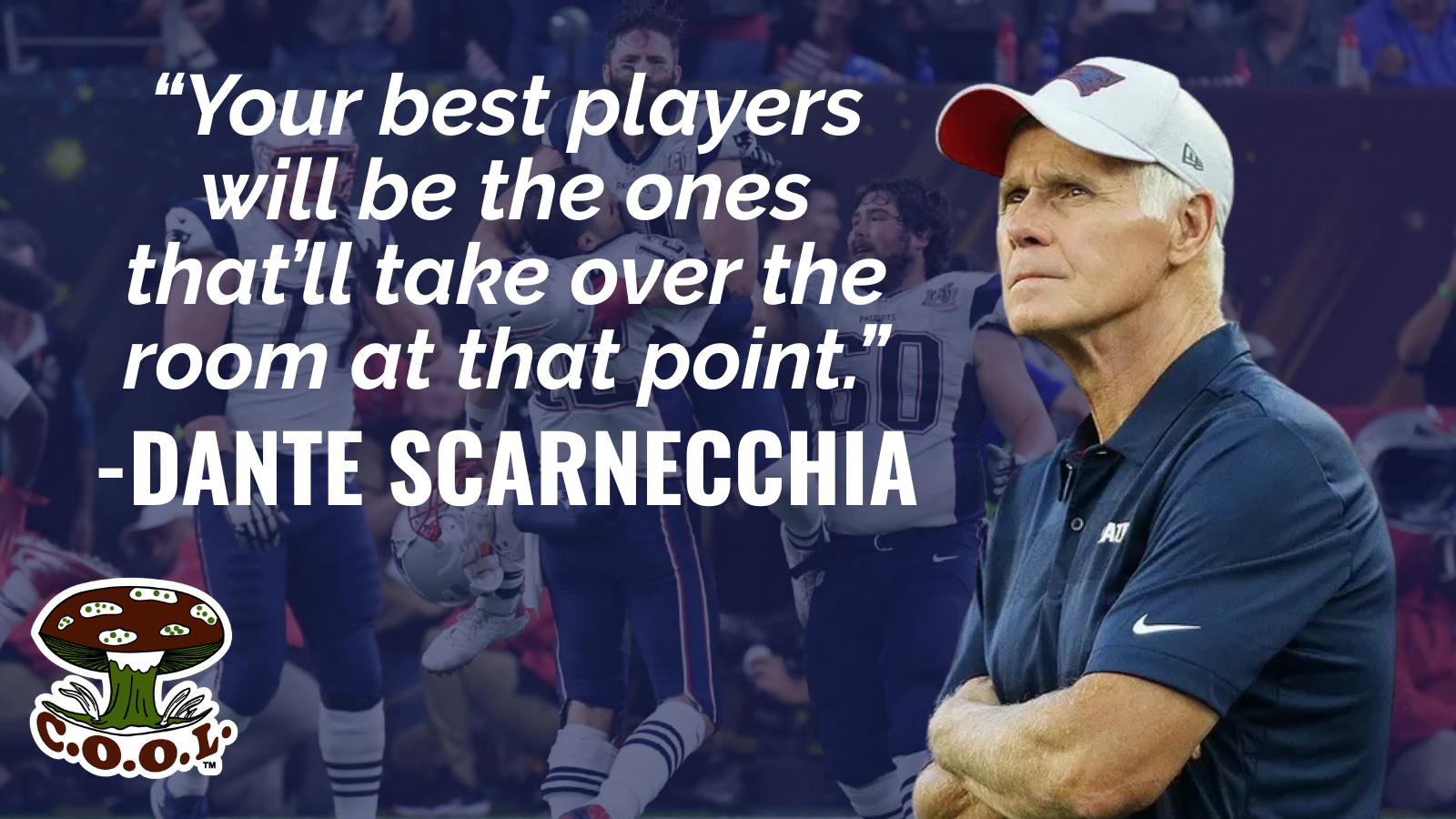
“What greater way to get guys to communicate, how to get things done. And believe me, your best players will be the ones that’ll take over the room at that point. Well, your best players are guys that are going to be playing. And a lot of times they’re going to be carrying guys that aren’t as good mentally along with them. So it gives them a forum to open up on themselves and keep everybody on the same page relative to the system that you’re trying to teach.”
An offensive line works because five players have to understand how the call fits together, and the collaborative test puts that communication in a chair. The players who know the system explain it out loud to the players who do not. The players who are going to play are the ones carrying the room. And Scarnecchia gets to watch who takes over.
Research on collaborative testing is less uniform than the research on retrieval practice, but studies have found benefits ranging from better performance on the test itself to stronger later retention, with some evidence that lower-performing students benefit especially from working alongside stronger peers. Other studies have found the immediate performance benefit without improved long-term retention. Scarnecchia did not rely on the collaborative version alone.
Words or diagrams
“The test questions can be asked in either words or diagrams. To me, they’re both perfect,” he said. “If it’s a two-word answer, great, two blank spaces. Or if it’s a diagram, show me the blocking for this, you know, 64 protection, three-by-one formation against this blitz.”
Drawing the protection against a specific blitz gets much closer to what the player actually has to understand on the field. The player has to produce the picture, not recognize it. “Most importantly,” Scarnecchia said, “they’re great ways to get people to understand your call systems.”
The individual version of the test asks for more than a player’s own assignment.
“You have to call every block for this run. And if it’s not a collaborative test, that means that your center’s got to know what the guard-tackle call is, or the right tackle’s got to know what the backside call is, on and on and on.”
That is the difference between this and a vocabulary quiz. The center has to know the call between the guard and tackle. The right tackle has to know what is happening on the backside. Every player can be asked to put down every block on the play, including the ones that belong to the man next to him, or draw the protection against a specific blitz. Scarnecchia is testing whether his linemen understand the whole system, not just their piece of it.
“The more you put all those things down,” he said, “the more you learn them and better you ingrain everybody into your system and way of doing things.”
The rest of the meeting room
The tests fit a meeting room where the players are constantly producing rather than watching. Scarnecchia filled every chalkboard before a meeting started, because “guys see it, they write it, they say it, it’s all visual.” He called on players by name and asked what call they would make against a given look, because it “keeps everybody engaged on their toes.” He told players a hundred times that there are no dumb questions, that a question one player asks is one that five others in the room did not have the guts to ask, and that if you say there are no dumb questions you cannot laugh when one comes.
In his final four years his meeting room was set up so that he faced the players instead of the screen, and he could see who was nodding and who was giving him what he bluntly called the “all fucked up look,” the sign that a point was not coming through. He said he wished he had done it in the previous 44.
Put it on paper
Scarnecchia’s test could be words or diagrams. It could ask for a two-word answer or every block in a protection against a named blitz. Sometimes the players worked alone and every one of them had to know every call. Sometimes he gave them 20 minutes and let the whole room talk.
The point was the same each time. Put the system on paper. Make them produce the answers. Find out what they know.
And sometimes, step out of the way and find out who teaches the room.
Want to keep growing as an offensive line coach? Join the Mushroom Society for year-round development, drills, scheme, roundtables, active conversations, and a community built for OL coaches.
Access Coach Scarnecchia’s presentations:
Dante Scarnecchia 2025 – Things I Have Learned Along the Way

Related:
Research cited
Roediger, H. L., and Karpicke, J. D. (2006). Test-Enhanced Learning: Taking Memory Tests Improves Long-Term Retention. Psychological Science, 17(3). https://journals.sagepub.com/doi/10.1111/j.1467-9280.2006.01693.x
Cortright, R. N., Collins, H. L., Rodenbaugh, D. W., and DiCarlo, S. E. (2003). Student retention of course content is improved by collaborative-group testing. Advances in Physiology Education, 27(3). https://journals.physiology.org/doi/full/10.1152/advan.00041.2002
Giuliodori, M. J., Lujan, H. L., and DiCarlo, S. E. (2008). Collaborative group testing benefits high- and low-performing students. Advances in Physiology Education. https://journals.physiology.org/doi/full/10.1152/advan.00101.2007
Leight, H., Saunders, C., Calkins, R., and Withers, M. (2012). Collaborative testing improves performance but not content retention in a large-enrollment introductory biology class. CBE Life Sciences Education. https://www.lifescied.org/doi/abs/10.1187/cbe.12-04-0048