
Special teams coaches spend a lot of time teaching schemes, assignments, and technique. Justin Lustig starts somewhere else.
In this free lesson from The Give, the Penn State special teams coordinator explains that special teams only matter to players when coaches give them meaning. That means connecting the phase to team success, player development, and the standard of the whole program.
Lustig does not treat special teams like a side period. He treats it like a daily culture builder.
Special Teams Must Echo the Head Coach’s Message
Lustig makes a simple point that more coaches should study: special teams gives assistant coaches a chance to reinforce what the head coach already values.
At Penn State, that message comes down to three things: ball security, explosive plays, and field position. Those are not separate from the game. They are often the fastest way to swing it.
Lustig puts it plainly: “We say the ball is the program.”
The phrase gives players more than an assignment. It shows them that ball security is not just a special teams coaching point. It reflects the team’s standard.
Why Lustig Starts With Outcomes Instead of a Scheme
Before he gets into drills, Lustig explains why special teams matter to the players.
He points to three outcomes that change games:
1. Ball Security
Turnovers can flip a game in one snap. Lustig backs that up with Penn State’s numbers and uses them to show players that takeaways and ball security are not abstract ideas. They directly connect to winning.
2. Explosive Plays
Special teams can create instant offense or erase bad field position. A return, a block, or a hidden-yardage swing can do more than any speech during the week.
3. Field Position
Lustig does not talk about field position as a boring stat. He treats it like a real battle. Every unit can either hand the team an advantage or force the offense and defense to play uphill.
Players buy in faster when they see special teams as a direct path to winning, not a place to stash backups.
How Penn State Creates Buy-In on Special Teams
Lustig also takes on one of the hardest problems in football, convincing talented players that special teams serves them, too.
His answer is smart and practical. He shows players real examples from Penn State alums in the NFL. He uses slides that highlight how often former stars played special teams, how that role helped them stick, and how it shaped their future.
Many players still see special teams as temporary work. Lustig pushes back on that idea.
Special teams can be the first step toward earning trust. At the next level, it often becomes the skill that keeps players active on Sundays. More broadly, it still shows that football rewards toughness, attention to detail, and unselfish play.
Coaches at any level can use the same approach. A high school staff can point to former players who carved out early college roles on special teams. Once players see that path, the phase no longer feels like an obligation.
The Culture Word at Penn State: Total Effort
The strongest part of this free lesson comes when Lustig explains the cultural answer he wants from his players.
If someone asks what Penn State special teams stands for, he wants them to say total effort. Then he defines it in four parts: the start, the middle, the finish, and the return.
His framework gives players a language they can repeat and coaches a standard they can coach every day.
The Start: Be Ready Before You Begin
Lustig’s standard for the start is simple: know the call, know the alignment, know the stance.
His phrase is sharp and usable: “ready before you begin.”
The idea goes beyond special teams. Players cannot play fast if they start late mentally. They cannot be physical if they are still sorting out the call. Lustig teaches preparation as part of the effort, not separate from it.
That is a valuable coaching point. Many players think effort starts at the whistle. Lustig teaches that effort starts before the rep.
The Middle: Fight for Every Blade of Grass
Once the play starts, Lustig wants his players to play fast and physical. He wants them attacking, not hesitating.
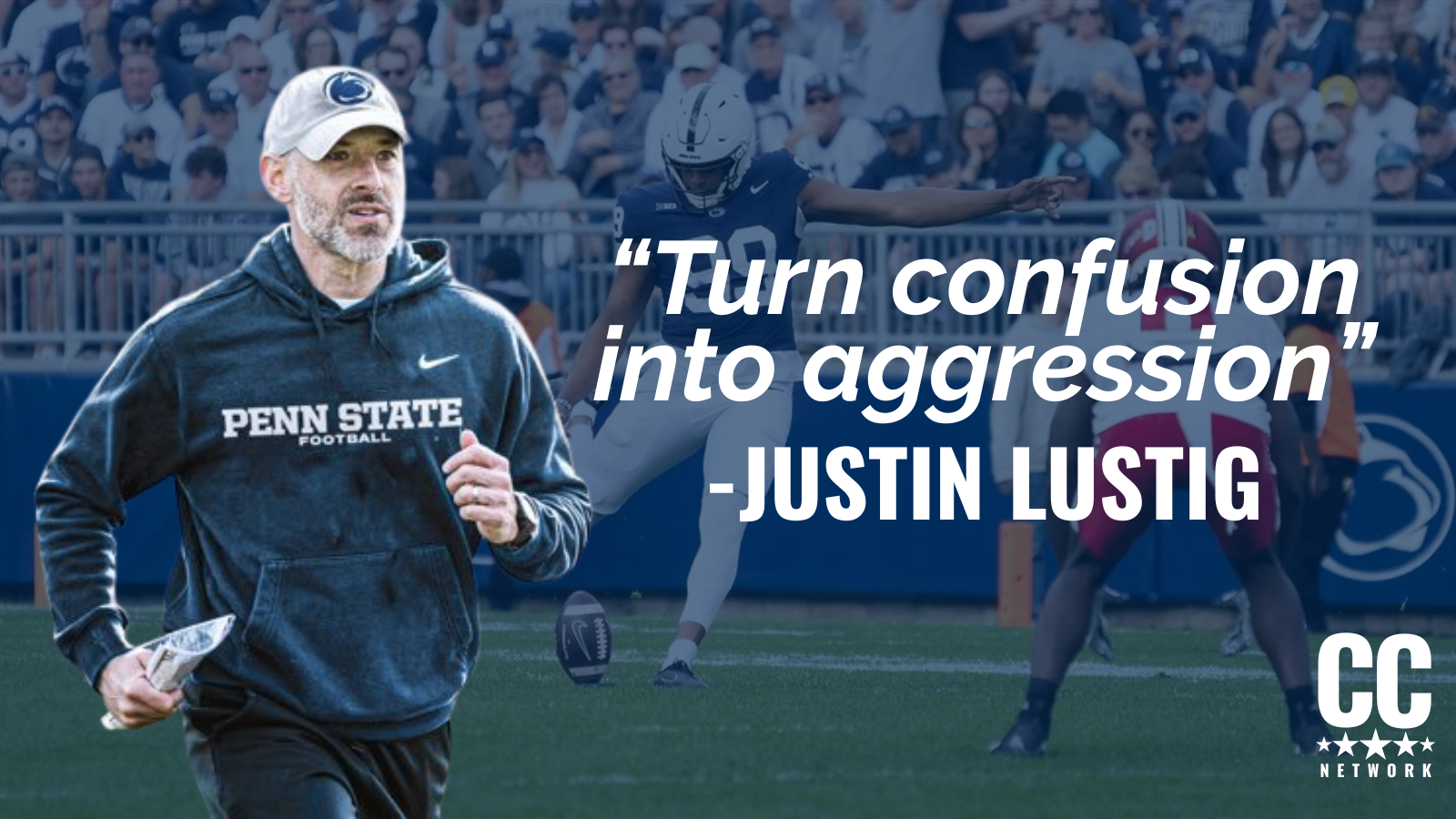
One of his best coaching lines is “turn confusion into aggression.”
The point is simple. Players do not move well when they freeze. On special teams, hesitation kills speed, leverage, and violence. Lustig would rather coach aggressive play than passive uncertainty.
The phrase also fits the phase itself. Special teams live on decisive action. Players have to trigger, run, strike, and finish. If the call has already been taught, then the rep demands trust.
The Return: Recycle Positive Energy
Lustig’s last piece is different from what many coaches emphasize, but it is important.
He believes special teams can create momentum for the entire team. His phrase for that is “recycle positive energy.”
He wants players to celebrate, connect, and send energy into the stadium after a big rep. The energy does not stay with the special teams unit. It spills into the offense, defense, sideline, and crowd.
It shows up in team performance.
Coaches often talk about momentum as if it appears out of nowhere. Lustig coaches it on purpose.
The Coaching Value in This Lesson
The best part of Lustig’s lesson is that it is not built on slogans alone. Every phrase has a coaching application.
“The ball is the program” gives players a reason to value possession.
“Ready before you begin” turns preparation into a visible standard.
“Turn confusion into aggression” teaches players how to respond under pressure.
“Recycle positive energy” reminds the unit that its impact extends beyond a single snap.
This lesson goes beyond motivation. Lustig gives coaches a framework they can use to create buy-in and coach it every day.
Final Takeaway
Justin Lustig’s free lesson is not really about special teams alone.
It is about how coaches create belief.
Players buy in when the phase connects to winning. They buy in when it connects to their future. They buy in when the standard is clear enough to repeat.
Lustig’s framework does all three.
If a coach wants to build better special teams, this is a strong place to start.
Here’s What’s Inside the Full Presentation
The free lesson introduces Justin Lustig’s thinking on buy-in, culture, and total effort. The full clinic takes coaches deeper into how those ideas get taught and applied at Penn State.
Inside the complete presentation, Lustig breaks down:
- The philosophy behind the unit and how culture, scheme, and fundamentals connect
- Return game strategy built to create hesitation and stress opponents
- A five-minute practice structure that keeps special teams organized and efficient
- Punt coverage drills are used to teach leverage, violence, and finish
- Punt return techniques for block disruption, reengagement, and downfield execution
- A more intentional approach to practice, so drills lead to real improvement.
- Meeting room accountability through simple tools that keep players locked in
- Competitive periods that bring technique and effort together on the field
The full presentation shows how each part fits together. It is not just a list of drills. It is a complete look at how Lustig teaches special teams from the meeting room to practice.
Special Teams Coordinator School is coming soon for LFG Clinic Premium members at lfgclinic.com. Join LFG Clinic Premium to access Justin Lustig’s full presentation and the growing year-round library of clinics, courses, and coordinator education.
About Justin Lustig
Justin Lustig is the Special Teams Coordinator, Outside Linebackers Coach, and Nickels Coach at Penn State. Now in his second season with the Nittany Lions, Lustig brings a long track record of building high-level special teams units and developing impact players across college football.
Over the course of his career, he has coached 56 all-conference selections, a Lou Groza Award winner, and a Ray Guy Award finalist. Before Penn State, Lustig held key roles at Vanderbilt, Syracuse, Edinboro, Ball State, Louisiana Lafayette, Eastern Illinois, Christopher Newport, and Villanova. At Edinboro, he led one of the most remarkable turnarounds in college football history, taking an 0-11 team to 9-2 and earning D2Football.com Coach of the Year honors.
A former four-year starter and team captain at Bucknell, Lustig has built his reputation on special teams excellence, player development, and clear teaching. He has also contributed to LFG Clinic and appeared on Coach and Coordinator Podcast to share his insights on special teams culture, buy-in, and fundamentals.