

The football world lost Lou Holtz on March 4, 2026. He was 89 years old, and he left behind far more than wins, trophies, and championship highlights. He left behind conviction, standards, and words that moved people to act.
For me, his impact was personal.
I had always wanted to have Lou Holtz on as a guest on Coach and Coordinator. So when Patrick Steenberge at Global Football and I went through the episodes he had captured, I was excited to find out we would be airing one with Coach Holtz. It wasn’t just another strong episode for our audience. It was one I felt personally. Years earlier, Lou Holtz had already changed the direction of my life.
The Book That Changed My Direction
I was 23 and had just graduated from Baldwin-Wallace College with a business degree.
A few years earlier, when I was 18, I badly tore up my knee. That injury changed things for me. I could not keep chasing the game the way I had before, so I started coaching with my dad down the road from campus at St. Bartholomew School. We ran two programs there, one for fourth through sixth grade and one for seventh and eighth grade.
After college, I worked on the east side of Cleveland for an automotive parts manufacturer. I worked full-time and, in the fall, still coached after work. Coaching stayed with me, but at that point, it was still something I did around the edges of the rest of my life.
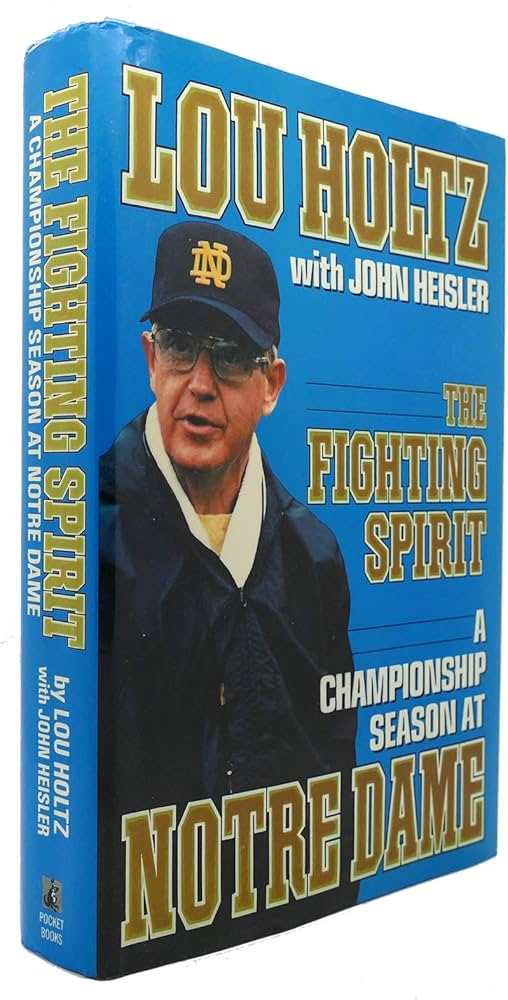
Then I read Lou Holtz’s book The Fighting Spirit.
That book hit me at the right time. It did more than motivate me. It pushed me and made me look hard at what I wanted my life to be. I did not just want to work and coach on the side; I wanted to teach and especially coach. I wanted that to be the work.
So I went back to school for my master’s in education.
It took me three years while I worked full-time. I took overload schedules, more hours per quarter than I ever had as an undergraduate. I went to class at night and on weekends. At one point, I had to sit down with the company and convince them to let me come in earlier, complete my field experience, and then come back to finish my work.
It was a grueling schedule.
But I had made up my mind. I was going to be a teacher and a coach.
That decision did not come out of nowhere. Lou Holtz helped spark it.
And that is why this conversation meant something to me beyond the usual reasons.
More Than a Guest
When Patrick and I started talking about the podcast episodes he had recorded, he pointed me toward the Lou Holtz conversation. On the way home from a clinic in Pittsburgh, I listened to it. I already knew how much Coach Holtz had meant to me, but hearing that voice again brought me right back to that point in my life.
In the episode, I said it plainly: reading The Fighting Spirit at 23 inspired me to do more as a coach. It pushed me toward education and helped move me toward the career I wanted. And even though I had never had Coach Holtz on directly myself, I felt a real thrill that we could share his voice with our audience through Patrick’s interview.
That is part of what made Lou Holtz so powerful.
Many people knew him as a national championship coach and as a broadcaster. But many coaches knew him as something else: a voice that could push you to make a harder, better choice.
He Coached Life
One line from the podcast says as much about Lou Holtz as anything else he ever said.
“I never felt like coaching football. I felt like coach life.”
That line explains why his influence reached so far.
Holtz won at the highest level, but he did not talk about coaching as if the game sat in a separate box from the rest of life. He saw football as a training ground for choices, standards, discipline, and relationships.
His perspective mattered to me then, and it still matters now.
When I decided to go back to school, I was not just choosing a profession. I was choosing a life and the kind of work that would let me teach, lead, and pour into young people. That is what Lou Holtz represented to me. Not just success in football, but purpose through coaching.
His Message Was Simple and Demanding
Lou never needed complicated language.
He believed in direct standards and direct choices.
“We had three rules,” he said. “Do the right thing. You do the right thing, you’re going to build trust with people, do everything to the best of your ability… and always reach out and show people how you care.”
That is not complicated, but it is demanding because it asks for integrity, effort, and care.
That is also why his words have lasted.
Coaches can use that. Teachers can use that. Parents can use that. Players can use that. Those standards hold up anywhere.
He Gave People Purpose
The other part of Lou Holtz that always stood out to me was his strong belief in direction.
He said, “Goals are exceptionally important.” Then he asked the question that cuts right to the heart of it: “Are you growing, or are you dying?”
His question forces honesty.
At 23, I had a degree, a job, and a path that made sense on paper. But I also knew I wanted something else. I wanted work that meant more to me than staying comfortable.
Lou’s words helped push me toward that decision.
He also said, “Anytime you maintain anything in your life, you’re really dying.”
The Coach Holtz mindset demands movement and growth, and that you stop hiding inside a safe plan if you know you are called to something else.
That was the challenge then. And for many coaches, that is still the challenge today.
He Understood People
Lou Holtz did not just understand ambition. He understood people.
“When I meet people,” he said, “I always say, before they can ask me a question, I’ll say, tell me about you.” Then he explained why: “Everybody’s got a story. Everybody has a book inside of them.”
He had a unique way of seeing people.
He also said, “I never learned anything by talking. I only learned by listening.”
As coaches and leaders or anybody in a position of influence, if you want to move people, you first have to see them. Lou did.
And maybe that is why so many people felt personally impacted by him, even if they never played for him or even met him in person.
Why This One Meant So Much
When we aired this episode, I was excited because of who Lou Holtz was in the game.
But I was even more excited because I knew what he had meant in my own story.
At 23, I read a book that made me rethink my future.
I went back to school, working through a brutal schedule, changed careers, and became a teacher and coach.
That decision shaped everything that followed and continues to shape me as my work in coaching education evolves.
So when I heard his voice on that episode, I did not hear just a legend. I heard someone whose words had already helped move my life in a different direction.
For many, this is why this loss hits deeper than football.
Lou Holtz won a national championship at Notre Dame and built one of the greatest careers in the sport’s history. Of course, that record will always matter.
But for many of us, his legacy lives somewhere even more personal.
It lives in the choices we made because of something he said, the standard we try to hold, and most importantly, in the lives we try to shape through coaching.
Lou Holtz once said, “Everybody can be the best they’re capable of being. That’s all I ask out of them.”
That is a fitting way to remember him.
Because he asked for more.
And in doing that, he drew more out of a lot of us.