
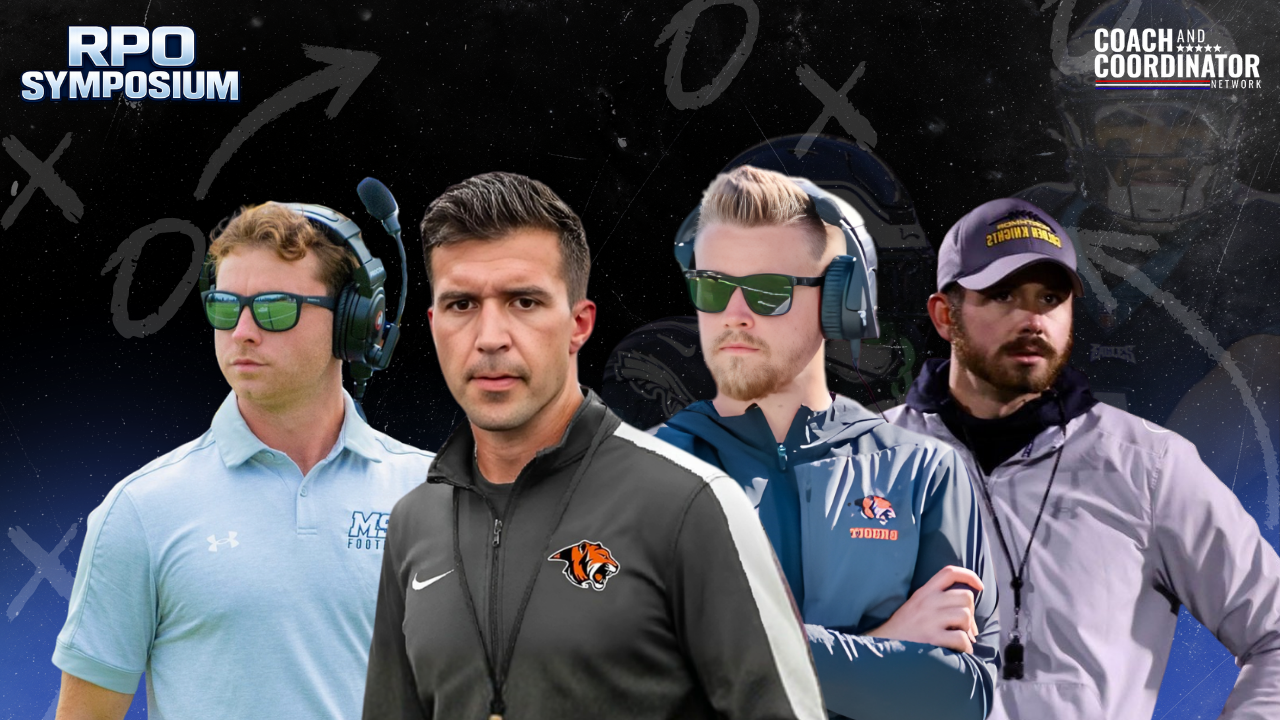
The Switchblade is not a bag of answers.
It is a framework for building them.
That is where the Switchblade stands out. The framework Caleb Corrill describes is not built on chasing new plays. It is built on learning how a concept works, understanding what stresses it, and then layering answers without losing the offense’s core identity. In Caleb’s view, real evolution is not adding something random to the call sheet. It is going deeper into what you already believe, then building answers that hold up over time. He talks about coaches needing a pathway to application, not just more film or more content, and that idea sits at the center of the entire Switchblade approach.
The name reflects the philosophy.
Corrill explains the Switchblade as a compact tool with multiple uses. The offense is supposed to work the same way. It should not require a bloated menu to solve weekly problems. It should give coaches and players a small set of core ideas they can use in different situations, across different formations, and against different structures. The point is versatility without clutter. The offense stays compact, but the answers keep expanding.
What makes the series strong is that each coach teaches a different layer of the same operating system.
Nate Hall shows where the system starts. Lane Little shows how the quarterback operates it. Dayne Keller shows how to stretch it across formations, motions, and personnel groupings. Corrill provides the framework that ties it all together. By the end, Switchblade feels less like a package of RPOs and more like a way to organize offensive football.
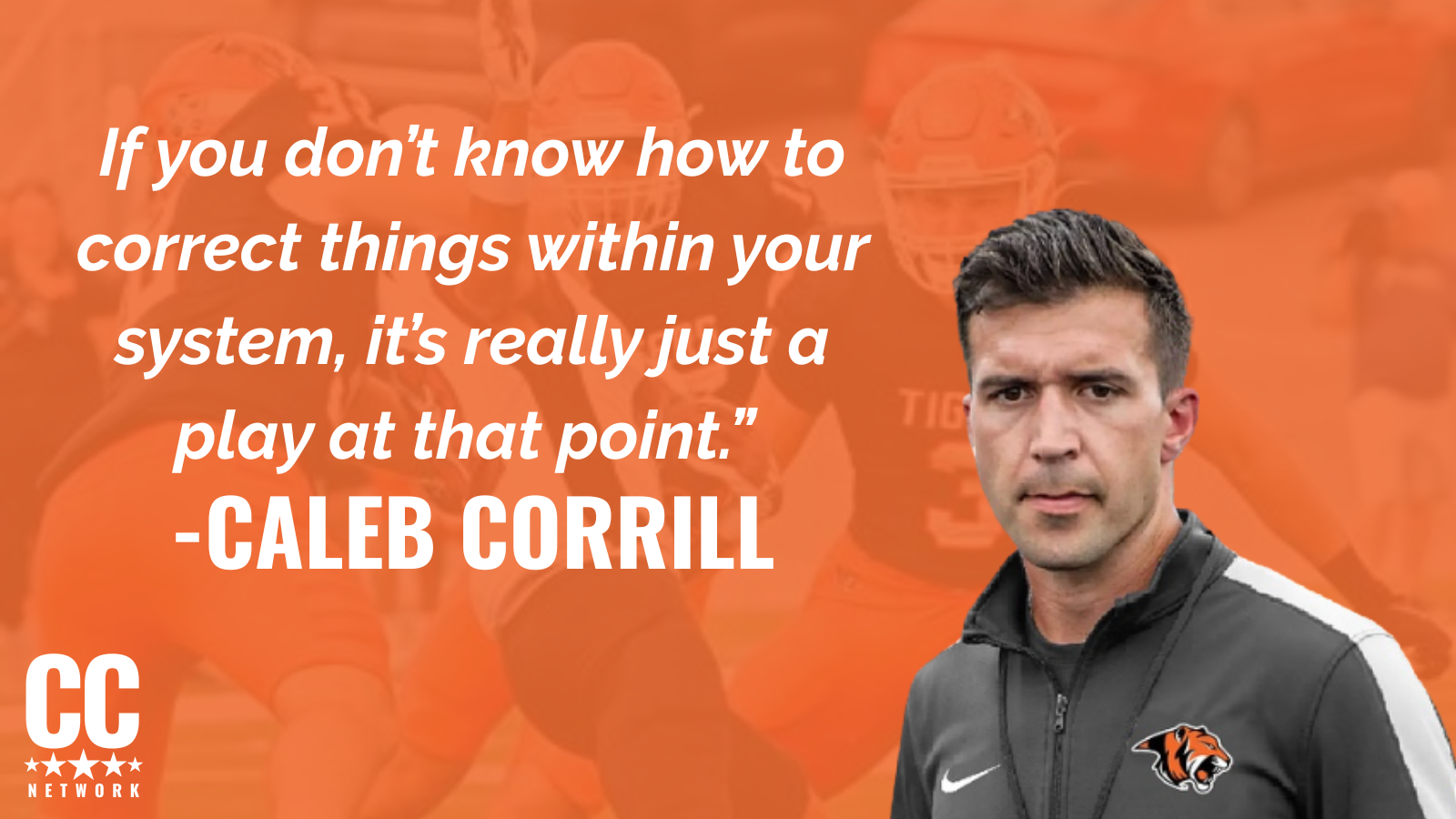
Caleb Corrill builds the logic behind it.
Corrill’s biggest contribution is the way he frames offensive growth. He pushes back on the habit of turning an offense into a grab bag of answers. If a coach does not know how to correct a concept within the system, then it is just a play. For him, the goal is to understand the structure deeply enough that answers can branch off naturally. He talks about concepts becoming “future proof” when coaches know what stresses them, what protects them, and how to package them for players. That is the lens that makes the Switchblade work. It is not about creativity for its own sake. It is about making an offense durable.
He also gives the series its educational shape. Corrill describes the Switchblade tree as a progression from the 100 level to the 400 level, showing how coaches can move from install to application to full system development. It gives the series a clear structure. These are not disconnected clinic talks stacked together. They build on each other. Each coach moves the system forward.
Nate Hall roots the system in the run game.
Hall’s presentation makes it clear that the Switchblade does not start with the throw. It starts with the run. His whole RPO system is built as an extension of gap schemes, especially buck and iso, and he is blunt about wanting the pass game to solve problems the run game creates. Hall grounds the system in the run game first. The offense still wants to be physical. The ball is still meant to be handed off when the numbers are right. The pass punishes the extra fitter without replacing the run identity.
Hall is also strong on evolution. He walks through how his system changed from simpler backside reads into frontside and backside RPOs, driven by personnel, experience, and the need for better answers. He describes losing key athletes, starting new varsity players, and adapting the system to smarter players who could handle more information. The system expands for a reason. The menu grows because the offense learns, not because the coach gets bored.
Maybe the most useful part of Hall’s piece is how player ownership shows up in it. He says the operation became player-led because the staff gave players tools and let them make decisions inside the system. Corrill’s larger point shows up here, too. The system only matters if it shows up on film, not if it stays on the whiteboard. Hall’s version shows the framework can scale to high school football without losing its edge.
Lane Little turns it into a quarterback operating system.
If Hall gives the run game roots, Lane Little gives the quarterback a clean decision-making process.
His six-man RPO series is organized around access, efficiency, and plus-one identification. He shows the numbers behind the concept, but more importantly, he gives the quarterback a clear checklist. Pre-snap, the quarterback works through a yes, no, maybe access thought process. Post-snap, he gets his eyes back to the plus-one defender and asks a simple question: Can that defender make the tackle for less than four yards? If yes, pull and throw. If not, let the run ride.
Little keeps bringing the quarterback back to the same point: the RPO starts with the run. The first letter is R. The pass answers are built to control the box, keep every defender honest, and punish overcommitment. His structure gives the quarterback a real operating system instead of a pile of situational guesses. It fits Caleb’s philosophy, too. Keep the concept simple. Build the answers inside it.
Little’s contribution also shows why Switchblade is not tied to one route family. He uses access speed outs, access glances, field reads, and two-man answers, but the bigger lesson is how the quarterback is taught to sort information. It holds up across seasons because the quarterback is learning the system’s logic, not memorizing isolated answers.
Dan Keller expands the menu without losing the core.
Dan Keller’s session is where the system opens up.
His focus is on extending the RPO menu through simple reads, multiple structures, and built-in answers. Keller organizes the offense around structure, leverage, conflict, and motion. He wants formation versatility, wide and condensed packages, and motions that force the defense to declare. He is clear that motion is not decoration. It is information. Keller builds the whole presentation around that idea. He is teaching coaches how to create better pictures for the same core ideas.
He also sharpens one of the series’ key themes. Switchblade is not really a play system. It is a conflict system. Keller says the job is to identify the conflict player, replace the run fitter, attack leverage, and force declaration through motion. His concepts can move across skinny post and five-yard in, stick-and-speed out, flat-fade, snag, smash, and isolation answers without feeling disconnected, because the offense is still solving the same problem—the picture changes. The conflict stays the same.
Keller may be the coach who best shows how compact the core can stay while the presentation becomes more varied. He stresses that the system is not built on one personnel grouping. It is built on surface creation. He can use 12 personnel, detached tight ends, condensed sets, expanded sets, and perimeter isolations without changing the teaching progression. The defense sees a different picture. The offense carries the same logic.
Why the Switchblade idea works
The best part of the Switchblade series is that each coach stays in his lane while reinforcing the same central idea.
Caleb Corrill gives the philosophy. Nate Hall grounds it in a run-first world. Lane Little gives the quarterback a process. Dan Keller shows how to multiply answers through structure, leverage, and motion. Put together, they do more than teach RPOs. They show coaches how to build an offense that can stay small for players and still be hard on defenses.
The framework gives the offense range without losing its core. A switchblade solves more than one problem without taking up much space. Corrill wants the offense to work the same way. Keep the system tight. Teach it deeply. Build answers off the same core. Then let the players bring it to life on Friday or Saturday. It is more than a good RPO package. It is an offensive system.
About the Coaches
Caleb Corrill
Caleb Corrill is the offensive coordinator and quarterbacks coach at Georgetown College. He is known for his systems-based approach to offense and for teaching coaches how to build concepts that can evolve, stay connected, and show up on film.
Nate Hall
Nate Hall is the head football coach at Logan High School in Ohio. His work centers on building player-led offense, using gap-scheme RPOs to expand the run game, and creating answers that fit the identity of the system.
Lane Little
Lane Little is on the football staff at Mount St. Joseph University, where he is lco-offensive coordinator and recievers coach. In the Switchblade series, he teaches the six-man RPO system with an emphasis on pre-snap access, quarterback decision-making, and keeping the concept run-first.
Dayne Keller
Dayne Keller is the wide receivers coach and recruiting coordinator at Georgetown College. His teaching in the series focuses on extending the RPO menu through structure, leverage, motion, and conflict-based answers that make the offense more multiple without losing its core.
Related:
Zach Riepma Builds Quarterbacks, Not Just RPOs