
Route running often gets taught from the top down. Coaches start with releases, stems, and landmarks.
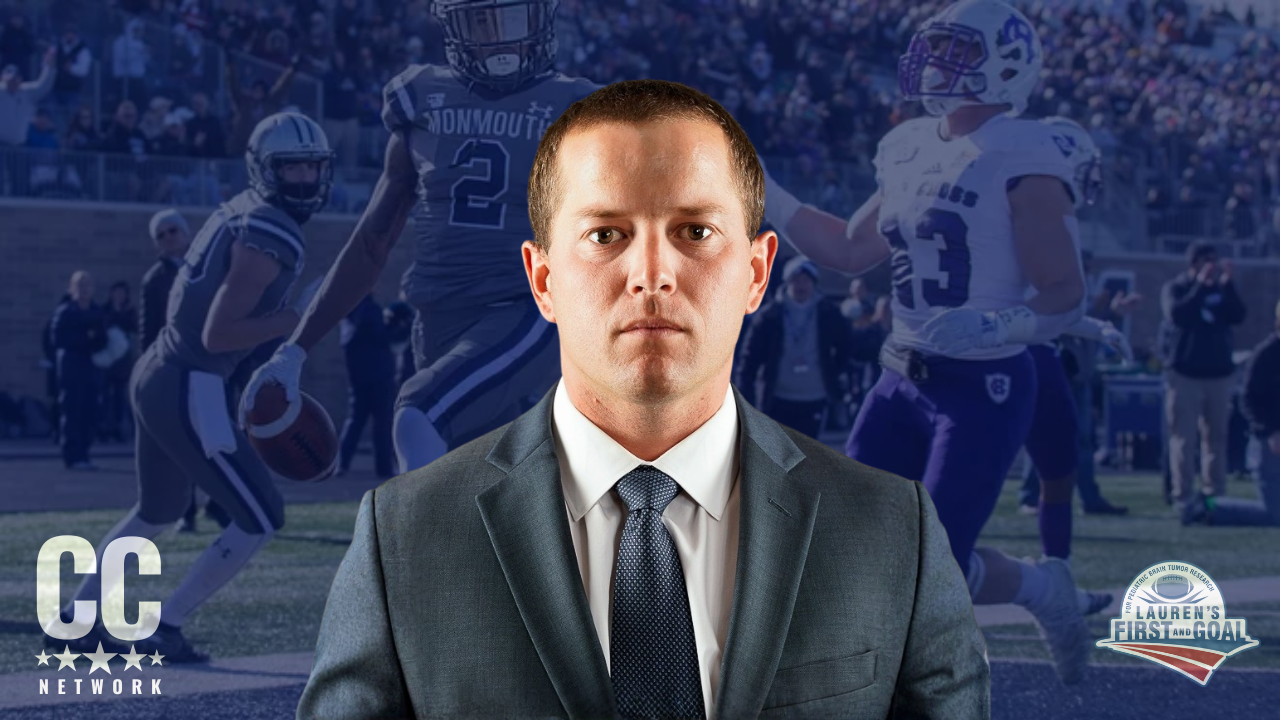
Kevin Callahan starts at the breakpoint.
For the Monmouth receivers coach, separation often comes down to what happens when the receiver has to decelerate, sink, and come out of the cut. A player can reach the right depth and still fail to win the route if he cannot break with balance, force, and timing.
In this lesson, Callahan separates breakpoints into two categories: hard breakpoints and speed cuts. This segment focuses on hard breakpoints, the cuts that demand real deceleration and redirection. That group includes 45-degree cuts, 90-degree cuts, curls, comebacks, and 180-degree breaks.
At the center of his teaching is one clear rhythm:
Drop. Rotate. Run.
Hard breakpoints start with body position.
One of the most useful parts of Callahan’s teaching is what he does not make the center of the lesson.
Callahan is not fixated on a certain number of steps. He is not building the whole drill around a single trigger step. He is not chasing perfect footwork language before the player understands how to carry his body.
His priority is body position.
At Monmouth, hard breakpoints are taught through posture, balance, and the ability to get in and out of the cut with power. The receiver has to drop his weight, rotate his hips and feet into the new path, and accelerate out of the break.
The result is a route that looks abrupt rather than slow and rounded.
Drop means violent hips and a violent chest.
Callahan teaches the first phase of the break with a phrase his players hear often:
Violent hips. Violent chest.
The point is not to ease into the cut. The receiver has to drop with intent. Hips go down. Chest goes down. Shoulders get over the toes.
He wants players to think about getting their fingers to their shins. That cue helps create the body angle needed to stay balanced and powerful through the break.
This is not a sitting position with the chest upright. It is a loaded position that prepares the body to redirect.
When receivers stay too tall, they lose power.; the chest rises, balance starts to go. When the shoulders drift behind the feet, the break slows and rounds.
Rotate opens the path out of the break.
After the drop comes the rotation.
This is where the receiver gets his hips and feet pointed toward the new path. Callahan emphasizes that a receiver will struggle to get out of a curl, comeback, or 180-degree cut if his body is still facing the old direction.
The body has to be turned so the exit is clear.
He also points to the plant foot here. The instep of the last plant step should match the route’s path. That puts the body in position to come out of the cut without drifting.
A lot of poor breakpoints happen because the receiver slows down, but never fully rotates into the new direction.
The drive step has to stay inside the midline.
Once the receiver drops and rotates, the next phase is the run phase.
Callahan teaches the drive step as the transition out of the break. It needs to hit the ground quickly and stay inside the receiver’s midline.
A key coaching point here is the purpose of the drive step. It is not meant to reach for extra ground. It helps the receiver pivot the hips, transfer weight efficiently, and get back to speed out of the break.
When that step crosses the body, the route starts to round off. The receiver loses efficiency, takes extra time, and gives the defender a chance to recover.
Clean breakpoints are not just about stopping fast. They are about getting back to speed fast.
Late eyes protect balance and power.
Another coaching point Callahan emphasizes is eye discipline.
His receivers are taught to keep late eyes at the breakpoint. In hard cuts, the eyes should be last out of the break.
The reason is simple. The body follows the eyes.
When a receiver peeks too early, his chest comes up. Once the chest rises, balance and power follow. That is when players slip, drift, or lose force as they come out of the cut.
Callahan wants the receiver to finish the break first, then bring the eyes out as the body transitions into the run phase.
The ball will be there. The break still has to be won first.
Low in, low out
One of the best phrases from this segment is Callahan’s teaching on levels:
Low in, low out.
He wants receivers playing on two levels, not three or four.
The route starts on one level. The receiver drops to a second level at the breakpoint. He should exit the break on that same second level before accelerating out.
Problems arise when players change levels too often.
Some raise their shoulders before the break, which tips off the defender. Others sink into the break but pop their shoulders back up on the way out, which kills separation.
Both create inefficiency. Both give the defensive back information he can use.
Clean route running is not just about where the feet go. The shoulder plane has to stay consistent enough to keep the cut sudden and disguised.
Separation comes from the finish.
Callahan’s teaching keeps bringing the lesson back to one point: the break is not complete until the receiver runs out of it.
He repeatedly emphasizes driving the ball into the ground and accelerating out of the cut. That is where separation gets created.
A receiver who can sink but not reaccelerate is still covered.
A receiver who can stop but not redirect with force still gives the defender time to recover.
The best route runners make the cut and get gone.
That is why Callahan’s teaching works. It is simple, direct, and tied to what creates space on Saturdays:
Drop your weight. Rotate your body. Run out of the break.
Coaching takeaway
For coaches working with receivers, this lesson offers a clear starting point. Breakpoint fundamentals do not need to begin with complicated footwork language. Start with posture, balance, and intent.
Coach it in a simple progression: play low, rotate efficiently, keep the eyes disciplined, and run out of the break with force.
Hard breakpoints turn clean when the body is in the right position.
Clean breakpoints turn into separation.
About Kevin Callahan
evin Callahan Jr. serves as General Manager and Wide Receivers Coach at Monmouth University and is respected for his clear, practical teaching of receiver fundamentals. With coaching experience at Monmouth, Lafayette, Columbia, and Amherst, he has also been a generous supporter of Lauren’s First and Goal, presenting multiple times to help coaches grow while supporting the fight against pediatric brain cancer.
Go Deeper with Kevin Callahan Inside LFG Clinic
If you want the rest of Kevin Callahan’s teaching, the full presentation is available inside LFG Clinic. Beyond this free lesson, he walks through the full progression for teaching breakpoint fundamentals, speed cuts, drills, and the details that help receivers separate with consistency. LFG Clinic gives coaches year-round access to presentations like this, plus a growing library of practical football education built for the meeting room and the practice field. And every coach who joins also supports the bigger mission of Lauren’s First and Goal in the fight against pediatric brain cancer.
Related
Accelerate Receiver Development: A Guide for Coaches Who Want More Than Just Speed
Teachable Moments – Jordan Hogan, Wide Receivers Coach, Colgate
Tight End Pass Fundamentals: Vision, Leverage, and Situational Awareness | Brian Sheehan