

RPO football can get complicated fast. Zach Riepma has a way of making it teachable. His offense is built on structure, quarterback ownership, and solutions players can trust when the picture changes after the snap. It comes through in his teaching and in the way he organizes the game, always framing offense as something that should equip players, not just ask more of them.
A Background That Shaped the Way He Coaches
Riepma’s football background did not lead to a scattered approach. It helped form a system rooted in structure and purpose.
Riepma grew up around triple option football through his dad’s coaching background. Later, he worked at Northwood before helping shape Alma’s offense. His background helps explain why he does not treat RPO football like a grab bag of tags and answers. He carries over old option principles, but applies them through a modern system built on numbers, space, and clear rules for the quarterback.
One of the most revealing parts of Riepma’s presentations has nothing to do with a specific play. He emphasizes a systematic approach, so the quarterback understands why the ball is going where it is. “I liked it, coach,” is not enough. He wants decisions tied to the rules, the language, and the structure of the offense.
He Wants to Simplify the Chaos
The strongest theme in Riepma’s work is not really tempo, or triple option, or even RPOs.
It is a simplification.
He knows defenses are too multiple to live on loose teaching. That is why he keeps coming back to the same goal: simplify the complexity. He wants players to see the game through a common language. He wants them to identify the extra defender. Then it is about understanding sound versus unsound structure, and know where the offense has numbers and space. The point is not to make football smaller. It is to make it clearer.
What makes Riepma’s presentations valuable is that he goes beyond broad ideas. He defines the numbers, explains what space looks like within the offense, and teaches players when it is there and how it changes by opponent. Players are not left with buzzwords. They are given answers they can apply.
Quarterback Play Sits at the Center
For Riepma, the offense only works if the quarterback can own it.
Much of Riepma’s teaching centers on the quarterback’s decision-making. He emphasizes protecting the play and protecting the player, making sure the quarterback understands when he is covered up, when he is exposed, when to hand it off, and when to get the ball out. He is not asking the quarterback to play hero ball when the structure says the right decision is to stay on schedule.
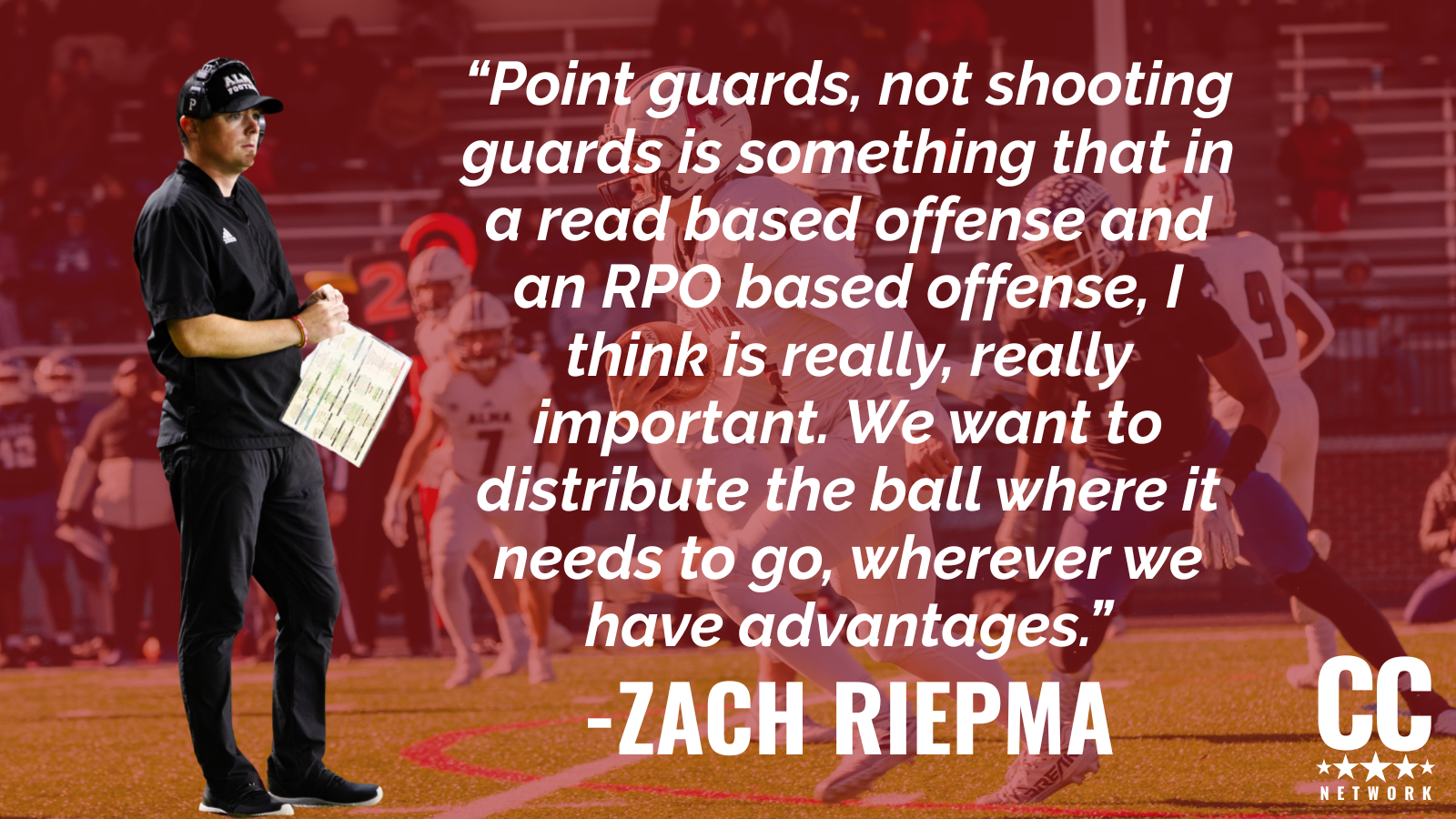
Riepma says the quarterback has to be a point guard, not a shooting guard. He wants the quarterback moving the ball to the advantage, whether that means an access throw, a give into a light box, or a post-snap answer off the read key. The offense is built to attack, but with control.
Riepma keeps bringing it back to decision-making. The quarterback is not hunting one throw or trying to force a big play. He is expected to move the ball to the offense’s advantage.
He Builds Systems, Not Whiteboard Collections
One reason Riepma stands out is that he does not sound like a coach chasing every new idea.
He sounds like a coach trying to make sure each idea fits.
In the podcast, he talks about not getting too enamored with the whiteboard and about having a “hopper” where ideas can sit until they truly fit the week and the call sheet. He is open to new ideas and willing to collaborate, but he also knows a good play is not automatically the right call for that game plan.
His clinic work reflects the same discipline. He works to keep the rules intact even as the presentation changes through formations, motions, perimeter tags, and run schemes. The quarterback may get a different picture, but the underlying framework stays the same. The result is a true system, not a collection of answers.
Modern Triple Option Gives His Offense Its Edge
Riepma’s offense has a clear fingerprint.
His triple-option background shows up in everything he teaches about modern RPO football. He talks about the read key, the pitch key, column rules, and the ability to create multiple answers without changing the quarterback’s world. At Alma, that has helped evolve their offense into a modern triple that can still live within a tempo spread structure.
Riepma is not trying to recreate old-school triple option football. He is using his logic to help players see the game faster, create leverage, and find answers on the perimeter and in the red zone. Even his “fast break” RPO language points to the same goal: give the quarterback a clean picture and let the offense play fast without losing control.
The Process Behind the Coach
Some of the most revealing moments in Riepma’s podcast are not about the scheme at all. He keeps coming back to stacking good days, doing the next right thing, and not letting one game or one goal overshadow the daily work. That same mindset shows up in the way he teaches offense. He wants urgency without panic and confidence without carelessness. His system gives players structure, but also allows them to think fast and play free.
Why Riepma’s Approach Stands Out
Zach Riepma comes across as a coach who knows the difference between having answers and building understanding.
Riepma wants players to understand the why behind the offense, and he wants the quarterback to own the picture when the defense clouds it and the game speeds up. More than an RPO story, this is a window into the kind of coach he is: organized, demanding, and committed to giving players a framework they can trust. In a game that gets more complicated every year, coaches value systems that help players play fast without losing control.
About Zach Riepma
Zach Riepma is the offensive coordinator and quarterbacks coach at Alma College. Since joining the Scots’ staff in January 2020, he has helped build an offense centered on quarterback ownership, tempo, and systematic answers that allow players to operate fast within structure. Riepma is a Hope College graduate and has become known for teaching modern RPO football through the lens of numbers, space, and option-based decision-making.