
Most coaches hear “situational football” and immediately think about special periods.
Third down.
Red zone.
Two-minute.
Four-minute.
Backed up.
Those moments are important, but they are not separate from the rest of the game.
Football is always being played inside a situation. The hash changes spacing. Field zone changes tendencies. Down and distance can shrink or expand the call menu. Personnel affects formations. Motion changes leverage. Clock and score shape decisions before the ball is even snapped.
Dan Carrel explained it perfectly:
“Every time the ball snapped, there’s some situation and there’s some context that should be provided.”
That idea should make coaches think differently about defense.
Players Need More Than a Play Call
A call by itself does not solve the snap.
The whiteboard version of football is clean. Friday night football is not.
Receivers move. Formations shift. Motion changes leverage. Route spacing changes the picture. Backfield action affects the eyes of second-level defenders. Tempo speeds up every decision.
Players who only memorize the playbook usually struggle when the picture changes after the snap.
Carrel made a strong point during the conversation:
“Knowing the plays is ground zero for being able to play.”
Ground zero is not mastery.
Real understanding starts when players know why the offense is building that look, where the stress is coming from, and what the situation is trying to force them to defend.
The Situation Starts Narrowing the Picture
Great defenders rarely feel surprised before the snap.
They gather clues.
Formation.
Hash.
Field zone.
Personnel.
Down and distance.
Game flow.
Everything starts building a picture.
Carrel talked about using context to eliminate possibilities before the play begins:
“The biggest thing I think about from a contextual standpoint is how many plays, what things can we just get rid of?”
That is a huge part of defensive football.
3rd & long does not carry the same menu as 2nd & 4. Low red zone football changes route concepts and quarterback involvement. Wide hash football creates different stress points than middle-field football.
Players still need great eyes and technique. They still have to react fast and adjust on the move.
Context just helps defenders play ahead of the snap instead of behind it.
Teaching Beyond the Diagram
The playbook only gives the starting point.
A drawn-up coverage does not explain every motion, stack, bunch, or release variation players will see during a game.
Coaching fills in the missing parts.
What happens when No. 2 releases out?
How does the coverage adjust to motion?
What changes when the back fast-flows weak?
Where should the eyes go against condensed splits?
How does the safety fit the picture from the boundary hash?
Those answers build confident players.
Without those answers, players become hesitant the second the offense changes the picture.
The Best Defenses Build a Pre-Snap Process
Great defensive football starts before movement.
Carrel referenced the idea of scanning before the snap. Defenders process the situation first before execution.
Down and distance. Formation. Personnel. Splits. Field zone.
Everything gives defenders information before the snap.
A safety seeing a tight end attached in the core should feel the run threat increase immediately. Corners should understand how reduced splits affect route possibilities. Fronts should understand how field position changes the offense’s risk possibility.
That awareness helps players play faster because they understand what they are seeing.
Practice Should Look Like the Game
Many drills fail because they never truly connect back to what players will see on game day.
Players get good at performing the drill instead of solving the problem.
Carrel talked about building practice backward from the game situation. If team period emphasizes red zone football, then indy and group periods should prepare players for red zone spacing, communication, and leverage.
The same applies to third down, tempo, sudden change, or backed-up football.
Every drill should answer a simple question:
Where does this show up on Friday night?
Film Should Shape the Drills
One of the smartest parts of Carrel’s process involves studying missed opportunities and building drills directly from game film.
He described finding takeaway opportunities where a defender set the edge, retraced vertically, and had a chance to attack the football from behind.
Instead of just talking about takeaways, the staff built a drill around the exact situation they kept seeing on tape.
That is practical coaching.
The game shows the problem.
Practice creates the answer.
Friday night reveals whether the habit transferred.
Communication Changes Everything
Situational football falls apart without clear communication.
Carrel said:
“Language is everything to me.”
Players need words they can process quickly under pressure. Meetings, indy periods, group work, and game-day communication all need to sound the same.
Confusing language creates hesitant football.
Defenders should hear the call, recognize the situation, and connect the coaching point to the picture in front of them.
That only happens when the language stays consistent across the program.
Good Practice Structure Ties the Entire Week Together
Strong defensive staffs connect every part of the workflow.
Meetings introduce the picture.
Individual periods sharpen the technique.
Group work adds conflict and movement.
Team periods place everything into game-like situations.
Each layer should build on the previous one.
Carrel talked about making sure the same coaching points show up from meeting room to practice field to team periods.
Players improve faster when the message stays connected.
Every Snap Carries Information
Football constantly gives defenders clues.
Hashes change spacing. Splits affect leverage. Personnel changes formations. Down and distance shape the offense’s decisions.
Strong defenses train players to recognize those details before the snap.
Every down is situational football.
Attend the Smart Clinic – No Free Yards – Situational Defense:
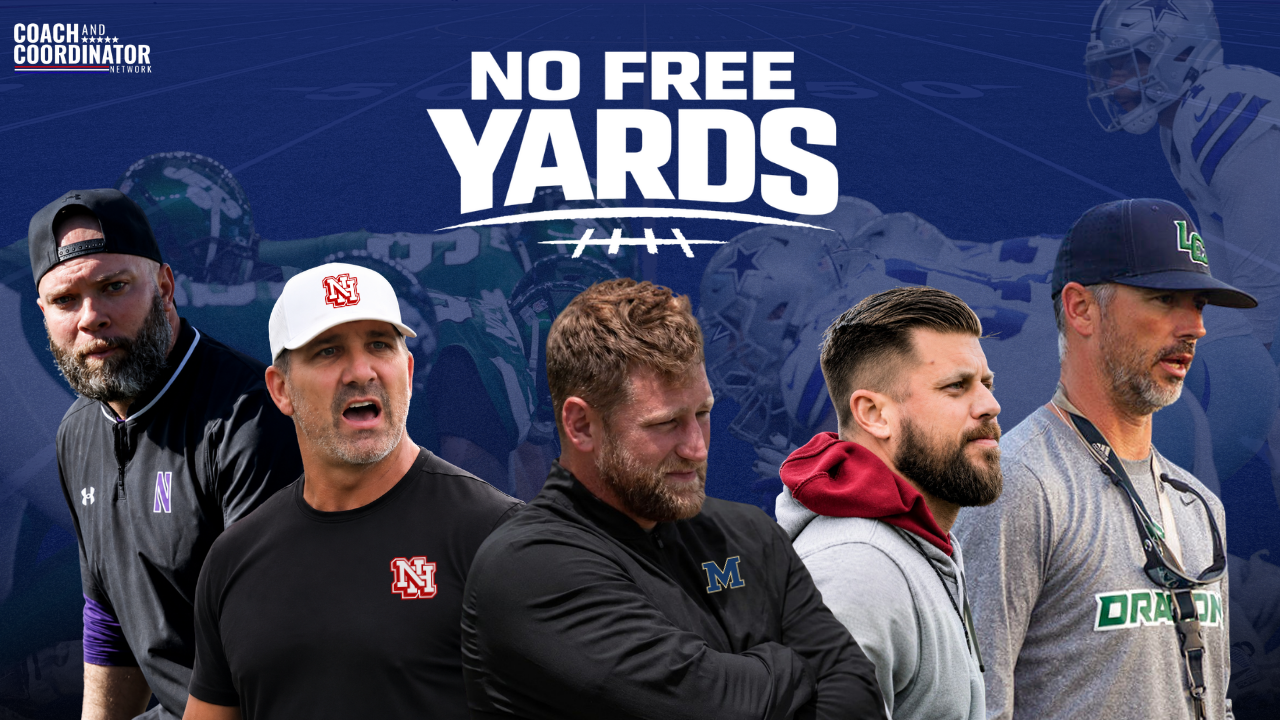
18 sessions, including 3 live and interactive sessions from top high school and college defensive coaches.
Related:
Getting a True Picture of the Season on Offense and Defense
Defensive Football IQ Starts Before the Snap
Connect on X
Dan Carrel: @DanCarrel
Keith Grabowski: @CoachKGrabowski