
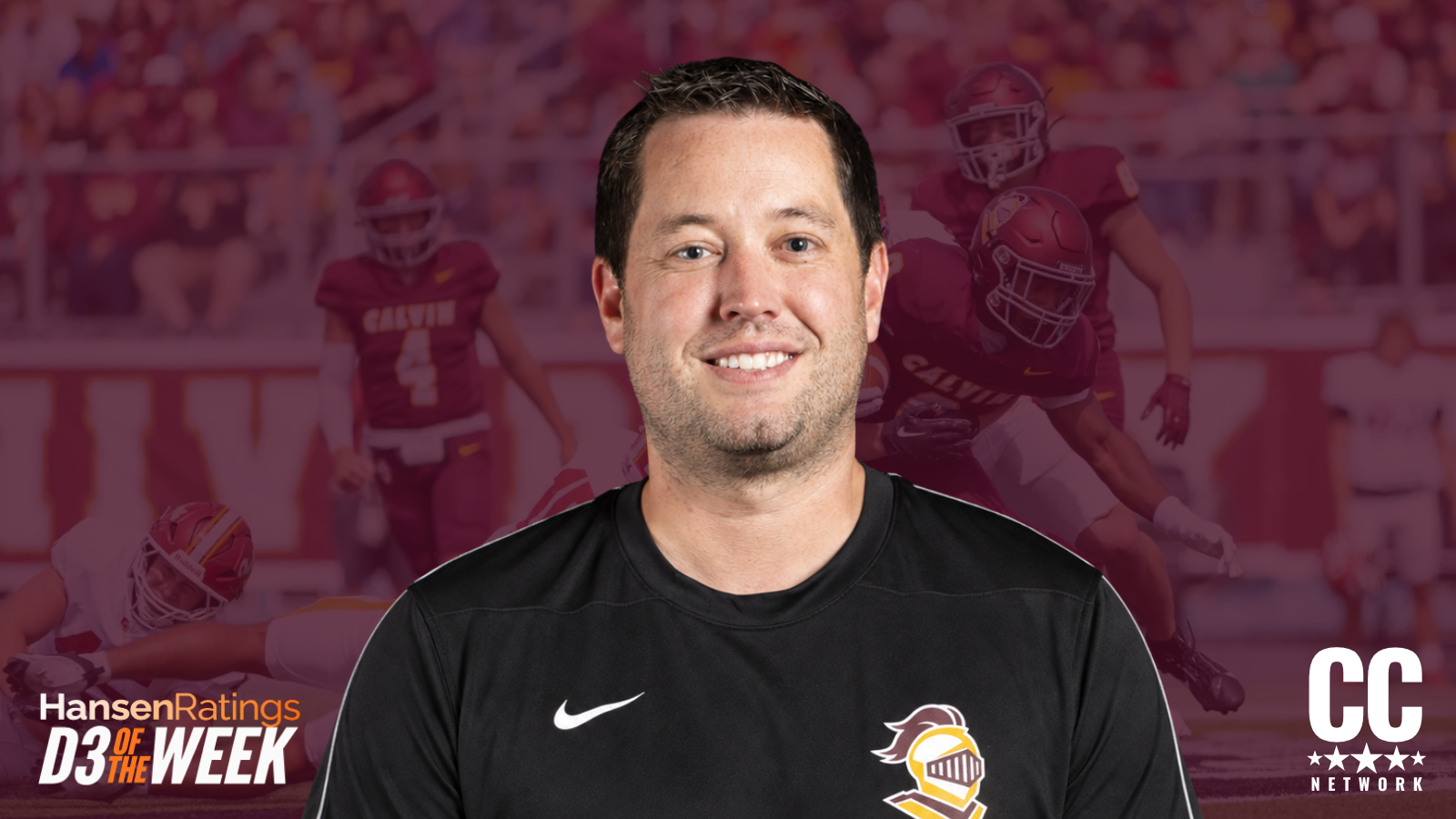
Through three games in 2026, Calvin University is averaging 47.7 points 589 yards per game, and 337.7 passing yards per game.
Offensive coordinator Ben Dixon described how that offense practiced tempo back in 2024, Calvin’s first season of football, after he was named Coach and Coordinator’s D3 Offensive Coordinator of the Week. The Calvin offense played up-tempo and no-huddle. In team periods, Dixon’s staff tracked one number closely:
“We continuously film, then we time between each snap how long it takes us to snap the next snap.”
Much of the practice structure he described was aimed at reducing that time without losing the scout look or the reps his players needed.
Build around the skills you already have
Dixon started the week with fundamentals and used what he called the hedgehog principle to explain the emphasis.
“I’m a big believer in almost the hedgehog principle to where you want to be world-class at something. A hedgehog is world-class at digging holes. We want to be world-class at what we do.”
The scheme was built to fit those fundamentals. “When we build a scheme, we build it around what skills do we already possess and how much can we put in without creating new skills,” he said. “Then, we really work to practice that as quickly and efficiently and as fast as possible throughout the week.”
Before practice, Calvin ran a walkthrough from a detailed plan. Dixon would sometimes cut meetings short to add walkthrough time, “just because we’re such big believers in kinesthetic learning around here.”
Timing the gap between snaps
After walkthrough, Dixon’s focus turned to team periods and one question: “How can we be the most efficient team as an up-tempo, no-huddle offense?”
Calvin filmed continuously through every team session. The ball rarely got spotted in the same place twice. “We move the field,” Dixon said, and the program had enough grass and turf to put offense and defense on separate fields.
The harder problem was the scout team. A tempo offense needs a defensive look it can snap against quickly, and that look has to match the opponent. Dixon’s offensive staff built a system for it:
“Our scout team is on wristbands. They build wristbands throughout the week, and they just look at the defense and tell them what wristband number they’re on. They look down, and they get set as quickly as possible.”
“It’s worked really well for us to where we’re getting over two plays a minute right now in our team sessions, which has really helped us train our tempo, but also allows us to do it with great execution against the look that we’re going to get.”
The scout players were prepared before they ever saw a wristband. During pre-practice walkthrough, two of Calvin’s younger coaches worked with the scout team, walking through the same plays the offense was walking through, against formations, so the scout players knew how to line up and what techniques that week’s opponent used. The defensive staff also watched scout team film with those players on Thursdays and corrected them. “The kids on the scout team, they want to do a great job,” Dixon said.
“I didn’t get that rep this week”
Speed in team periods mattered to Dixon partly because it paid for reps. Calvin got 25 plays in about 10 to 11 minutes, and the rotation was set:
- five plays with the ones
- five with the twos
- three with the threes
- then back to the ones
“We take a lot of pride in making sure that, especially our two deep, gets coached like everyone’s a starter,” Dixon said.
Each team session covered one specific part of the game plan. The twos ran the same plays as the ones, in a different order. That mixed things up for the scout defense and for his own players, “so they’re not just memorizing what the quarterback in front of them did.” The threes got a little less of the game plan and a little more of the base offense, “because that’s what they’d be running if they were in.”
Dixon’s reason for repeating the plays:
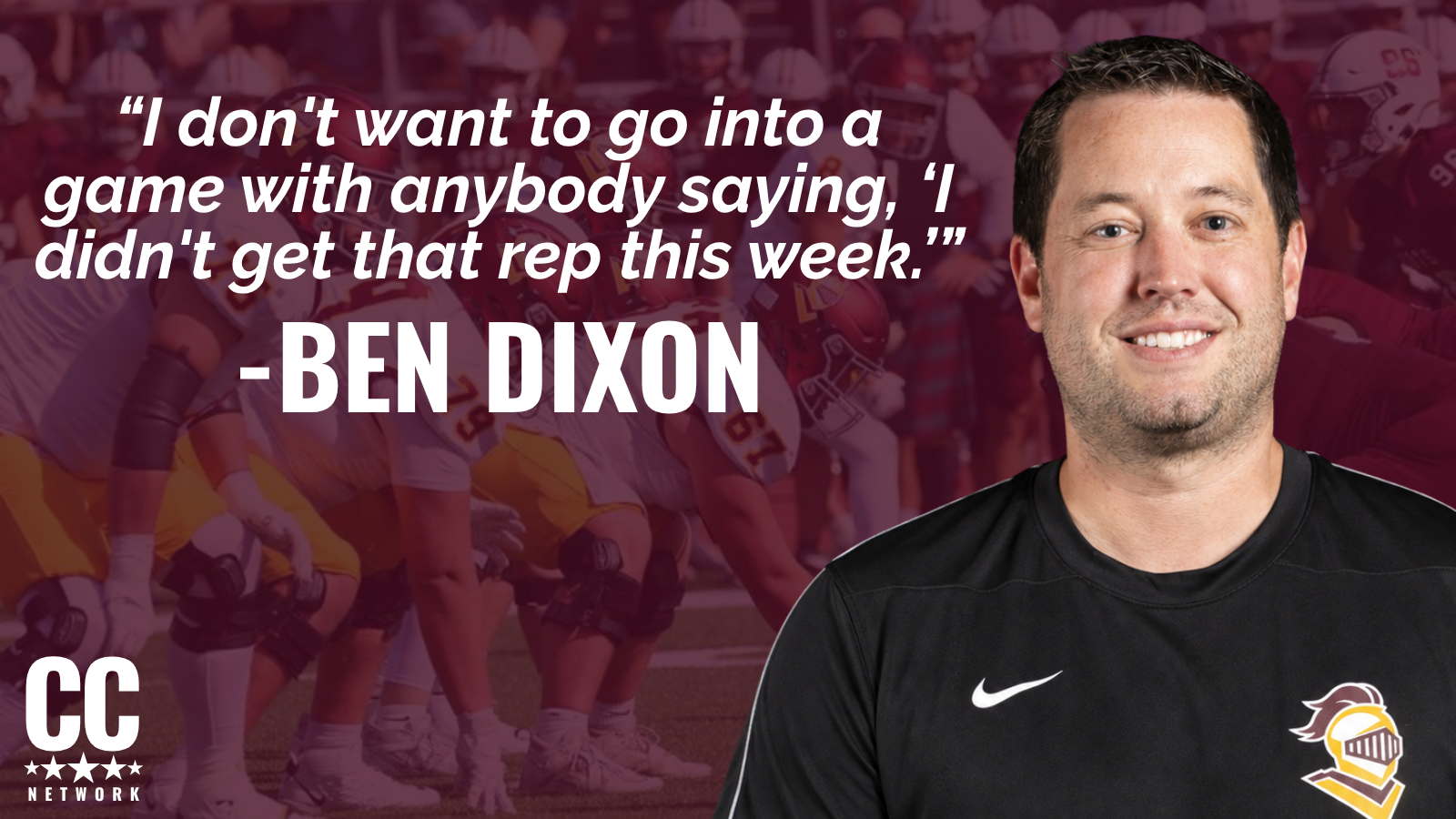
“I don’t want to go into a game with anybody saying, I didn’t get that rep this week. That really allows me to make sure that everyone got the rep, got it going each direction that we wanted to run it that week, and makes us be efficient yet also detailed with the reps at the same time.”
The student in the orange vest
Calvin moved the ball in most team periods. Red zone was the exception. Those plays were spotted where the staff wanted to run them, to get specific looks. On base downs, the ball went down the field.
To make sure each rep landed where it was supposed to, one of the student assistant coaches handled the ball. “He wears an orange vest in practice or an official’s vest, and he moves the ball 10 to 15 yards down the field every single play to the hash that I prescripted.”
Calvin also got a true move-the-ball period each day through a small amount of good-on-good work. “It’s not a ton of reps. It may just be up to eight reps, but where it’s true move-the-ball, working on getting the ball back to the umpire, which is a big emphasis for us, and finding the ball and getting set and running the next play.”
Get the ball back to the umpire
Asked for small things that help tempo teams in practice and on game day, Dixon started with the umpire.
“What I’ve seen carried across the most, across all levels of football, is get the ball back to the umpire. We don’t want side judges to have to throw it back in. We’re quicker running the ball back into the umpire.”
He knew some programs teach players to give the ball to an extra official in the backfield when the gain is zero or less. “But what we found is in high school sometimes, and even sometimes small college, you don’t always have that extra official. And so we just said get the ball back to the umpire.”
From there, each position had a way to find the new line of scrimmage:
- Outside receivers watched where the side official spotted the ball, found his foot, lined up there, and then looked into the center to make sure they were still onside.
- The center found the ball as quickly as possible.
- The tackles found the line of scrimmage off the side judges and the center.
- The quarterback, in Dixon’s words, “just gets lined up behind the center.”
The skill players also had landmarks to reach before they were fully set. Slot receivers and tight ends got back inside the hashes as fast as they could. Outside receivers got between the hashes and the numbers first, Dixon said, “so that if we do want to flip them over to the other side or make formation adjustments or go unbalanced or things like that, then it’s not as far for them to run, and thus saving time.”
Year three
Calvin finished that first season 2-8, averaging 26.5 points and 342 yards per game. In year two, Calvin went 7-3, and the offense climbed to 34.6 points and 396.4 yards per game. Three games into year three, Calvin is scoring 47.7 points per game, averaging 589 yards per game, and throwing for 337.7 yards per game. That’s nearly as many yards through the air alone as the offense gained in total per game as a first-year program. Three games is a small sample, but each season has built on the last. Dixon described this practice structure when the program was only three games old, and the offense has produced more every year since.
About Ben Dixon
Ben Dixon is the offensive coordinator at Calvin University, where he was hired in January 2023. Before joining Calvin, he served as offensive coordinator and quarterbacks coach at Midland University, helping the program finish 8-3 in 2022 for its best record in 12 seasons.
Dixon has also coached at Oberlin College and Dordt College, his alma mater, working with wide receivers, the passing game, and recruiting. He earned his degree in Physical Education from Dordt in 2012 and later completed a master’s degree in Sports Leadership in 2020.
Related
Keith Grabowski (01:54.678)
Let’s hear from their offensive coordinator, Ben Dixon, at Calvin University. Joining me now is our week three offensive coordinator of the week from Calvin, their offensive coordinator, Ben Dixon. Ben, it’s great to have you here on the podcast and congratulations on being named our offensive coordinator of the week.
Ben Dixon
Hey Keith, yeah, I really appreciate it. You know, pretty pretty cool honor for us and our first year program to get named with this. But no, I do want to recognize our staff and you know stress. Coach Fig at the top and all of our administration, they just give us great support and great vision. And then really to me, this is a coaching staff and team award. You know, we have great players that execute the plan and then we have great coaches. You know, we have Coach Austin Gardy, coaches offensive line, Andrew Vasquez with our running backs, Coach Ike Posta with our wide outs, Ryan Patterson with our tight ends, and then we have the an elite student assistant that signals and does a lot of self scout for us named Jaden Burgess and man, that they’re just making my job a whole heck of a lot easier.
Keith Grabowski
Yeah, it’s always great the more help you can get and guys who are engaged in it and doing their job. You mentioned you you know, your student coach and the signaling, and I know you guys are an up tempo team. It’s part of what you do. And we’re gonna get into practicing up tempo. I think it’s it’s always great to see how people do this. I mean, I don’t think I’ve I’ve talked to a coach who talks about up tem up tempo where I don’t pick something up. So hopefully we have some great things that we could share with our listeners here. So talk to us a little bit, I guess, first about your philosophy of practice and and what you’re aiming to get out of of practice at as you look over the course of a game week.
Ben Dixon
Right. So when we look over the course of a game week, for us practice it starts with the fundamentals, right? We spend a lot of time working those fundamentals. I’m a big believer in almost the hedgehog principle to where you want to be world class at something. A hedgehog’s world class at digging holes. We want to be world class at what we do, right? So we spend time each week just honing in on our craft, scheduling out fundamentals and then so that we can translate those skills into our scheme. When we build scheme, we build it around what skills do we already possess and how much can we put in without creating new skills. And then we really work to practice that as quickly and efficiently and as fast as possible throughout the week.
Keith Grabowski (04:22.710)
The quick and the efficient part, I think, is what I’d like to dig into here. And again, finding those little tips that you can implement even in season to make yourself better and practice is always good, especially as you get later into the season. And I think your your players are looking for efficiency. Your coaching staff certainly is, you know, it’s it’s been a long grind already, but you know, getting into that later part of the season, looking for those tips. So what kinds of things do you do that help you be more efficient? And I know we always borrow things and adopt adapt it to ourselves. So I’m I’m sure you pick some great things up along the way.
Ben Dixon
For sure. I’m definitely a thief when it comes to especially practice plans. You know, one thing that we start with is we make sure that we have a very detailed plan for walkthrough pre practice. We will sometimes cut meetings short and add walkthrough time just because we’re such a big believers in kinesthetic learning around here. So once we get through that walkthrough, you know, my mind transitions to team. How can we be most efficient team is an up tempo, no huddle offense. And some things that we’ve done that have really helped us out is we have a continuous film throughout our all of our team sessions. Right. We rarely ever just spot the ball in the same spot. We move the field, we have the grass and the turf space to be able to separate offensive defensive fields. And so we continuously film, then we time between each snap how long it takes us, right, to snap the next snap. And then within that it comes, well, in the game week you have scout teams. How do you get the correct look? And so my offensive staff does a great job of building systems and putting them in place to where now our scout team is on wristbands. And so they build wristbands throughout the week. And they just look at the defense and tell them what wristband number they’re on. They look down and they get set as quickly as possible. And it’s worked really well for us to where we’re getting over two plays a minute right now in our team sessions, which has really helped us train our tempo, but also allows us to do it with great execution against the look that we’re gonna get.
Keith Grabowski
So looking at getting those two plays a minute, how many reps are you gonna go with your ones before another group takes reps?
Ben Dixon
Yeah, we take we take a lot of pride in making sure that our especially our two deep gets coached like everyone’s a starter. And so we usually go on about five play rotations. And so we’ll go five with the ones, reset, go five with the twos, and then we’ll go three with the threes and then we’ll go back up to the top. And with as many reps as we’re able to get in a team setting, everyone is still able to get what they need. And obviously as we get down to the threes we pare it down just a little bit, a little less game plan specific and a little more just sort of our base offense ’cause that’s what they’d be running if they were in. And so we’re able to get twenty-five plays in about ten, eleven minutes. And and then yeah, we split that up into approximately thirds for all those groups.
Keith Grabowski (06:49.346)
So looking at those reps between the one and the twos, are those guys repeating reps? Are they working a different part of the game plan? How are you doing that with your script?
Ben Dixon
Yeah, great question. We we repeat the reps here. Because of the tempo type of offense, we really segment each team session into a specific part of the game plan so that we can go our ones run the plays and our twos may run the same plays just in a different order, you know, just to mix it up just a little bit for both the scout team defense and for our own players so they’re not they’re not just memorizing what the quarterback in front of them did. But they’ll essentially get the same plays and then we’ll repeat again. And that makes it to where I don’t want to go into a game with anybody saying, I didn’t get that rep this week. That really allows me to make sure that everyone got the rep, got to go on each direction that we wanted to run it that week and makes us be efficient yet also detailed with the reps at the same time.
Keith Grabowski
You mentioned the scout team. So how are you handling those guys, right? I mean, are you switching out scout teams w in each segment too? how are you getting the best look possible?
Ben Dixon
Yep. So during pre practice walkthrough, two of our younger coaches go and practice with the scout team. And so while we’re walking through our place for the day, they’re also walking through the same plays just against formations to make sure that they know how to line up, the type of techniques that are used by the team we’re playing in that week. And the best part is we just have great kids. You know, the kids on the scout team, they want to do a great job. And our defensive staff is outstanding. You know, they give us the ball in short fields all the time, which is great. But they’ve taught those kids that they just want to get better. And so they watch the scout team film with them on Thursdays and correct them on some things and help us just share the importance of that. And so we just have great kids that buy into the importance of it. Everyone has a role on the team and that’s something that Coach Fig has really appreciated these guys and they’ve just really bought it hook, line, and sinker.
Keith Grabowski (09:13.068)
When you’re looking at, you know, you’re running your plays up tempo, are you moving the ball down the field? Are there chains? Are you working it within the context of you know, I know we still might get specific on, you know, this is gonna be a third down period or whatever it might be, but I guess how do you break those down and I guess eventually over the course of the week, make sure that you are working within the context of of what it’s gonna look like on game day.
Ben Dixon
Yep. What we found to work best is we do move the ball in most of our team periods. You know, obviously in red zone, we don’t move the we don’t move the ball. We spot it in the specific spots that we’re looking to run those specific plays and it’s those specific looks. But when we’re working our base downs, our first second downs, we are moving the ball down the field and what we found the best way to do that to make sure we get every rep hit the way we need it to is we have our s one of our student assistant coaches, he wears an orange vest in practice or an official’s vest, and he moves the ball ten to fifteen yards down the field every single play to the hash that I prescripted. And then how we get the true game field is we do some good on good every single day to where it’s true move the ball period. It’s not a ton of reps, but it may just be up to eight reps, but where it’s true move the ball, working on getting the ball back to the umpire, which is a big emphasis for us. And finding the ball and getting set and running the next play.
Keith Grabowski
When you look at being an up tempo team, there’s a lot of ways to practice this and you know, I’ve seen some clinics that get really detailed, like an example would be Glenn Ellerby at at Tennessee twice now in the clinics. He’s done went into how they train their offensive line to move down the field to get to the ball. You know, where they’re looking, how they’re moving, all those kinds of things. I thought it was really interesting the detail put into it. So I guess in in that regard, what little things do you have to offer that, you know, might help coaches get more out of their up tempo procedures on game day, but also in practice?
Ben Dixon
Yeah, for sure. What I’ve seen carry across the most across all levels of football is get the ball back to the umpire. We don’t want side judge it side judges to have to throw it back in. We’re quicker running the ball back into the umpire. You know, I I know some people teach give it to that eighth official back behind if the gain is zero or less, right? But what we found is in high school, sometimes and even sometimes small college, you don’t always have that extra official. And so we just said get the ball back to the umpire. We teach our outside receivers to see where the side official is sp spotting the ball, where his foot is, get lined up there and then look into the center and make sure you’re still on side. We teach our center to find as quick as possible and we teach our tackles, find the line of scrimmage based off the side judges and your center.
Ben Dixon (11:38.210)
And that helps us get set as quickly as possible. And then the quarterback just gets lined up behind the center. With our skill guys, we teach all slot receivers and tight ends to get back inside the hashes as quickly as possible. And we tell our outside receivers to get in between the hashes and the numbers before getting fully set and lined up. So that if we do want to flip them over to the other side or make formation adjustments or go unbalanced or things like that, then it’s not as far for them to run and thus saving time.
Keith Grabowski
Coach, I love those tips. I think especially thinking about again, we all don’t have that extra official, but getting it to the umpire, that understanding. And I love the little things you do with how your guys get lined up, because I I think the last thing you want is some kind of a a pre snap penalty, right? Things that are within your control. And I think giving them those details keeps it within your control. I was interested in one more thing this year. Obviously brought some new things to college football and the use of technology, and that certainly differs around country through different conferences and in the different levels, but you know, sideline replay is a big part of this, right? How do you guys utilize that? What have you found to be some of the most efficient things and best things to do when you get you guys to the sideline?
Ben Dixon
Yeah, that’s a great question. You know, and we’re kind of learning as we go with it being new to college football. However, what we found to work best is I give our my iPad to one of our quarterbacks who’s a really bright young kid and has a really good eye for it. And so he will watch after every play on the iPad. And when I come off the field, he’ll have some things that he saw for me. And then I can say, hey, can you pull up that play action we called what happened? And he’ll pull it up, have it ready, loaded for me, and I’ll look at it. And then I can go over and watch it with the quarterbacks. Our offensive line coach does the same thing with his position group. He has an offensive lineman that doesn’t play a whole lot, have the iPad because the kid’s really smart and he knows what we’re looking for and he will go through and he’ll and they’re starting to get figured out like what plays we’ll want to look at when we’re done with the series and we’ll come off, we’ll look at those and then quickly discuss and move on to the next play. What we found is you can’t rely on the technology, right? It’s a good addition to but what we found is the best coaches still are able to see the game live and be able to make those adjustments quickly. The iPad is more for verifying what we see.
Ben Dixon (14:03.916)
And it’s great for the box coaches to be sorting through. So now we don’t have to chart every formation by hand. We can just go back to the iPad and look and see how they’re lining up, which allows our box coaches to be able to use their eyes during the game just a little bit easier.
Keith Grabowski
I I love that idea of utilizing some of those players like that. I haven’t haven’t heard of that one before, but certainly you know you think of efficiency, when you by the time you hit that bench, you know exactly what you’re gonna look at instead of searching through the those guys are helping you. I think it’s a great role for them to play too. Obviously they’re adding a lot to the team than maybe they were before the technology came about.
Ben Dixon
For sure. And and everyone has those guys that want to be coaches someday and they they thrive in that role. And now they get to see it before they get the chance to coach on their own someday.
Keith Grabowski
Coach, I love it. Thank you for sharing some of those tips today and ideas and giving us a peek at your program. We’d love to have you back in the off season and dig into some more things, but again, congratulation to you and your offensive staff on being named the D three offensive coordinator of the week presented by Hanson Ratings.
Ben Dixon
Yeah, I appreciate it. Thanks so much for having me on and look forward to talking to you in the future.