
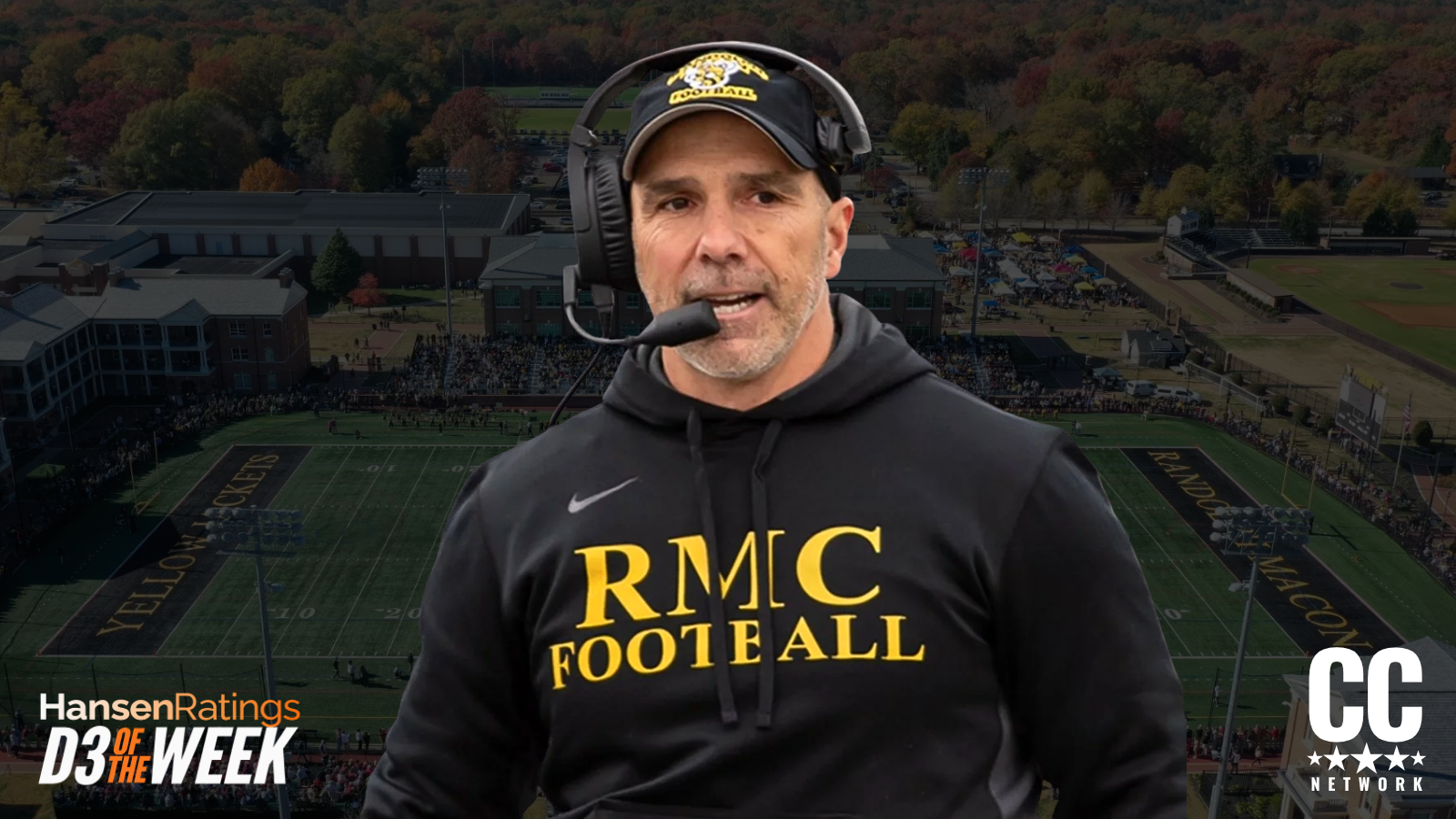
Pedro Arruza does not lose regular season games very often. By his own count, made the week before this interview, Randolph-Macon had lost three of them in the last six years. So opening the 2026 season with a loss at Dickinson, a team returning eighteen starters, was not something his program had much practice absorbing.
“We literally got beaten every phase,” Arruza said. “They kicked our butts offensively, defensively. They had a great game plan and their kids played really hard.”
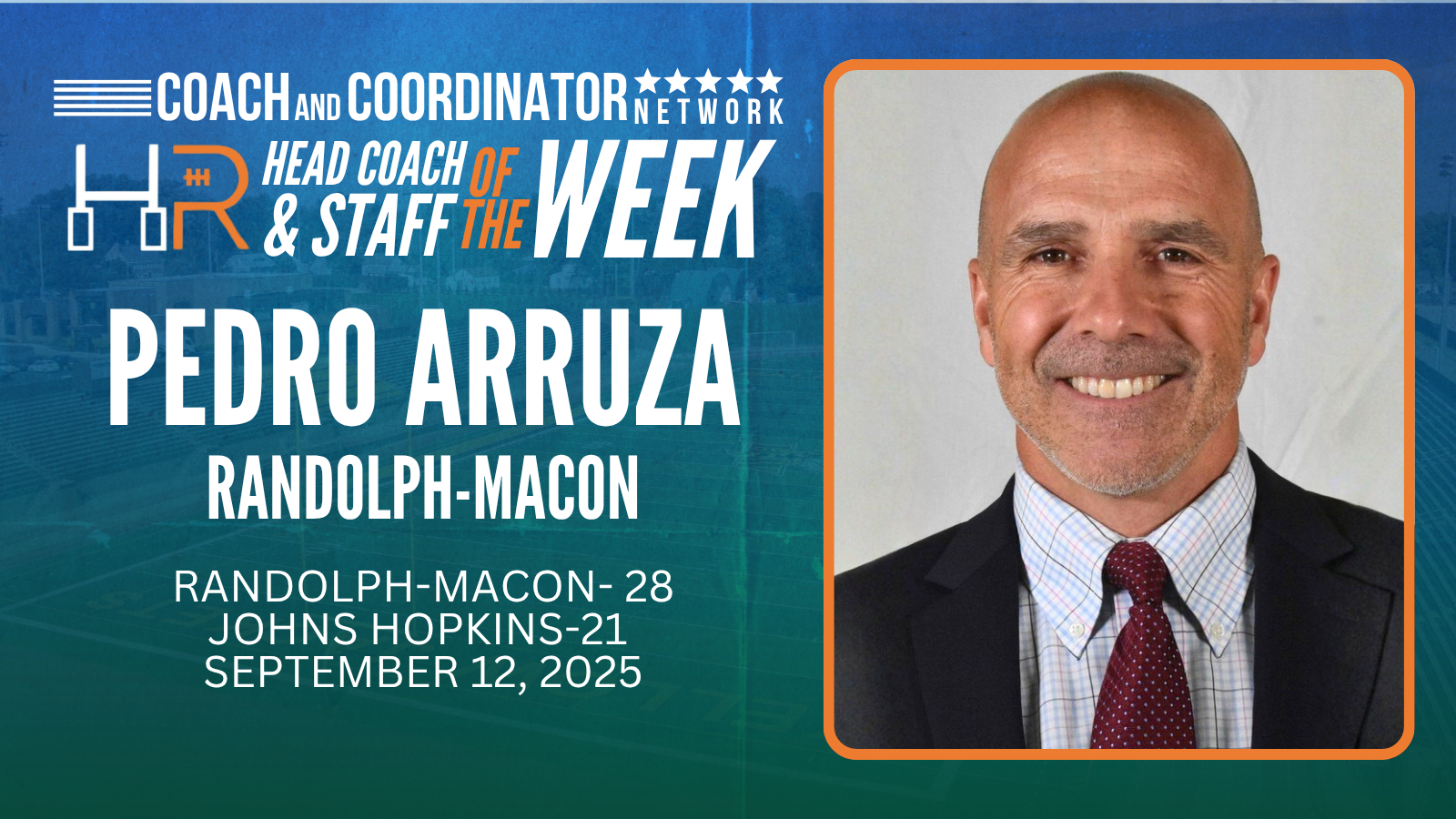
The following Saturday, Randolph-Macon beat Johns Hopkins 28-21. Hopkins came in ranked No. 3 nationally and, according to the Hansen Ratings breakdown that named Arruza and his staff the Division III Head Coach and Staff of the Week, had lost only three regular season games in the previous five seasons. Randolph-Macon outgained the Blue Jays 360 to 332 while running 48 plays to Hopkins’ 80.
Ask Arruza what changed in a week and the answer is not a scheme adjustment. It is the thing that runs through the whole conversation: the win was built on the parts of the game every coach talks about and, in his words, “probably don’t emphasize enough.” He says a version of that line twice, once about fundamentals and once about team chemistry.
Hard, not complicated
Arruza has been at Randolph-Macon for twenty-three years, and he has a settled view of why big games are won or lost.
“There have been games over the years where we’ve won big games and games where we’ve lost those big games. And almost always, Keith, it comes back to those things, right? Fundamentals and tackling and execution. We all think it’s about scheme. That’s what everybody gets excited about. Hey, I saw this play on Twitter. And I’ll tell you, after doing this for a while, it really does come back to fundamentals and your discipline and how hard you play.”
His summary of the game itself is worth keeping: “You can overcomplicate this game. It’s a hard, hard game, but it’s not a complicated game.”
That is the lens he put on the Dickinson loss. The things his program talks about all the time, physicality, discipline, effort, did not show up. Guys got tired. Dickinson had some long sustained drives. He did not think the fundamentals or the discipline were there. So that became the focus of the week, and he credits what went right against Hopkins to the same short list. “A lot of the things that we did well on Saturday came back to that. Just simple fundamentals, effort, discipline, those things that coaches like to talk about a lot, but probably don’t emphasize enough.”
The Hansen numbers line up with a game won on execution rather than volume. Randolph-Macon’s average completion went for 18 yards, including a 61-yard touchdown, and more than a quarter of its rushing attempts went for ten or more yards or a score. Defensively, Hopkins ran 80 plays and averaged 4.2 yards per pass and 4.1 yards per rush. The special teams and penalty numbers also fit Arruza’s emphasis on effort and discipline. Randolph-Macon held Hopkins to an average of one yard per punt return and 15 yards per kick return, against national averages of ten and twenty, and finished with a 148-yard advantage in the hidden yardage created by special teams and penalties.
You cannot condition for a fifteen-play drive
The tired-legs part of the Dickinson loss deserves its own note, because Arruza did not respond by questioning the team’s conditioning plan.
“The demands of the game are the demands of the game. When you have a fifteen play drive on defense, okay, I don’t care how many gassers you run, and we don’t run gassers here, by the way, but I don’t care how many gassers you run or what you’ve done. That’s impossible to prepare for.”
His conclusion was about the game, not the conditioning. “I told our guys, if we want to play faster and we want to play better, you gotta get off the field on third down. You can’t be out on the field for fifteen plays and be in condition, so to speak. Nobody can do that at any level, no matter what kind of preparation you’ve had.”
Arruza has talked at length elsewhere about how he manages player load, and he did not second-guess it after the loss. He told his coaches he would not change anything about preseason camp, and he said the staff paid more attention to load this year than ever before. His reference point is Bill Walsh’s observation that there are two times of year a coach can really beat up his team, preseason camp and the end of the season, and that most coaches only pay attention to the second one. Randolph-Macon came out of camp healthy and fresh, and Arruza said he felt good about that going into Hopkins.
The freshman who played one snap
The second time Arruza uses the “easy to talk about” idea, he is talking about his sideline.
“When I stood on that sideline, there wasn’t one guy on our sideline that cared one iota about whether he was the one scoring the touchdowns or whether he was the one making the tackles. It was unbelievable how unselfish our guys were on Saturday. And you could just feel that on the sideline.”
He gave three examples, and they matter because they are halftime decisions that only work if the room accepts them.
Two running backs, Mitch Johnson and Devin Bryant, were splitting carries, and Arruza watched them rooting for each other between series. At halftime he told one of his receivers that he was not doing a great job on the jet sweeps and that someone else was going to run them. “He looked at me, he said, yes, sir. He didn’t push back. There was no, why are you seeing that, coach? I can do that. He understood. Hey, this guy’s gonna do a better job.”
Then the screen. Arruza brought in a freshman to run a screen. He played one snap the entire game, and the screen went 61 yards. What Arruza wanted to talk about was not the play but the reaction when he announced it at halftime. “There wasn’t one single guy among that receiver group that looked at me like, hey, why am I not the guy that’s getting that touch?”
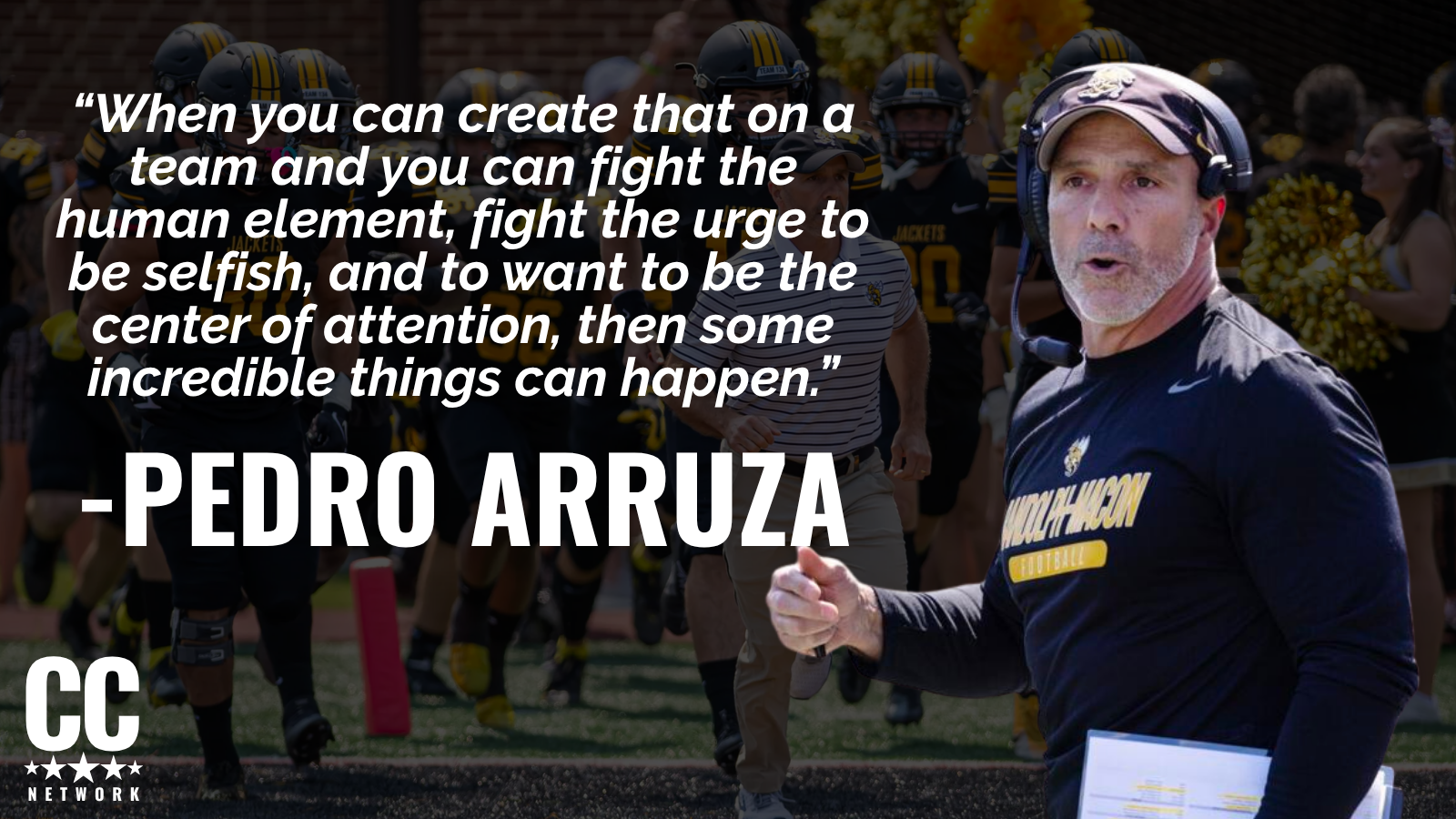
His read on why that matters: “When you can create that on a team and you can fight the human element, fight the urge to be selfish, and to want to be the center of attention, then some incredible things can happen.”
For Arruza, this is the essence of “team.” “If we can just recreate that sense of camaraderie, that sense of teamwork. Everybody talks about that. Easy to talk about, right? Very, very hard to create that on a football team, especially in this era where there’s so many distractions.” He listed them: social media telling a kid the grass is greener somewhere else, NIL, transfers.
What stands out is how the all of this connects. The unselfishness Arruza describes gave the staff freedom to make corrections without creating another problem. He could change who ran the jet sweep at halftime and get “yes, sir” instead of resistance. He could put a freshman on the field for one snap and give him the ball without the receiver room wondering why the touch wasn’t theirs.
Why he thinks Division III can still do this
Arruza’s explanation for where that sideline comes from is specific to his level, and he is not shy about it. “It’s why I love Division III football. We’ve got a program here and an operation, as do probably many people at this level, where our kids play for each other and they love each other and they’re playing because they love the game of football. When they come out on a January morning and it’s ten degrees outside and they’re there at six o’clock in the morning, they’re not there because they’re on scholarship.”
He also connects the culture to what he has to remind himself of every day. He wants to win. He wants to compete for a national championship someday. “But my purpose is not to win. My purpose is way, way bigger than that.” He describes coaching at Randolph-Macon as a chance to make the program a transformational experience, so that his players are better husbands, dads, and leaders when they leave. He admits that is hard to hold onto as a competitor, and that his wife will occasionally have to grab him and remind him of it. He tells the players something similar: football is part of your identity, and you will play it for four or five years, and it cannot be all of your identity. “When you lose, you gotta remember that. When you win big games, you gotta remember that too.”
The staff’s part
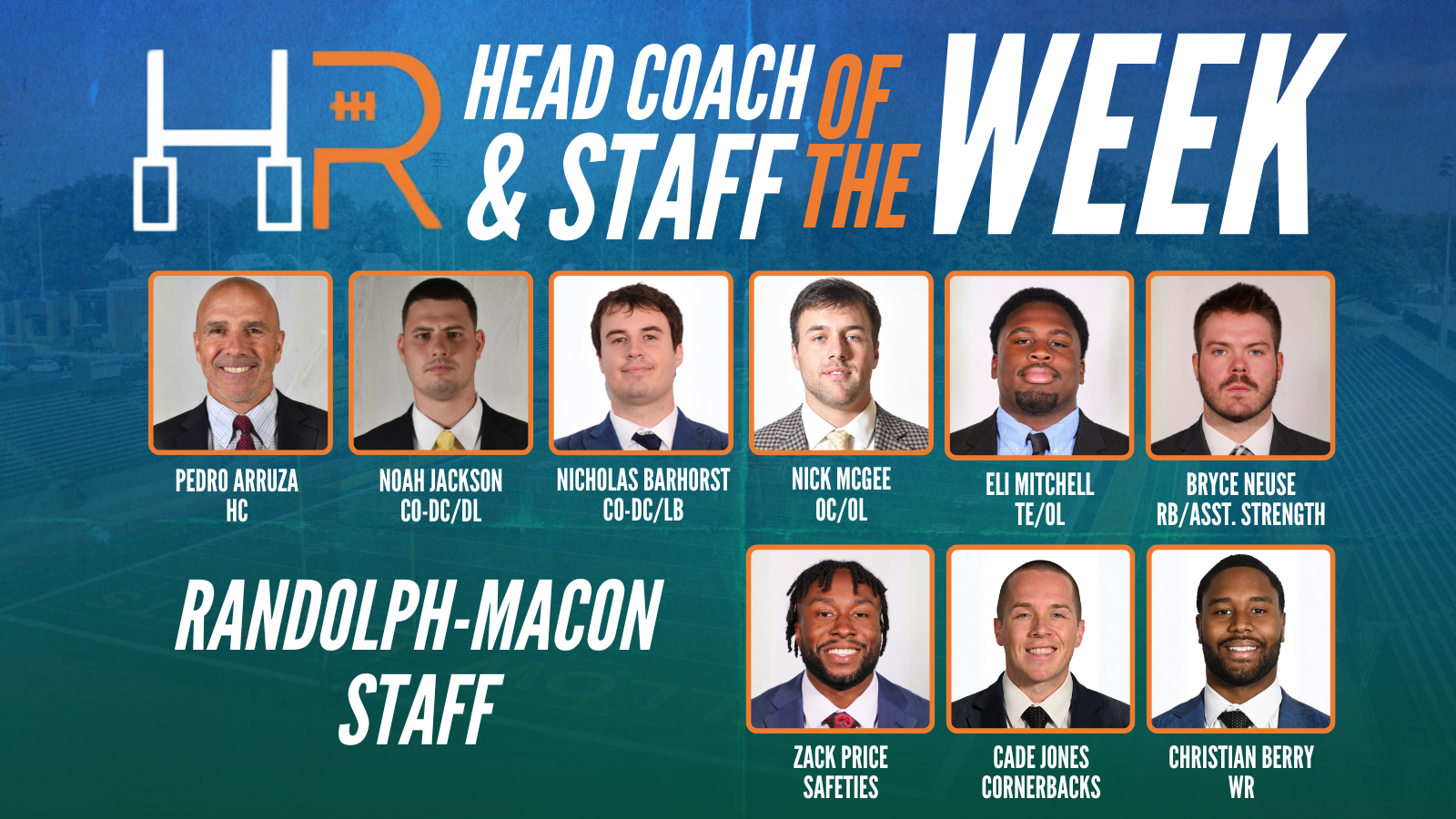
Arruza gave the credit for the week to his assistants, and his description of how they handled the Monday after Dickinson is the same idea again. He told his team on Sunday that the assistant coaches “did a tremendous job of coming into the office after a tough loss and being super positive, and being very critical of the areas where they and their players needed to get better.” Nick McGee, his offensive coordinator, has been with him since the spring of 2021 and also coaches the offensive line. The defense is coordinated jointly by Noah Jackson and Nick Barhorst, two former Baldwin Wallace players, and Arruza said they came up with a tremendous plan for Hopkins. He called this staff one of the best groups he has had at Randolph-Macon.
What to do with this
The idea in Arruza’s week is not new, and he would be the first to say so. That is his point. The physicality, discipline, and effort that decide big games, and the unselfishness that makes a halftime personnel change stick, are things every staff already talks about. His question, implied rather than stated, is whether they get emphasized at the same volume they get discussed.
One practical test is his own: after a loss, does the correction go to the scheme first, or to the short list? Arruza’s staff went to the short list, kept the camp plan that had the team fresh, and trusted a room that would not flinch when a freshman got the ball. “It’s a hard, hard game,” he said, “but it’s not a complicated game.”
About Pedro Arruza
Pedro Arruza is the head football coach at Randolph-Macon College, where he has led the Yellow Jackets since 2004. Entering his 23rd season, Arruza is the longest-tenured college football head coach in the state of Virginia and has overseen the most successful stretch in program history.
Under Arruza, Randolph-Macon has won seven ODAC championships in the past 10 seasons and made repeated deep NCAA playoff runs, including a national semifinal appearance in 2023 and Round of 16 appearances in 2022 and 2024. He has been named ODAC Coach of the Year seven times and State Small College Coach of the Year by the Touchdown Club of Richmond eight times.
Before Randolph-Macon, Arruza coached at Washington University in St. Louis, Butler University, and Battle Ground Academy. At Washington University, he served as defensive coordinator and strength and conditioning coordinator and was named the AFCA Division III Assistant Coach of the Year in 2003. A native of West Palm Beach, Florida, Arruza graduated from Wheaton College in 1995 after a standout career at running back. He was a two-time Division III All-American, three-time first-team All-CCIW selection, and three-year Academic All-American before later being inducted into Wheaton’s Hall of Honor.
Arruza and his wife, Kara, have three children: Owen, a 2025 Randolph-Macon graduate; Ella Joy, a 2025 Liberty University graduate and current graduate student there; and Will, a 2025 Patrick Henry High School graduate and member of the Randolph-Macon football team.
Related:
The Evolution of Sprint-Based Football at Randolph-Macon College- Pedro Arruza, Head Coach
Connect on X:
Keith Grabowski: @CoachKGrabowski
Logan Hansen: @LogHanRatings
Pedro Arruza: @RMCfootball
Check out this years Hansen Ratings – HansenRatings.com
Keith Grabowski (00:02.316)
joined by the head coach of Randolph Macon, Pedro Arruza. Pedro, great to have you back here. A multiple performance guy here on the podcast. We’ve had you on a a couple of times before. So it’s great to see you back and to be able to give you and your staff this honor this week.
Pedro (00:17.443)
No, I appreciate it. Always good always good to talk to you.
Keith Grabowski (00:21.006)
So when we look at the head coach and staff of the week, Logan Hansen always surfaces those those programs, those teams that put it all together. And y you guys did that here in a a big win this week. What do you feel were some of the keys for you going into this week to to be able to have a huge performance like this?
Pedro (00:41.261)
Yeah, you know, obviously starting out the season up at Dickinson, we knew we knew that was gonna be a tough game. They had eighteen starters back. I think they’ve got a great program up there. Coach Fordis has done a tremendous job up there. And so w we knew that was gonna be a great, you know, challenge for us to, you know, get on a bus and go up there and play them with all those starters coming back. but it’s always disappointing, right? Like, you know, we’ve had a lot of success here and you know, I think I
counted it up last week. I think we’ve lost three regular season games in the last six years. So to start out start off the season with a loss, that that was tough. I mean it was tough tough for me, tough for our coaching staff, tough for our players. So I I think probably the the thing that I’m most proud of is just the fact that, you know, when you lose lose a game and you lose when and and we literally got beaten every phase. I mean they they kicked our butts offensively, defensively
Keith Grabowski (01:14.478)
Mm.
Pedro (01:38.208)
they had a great game plan and and their kids played really hard. So to be able to come back from that and, you know, respond in a positive way and have a great week of practice and, you know, knowing what we were up against, we have a tremendous amount of respect for the Johns Hopkins football program and, you know, Coach Wataka and that entire operation. I I think that was the biggest thing. It’s just the the positivity and the resilience and the the preparation that our our staff
and our and our players put into this week. I I was just really proud of of everybody. You know, our assistant coaches came in and, you know, worked really hard to prepare a good game plan and the kids were, you know, very responsive and and just responded in in a way that, you know, you you want a team to respond when you you face adversity. So that that was the big biggest thing about this week. It was just the the response to some hard things happening in that opening game and, you know, we were super proud of our our guys for that.
Keith Grabowski (02:36.961)
Yeah, like you said, not something you guys are used to and and all of these things when you’re able to to rebound and and and then have a week in in another you know, playing another great team, you know, it’s it’s always easier maybe when, you know, you you have maybe that layup opponent, but that’s not what you went into. Well for you, you know, looking at it as you set the tone for the week, what were the things you focused on to say, Hey, this is
This is where we need to be.
Pedro (03:07.885)
I think that, you know, from our standpoint, the things that we talk about all the time, you know, being very physical, you know, playing with great discipline, playing with great great effort. and I don’t think those things happened in that first game. You know, I th I think that guys got tired, I think that they had some long sustained drives. I didn’t think the physicality was there. I didn’t think we played with, you know, great fundamentals and great discipline. So that that was a big focus last week.
You know, it it it’s really, you know, I’ve been here now for twenty-three years and you know, there there have been games over the years where we’ve won big games and game games where, you know, we’ve lost those big games. And almost always, Keith, it comes back to those things, right? Fundamentals and tackling and and execution. You know, we all think it’s about scheme. that’s what everybody gets excited about, right? Like, hey, saw this play on Twitter, I saw this play.
You know, that they ran on Saturday night and man, I I’ll tell you after doing this for a while, it it really does come back to fundamentals and, you know, your discipline and how hard you play. And, you know, you can overcomplicate this game. It’s a it’s a hard, hard game, but it’s not a complicated game. And I think a lot of the things that we did well on Saturday came back to that. Just simple fundamentals, effort, discipline, those those things that
You know, coaches like to talk about a lot, but probably don’t emphasize enough.
Keith Grabowski (04:42.094)
I know in having you on the podcast in the past, your most recent episode was with Tony Holler on our sprint based football series. But you also did a a full presentation on that at Lauren’s First and Goal where you talked about, you know, how you run your program and and you mentioned there like maybe the guy’s getting tired. what were some of the things, you know, th thinking of all that you shared and I’ll link both of those in in our show notes for our listeners so they can listen to that as well. But
Some of those aspects of it, the things you believe in that became part of this week and and critical for as you’re saying, like not seeing a team that maybe a guy’s tired or whatever it might be over the course of the week. ‘Cause I know you pay a a a lot of attention attention to player load.
Pedro (05:25.355)
One one hundred percent. And you know, I mean the demands of the game are the demands of the game. I’ve said that before. When when you have a fifteen play drive on defense, okay, I don’t care how many gassers you run, and we don’t run gassers here, by the way, but I don’t care how many gassers you run or what you’ve done. That that’s impossible to prepare for. You know, so I told our guys if you know, we want to play faster and we p wanna play better, you gotta get off the field on third down. You know, you
You can’t be out on the field for 15 plays and and be in condition, so to speak. You know, nobody can do that. You know what I mean? Like you can’t do that at any level, no matter what kind of preparation, you know, you’ve you’ve had. So, you know, I believe in what we do. I I think that it was really important for for me and for us that we come out of camp fresh. I think Bill Walsh talked about this when he was with the 49ers. There are two times of the year where you’ve got
Yeah, the potential to really beat your team up. One of them is preseason camp and the other one is at the end of the season. most coaches paid a lot of attention to the end of the year. They’re like, hey, we’re tired. We don’t need as many reps. And for for us, you know, if I I told our coaches I wouldn’t change anything about the way that we did preseason camp. I think that we paid more attention to player load this year than we’ve ever paid paid before. And I think we are very healthy coming out of camp.
And felt good. Felt good about the preparation that we that we put in. I I tell you one one big thing coming out of Saturday’s game, Keith, and I said this to our guys on Sunday when I met with our team, is when I stood on that sideline, okay, there wasn’t one guy on our sideline that cared one iota about whether he was the one scoring the touchdowns or whether he was the one, you know, making the tackles.
it it was unbelievable how unselfish our guys were on on Saturday. And you could just feel that on the sideline. You know, we had two running backs, Mitch Mitch Johnson and Devin Bryant, who were both, you know, carrying the ball and man, I I s I saw the interaction between those guys on the sideline and the way they were rooting for each other. I came in at halftime. I told one of our receivers, I said, I don’t think you’re doing a great job with a with a jet sea s the jet sweeps. we’re gonna get so and so to run
Pedro (07:49.454)
He looked at me, he said, yes, sir. He didn’t push back. There was no, you know, no, no, no sense of, hey, wh why are you seeing that coach? You know, I can do that. He was like, he understood. Hey, this guy’s gonna do a better job. We we brought in a freshman to run a screen for us. He he played one snap the entire game. And it was a 61-yard screen that he ran. And when I came in at halftime and said, hey, Quentin’s gonna run this screen, I think he’s the best guy for it.
there wasn’t one single guy among that receiver group that looked at me like, Hey, why am I not the guy that’s getting that touch? I can do this, you know? And so I think when you can create that on a team and you can fight the human element and fight fight the urge to be selfish and to want, you know, you to be the center of attention, then some some incredible things can happen. And, you know, that was a good football team that we played. And you know, they I I again they’ve got a great history. They know how to win.
They’re well coached, you know, they play really, really hard. And but that was the thing that I came away from that game, just telling our guys like, man, if we can just recreate that sense of camaraderie, that sense of, you know, teamwork, you know, everybody talks about that. Easy to talk about, right? Very, very hard to, you know, create that on a football team, especially in this era where, man, there’s so many distractions and so many things, you know, going on around you and you know, you got
social media telling you that, you know, you’ve you’ve gotta go out and find something better and the grass is greener somewhere else and there’s NIL and transfers and all this other stuff. And it’s why I love Division Three football. You I th I still think that we’ve got a a program here and an operation, as do, you know, probably many people at this level, where our kids play for each other and they love each other and they’re playing because they love the game of football. And when they come out on a January morning and it’s, you know, ten degrees outside and
Yeah, they’re they’re there at six o’clock in the morning. They’re not there because they’re on scholarship. They’re there because they love they love football and they wanna, you know, be great and they wanna be a part of this.
Keith Grabowski (09:57.295)
Well, that’s that’s a huge kudos to your staff because those are built those behaviors are built when you talked about back in January, those start then and and but they’re important though. I mean you talk about, you know, from the larger sense, you see that on the macro level with what your team did and and guys not being selfish, but even when you go into the micro level and you think about it the you know, the environment that we fight.
out out there all the noise that social media, as you mentioned, creates or whatever might be worthy the whole, you know, hey, do better, go to a higher level type of deal. this is a game where y you still need to do your job. Like you can’t have that guy pressing, I’m gonna do a little bit more to, you know, make myself bigger in this. Like y your job might be to
Pedro (10:46.999)
Mm.
Keith Grabowski (10:47.254)
you know, run this route that clears things out for somebody else as an example. Like, you know, you have to be willing to do that and stick to doing your job because when one guy starts to veer off of that in one way the the whole system starts to crumble. And that’s I think the one of the challenges that we have today that, you know, maybe we didn’t have five or six years ago. And and now it’s, you know, it’s at the forefront of continuing to get these guys to do their job every single play, every single practice and
like I mentioned that those behaviors are built in in January.
Pedro (11:21.345)
No, there’s no no question about it. And you know, listen, I have to remind myself of this ’cause I’m like anybody else. I want to win every game. And, you know, I want to be, you know, national champion someday. And, you know, you you have all of these individual goals and team goals and program goals that you want to accomplish. But, you know, Keith, what I what I have to do every day when I come into this office, I have to remind myself what w of what my purpose is. And my my purpose here i it’s I wanna win. I’m not
saying that I don’t want to win, but my purpose is not to win. My purpose is not to compete for a national championship. My my purpose is way, way bigger than that. And, you know, I think that I’m coaching here at Randolph Macon to impact lives and to make sure that when these guys graduate from here, this program has been a a transformational experience and that they’re better husbands and dads and leaders when they leave here and that ten years back you know from now they can look back on this experience and say,
Man, that was a life changing, life altering, transformational experience. So it’s it’s hard though. You know what I mean? It’s really hard because as a competitor, you come in here and man, it’s football, football, football. And every once in a while my wife will grab me and say, Hey, you gotta remember what what your purpose is. You know, why why why did God put you on this earth? Why did God make you a coach? And you know, that that’s and I tell the players that, you know, every once in a while when
You get out of the chaos of, you know, running for meeting to class to practice. Y you know, you gotta remind these guys, like, hey, you’re you’re a football player. Yes, that’s a part of your identity. You’re gonna play football for four years, five years if you’re fortunate enough to do that. And then, you know, the rest of your life you’ve gotta live your life as a human being and what what’s your identity gonna be? It it can’t just be can’t just be football. You know, it gotta be more than that. And I think it’s an important reminder.
You know, when you lose, you gotta remember that. When you win big games, y you gotta remember that too. You know, for me my identity is not, you know, football, it’s you know, I’m I’m a Christian, I’m a husband, I’m I’m you know, a father and hopefully a a mentor to these to these guys. And I think that’s what I’ve gotta remind myself of and when you’re grounded in that and you remember that, I think that that helps tremendously.
Keith Grabowski (13:40.377)
Yeah, ’cause that’s that’s always come through in what you do from the first time I I met you, which I believe I I I can’t remember the year, but we were in Texas, I believe. We met at Tony Franklin’s One Magic. I don’t even remember where in Texas we were. San Marcos, that’s right. Yeah. Yeah.
Pedro (13:53.903)
Yes.
San Marcos, I think. I think it was seventeen or eighteen. Yeah. I still have all the notes. I’ve got like a notebook filled with notes from that clinic.
Keith Grabowski (14:06.604)
I just came across those the the other day. I I have that notebook there too. But yeah, that that’s I think, you know, whether it’s how you’ve developed your offense or your defense, like you you’ve had this just bigger creation of a system that now you can bring your people into and it can serve them well for the bigger purpose of it. So really appreciate that about you. Before we wrap up, coach, I wanna make sure that we do mention
your staff here and and run down the members of your staff as I said as a head coach and staff of the week for what you guys were able to do.
Pedro (14:31.855)
Absolutely.
Pedro (14:37.229)
Yeah, absolutely. N Nick McGee’s our offensive coordinator. Nick’s been with me since the spring of twenty twenty one. gr great, great person and does a an unbelievable job with our offensive line and coordinating our offense. So he he makes my job, you know, way easier. Bryce Noisey coaches our running backs, another you know, great young coach that does a a really good job. We we hired Christian Berry this year to coach our wide receivers. He’s done a phenomenal job.
and then on the and then Eli Mitchell’s working with our tight ends and our offensive line, does does a great job. And then defensively, you know, we’ve got two guys that coordinate the the defense, two two Baldwin Wallace guys, former Baldwalla, Noah Jackson who coaches our defensive line. Noah’s been with me since two thousand twenty two. Great, great coach, great person. Nick Barhorst has been here now for two years and those two guys
Coordinate the defense and and did a great job of coming up with a tremendous game plan. And then in the secondary, we’ve got Cade Jones coaching the corners who play for us here at Randolph Macon was a part of that Final Four team in 2023, and then Zach Price coaches safeties. And you know, all of those guys do a lot with special teams. And I did, you know, tell our I told our team on Sunday when
You I met with them, I said I thought our assistant coaches did a tremendous job of, you know, coming into the office after a tough loss and being super positive and, you know, being very critical of their the areas where they and their players needed to get better. And I I’m very fortunate. It’s a great group of guys, one of the best groups in terms of a staff that I that I’ve had here, super bought into what we’re doing here. And you know, they work they work their tails off and man, I’m I’m I told my wife
after the first two weeks of camp I’m like this is one of the best groups of guys that I’ve had on a staff. They’re they’re just, you know, awesome and I mean, you know this, that that that’s the heart and soul of a football program, right? Is the the the staff that you have and very, very fortunate and lucky to to have those guys on staff.
Keith Grabowski (16:46.99)
Coach, outstanding job. Congratulations again to you and your staff. I appreciate you taking the time here during a busy week. I know what it’s like with D three football and all the hats we gotta wear, but I I appreciate you taking the time. It’s great to have you back here and best of luck to you and the Yellow Jackets the rest of the season.
Pedro (17:04.292)
Yeah, thank you. I appreciate everything that you guys do for the game of football.