
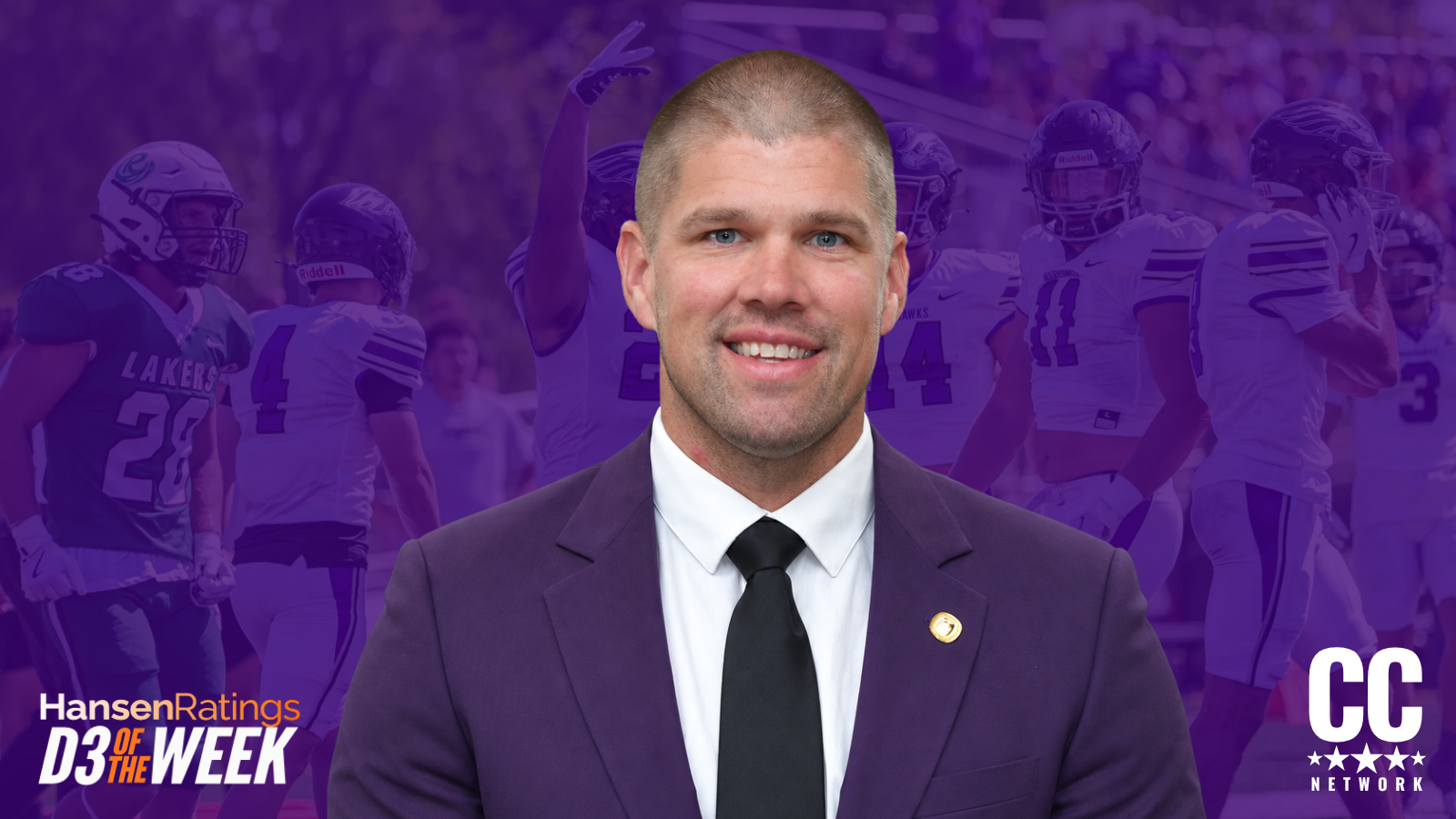
UW-Whitewater’s week one box score reads like something a coach would draw up to prove a point. A 69-7 win over Carleton. Eleven receivers with a catch. Seven ball carriers. Two quarterbacks with completions. Two different kickers with field goals. Thirteen defenders credited with a havoc play, whether a sack, tackle for loss, forced fumble, interception, or pass breakup. Hansen Ratings’ Logan Hansen called it the best offensive performance in program history and the fourth best in the history of the WIAC, with the Warhawks averaging 11 yards per play while holding Carleton to 3.7. They outgained their opponent by more than 500 yards.
When Rindahl sat down with Coach and Coordinator Network as the Hansen Ratings D3 Head Coach and Staff of the Week, he did not talk much about Carleton. That is not an accident. The most useful thing in the conversation is the reason he did not, and it is a phrase Whitewater uses inside the program: the nameless gray face.
Whoever is out there
Here is how Rindahl explains it.
“You can be influenced by outside circumstances. We want to be tough, right? So that means a situation, a circumstance or other person doesn’t dictate my behavior. My behavior and how I go about it is the same way no matter if I’m practicing in the stadium or I’m practicing on the grass field. Whether I’m going against a team that’s undefeated in the top five in the country or a team that maybe hasn’t won. Whether we’re up in the fourth quarter or it’s the first drive and it’s 0-0. Like those things shouldn’t matter on how we want to play.”
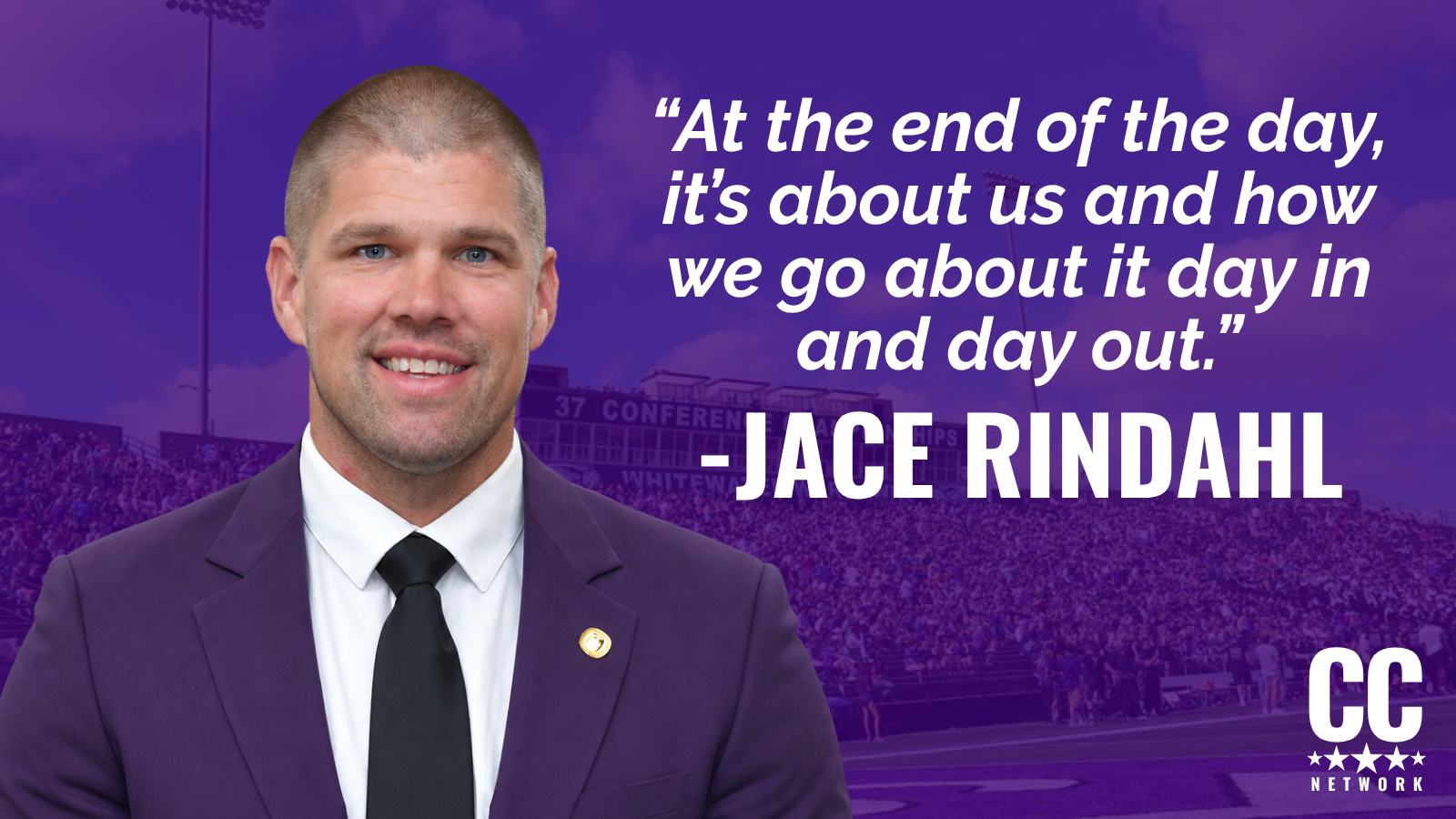
The nameless gray face is the opponent stripped of everything that might change a player’s behavior: the record, the ranking, the reputation, the scoreboard. Rindahl is careful to say this is not an excuse to skip preparation. “Whoever’s out there, yeah, let’s learn about them. Let’s be prepared. Let’s make sure we have a good game plan to attack their weaknesses and utilize our strengths. But at the end of the day, it’s about us and how we go about it day in and day out.”
That last clause is the whole idea. Scouting is about them. Behavior is about us. Whitewater keeps those two things in separate boxes so that the second one never changes based on the first.
For a program like Whitewater, that matters in a specific way. The Warhawks play a competitive schedule in league and out, bring in talented players, and expect to make deep runs. The challenge is keeping the standard from rising or falling with the opponent, the ranking, or the scoreboard. The nameless gray face is designed to remove those variables.
The two points of emphasis in week one
The game plan messaging heading into the opener was narrow. Rindahl says there were two points of emphasis, and neither was about Carleton.
The first was to play fast, and he unpacks what that actually requires: “Can you play fast? Are you in shape? Do you know what you’re doing? Are you confident in your assignments and going out there to play with the technique that the coaches are asking you?” Playing fast, in this framing, is not a tempo decision. It is the visible result of conditioning, assignment knowledge, and technique confidence, which are all things the players own.
The second was to respond. “It’s the first game of the year. There’s gonna be issues, there’s gonna be challenges, there’s gonna be some growing pains.” Whitewater has, by Rindahl’s description, a unique roster: a lot of seniors alongside a freshman group that makes up about half the team, with a lot of young players actually on the field. So the instruction was blunt. “If something goes well, okay, great, but next play. If something goes wrong, okay, we don’t like that, but whatever, next play.”
What stands out is that both points of emphasis are internal. Neither depends on what the other sideline does. Rindahl ties them back to a question each player answers alone: “Did I play my best? Did I give it my best on this snap? And let’s do it again.”
It is worth noticing what his two stated points of emphasis were: play fast and respond. Both were about Whitewater’s execution rather than anything Carleton could control. The scouting work happened, by his own account, but it was not what the team was told to think about.
Pound the rock
The nameless gray face sits inside a larger framework Rindahl describes as pound the rock. He calls it a process-oriented approach: “one meeting at a time, one practice at a time, one weight room session at a time, and being where your two feet are, striving to be your best.”
He is explicit that the program’s stated commitment to excellence “has nothing to do with a trophy or an outcome. It’s about you striving to be your best daily, and it’s about you treating other people right.”
That sounds like the kind of line every program has on a wall somewhere. The difference at Whitewater is that Rindahl can name the concrete standards attached to it, and they are small.
“We’re at practice, we don’t walk. We’re in meetings, we don’t have headgear on. When we’re on deck for an assigned period, we’re behind the line, we’re not on it.”
His reasoning for the small stuff is habit formation: “Just teaching guys those little things right there and doing those things with consistency is going to develop good habits, and ultimately good habits are gonna form who you are. First you form your habits, then your habits form you.”
And then the connection back to the opponent: “We’re all about doing those things with consistency, whether you win, whether you lose, whether it’s a good opponent or a bad, it doesn’t matter, right? Those standards are the same no matter what.”
Read together, these pieces form one system. The standards (don’t walk, no headgear in meetings, stay behind the line) are the same every day. The opponent is a nameless gray face so that nothing about game week changes those standards. The two points of emphasis, play fast and respond, are the game-day expression of the same idea. One way to describe the whole thing is that Whitewater has built its program so that the opponent has no input into how the Warhawks behave.
A championship they do not talk about
Rindahl does not pretend the program has no outcome goals. “We do have a long term vision of winning a WIAC conference championship. And you come to Whitewater because you want to be the best and we want to win a championship.”
Then he says the part that most coaches with those goals would not say out loud: “We don’t really want to focus on that because that’s gonna be doing nothing but distract us, right? That’s future. We can’t control that. We can’t worry about that. We gotta worry about what we’re doing right now.”
The championship gets the same treatment the opponent gets. It exists, everyone knows it exists, and it is deliberately kept out of the daily conversation. In its place: “setting clear expectations, guys understand what the standards are.”
Rindahl frames Whitewater as a developmental program, and this is where the internal focus does real work over a season. “It’s not necessarily who gets there first or where you’re at at the beginning of the year. Maybe you’re third on the depth chart. Well, it’s the beginning. You want those reps at the end of the year. We wanna be playing our best at the end of the year.”
The same standards are meant to travel with the player beyond the field. “If our guys can take that and approach that to their life, whether it’s the social space, whether it’s the academic space, and then ultimately the professional space, when they leave here, I think they’re gonna be better humans.”
280 days and a staff that stayed together
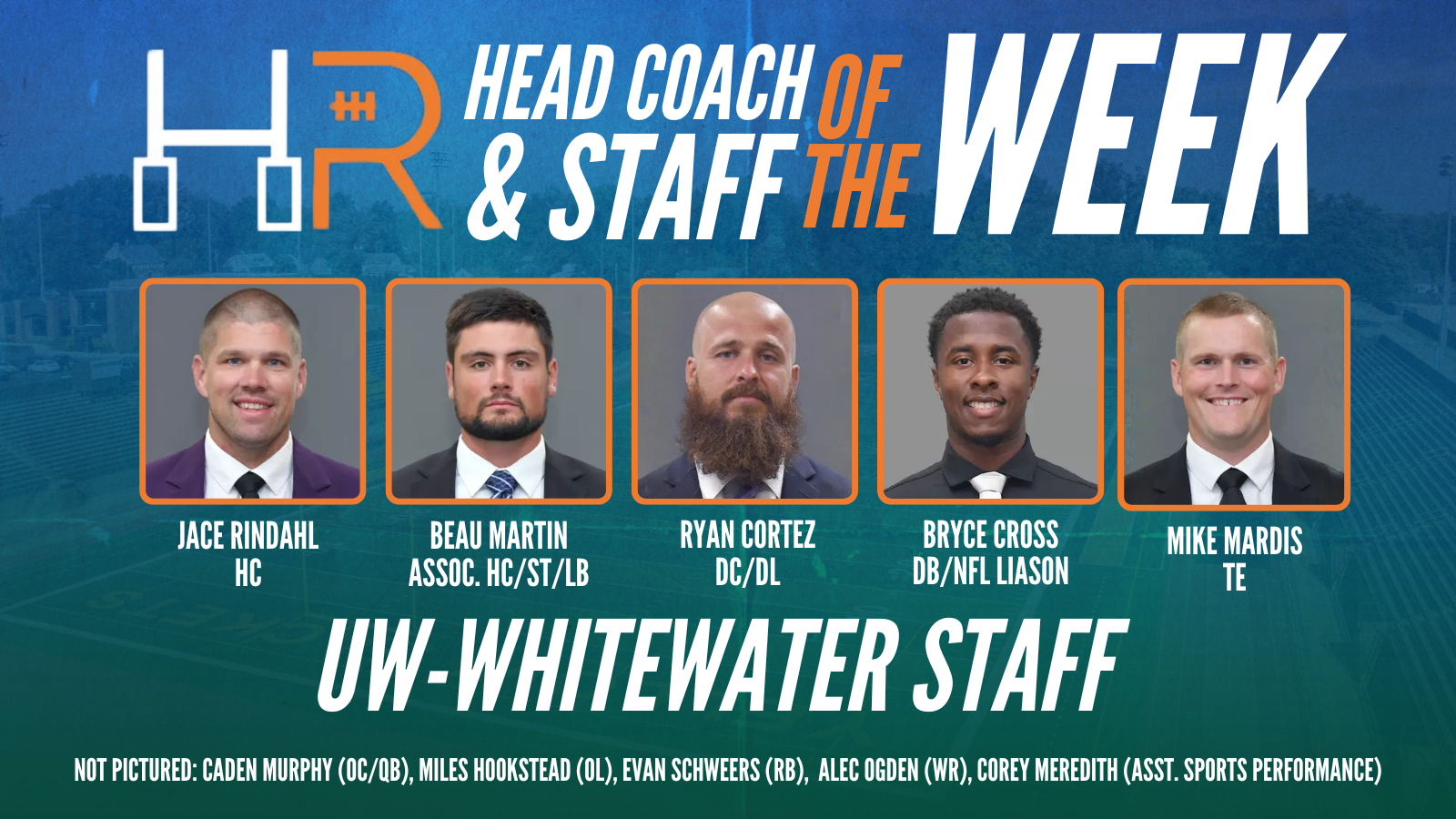
Rindahl opened the conversation with a number: 280 days since Whitewater last played. His reading of the opener is that the box score reflects the work put in across those 280 days, and that a big part of it showing up on Saturday was continuity. This is year two of his staff, and by his estimate 95 percent of it is back from last season. Running backs coach Evan Swears, added this summer, was the lone new addition. Rindahl singled out strength and conditioning coach Corey Meredith for what was visible on the field: “You look at game one and our speed and our ability to run around on that field and do it for four quarters, that clearly goes to Coach Meredith and what we’re doing in the weight room and in our offseason training programs.”
One way to read that continuity is that it matters more in a program built on consistency. Standards like the ones Rindahl lists are easier to reinforce when the staff teaching them has been together long enough to share the same language and expectations.
What this asks of your program
Rindahl’s approach raises a practical question for any coach reading a scouting report this week: how much of your team’s behavior is currently being set by the opponent?
Not the game plan. The game plan should change. The question is whether practice tempo, meeting posture, sideline energy, and the response to a bad play look different in a rivalry week than in a week where the other team has not won. If they do, the opponent has input into your standards.
Whitewater’s answer is to name the opponent something that cannot influence anybody, keep the standards small enough to enforce daily, and give the players two things to think about on game day that they control entirely. Rindahl is not claiming that is why the Warhawks scored 69. The idea is that it gives them a way to approach next week, and the week after, with the same standard no matter whose name is on the schedule.
“If we can do that collectively and we can all as a team be like-minded in our mindset and our approach,” he says, “I like our chances of being successful.”
About Jace Rindahl
Jace Rindahl is the head football coach at the University of Wisconsin-Whitewater, where he took over the Warhawk program in 2023 after previously serving on staff as run defense coordinator, linebackers coach, and defensive coordinator. In his first season as head coach, Rindahl led UW-Whitewater to an 11-2 record, two NCAA postseason victories, and a trip to the national quarterfinals.
Rindahl has been part of UW-Whitewater football for much of his career. As an assistant, he helped the Warhawks win multiple WIAC championships and make deep NCAA playoff runs, including a national runner-up finish in 2019. He was named the Wisconsin Football Coaches Association College Assistant Coach of the Year following the 2018 season.
A former Warhawk linebacker, Rindahl earned first-team All-America honors and was named the D3football.com Defensive Player of the Year in 2008. He helped UW-Whitewater win its first NCAA Division III national championship in 2007 and was later selected to the WIAC All-Time Football Team. Following his playing career, he coached linebackers and special teams at UW-Whitewater from 2009-12 before spending two seasons at the University of South Dakota and eventually returning to Whitewater.
A native of Cambridge, Wisconsin, Rindahl earned his bachelor’s degree in physical education from UW-Whitewater in 2010 and his master’s degree in professional development in 2012.

Related:
One Punt, One Negative Play: How Aaron Keen Gets the Whole Wash U Roster Ready to Execute
Connect on X:
Keith Grabowski: @CoachKGrabowski
Logan Hansen: @LogHanRatings
Jace Rindahl: @CoachRindahl
Keith Grabowski (00:01.4)
Sitting down with our week one head coach of the week and leader of the staff of the week as well at University of Wisconsin Whitewater, Jace Rindahl. Jace, great to have you here on the podcast.
Jace (00:12.571)
Yeah, thanks, Keith. Appreciate it. Appreciate you having our program on and recognizing us for what took place in week one game.
Keith Grabowski (00:20.248)
Yeah, well what took place is is a a complete game when you look at it. And it’s it’s gotta be fun to see just all the contributions of, you know, all the guys catching a ball, running the ball, throwing a ball, all the guys creating havoc on defense, even special teams, a couple kickers getting involved. So to go out week one after, you know, it’s always a long camp and off season and then to have everybody contribute to a win like that has to feel good.
Jace (00:44.583)
Feels great. I mean the credit goes to the players.
They went out there and executed it and put it on the field. But when you look at it from a program standpoint, it’s been 280 days since we played last. I think that shows the work that was put in throughout those 280 days. We got a special special group of guys. It’s kind of a unique team where we have a lot of seniors, but then we also have like half our team are freshmen. So it’s a it’s a unique blend. But we’re, you know, they’re hungry, they’re motivated, they’re talented, and for them to be able to go out there and put
On the field like that is pretty special. And you know, our staff did an unbelievable job getting them prepared. You know, year two of us, for the most part, 95% of our staff is back from last year. So the continuity is there, and I think that was a big part of the success that happened on Saturday was that combination of our players, our staff being together for two years and going out there and putting that work in and letting it show up on game day.
Keith Grabowski (01:43.192)
The the approach for you guys and I mean you guys always play a competitive schedule, whether that’s in league or out, and then obviously you know, deep runs in the playoffs. And you know, for you guys, there’s an approach to that and how this is you keep the focus on yourself. We’d love to hear you talk about that.
Jace (02:02.577)
Yeah, I mean I think, you know, as we went into this game, the two points of emphasis were we gotta play fast. And and number one, can you play fast? Are you in shape? Do you know what you’re doing? Are you confident in your assignments and going out there to play with the technique that the coaches are asking you? And then the next point of emphasis was respond. Right? How are you gonna respond? How are you gonna get to that next play? It’s the first game of the year. There’s gonna be issues, there’s gonna be challenges, there’s gonna be some growing pains. We do kind of, as you look at it, have a lot of youth on our team.
team and a lot of young guys that are playing and if if if something goes well, okay, great, but next play. If something goes wrong, okay, we don’t like that, but whatever, next play. And I think our guys really bought into that. And you know, at the end of the day that’s you reflecting at yourself and looking yourself in the mirror and hey, did I play my best? Did I give it my best on this snap? And
Let’s do it again. So play into that standard one snap at a time and you know we gotta keep building off of that because that’s ultimately gonna get us where we wanna go. But it was a great start and proud of our guys.
Keith Grabowski (03:07.403)
The the philosophy you guys carry into this each week is really doesn’t matter who is on the other side of that schedule. You guys make it about you and you share with me the the philosophy behind that to and something that you’ve you’ve lived for a while here at Whitewater.
Jace (03:23.205)
Yeah, pound the rock is what we talk about. it’s a process-oriented approach. It’s one meeting at a time, one practice at a time, one weight room session at a time, and and and being where your two feet are, striving for to be your best. We talk about a commitment to excellence, and that has nothing to do with a trophy or an outcome. It’s about you striving to be your best daily, and it’s about you treating other people right. So that’s how we go about it. we got great dudes in this program. You know, we recruit high
Character and and guys that love football, and that’s who we are, and so we’re like-minded from that standpoint that football is a priority to us. we’re gonna we’re we’re good people, so at the end of the day, we understand we’re committing ourselves to something greater than ourselves, which is the team, and then let’s just go to work, right? Let’s go put the work in and let’s earn it, and then the results will take care of itself. When you got good dudes, love football, we know that we’re gonna go earn it and work it by pounding the rock one day.
Yeah.
Keith Grabowski (04:24.821)
You you mentioned to me too that you you talk about a nameless gray face as the opponent there and how important that is that in in a program like yours that one it’s I mean, you you guys have a ton of talent, you bring in a lot of talent, keeping the focus on yourself.
Jace (04:43.909)
Without a doubt, you know, you you you can be influenced by outside
circumstances or or you know we want to be a tough we want to be tough, right? So that means a situation, a circumstance or other person doesn’t dictate my behavior. My behavior and how I go about it is the same way no matter if I’m practicing in the stadium or I’m practicing on the grass field. Whether I’m going against a team that’s undefeated in the top five in the country or a team that maybe hasn’t won.
Whether we’re up in the fourth quarter or it’s the first drive and it’s 0-0. Like those things shouldn’t matter on how we want to play. So the nameless gray face is, hey, whoever’s out there, yeah, let’s learn about them. Let’s be prepared. Let’s make sure we we have a good game plan to attack their weaknesses and utilize our strengths. But at the end of the day, it’s about us and how we go about it day in and day out. And if we can do that collectively and we can all as a team be like-minded in our mindset and our approach.
You know, I like our chances of being successful.
Keith Grabowski (05:49.73)
Chase, how do you feel that builds a a culture of
I guess really development, right? We’re seeing a day and age now that’s now it’s reaching down even to the high school levels where guys are always looking for the grass is greener situation. I think something like this that during the season is, you know, a focus on ourselves. Obviously that carries into the off season too. How important is that in a culture today to be able to keep guys and keep them focused on their development rather than, you know, I could I could take a shortcut and jump over here or there and it’s gonna be better.
Jace (06:24.601)
Yeah, we’re a program of d a developmental program as as you stated there. And you know, it’s all about the growth. It it’s not necessarily who gets there first or or who’s you know, where you’re at at the beginning of the year. It’s okay, you’re you’re, you know, maybe on the third on the depth chart. Well it’s the begin right, you want those reps at the end of the year. We wanna be playing our best at the end of the year. And if we just keep that focus on growth and improvement and and doing it daily,
You know, we’re gonna get to where we wanna go. And for me as the as the leader of the program, we do have a long term vision of of winning a WIC conference championship. And and you come to Whitewater because you want to be the best and we want to win a championship. But we don’t really want to focus on that because that’s gonna be doing nothing but distract us, right? That’s future. We can’t we can’t control that. We can’t worry about that. We gotta worry about what we’re doing right now. So setting clear expectations, guys understand what the standards are. you know, we’re at
Practice, we don’t walk. we’re in meetings, we don’t have headgear on. when we’re you know on deck for an align assigned period, we’re behind the line, we’re not on it. But just teaching guys those little things right there and doing those things with consistency is going to develop good habits. and ultimately good habits are gonna form who you are. and you know, first you form your habits, then your habits form you. So we’re all about those little things, we’re all about doing those things with consistency, whether you win, whether you lose, whether
It’s a good opponent or a bad, it doesn’t matter, right? Those standards are the same no matter what. And if our guys can take that and approach that to their life, and and whether it’s the social space, whether it’s the academic space, and then ultimately the professional space, when they leave here, I think they’re gonna be better humans and they’re gonna develop. So we’re gonna use the sport of football. That’s why we recruit dudes that love football, because if they love it, then you know they’re gonna sacrifice for it and invest into it, and we can use this beautiful game.
Game football to help teach them life lessons and shape them as people, which will ultimate ultimately make them be successful as they go on in their life.
Keith Grabowski (08:31.137)
Yeah, I I love it. I mean that’s what I love about D three football is and it still feels that way, that this is is
you know, a bunch of guys who love to play the game and I I I hope that, you know, I know guys get poached from the D three level as well, some of that happens, but I think when you look at it, guys are really doing a great job building programs and and building that culture that I think makes a difference to that young man. Right. And and I mean if I’m looking at it and I’ve got a choice of, you know, my son can go to a school and and just, you know, be a a guy on campus versus I’m gonna spend
a little extra for him to go and continue his his college football career and be a part of something that’s gonna develop him way beyond the four years that he’s there or five years I guess they get now. But I I think that’s what we see in D three football too and I think that’s why we all love it.
Jace (09:24.893)
Relationships and experiences, man. That’s what that’s what life’s about. you know, you’re here at Whitewater, we got good dudes, right? You’re gonna
You’re gonna be like-minded from that standpoint. So we’re gonna create relationships. And then if we can do that, we can have that connected player-led locker room. I I think we’re gonna be able to make some pretty, pretty fun experiences and do some special things together. But at the end of the day, that’s what life’s about. And you know, I struggle with the transfers and all that, and sometimes it’s it’s for a better opportunity. And you know, we’ve only lost a few guys, but you know, some of them have got their school paid for. And you know, that’s that’s a pretty good deal for them. But you know, at the end of the day, life’s about
relationships and experiences and we like to keep that on on you know on the forefront here and and I think if we can mold that and build that and create that the the results and the success takes care of itself.
Keith Grabowski (10:17.963)
You mentioned the consistency of staff and this honor is head coach and staff of the week. So wanted to talk a little bit about that. I really I think you hit the nail on the head, right? Having a staff together, even just in a year or two, is such a big difference than that first year you get together. Talk about that consistency and and how you see that working for you guys moving forward.
Jace (10:39.161)
It’s so key, it’s so critical.
You know, offensive staff, Coach Caden Murphy going into year two as our offensive coordinator. around him, Miles Hookstead’s our offensive line coach. Mike Martis, who’s our our tight ends coach. All three of those guys you know, have been in those roles and have built together the the last two years. Alec Ogden as well is an alum of our program, coaches our receivers, done an unbelievable job with them. Then we were able to add Evan Swears as our running backs coach this summer. He was the one new addition that we added.
Then you get to the defensive side of the ball. Ryan Cortez, our defensive coordinator. He’s been in that role for four years. He came to Whitewater in 2009. He’s been a part of this tradition and success for over two decades. Maybe a decade and a half. Wrong with the math there. But then Bo Martin, our associate head coach, special teams, recruiting coordinator. He came to Whitewater in 2013. He left and then came back. But those guys are unbelievable. And Bryce Cross going into year two is our DB coach. Bryce is an unbelievable.
enthusiastic, knowledgeable young man that’s a that’s an awesome coach. And Corey Meredith’s our strength and conditioning coach that joined us last year as well. I think you you know you look at game one and our speed and our ability to run around on that field and do it for four quarters that clearly goes to you know Coach Meredith and what we’re doing in the weight room and in our offseason training programs. So I’m honored I’m very fortunate to have an unbelievable staff like we do. I mean I’d argue it you know I don’t know if there’s one better out there. Obviously that’s
subjective and people can measure that and ultimate we’ll find out how good we are at the end of this thing this year. But I think we got a special one here and I’m I’m super proud to be the leader of our program.
Keith Grabowski (12:22.497)
Coach, I re appreciate you taking the time during this busy week and congratulations to you on your sta and your staff on the honor of being named our head coach and staff of the week and good luck the rest of the way with for you and the the Whitewater team.
Jace (12:37.308)
Yeah, thanks Keith. Appreciate you guys having us. Keep doing what you do. It’s great for the game of football on D3, and we thank you so much.