
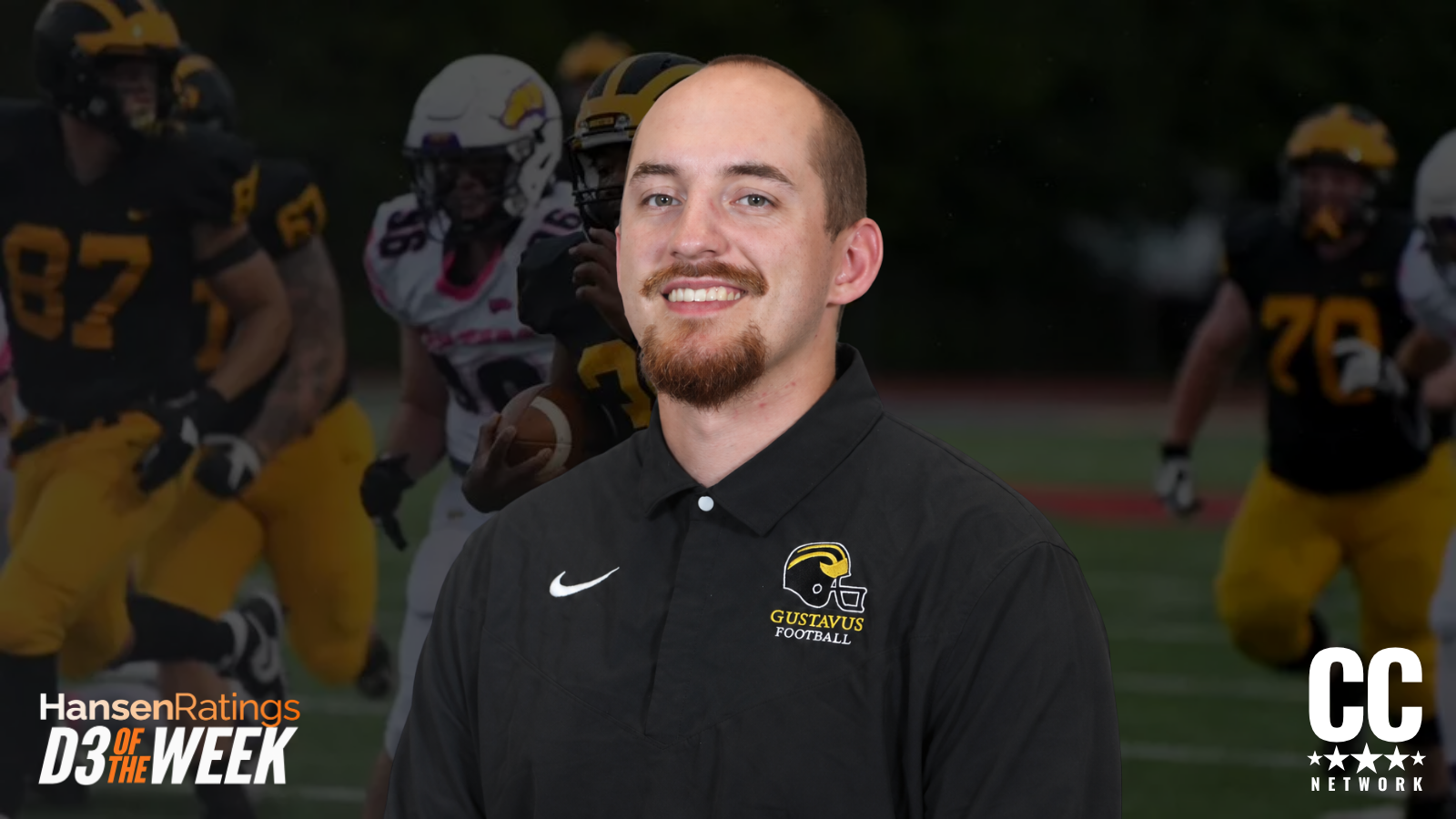
Gustavus Adolphus defensive coordinator Landon Rauen has a line for why his defense does the same two things every single practice day.
“I guess I’m a believer that you get what you emphasize.”
The interesting part is not the line itself. Plenty of coaches say some version of it. The interesting part is how Rauen has to make it true at a Division III program where, as he puts it, “we all wear a lot of hats.” He is responsible for all of the defense’s film. His defensive line coach is also the special teams coordinator, and special teams time is before practice. The staff has things to get ready before the first period starts, which means one of the things Rauen wants emphasized every day, taking the ball away, has to happen at a moment when the coaches are not available to run it.
So the players run it.
That arrangement, and the daily tackling circuit built on the same emphasis inside practice, is the most transferable idea in Rauen’s conversation with Coach and Coordinator Network after he was named the Hansen Ratings D3 Defensive Coordinator of the Week for week one.
What the Gusties did to Central
The performance that earned the honor deserves its own paragraph, because it was not an ordinary week-one defensive game. Gustavus beat Central 29-3. According to Hansen Ratings’ Logan Hansen, eight teams earned an A-plus offensive grade in week one and only one earned an A-plus on defense, and it was Gustavus. Central had not been kept out of the end zone since a 10-6 loss to Wartburg in 2024, and had not been held to three points since a 29-3 loss to Wartburg in 2003. The Gusties allowed under 100 yards rushing and under 200 passing to an offense that averaged almost exactly 400 yards per game in 2025. Central converted three of 15 third downs and two of eight fourth downs, and came away with three points on three red zone trips. Gustavus finished with five sacks and eight tackles for loss.
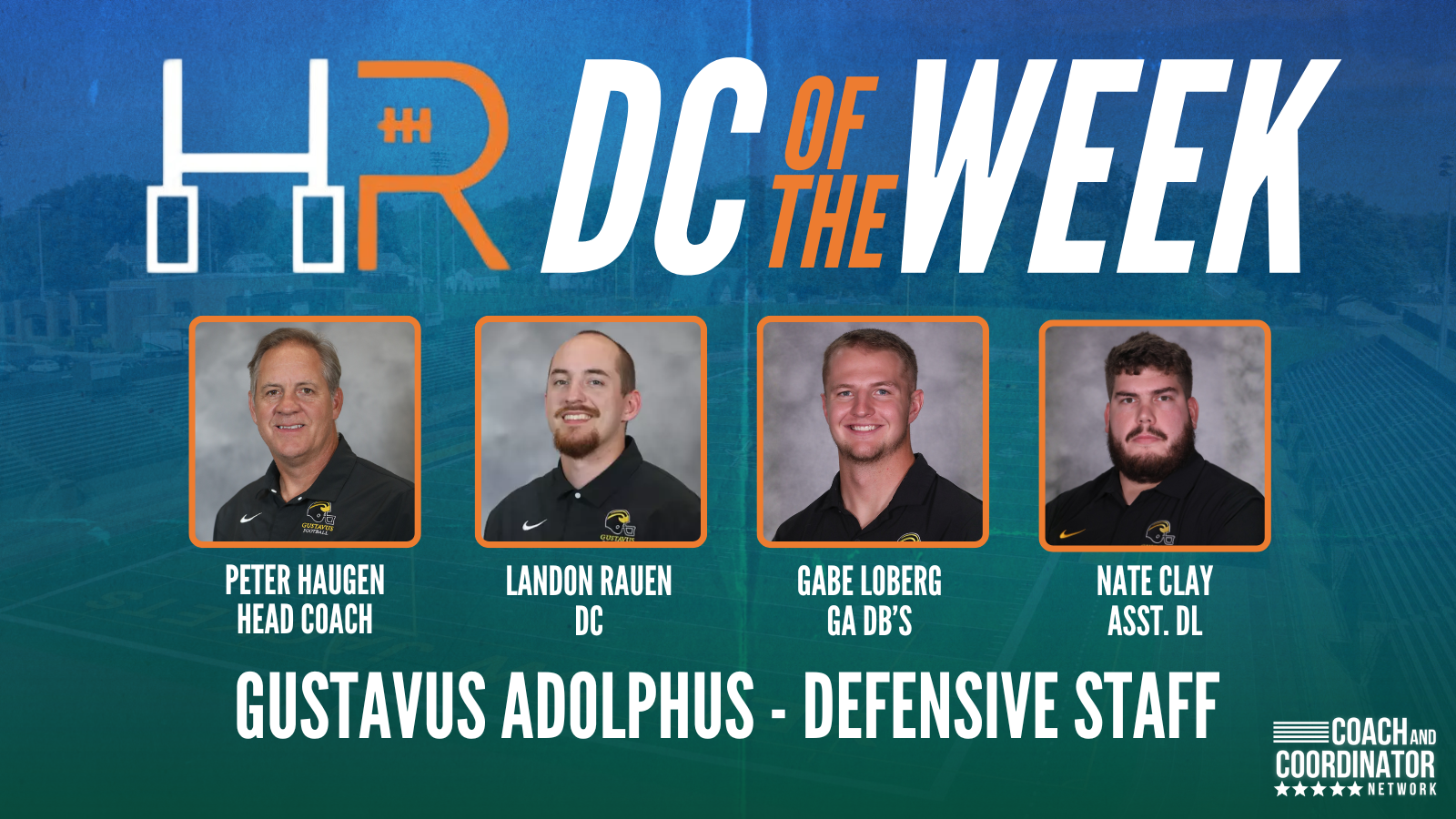
Rauen’s own accounting credits the defensive line first. Four of the five sacks came from that group, which he says had graduated a couple of players, lost a couple more to attrition, and “was maybe a bit more of a question mark for us than what showed on Saturday.” He handles the linebackers himself. The secondary lost two starters from last year and then lost a player Rauen thought was going to be a good one for them during fall camp, so a couple of defensive backs were starting their first college game. He credits defensive line coach Derek Glenn and new part-time assistant Nate Clay up front, and Gabe Loberg for getting the defensive backs ready.
The takeaway circuit
Here is the setup, in Rauen’s description.
The circuit is laid out before practice, as players are walking out, at whichever of the program’s two practice locations they are using that day. It runs the width of the field with four stations. The first is a recovery station: catching a ball or scooping a ball. The second is attacking the football: raking at it or punching at it. The third is a pass rush station. The fourth is matching the hand of a quarterback.
It is not a full-speed period. “It’s just above probably a walkthrough a lot of the time.” The equipment is “not much, usually just footballs and maybe a couple other things.”
The coaches’ involvement is front-loaded. “We make sure to go through what specific drills we’re doing at each station before we get out onto the field so they know.” After that, the players fill in. A player goes through a station, then tags out a teammate who was holding the ball or serving the drill, and that teammate gets his rep.
Rauen is candid that this is partly a staffing solution. Between his film responsibilities and his defensive line coach’s special teams duties, “it’s a lot of time that’s, hey, our players are getting out there.” But he frames the ownership as a feature rather than a workaround, and the circuit is reinforced by a takeaway competition that runs through the rest of practice, with players earning points for a punch at the football, an interception, and similar plays.
The purpose is repetition of the idea, not just the skill. “If we can emphasize that by saying, hey, we’re gonna do this every day regardless, it’s always something that’s on our guys’ mind.”
He also does not oversell it. Gustavus did not take the ball away against Central. “We didn’t have one Saturday, which was unfortunate.” His case for the circuit is longer than one game: “If we can do that consistently, it’s gonna allow us to be a lot better than we can if we don’t.”
Five minutes, four stations, sixty guys
The tackling circuit lives inside practice rather than before it, and it is built for speed of throughput.
Four stations again, with two drills at each that rotate based on the day. The whole defense goes through it in one period, “five minutes or less.” A player takes his rep as the tackler and hops to the next line. Everyone knows the rotation: rabbit line to tackle line, then on to the next station. Rauen wants it to look a certain way from the outside. “If you were watching from the side it’d be a little frenzied. We kind of want it to be that way,” because the goal is to get every player a rep in as little time as possible.
That is not a small group. Specialists go through it too, kickers and punters included, so it is “probably fifty to sixty guys every day,” and everyone gets through all four stations inside the period.
Two design details stand out. First, the circuit does not change much with the practice plan. “It’s not something that has to change much whether we’re in pads, we’re not in pads.” Second, players are coached by every defensive coach as they move through, not just their position coach. “You’re getting coached by our D line coach, our DBs coach, so on and so forth there. I think that part’s big.”
The circuit handles the general tackling skills. Position-specific tackling work lives in individual time, where Rauen says each position group has “probably two or three drills” they will run.
The coaching point is the monotony
Rauen says the same thing about both circuits, and it may be the most useful thing in the interview for a coach thinking about installing something similar.
Daily circuits work because they are daily. They also decay because they are daily. “We are doing it a lot, and so I think the natural human tendency is for it to just kind of become monotonous and guys are just going through the motions.” On the tackling circuit: “Guys start to, the natural tendency is to go through the motions a little bit, and so I think that’s part of what we’re coaching there. Okay, we gotta be deliberate about this work.”
So one of the most important coaching points in these periods is intent. Rauen says the takeaway circuit is where “we probably coach with that period more than anything,” and the coaching point is peer-driven: “If you feel like he didn’t do the rep right, just have him go do it again.”
That instruction only works if the players are willing to say it to each other. Rauen attributes that to a culture built over time under head coach Haugen, who has been at Gustavus for 18 seasons and coached Rauen as a player. “It’s player led as much as anything. It’s one thing if I or our other coaches are saying stuff to them, but we got guys that are bought in, that are willing to hold each other accountable.” He ties that directly to staff stability: “That kind of culture has been built up over some time just with the stability we’ve had coaching wise here.”
Mental reps and a week that did not go to plan
The same ownership shows up in how Rauen handles the players who are not getting physical reps. His view of game preparation is that a staff will never cover everything. “We’re not gonna be able to get every rep of every coverage or every call against every play that they’re gonna run.” What matters is that players are exposed to what will challenge them, and that “our guys that aren’t getting those reps physically are getting them mentally too,” including the ones standing on the sideline watching.
Asked whether he has a method for that, Rauen’s answer is honest. “I don’t know that I have a secret necessarily other than trying to stay on top of the guys that aren’t in the game.” Then he points back to the players holding each other to it.
Week one tested that more than usual. Heat pushed the game up and forced the Gusties to move practices around on Wednesday and Thursday. The motto for the week, in his words, was “anytime, anywhere, whether it’s practice, a game, we’ve got to be able to live out our values.” He connects it to a phrase the program uses often: “Our situations don’t dictate who we are.”
Rauen does not make the connection between the circuits and that scrambled week explicit, but the pattern in his examples is consistent. The things his defense does every day are designed to keep happening when the coaches are busy, when the practice plan changes, and when a player has to tell a teammate to do a rep over. That is what emphasis looks like when a staff cannot be everywhere at once.
What this asks of your program
Rauen’s setup raises a plain question for a short-staffed defense: what is the one thing you say you emphasize, and who is actually running it when you are somewhere else?
At Gustavus the answer is a four-station takeaway circuit that the players set up and run at just above walkthrough pace while the coaches finish their pre-practice jobs, and a five-minute tackling circuit that puts 50 to 60 players through four stations in front of every defensive coach on the staff. Neither requires much equipment. Neither changes when the pads come off. And both, by Rauen’s own description, have to be coached hardest on the days when they feel routine.
About Landon Rauen
Landon Rauen is the defensive coordinator at Gustavus Adolphus College, a role he moved into during the summer of 2024 after joining the Gusties’ coaching staff following his graduation in 2021. His recruiting areas include southwest Minnesota, Wisconsin, Iowa, and South Dakota.
Working primarily with the Gustavus defense, Rauen helped the Gusties reach the MIAC championship game in 2023 for the first time since 1987. Gustavus finished 6-4 overall and 5-2 in conference play, won the Northwoods Division, and defeated No. 7 Saint John’s for the program’s first win over the Johnnies in 10 years.
Rauen also helped coach Carson DeKam to MIAC Defensive Player of the Year honors in 2023, the first player in Gustavus program history to earn the award.
A 2021 Gustavus graduate, Rauen played linebacker for the Gusties from 2017-21. He appeared in 18 games, recording 35 tackles and an interception.

Related:
One Punt, One Negative Play: How Aaron Keen Gets the Whole Wash U Roster Ready to Execute
The Nameless Gray Face: How Jace Rindahl Keeps UW-Whitewater From Playing the Opponent
Connect on X:
Keith Grabowski: @CoachKGrabowski
Logan Hansen: @LogHanRatings
Landon Rauen: @CoachRauen
Keith Grabowski (00:01)
Our week one defensive coordinator comes to us from Minnesota. Gustavus Adolphus. As Logan mentioned, these guys had an incredible weekend, just doing a great job on defense. And that’s the defensive coordinator for Adolphus Gustavus Landon Rauen. Landon, great to have you here and congratulations on a great week.
Landon Rauen (00:22)
Appreciate that, yeah. Thanks for having me on.
Keith Grabowski (00:25)
Landon, you you have spent about a third of your life there at Gustavas. Just tell us a little bit about your background there and in coaching.
Landon Rauen (00:35)
Yeah, so really fortunate to to be here. I think we’ve gotta you know, just really thankful for, you know, our head coach, Coach Haugen. he’s been here for eighteen seasons and so he coached me here as a player.
you know, has obviously been my head coach for the entire time. I’ve been coaching. Learned a ton from him, learned a ton from some other coaches we’ve had in our program. I owe lot of just who I am as a person to to what I’ve learned from the people here within our program, even outside of it, I think we’ve got a really tight knit campus. And so really fortunate that way. you know, grew up as a son of a you know high school football coach. My my dad was a high school head football coach. His dad was a high school head football coach. So kind of been something that, you know, probably was always destined to do and you know thankful to
have gotten an opportunity here, you know, kind of straight out of college and then, you know, been been lucky to still be, you know, still be around and trusted me to, you know, be in be in this position. So thankful for that. And you know, we’ve got a really good just a good group of guys to work with too. Thankful to to come to work each day with with some some good coaches alongside me and some really good players that work hard and and care about what they’re doing.
Keith Grabowski (01:42)
Any honor like this is obviously a collective effort. So I want to make sure you get a chance to mention those guys who are a part of this with you.
Landon Rauen (01:50)
Yeah, for sure. So yeah, I think our like our our D line our D line coach, we’ve got, you know, like our full time D line coach Derek Glenn. I think he does a great job and and we’ve got a new kind of part time assistant with us this year, Nate Clay. and and they did a tremendous job. Like our D line had had a really good game on Saturday and I played a really good, you know, just four quarters of football. We got a lot of pressure on the quarterback. I think those guys ended up with I think we had five sacks total, four of those came from our D line and
you it was a group that lost a lot of of people from last year, I think. You know, we graduated graduated a couple, lost a couple to attrition and you know, coming into camp was maybe a bit more of a question mark for us than than what showed on Saturday and that I think is a testament to those guys and then I think in you know, I handle the the linebackers and
you know, are are in the secondary for us. we’ve got a graduate assistant that’s that’s working with those guys and and kind of the same deal. You know, we lost lost two starters last year and you know, we had a we had a guy that
you know, we thought was was a pretty good player for us to go down in fall camp that didn’t play on Saturday. you know, we’re hoping he’s back at some point this year. But had had to shuffle some things around. I think those guys played well. You know, a couple of kind of starting their first game, first college game and they showed up to play and and so I think Gabe Loberg is our D B’s coach and you know he did a really good job of of getting those guys ready. I think it was it was absolutely a collective effort from from the staff down to to the players at all three levels.
Keith Grabowski (03:20)
You mentioned, you know, going into this game, thorough preparation and you know, this is definitely a a tough division three offense to defend. I mean, you you guys did some things as as Logan Hansen mentioned in the introduction that not a lot of people do. Talk to us about some of the things, just your your philosophy and some of the things you do to make sure your guys are thoroughly prepared each week.
Landon Rauen (03:43)
Yeah, I think it i it it starts with just our identity as a defense. I think for us, like our biggest thing is you know, we want to defend what an offense does well. You know, we’re not going into a game necessarily saying, “hey, we gotta stop the run” or “stop the pass” or whatever the case may be. It’s all it’s all opponent specific and you know, part of that is schematic, part of that is personnel driven. and so I think that was a big thing with with Central, you know, they were
They they had some really good skill players. You know, I think they they’re the two of the better backs that we’re gonna see this year. felt like they had some some good receivers that were gonna give us some problems physically. just size-wise, they had some big bodies that could catch the ball. And you know, we knew that you know their their quarterback was young. and so we felt like that’s that’s an area of like, hey, they got a lot of really good skill players and we gotta try and make that guy be, you know, maybe be the focal point for them. And so I think it the other thing that they do is just you know a lot of
different stuff on offense. Like it’s it’s hard to prepare for because of you know how specific they are to an opponent and obviously being game one you never know what they’ve been studying in the offseason and how they’ve been adapting and never having played us before. So I think it was really just you know we felt like we had a a decent idea based on some of the the games that we had on film that defenses that are similar to ours. And then we just you know wanted to kind of be ready for some of those those concepts that we felt like you
Here’s some of the stuff that they had shown and here’s some of the stuff maybe that had hurt us in the past that they had seen on on the film that they had of us and making sure that we were really prepared for that and then we were really prepared for just, you know, anything that could give us stress, you know, different motions and shifts that they had shown and and all that stuff and just trying to be really thorough and and make sure that our guys hadn’t
You know, or they they weren’t gonna you know, we just kinda said during the week we’re not gonna be able to get every rep of every coverage or every call against every play that they’re gonna run, but it’s gonna be important that our guys are getting exposed to stuff that is going to challenge us. and that our guys, you know, that aren’t getting those reps physically are getting them mentally too. I think that’s always a big thing for us ’cause we you know, we we could be out there all day, every day and and I think, you know, we’re still probably not gonna get every guy a rep at every every look. So gotta make sure that we’re
you know, we’re on top of the guys not only in the game, you know, or in, you know, taking the rep and practice, but also the ones that are that are on the sideline watching too and make sure that they’re getting as much out of it as they can.
Keith Grabowski (06:15)
Yeah, how how do you go about making sure guys get those mental reps? That’s not always an easy thing to do, right? But do you have any any methodology for that? Any kind of things you guys like to do that make sure these guys are staying engaged when they’re not out on the field and practice?
Landon Rauen (06:30)
Yeah, th I think it’s tough, honestly, and and I give our guys a lot of credit. We had some you know, we had some, you know, adversity I guess throughout the week just with you know, obviously the game getting moved up ’cause of the heat that was affecting us in practice too. you know, like we had to move some practice around on on Wednesday and Thursday and and I give our guys all the credit from that standpoint of you know, they were really adaptable and you know, that was kind of the the the motto or
we took this week was just like hey any anytime anywhere whether it’s practice a game like we’ve got to be able to to live out live out our values that’s something we talk about a lot as a program that you know our situations don’t dictate who we are so I I give our guys credit I don’t I don’t know that I have a secret necessarily other than trying to stay on top of the guys that that aren’t in the game and I think it’s it’s it’s player led as much as anything you know like as as I think everyone knows. You know we can it’s one thing if I’m or if our other coaches are saying stuff to them but we got guys that are bought in that are
are willing to you know hold each other accountable that are willing to make sure that they’re you know kind of leading from the front in that way. I think that I think that is is so much more powerful and we’ve been fortunate that like that kind of you know culture I guess has been built up over over some time just with the stability we’ve had coaching wise here which has been a good thing.
Keith Grabowski (07:46)
You mentioned to me a couple of things that are important to what you guys do on defense. And the first one is just a a few minutes every single day as these guys are coming out onto the field running a takeoff or I’m sorry, running a takeaway circuit. Talk to us about the setup of that and and what you guys are working to accomplish.
Landon Rauen (08:04)
Yeah,
so we you know, we’re just setting it up every day. as as the guys are coming out to the field, kind of just like we we have two practice locations, so kind of on our field at our practice field or on in the stadium field, like we’re just gonna set it up right as guys walk out to the field, it goes the width of the field. There’s four stations. The first one’s kind of like a recovery station, so you know, it’s either catching a ball, scooping a ball. Second one’s where we’re kind of attacking the football, so you know, we’re raking at the ball or punching at it, or so on and so forth there. The third one
One is just kind of a pass rush deal.
And then the fourth one is just kind of like, you know, matching the hand of a quarterback. And so it’s something that we try to do before practice every day as guys are getting out of the field. You know, it’s not a full speed thing. It’s it’s you know, you know, just above probably a walkthrough a lot of the time. but something that our I think our guys understand, like, hey, this is what we’re doing every day as we get out to practice. It’s something that our players are the ones essentially running, you know, like between, you know, being being a division three school, we all wear a lot of hats. So like between myself, I’m responsible for all our film.
stuff so I’m I’m kind of going back and forth making sure that’s all getting ready. Our D-line coach is our special teams coordinator. Their time is before practice. you know we all have stuff that’s kind of we gotta get ready before we start. So it’s a lot of a lot of time that’s hey our players are getting out there. We make sure to go through what specific drills we’re doing at each station before we get out into the field so they know
and then it’s like, hey, when you guys get out there we we give give the equipment that they need, which is not much, usually just footballs and and maybe a couple other things and guys will fill in and and I give our guys credit ’cause they’re they’re willing to to do that and you know, and once once a guy goes through he can tag out his buddy and and fill in his spot, maybe holding the ball or whatever the case may be, and then that guy can go get his rep and something that’s you know, it’s important to us is just trying to take the football away. and
something that we feel like, you know, I I I guess I’m a believer that you get what you emphasize, so if we can emphasize that by saying like, “Hey, we’re gonna do this every day regardless.”
You it’s it’s always something that’s that’s on our guys’ mind and it kinda coincides with we do kind of a competition with our guys of of taking the ball away throughout practice where guys are getting a certain amount of points if they can you know, take a punch at a football or if they get a pick or things of that nature. So just something that is it’s you know, it’s it’s constantly being something they’re reminded of and you know, it’s something that’s really important. and you know, we didn’t we didn’t have one Saturday which which was unfortunate, but you know it’s something that you know we feel like if if we if we
We can do that consistently, you know, it’s gonna allow us to be a lot better than we we can if we don’t. So
Keith Grabowski (10:43)
Yeah, and it I mean what you’re talking about there at the D three level certainly is true at the high school level, you know, limited staff, other roles, all those kinds of things. It’s really, I think important what you talked about, it’s the emphasis of it for one. It’s not necessarily a heavy physical period, but I think the other thing I really like about that is the ownership in it, that it’s not relying on you guys. Those guys know you gotta go do a few other things to get ready for practice and they’re out there doing it. I think it just shows, you know, the buy-in of those players that they’re willing to take ownership and lead that period.
Landon Rauen (11:14)
Yeah, without question. I think that’s kind of the thing and you know, that we we probably coach with that period more than anything is is that part of it is is guys like, hey, if if you feel like he didn’t do the rep right, like just have him go do it again. And I think the other part is like, hey, we are doing it a lot and so that I think that you know, the natural human tendency is for it to just kinda become monotonous and guys are just going through the motions and so that’s the other part is making sure that like yes, this isn’t a full speed thing, yes, this isn’t a a super high tempo.
Keith Grabowski (11:52)
Think everybody in in the football world today has looked at how much contact you do in a period. So doing things like a circuit for tackling I think becomes really important, especially if it’s coached the right way, ’cause, you know, we’re all tagging off or thudding up, you know, that the tackling has to happen somewhere. And for you that’s also circuits like it is for many people. Talk to us about your tackling circuit that you guys do every day.
Landon Rauen (12:18)
Yeah,
I think it’s it’s kind of the same idea. You know, it’s it operates a little differently than our takeaway circuit, but we you know, it’s similar. We’ve got four stations. there there’s essentially two drills that we’ll do at each station that that kind of rotate based on the day. and our guys go through. We we try to get it done in in one period of practice, five minutes or less, and you know, it’s basically like you get your rep as as the tackler, and you and you have hop to the next line. So our guys know the rotation. They’re all they’re always going from
the you know the the ball carrier, the rabbit line to the tackle line on to the next station and
You know, we try to make it like, you know, I guess if you were watching from from the side it’d be a little frenzied. You know, we c we kinda want it to be that way for us to get it in as in as in I guess in as little as time as we can, while making sure that everyone gets a rep and like I say, we can get through our whole group, which is with like we have our specialists, we have our kickers and punters go through that as well. It’s probably fifty to sixty guys every day. and we’re getting through everyone is getting through all four stations in five minutes or less typically and so
yeah, I think it’s an emphasis for our defense too and so getting everyone together, getting everyone working these kind of, you know, more general skills with tackling but
you know, it’s it’s something that again our guys know going into the day what we’re doing there and you know, they’re getting coached by each coach. I think that’s another big part of of just circuit work in general is, you know, you’re not always with that same position coach. You’re getting coached by, you know, our D line coach, our D Bs coach, so on and so forth there. So I think that part I think that part’s big and
you know, it’s it’s something that we’ll do and and we don’t you know, it’s not something that has to to change much whether we’re in pads, we’re not in pads or, you know, like it’s it’s always kind of the same deal and and it’s it’s kind of the you know, it’s it’s I guess the same idea is the takeaway circuit after a while I think it you know, guys start to the t natural tendency is to go through the motions a little bit and so I think that’s part of what we’re coaching there is
You know, okay, we gotta be deliberate about this work and then there is certain stuff that we feel like is more specific to position that if we wanna get from a tackling standpoint, we’re we’re gonna get that in our individual time and there’s probably two or three drills that I know each position group will do there.
Keith Grabowski (14:35)
Coach, the preparation, the focus certainly paid off for you guys here. You guys have been a program, yeah, you’re our first coordinator from Gustavus Adolphus to be on. But I know Logan’s mentioned you guys several times here over the last couple of years. So you guys keep up the great work. Congratulations again and best of luck the rest of the season.
Landon Rauen (14:56)
Appreciate that. Yeah. Thanks again for having me on and yeah, appreciate it.