
Before Kyle Flood showed a single outside zone clip at the 2026 COOL Clinic, he put up a slide he says he starts every clinic with.
It has nothing to do with outside zone. The Texas offensive coordinator and offensive line coach uses it for every block his players make, and he said so plainly. “This doesn’t matter if this is outside zone or inside zone or gap schemes or pin-pull plays, whatever, or pass protection.”
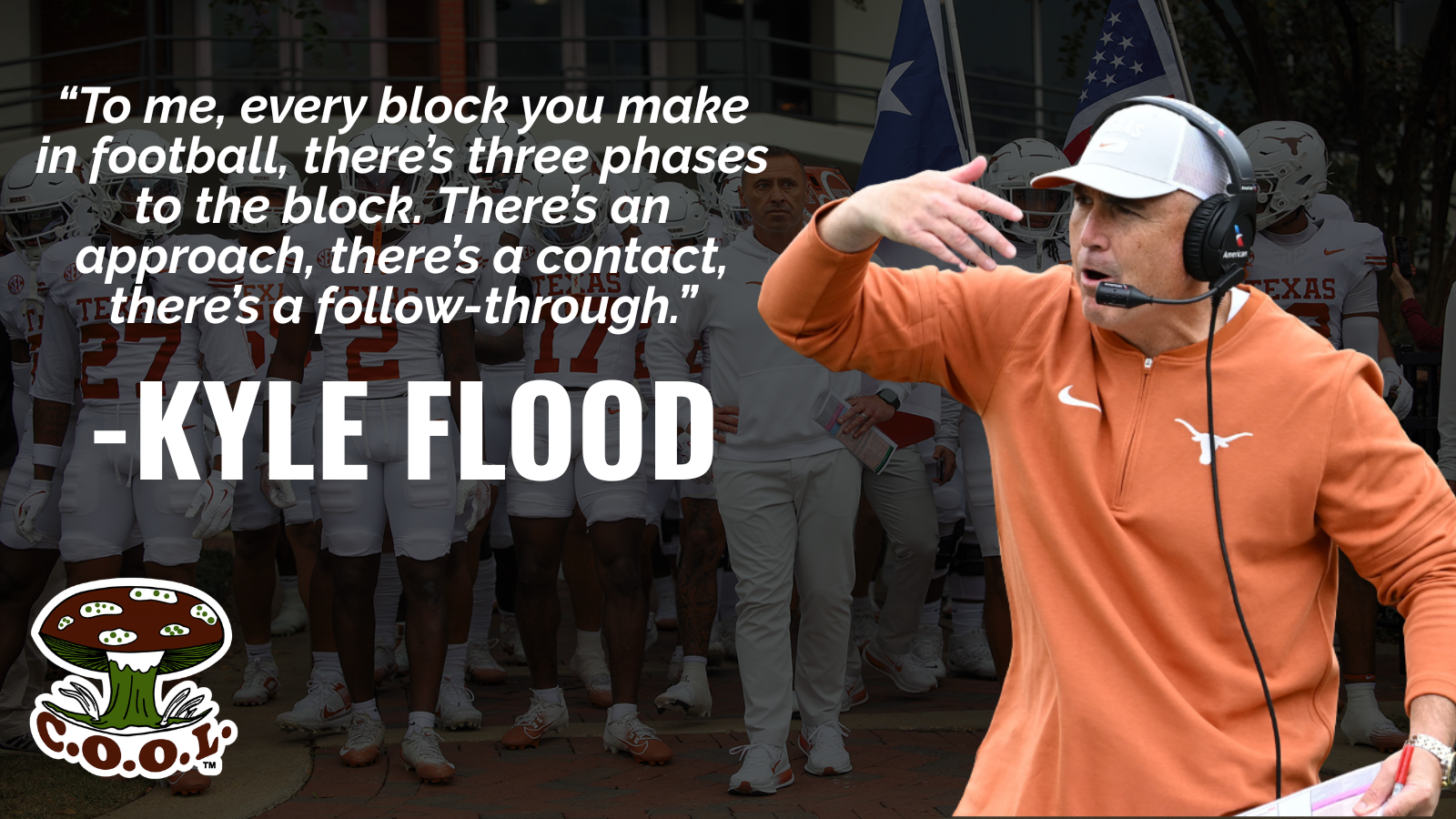
“To me, every block you make in football, there’s three phases to the block. There’s an approach, there’s a contact, there’s a follow-through. So when we’re teaching the block, we teach it in those phases. When we evaluate the block, we evaluate it in those phases.”
The reason he leads with it is a distinction most film sessions skip. “Some blocks are effective, but they’re not necessarily all good.”
Three phases, and what lives in each one
Flood credits a coach named Andy Kwan with putting the framework on paper for him when he was at Alabama a few years ago, but he says it is how he has always tried to approach coaching the offensive line. What the slide does is force the coach and the player to look at a block as a sequence rather than a result.
The approach is the target. In Flood’s words, “your target’s determined footwork and then ultimately your pad level.” He is careful about that last part. Pad level is not one fixed thing. On a screen, a lineman might be running with his pads high. The question the approach phase asks is how the player gets his feet and his pad level in phase right before contact happens.
The contact phase is about the contact surface. “Is it one hand? Is it two hands? Is it a shoulder? Is it a shoulder and a hand?” As he put it, “there’s a lot of different contact surfaces that happen in blocking in general,” and the contact phase is where the right one for that block gets coached.
The follow-through is the finish, and he frames it as two questions: what do I want the lower body to look like, and what do I want the upper body to look like?
Teach in those three phases. Grade in those three phases. The second half is the part he pushed hardest to the younger coaches watching.
Why “good block, bad block” is not enough
Flood’s warning was about how film gets graded. “As you evaluate your stuff, this is a really good systematic way of doing it to make sure you’re not just saying, hey, that was a good block, that was a bad block, that was a good block, that was a bad block,” he said. “Well, some blocks are effective, but they’re not necessarily all good.”
One way to read that is as a distinction between the result of a block and the quality of it. A block that gets the job done on Saturday can still have a phase in it that a coach would not want repeated. When a block does not get the job done, the framework gives the coach three specific places to start looking: the approach, the contact, and the follow-through.
He added that it has helped him through the years at every level he has coached, which runs from high school through Division II, FCS, Division I, the NFL, and now Texas.
What stands out is how ordinary the framework sounds. Flood is not claiming a secret. He is claiming a discipline: teach the block in three phases, and grade it in the same three.
Targets determine footwork
The clearest evidence that the slide is not just a warm-up is that Flood repeats its first principle, word for word, when he gets to scheme.
On the slide: “Your approach is your target. Your target’s determined footwork.”
In his offensive line notes for outside zone: “Targets determine footwork. We already talked about that.”
That callback is the bridge between the framework and the actual play. Everybody on outside zone has a play side gap responsibility, but Flood is clear that this is only a starting point. Depending on the system, the play can be a people play, where the line is told to block the front seven in 12 personnel or the front six in 11 personnel. It can be a spotted play, where the linemen block spots and do not care whether a DB or a linebacker ends up there. Or it can be a box play, where the line only blocks what is in the box. In every version, the lineman’s footwork comes from who or what he is trying to get to. Change the target and the approach changes with it.
Flood’s outside zone teaching shows why the framework matters. The play has a clear objective, stretch the front side horizontally and win the line of scrimmage, but he keeps breaking that objective back down into coachable details: targets, footwork, contact surfaces, hand placement, and finish. Two of those he flagged before the film started. “Your backside hand is really important,” he said, promising that the clips would show “how critical that backside hand is.” He called the catch hand “super, super important.” The fact that he flags both before showing the film tells you they are details he expects to matter when the clips start rolling.
Where Flood learned to think this way
Flood spent the first minutes of his presentation on something that had nothing to do with blocking, and it explains why he cares about handing this framework to younger coaches.
He started attending the COOL Clinic in the late 1990s as a very young coach. He got to watch Coach Wiley, Coach McNally, Coach Scarnecchia, Paul Alexander, and Bill Callahan before he knew any of them. “I don’t know that I could have progressed the way I did without this clinic because every year it was on the calendar.” He also named the staff that works with him at Texas around the clock, Darren Gatewood, Mitch Zolotti, Jason McAdoo, and Danny Rangel, because coaching a college offensive line with today’s roster numbers “is never just about one person.”
That is the context for the slide. Flood learned the premise behind his outside zone at the clinic. He had the block framework put on paper for him by a colleague. He now runs a room with four other coaches working alongside him. One practical advantage of a framework that simple is obvious: it gives every coach in a large offensive line room the same language for looking at the same rep.
What this asks of your grade sheet
Flood’s opening slide raises a simple question for any offensive line coach heading into a film session. When you mark a block, are you grading the result or the phase?
Put Flood’s framework onto a grade sheet and it gives you three boxes instead of one. Approach: was the target right, and did the footwork and pad level get in phase before contact? Contact: was the surface right for the block? Follow-through: did the lower body and upper body finish the way you coach it? A block that wins the rep and fails one of those boxes still gets corrected. A block that loses the rep but fails only one box gets a specific correction instead of a general one.
His point is not that the framework is complicated. It is that “good block, bad block” tells a player how the rep turned out, and three phases tell him what to fix.
Want to keep growing as an offensive line coach? Join the Mushroom Society for year-round development, drills, scheme, roundtables, active conversations, and a community built for OL coaches.

Access Coach Flood’s 2026 Presentation here: