
When Keith Grabowski walked back into the Bay High School locker room after a Friday night win, he looked up at the whiteboard. Two touchdowns were drawn on it. Bay had scored both of them in the fourth quarter, and both came exactly the way the staff had drawn them up at halftime.
Bay had trailed 20-7 going into the fourth quarter, on a night of steady wind and rain. Grabowski, Bay’s offensive coordinator, is clear about what the staff did not do at the break. “We didn’t come into the locker room at halftime and install a new offense, and we didn’t abandon what we believed in.” Instead, they used what they had collected during the first half and made three adjustments that fit inside the system they already had. Those adjustments made up 15 of Bay’s 32 second-half plays, about 47 percent, and produced 194 yards and two touchdowns.
That night is a clean example of how Grabowski sorts everything his staff changes during a game: into micro adjustments and macro adjustments, a distinction he broke down on the Coach and Coordinator podcast.
The size of an adjustment is how far it reaches
Grabowski’s definition has nothing to do with how clever a change is.
“The distinction isn’t necessarily how creative or complicated the adjustment is,” he said. “It’s how much of the offense it affects and what it takes to communicate and execute it properly.”
A micro adjustment is a change Bay can make during a series, or more often between series, without getting the whole offense together. It doesn’t change what Bay is doing at its core. It makes a particular play, protection, or concept work better against what the defense is showing. Usually it involves one player or one position group. Now and then it changes the call itself.
A macro adjustment changes a bigger part of the offense’s scheme, like a blocking scheme, a route structure, or a concept that affects several players. “Sometimes the change itself isn’t particularly complicated,” Grabowski said, “but it changes the picture for everybody involved.” That’s where halftime becomes valuable for Bay. The whole offense is in one room, the change can go on the board, and players can see the look on video.
Micro adjustments and the 15-second window
Most of Grabowski’s micro examples are small enough to give one player at a time.
Pass protection is one. If Bay has been sliding protection one way and a particular pressure or defender keeps causing trouble, the staff can flip the slide or change which player the protection is aimed at. The running back is another. If a rusher is a problem, the back can stay in and help instead of releasing. If the coverage calls for it, the staff can change his route out of the backfield.
The third example changes nothing about the route at all. Against certain coverages, Grabowski wants his quarterback to start his progression on the boundary and scan across the field. “We don’t need to change the route or the entire concept,” he said. “We’re simply adjusting how he processes the play based on what the defense is doing.” His friend Dan Gonzalez calls these navigation tags. At Bay they’re a code word the quarterback already knows.
Getting those changes to players takes planning at a high school like Bay. Players go both ways. Some are on special teams. The receiver or lineman who needs to hear something might be on the field playing defense. Sometimes the staff has to catch a player as he comes off the field, or wait for a special teams rep or a timeout. Quarterback Patrick Cleary doesn’t play defense, so Grabowski can always reach him. Everyone else depends on timing.
“We have to be strategic about what we change, how we communicate it, and when we communicate it,” Grabowski said. That’s where shared terminology pays off. “If I need five minutes to explain a simple adjustment, we’re probably not going to get that done between possessions. But if our players understand the terminology and the structure of what we’re doing, that adjustment might take 15 seconds.”
How the staff finds the adjustment between series
Bay doesn’t have a team of analysts. On game nights, Grabowski’s son Aidan, who isn’t a football coach, charts every play call and its result in Modern Football while the offense is on the field. He doesn’t identify coverages or fronts, and he doesn’t need to know why a concept was called.
“We’re separating the simple task of recording the play call and the result from the coaching task of identifying, interpreting what the defense is doing,” Grabowski said. “We don’t need to find another assistant coach to do this.”
When the offense comes off the field, the staff goes to a sideline tent with a TV and an iPad. Grabowski uses Hudl Sideline to run through that possession’s plays. He isn’t doing a full film breakdown. He watches for the two or three defensive details that matter for that opponent and tells Aidan, who tags them to the plays in Modern Football with a few taps. Within a short time, the calls, results, and defensive information are all linked.
From there the staff can ask the questions that drive adjustments. Is the defense playing Bay differently by formation or personnel? When is it more likely to bring pressure? What coverages is Bay seeing, and what has worked against them? Grabowski also looks at Bay’s own calls. “We’re not just scouting the defense during the game, we’re evaluating ourselves,” he said, checking whether Bay is creating patterns the defense can recognize.
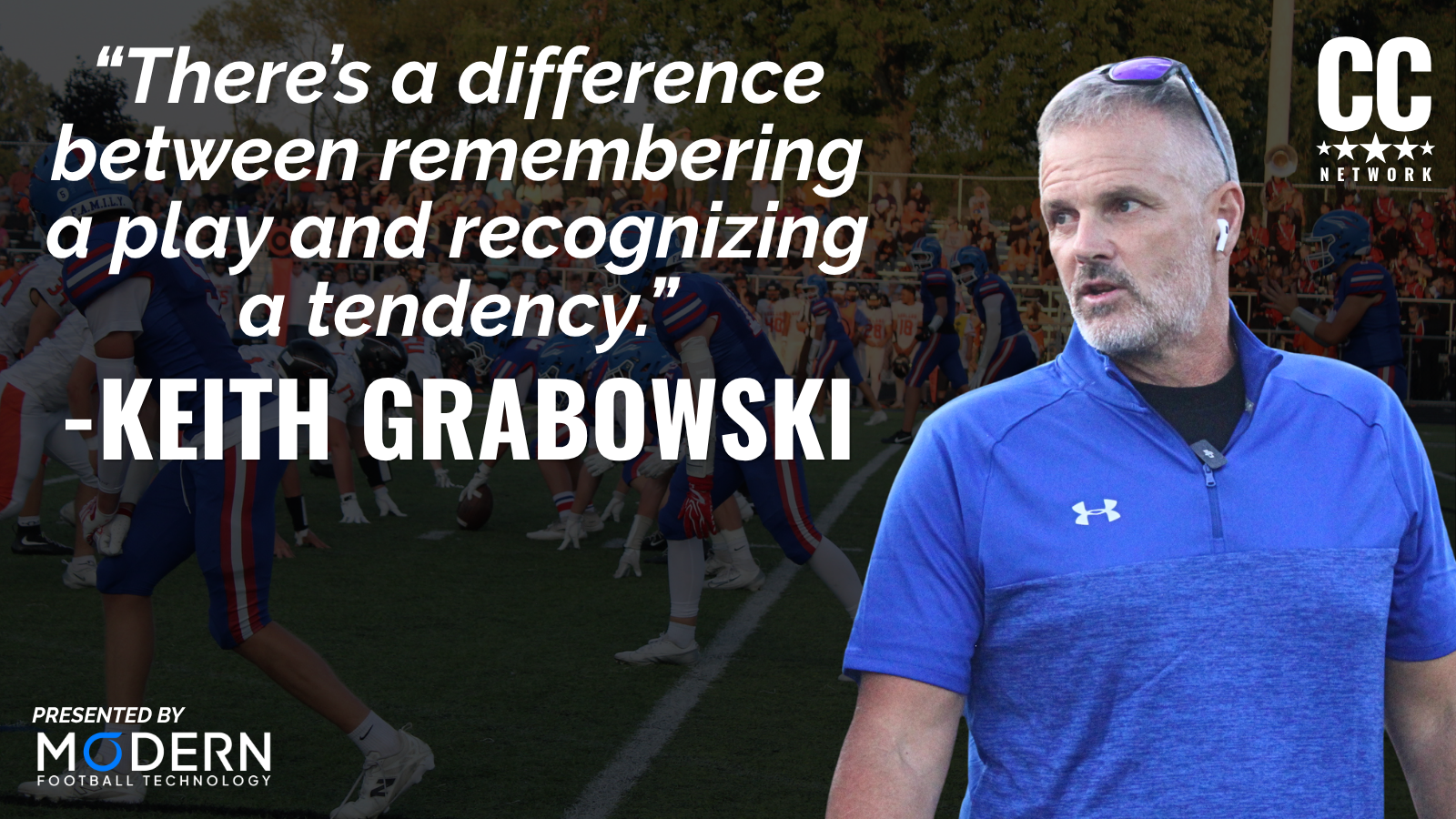
Without that record, he said, a staff is left with whatever stuck in memory: the pressure that caused a negative play, or the coverage that took something away. “There’s a difference between remembering a play and recognizing a tendency.”
Grabowski, head coach Nick Bigrigg, and offensive line coach Brandon Johnson keep a running conversation going through all of this. Johnson watches up front, Bigrigg brings his view of what they’re seeing and how to attack it, and Grabowski fits it into the next call. There’s no formal staff meeting. Often the answer is no change. “Sometimes the information tells us what we’re doing is working,” he said, and sometimes a negative play turns out to be just an execution issue. “The objective isn’t to constantly change what we’re doing, it’s to make the best decision with the information that we have.”
Three halftime adjustments
Because the first-half data was already organized, Bay didn’t spend halftime trying to remember defensive looks. The process was simple: review the data, pick the changes most likely to give Bay an advantage, draw them on the whiteboard, show the looks on the iPad, and make sure everyone understands what’s changing. “We’re not trying to cover 20 different things,” Grabowski said. All three adjustments came from things Bay already had in the offense.
An out route becomes an option route. Based on what the staff saw, and on what the receiver told them, Bay gave the receiver on an out route an option instead. It’s one route and two players, but it still needed the room. “It does sound like a relatively small change, but it changed how we were attacking the coverage and required the quarterback and receiver to be on the same page.” So the staff drew it up, explained the adjustment, and made sure both of them knew what they were looking for. Bay practices option routes every week. Some weeks they’re in the game plan. This week one came in as an adjustment. Bay called it twice in the second half: one was a 45-yard completion, and the other was a drop.
The run play gets a puller. Bay rarely hands the ball off. Early in the season its run game averaged 2.1 yards per carry, and the offense went three weeks without a handoff. That week’s plan had been outside zone inside a particular RPO. At halftime the staff changed the blocking to use a puller, which Grabowski described as “kind of between a draw and I guess a one-back power play.” Bay had already installed it, so it wasn’t new. But it touched almost everyone. “The offensive line has to understand how the blocking changes, the back needs to understand the path and how the play is going to develop, and everybody has to see the same picture.” Bay called it eight times in the second half for 62 yards, 7.75 yards per carry, including the winning touchdown.
A dropback concept gets a coverage option. On a dropback concept, Bay gave a receiver an option based on coverage. Like the first route change, it meant the quarterback and receivers had to be on the same page. “The foundation of the concept stayed intact, but we’re changing a route to create a better solution against what we were seeing.” Bay called it five times. Cleary completed three of the five for 87 yards and a touchdown.
Built in before Friday
None of the three changes was new to the players. Grabowski credits three things for that: an offense flexible enough to adjust, terminology that gives coaches and players a shared understanding, and a process for gathering and evaluating information. “If every adjustment requires that you teach an entirely new concept, you’re gonna have a hard time making those changes during a game,” he said. “Your system needs to give you the answers.”
That’s what he means when he says process wins over scheme. “That doesn’t mean the scheme isn’t important. It means that your process has to be designed to keep your scheme working.”
He’s just as clear that the whiteboard didn’t win the game. Cleary went 19 of 34 for 267 yards and two touchdowns in the wind and rain, playing through four dropped passes. The line adjusted to a different blocking scheme than Bay had planned, one the offense already had installed. Grabowski recalled that Bigrigg got texts before the game asking whether the weather would change the plan. As Bigrigg told the newspaper, he answered every one the same way: “Rockets fly in any weather. We’re not changing who we are.” In Grabowski’s words, “The adjustments put them in position to succeed, but their execution is really what made the difference.”
His own takeaway is about knowing which kind of change a moment calls for:
“The solution isn’t always another play. Sometimes it’s that small adjustment that makes the play you already have work better. Or sometimes it’s a bigger change that allows you to attack the defense in a different way. The key is having a process that helps you recognize the difference.”
Presented by Modern Football
Modern Football helps coaching staffs make better decisions faster while cutting out the manual work that slows down game day. It has been named a Hudl preferred partner. Teams can still get started late in the season, and plenty have been onboarded at this point in the year. You don’t need to overhaul your offense, change your terminology, or hire a staff of analysts. To see how it can work for your staff, visit modernfootball.com and book a demo below.
Related:
Keith Grabowski (00:00) Before we get started, I wanted to share some exciting news about modern football. Modern football has officially been named a preferred partner of Huddle. This is a significant milestone for modern football, and it’s something that we’re really proud of. From the beginning, the mission at Modern Football has been simple: help coaches make better decisions faster while eliminating the manual work that can slow down the game day process. Football coaches don’t need more technology that creates more work. They need tools that give them better information and more time to actually coach. And that’s what makes this partnership with Huddle so exciting. Both companies are focused on helping football coaches become more effective and efficient, and we’re looking forward to what we can build together. as we head into the playoffs, there’s still time to put modern football to work for your program. We’ve onboarded plenty of teams at this point in the season, and we’ve seen modern football make a difference for those teams in the playoffs. When every possession becomes more important, having the information you need to make the right adjustments can be a real advantage. If you’d like to see what modern football can do for your staff, visit modernfootball.com and book a demo or click the link in the show notes. Now let’s get into today’s episode because I want to share a firsthand example of exactly why modern football built this technology. Before I get into today’s topic, I want to give you a little context on what we’ve been doing offensively this season at Bay High School. Our quarterback Patrick Cleary is currently ranked 27th in the country and third in Ohio in passing yards, according to max preps with 2,642 yards. What’s interesting to me isn’t necessarily the ranking, it’s how we got there. Through our first three games, Patrick had thrown for just 378 yards. Over the last six games, he’s averaged 377.3 yards per game. That’s a pretty remarkable transformation in production. And as I discussed in our last episode, it didn’t happen because we completely abandoned our offensive system. We used data to evaluate what we were doing, identify where we could be more effective, and focus our attack on what gave our players the best chance to succeed. If you haven’t listened to that episode, I’d encourage you to go back and check it out. I walk through how we use the information available to us to get our offense on track. but here’s what I want to build on today. Making those big picture adjustments to your offensive approach is one thing. Keeping that offense operating efficiently from week to week, and especially from series to series on Friday night is another. Because once you’ve established what you want to be doing offensively, defenses are going to work to take it away. And you have to have the solutions to those problems. That’s where the distinction between micro and macro adjustments becomes so important. And this past Friday, we had an example of both the process and the adjustments coming together in a way that ultimately helped us win a football game. When I walked back into the locker room after the game Friday night, I looked up at the whiteboard. There were two touchdowns drawn on that board. Two touchdowns we had scored in the fourth quarter, exactly the way we had drawn them up at halftime. And I have to tell you, there’s something pretty satisfying about seeing that. We’d been trailing 20 to 7, heading into the fourth quarter. The weather was miserable. It was wind and rain throughout the night, and we needed to find a way to move the ball, put points on the board, and give ourselves a chance to win. And we did. But what stood out to me wasn’t necessarily the plays themselves. It was the process that got us to those plays. We didn’t come into the locker room at halftime and install a new offense, and we didn’t abandon what we believed in. We used the information we had collected throughout the first half, identified some opportunities. And made adjustments that fit within our system. Those adjustments accounted for nearly half our offensive snaps in the second produced 194 yards and two touchdowns, and they played a significant role in allowing us to come back and win that game. And that’s what I want to talk about today: the difference between what I call micro adjustments and macro adjustments. How we use both throughout the game and how our process with Huddle Sideline and Modern Football allow us to recognize opportunities and make those adjustments. and I want to talk about why the biggest lesson I’ve learned this season is that the process wins over scheme. Because having the right play is important, but having a process that allows you to get to the right play at the right time and communicate it to your players might be even more important. I think there’s really two different types of adjustments we make during a football game. The first is what I would call a micro adjustment. So these are the changes we can make during a series, more often between series, and they don’t require us to get the entire offense together. They don’t fundamentally change what we’re doing. They simply allow us to make a particular play, protection, or concept more effective based on what we’re seeing from the defense. Take pass protection, for example. Maybe we’ve been sliding our protection. One direction, but we’re seeing a particular pressure or defender who’s creating a problem. We can change the direction of that slide or change the player we’re directing the protection towards. That’s a micro adjustment. Or maybe we’re releasing a running back into a route, but we’re having trouble with a rusher. We can have that back help in protection instead of releasing. Or we might adjust his route out of the backfield to create a better solution for coverage that we’re seeing. Another example we use quite a bit involves our quarterback’s progression. There’s certain coverages where we want our quarterback to begin his progression on the boundary and then scan across the field. That’s something we can communicate directly to him. We don’t need to change the route or the entire concept. We’re simply adjusting how he processes the play based on what the defense is doing. My friend Dan Gonzalez calls those navigation tags. But all of these are relatively small changes, and sometimes they involve one player. or a position group, occasionally it might make an adjustment to the call itself. And because our players understand our terminology and how our offense is structured, we can communicate those changes quickly. That’s important because in high school football, especially in our situation, we don’t always have everybody available on the sideline. We have players going both ways, some are on special teams, we might have a receiver or a lineman who needs to hear something, but he’s on the field playing defense. So we have to be strategic about what we change, how we communicate it, and when we communicate it. Sometimes we have To catch a player coming off the field, or we might need to wait for a special teams rep or a timeout. A micro adjustment is something we can usually accomplish without bringing everybody together. A macro adjustment is different. The macro adjustment changes a larger part of what we’re doing schematically. It might be a change to a blocking scheme or a route structure or a concept that affects multiple players. And sometimes the change itself isn’t particularly complicated, but it changes the picture for everybody involved. That’s where halftime becomes so valuable because now we have the opportunity to get the entire offense together, put something on the board, show it on video, and make sure everybody understands exactly what we’re doing. The distinction isn’t necessarily how creative or complicated the adjustment is, it’s how much of the offense it affects and what it takes to communicate and execute it properly. And I think understanding that distinction helps us make better decisions throughout the game. So, first, let me walk you through exactly what this looks like on our sideline on a Friday night because I think this is where the real value of having a process becomes apparent. First, we don’t have a team of analysts working through all this. My son helps us on game night. He’s not a football coach, and that’s actually an important part of the story. While our offense is on the field, he’s charting every play and the result in modern football. That’s his primary responsibility. He doesn’t have to identify coverages or defensive fronts. He doesn’t have to understand why we called a particular concept. He doesn’t even have to make any coaching decisions. He’s simply recording what we called and what happened. So by the time we finish the possession, we already have that information. And I think this is an important distinction for coaches who might be thinking about implementing a process like this. We’re not asking someone to chart every defensive variable live while the play is still happening. We’re separating the simple task of recording the play call and the result from the coaching task of identifying, interpreting what the defense is doing. And that makes this practical. We don’t need to find another assistant coach to do this, and we don’t need somebody with years of experience identifying every coverage and pressure. we just need someone who can accurately enter the information on the iPad. Now when our offense comes off the field, we get to our tent. We have a TV and an iPad, and that’s where we begin to review things. I’m using Huddle Sideline to quickly go through the plays from that possession, not sitting there trying to do a complete film breakdown. I’m looking for specific information as I watch the play. I’m identifying two to three things, depending on the game and the opponent, that we need to chart about the defense. And I’m communicating that information to my son, who again is going back into the iPad in those plays and entering that information into modern football with just a few taps. The key is that we’re keeping this simple enough to work at game speed. We don’t need to chart everything that happened on every play. We need to chart the information that’s relevant to the decisions we’re trying to make. Within a short period of time, we have all of those calls now with the results and with the defensive information that we need associated with them. And we can begin to look at the bigger picture. What are they doing defensively? Are they playing us differently based on a formation or personnel? Are there situations where they’re more More likely to bring pressure. That’s an important one. What coverages were we seeing? What have we been successful against? And just as importantly, what are our own tendencies? that’s something I don’t think we talk about enough. We’re not just scouting the defense during the game, we’re evaluating ourselves. We want to understand what we’ve been calling, how effective those calls have been, and whether we’re creating patterns the defense can recognize. now think about how difficult some of those questions can be without a process. You might remember a particular pressure because it created a negative play, or maybe you remember a coverage because it took away something you wanted to run. But how often did that actually happen? and under what conditions did they do it? And what were they doing the rest of the time? There’s a difference between remembering a play and recognizing a tendency. And that’s where modern football becomes so valuable for us. As we accumulate information, we can quickly evaluate what we’re seeing instead of relying entirely on memory or gut feeling. And all this is happening while we’re preparing for the next possession. Our head coach, Nick Bigrig, and our offensive line coach Brandon Johnson and I are communicating throughout this process. Brandon’s focused on what’s happening up front. Nick brings his perspective on what we’re seeing and how we want to attack it. And I’m working through the information, reviewing the plays and determining how it fits into what we want to call next. We’re not stopping everything to hold a formal staff meeting. It’s just a continuous conversation. We might recognize that we need to change the direction of a protection, or we might identify a particular coverage where we want our quarterback to begin his progression on the boundary and scan across the field. We might decide to keep our running back in protection rather than release him, things I’ve mentioned before as micro adjustments. Those are the adjustments we can communicate relatively easily in that short amount of time we have with a few players on the sideline. Sometimes that’s just the quick conversation with Patrick. fortunately, he doesn’t play defense, so I always do have him there. Sometimes that’s a discussion with the offensive line or a particular receiver, and sometimes we have to wait. And that’s the other reality of coaching high school football. We have guys playing both ways. The player we need to talk to might be out there playing defense or involved in a special teams rep. So we’re constantly working around who’s available and how much time we have. And that’s another reason having a common language is so important. If I need five minutes to explain a simple adjustment, we’re probably not going to get that done between possessions. But if our players understand the terminology and the structure of what we’re doing, that adjustment might take 15 seconds. And here’s another important part of the process. We’re not just making adjustments to make adjustments. Sometimes the information tells us what we’re doing is working. Sometimes we recognize that a negative play was simply an execution issue. Or we might identify something that gives us an opportunity to make a small change and improve our chances on that next possession. The objective isn’t to constantly change what we’re doing, it’s to make the best decision with the information that we have. I think that’s so important. In the past, so much of this depended on what you remembered seeing, what somebody in the press box communicated, or what you could recognize quickly on the sideline. Now we can combine video with actual data, organize around the things we believe matter most. Instead of spending all of our time collecting information, we can spend more time using it. And we’re still doing the coaching. We’re still making decisions. but we’re getting to those decisions faster. And we’re doing it with a pretty small staff. That’s what allows us to make micro adjustments throughout the game. And when the information points towards something that requires a bigger change, we can carry that into halftime when we have the time and the entire offense together to make a macro adjustment. And that’s exactly what we were able to do this past Friday night. When we got into the locker room at halftime, we had a pretty good understanding of what we were seeing. And that’s certainly an important thing. We weren’t starting from scratch. We didn’t have to spend the first several minutes trying to remember every defensive look or figure out which plays had been effective because we’ve been collecting that information throughout the first half in modern football. Now we could put it together and decide what we needed to change. And our halftime process is pretty straightforward. We review the first half data, we identify the changes we believe give us an advantage, we draw them up on the whiteboard, We use the iPad to show players the looks that we’re talking about on video, and then we make sure everybody understands exactly what’s changing. We’re not trying to cover 20 different things. We want to focus on the adjustments that we believe will have the greatest impact and that our players can execute. And this week, three adjustments became particularly important to us. The first was in our passing game. We had a concept that we were running an out route and we decided to give that receiver an option instead and really came back from things we were seeing and then what he was communicating to us as well. And it does sound like a relatively small change, but it changed how we were attacking the coverage and required the quarterback and receiver to be on the same page about what we wanted. So we drew it up, explained the adjustment, made sure they understood what they were looking for. Now fortunately, this is a tool with these option routes that we work every single week. Sometimes they don’t make it into the game plan. Sometimes like this it comes up as an adjustment. So in the second half, we used that particular adjustment twice and completed one of those two attempts for 45 yards, and the other was a drop. So we had an opportunity to be two for two with that adjustment. But even with the drop, we created a significant play from a change to a concept we already had in our offense. Adjustment two was in the run game. And I know you’ve heard me talk about we don’t run the football, that’s true. in this particular game, I believe we handed it off eight times. And so this was something adjusting our running game. And we have been working in an outside zone in this particular RPO we had planned for the week. And as I talked about before, that was our main scheme. So what we needed to do here was adjust that to using a puller and something that was kind of between a draw and I guess a one-back power play is how I would best describe it. But again, it’s something we had done before. This wasn’t a brand new, hey guys, this Is what we’re gonna do now. It was something that we had done before, something that had been installed, and we made the adjustment in this particular RPO call to block it that particular way. Obviously, that’s an adjustment that affects a lot of people. The offensive line has to understand how the blocking changes, the back needs to understand the path and how the play is going to develop, and everybody has to see the same picture. That’s why we needed to make this change at halftime when we could get the entire group together to teach it properly. We caught that adjustment eight times in the second half and it produced 62 yards and a touchdown, and that’s 7.75 yards per carry. Now, if you’ve heard me before in the last episode, our run game early season was averaging 2.1 yards per carry, which is why we went three weeks without handing the ball off. But in this particular night, it worked out well for us, and we got that 62 yards. 7.75 yards per carry, 21 yards for the winning touchdown score. And again, it wasn’t that we were abandoning our offense. It required us to recognize what the defense was doing and use the flexibility within our offense and the system we put together to attack it differently. And then the third adjustment was to a drop back concept. And again, we were going to use an option route within here. And a bit of a change, something that you definitely have to have your quarterback and receivers on the same page. So we took that dropback concept and adjusted the receiver to give him an option based on the coverage. Again, the foundation of the concept stayed intact, but we’re changing a route to create a better solution against what we were seeing. And we called that one five times. Patrick completed three of those five attempts for 87 yards and a touchdown, and it came from adjusting a route within a concept our players already understood. When you put all three of those changes together, we had eight runs with the adjustment. We had two attempts with the first option route adjustment and five attempts with the second. That was 15 plays out of 32 plays that we ran in the second half. So about 47% of our second half offense came from those three halftime adjustments. And those plays accounted for 194 yards and two touchdowns. When you think about that, that nearly half of our second half offense came from three adjustments that we made based on what we learned in the first half. I think that’s huge. And we were able to turn that into production that helped us overcome a 20 to 7 deficit entering the fourth quarter. So very Meaningful numbers, but I think the bigger lesson is how we got there. We didn’t have to invent something completely new. We had a system that allowed us to make the changes, terminology that made those changes understandable, and we had information that helped us decide which changes made sense. That combination allowed us to take what we were seeing and turn it into something our players could execute. And that’s what I mean when I talk about having an end-to-end system. The system isn’t just the plays you carry into the game. It’s how you prepare, how you gather information, how you identify opportunities, and how you communicate those adjustments. All of those pieces have to work together. Now, I don’t wanna make it sound like this was all about adjustments on a whiteboard because it wasn’t, because you can draw up the perfect play or have every tendency in the world and and make what looks like the right adjustment. But none of it matters if your players don’t execute. And our guys executed Friday night in some extremely difficult conditions. It was windy, it rained for most of the game, and those certainly aren’t ideal conditions for throwing the ball, especially with the amount that we’ve been throwing it this season. Our head coach, Nick Bigrig, had a great quote in the newspaper after the game. he said, I had a lot of people text me throughout the day asking if the weather is going to change the game plan. And I responded to each of them the same way. I said, rockets fly in any weather. We’re not changing who we are. The kids were great. I love that. I love having the confidence of our head coach. Not at any point did he even ask me, hey, should we think about maybe running the ball more? He had confidence in what we were doing because our kids executed it all week long in practice. And I love that comment. Rockets fly in any weather. Our quarterback Patrick Cleary certainly played that way. He completed 19 of 34 passes for 267 yards and two touchdowns. We had four drops during the game, but he kept playing and we didn’t let those plays affect the next one. He operated our offense and so did our receivers like it was a dry night. And the other players involved in those adjustments did a tremendous job as well. The offensive line adjusted to a different blocking scheme than we had planned. Our receivers understood the changes we need made to the passing game, and our players took what we showed them at halftime, carried it out onto the field, and ultimately allowed us to come back and win. The adjustments put them in position to succeed, but their execution is really what made the difference. And I think that’s something I never want to lose sight of when we’re talking about tech. Technology and analytics. The objective isn’t to make coaching about numbers. It’s to use the information to help our players be successful. They’re still the ones who go out on the field and execute. I think one of the biggest lessons I’ve learned this season is that process is king. I believe process wins over scheme. But that doesn’t mean the scheme isn’t important. It means that your process has to be designed to keep your scheme working. You’re never going to have every solution to every problem going into a game. The defense will adjust and players respond differently than you expect. And of course, conditions change, like the weather. The question isn’t whether you’ll need to adjust because you will. The question is whether you’ve built an offense, a communication system, and a game day process that allow you to recognize what needs to change and make that change before the opportunity is gone. I think there’s three things that make that possible. First, you need a system that’s flexible enough to adjust. If every adjustment requires that you teach an entirely new concept, you’re gonna have a hard time making those changes during a game. Your system needs to give you the answers. Second, you need terminology that creates that shared understanding between the coaches and players. When I tell our quarterback to start on the boundary and scan with the code word that we have for that, he understands what that means. when we change a protection or adjust the responsibility of a back, our players understand how that fits within what we already do. That shared language is what makes quick adjustments possible. And third, I think you need a process for gathering information, evaluating it, and making decisions. That’s where technology has made such a difference for us. Huddle Sideline gives us the ability to review the plays and see what’s actually happening. And modern football allows us to organize the information and quickly see the tendencies and results that help guide our decisions. It doesn’t make the decisions we still do, but it gives us the information we need to make those decisions faster. And I think that’s where the real value is. We’re not waiting until Saturday morning to discover something that could have helped us on Friday night. We’re using that information while the game is being played, and it doesn’t take a team of analysts to get it done. Most of what we’re doing comes down to Nick, Brandon, and me communicating about what we’re seeing and what we need to do next, and with my son Aiden helping us to get the information into the system. It’s a pretty simple operation, but we have it organized, everybody understands the role, we collect the information, evaluate it, make a decision, communicate it, and keep it moving at the speed of the game. I think this becomes important for teams as you head into the playoffs because that’s where the margin for error gets smaller. You’re playing better teams. You’re playing coaching staffs that have done their homework and you’re probably going to face something that you didn’t anticipate. Maybe it’s a pressure you haven’t seen or a coverage adjustment that takes something away that you’ve been successful with. It might be that a team changes a defensive approach based on your formation or personnel, and you’re gonna have to respond. You can’t go into those games expecting your original game plan to solve every problem. You need to have a process that allows you to recognize what’s happening and find the best answer. That’s why I think the ability to make both micro and macro adjustments becomes so valuable at this time of the year. Sometimes it’s the simple things, the protection or a backout, or the quarterback starting his progression in a different place. And sometimes it’s the bigger halftime adjustments that give your offense a different way to attack the defense. The point is that you don’t want to be guessing and you don’t want to discover the day later that there was something you could have taken advantage of on game night. the opportunity to act on the information is during the game, and that’s why we’re trying to help coaches do that with modern football. That moment in the locker room after the game was with my son, and it really meant a lot to me. We looked up at that whiteboard and seeing those two fourth quarter touchdowns draw exactly the way we’d gone over them at halftime was really that entire process coming together. and it was just, you know, I guess coincidental, because we all kind of walked by that whiteboard at the same time. I pointed to it. My son was there, Brandon was there, Nick was there and I pointed those and like two touchdowns there, both of those. It was the entire process coming together. We identified something in the defense. We used the information to help us determine what we needed to change, made those adjustments within our system, communicated them to our players, and they went out and executed. And to me, that’s coaching. That’s what you do when you have an end-to-end system. it should help you prepare your players during the week, identify what’s happening on game night, and give you the flexibility and information. To respond. Because at the end of the day, the objective isn’t to have the most sophisticated playbook or the most complicated system. It’s to put your players in the best possible position to win. And the better our processes become, the more consistently we can do that. So if you’re listening to this, I’d encourage you to evaluate your game day adjustment process. How are you collecting that information, identifying tendencies, and what needs to change, and more importantly, how efficiently can you communicate those changes to your players? Because the solution isn’t always another play. sometimes it’s that small adjustment that makes the play you already have work better. Or sometimes it’s a bigger change that allows you to attack the defense in a different way. The key is having a process that helps you recognize the difference. And that’s what we’re continuing to build with our offense at bay. And it’s what modern football has helped us do through its technology. Before we wrap up, I want all of you who are heading into the playoffs, especially, to think about using modern football. Don’t assume that it’s too late in the season to get started. I know at modern football, they’ve onboarded plenty of teams at this point in the year, and we’ve seen modern football make a real difference for those teams during playoff runs. You don’t need to overhaul your offense or change your terminology. And as I explained today, you certainly don’t need a staff of analysts to make this work. You need a process for getting useful information into the hands of the people who are making the decisions. Whether that’s identifying a tendency on the defense, recognizing something in your own play calling, or Finding the adjustment that can make a difference in a critical possession. That’s what modern football is designed to help you do. And now as a HUDL preferred partner, we’re even more excited about where this technology is headed. So if you want to give your staff another advantage for the playoff run, go to modernfootball.com or click the link in the show notes and book a demo. They’ll show you how it works, how quickly your staff can get started, and how you can begin using real-time information. To make better decisions on game night. Don’t wait until the season’s over to find out what you could have been seeing during the game. Visit modernfootball.com and book your demo today. Thanks for listening. Good luck to everybody heading into the playoffs in these final weeks and keep finding the best possible ways to put your players in position to win. Follow all we’re doing at coachandcoordinator.com and follow us on X at CoachK Grobowski.