
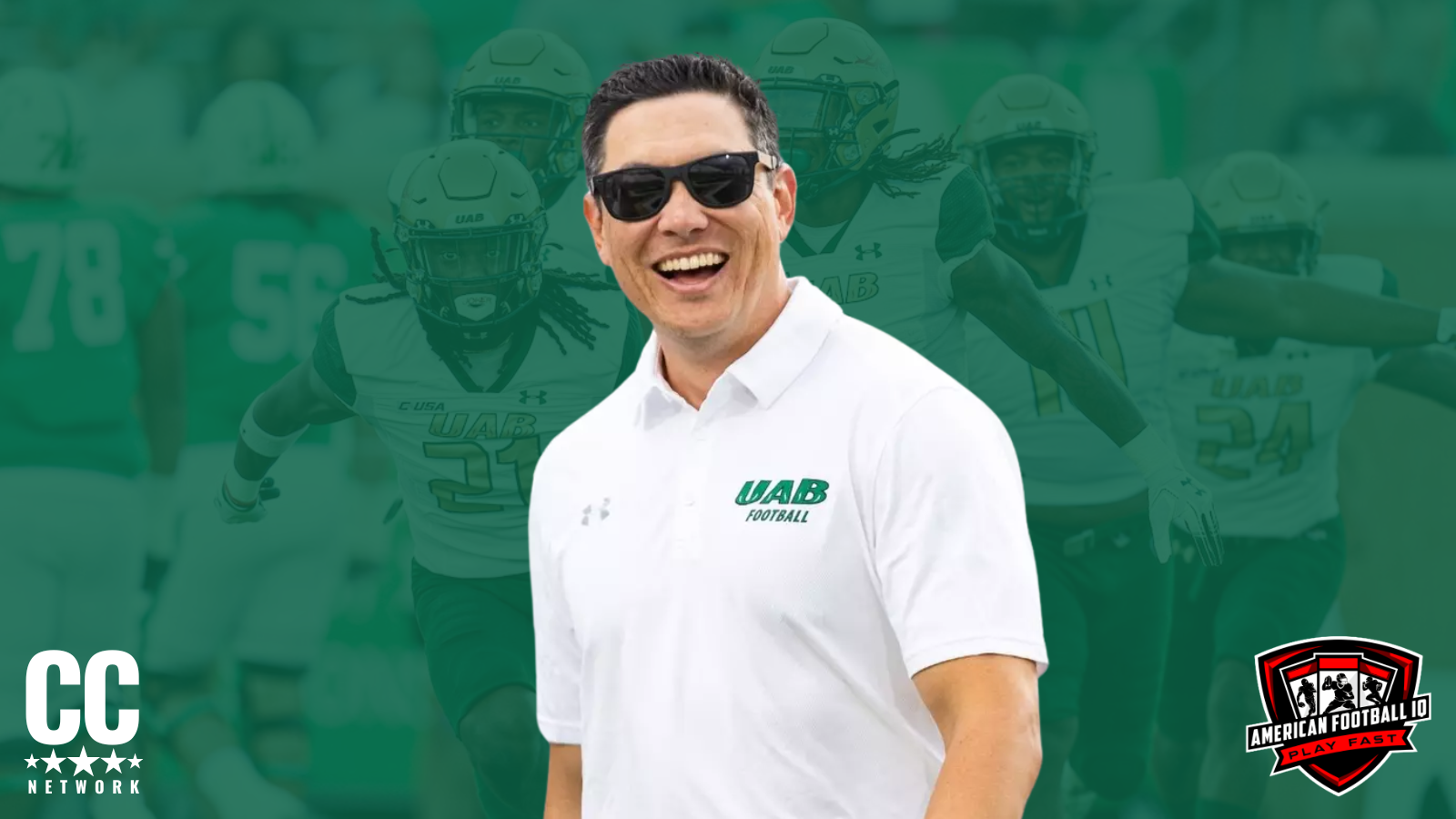
Danny Mitchell has coached football in 21 different countries.
He has coached in Germany, Sweden, Austria, and now at UAB. He has worked as a quarterback coach, offensive coordinator, head coach, analyst, and running backs coach.
Across every country, roster, and role, Danny Mitchell kept coming back to the same idea: football becomes powerful when coaches learn the people first.
During his appearance on the Football IQ series with Doug Brady, Mitchell talked about scheme, leadership, offensive structure, and player development. Beneath all of it sat a bigger idea that shaped his entire career.
Football became the common language.
“Football is a language,” Mitchell said. “It’s spoken all over the world.”
For Mitchell it became the foundation of his coaching journey.

Born Into Fall Camp
Mitchell’s football life started long before he became a coach.
His father has coached high school football and baseball in San Diego for decades, and Mitchell joked that the first place he ever went after leaving the hospital was fall camp.
“A football field is literally my home,” Mitchell said.
That environment shaped how he saw the game from an early age. Football was not separated from family, leadership, or relationships. It was woven into everyday life.
As a high school quarterback, Mitchell learned the game through responsibility and leadership. His coaches trusted him to operate the offense, make checks, and understand defensive structure at a deeper level.
That experience changed how he viewed football IQ.
His coaches trusted him to think like a quarterback, not just run the call, and that same belief still shows up in how he teaches the game.
From Backup Quarterback to Lifelong Coach
For all of his coaching success, Mitchell still starts with the same description: “a backup D3 quarterback.”
That humility shows up constantly in the way he talks about football.
His path into coaching accelerated through legendary quarterback coach Tom Martinez, best known for mentoring Tom Brady. Mitchell spent time around Martinez while still in college and even helped work quarterback camps alongside players like Brady and Julian Edelman.
One moment especially stayed with him.
At 19 years old, Martinez asked Mitchell to help coach NFL quarterback Matt Gutierrez during an offseason throwing session.
“You want to talk about empowerment?” Mitchell said. “I’m 19 years old.”
That trust built confidence.
That moment reinforced a belief Mitchell still carries into every room he coaches: players need to be trusted with the why, not just handed the what.
Learning Football as a Language
One of the strongest themes throughout the conversation centered around communication.
Mitchell compared football learning to language immersion. Coaches can teach terminology in classrooms, but eventually players must experience the game itself in order to truly process it.
“There’s two ways you can learn Spanish,” Mitchell explained. “You and I can go sit in a classroom and learn Spanish that way… or you can drop us off in Mexico City and say, ‘Hey, good luck.’”
Mitchell’s point was simple.
Football IQ grows through immersion, repetition, communication, and real experience.
Mitchell is talking about real football learning, the kind that goes beyond memorizing terms. That is the kind of learning American Football IQ is built to support. AFIQ helps athletes move beyond memorization through film-room style education, tactical breakdowns, and training flashcards that teach players how to recognize coverages, process defensive structure, and react faster during live situations.

For Mitchell, football IQ shows up when players can see the whole picture, connect the pieces, and play without waiting for every answer from the sideline.
Building an Offense Around the People in the Room
For Mitchell, offensive identity starts with the players you have, not the system you wish you had.
Too often, coaches become attached to systems without considering whether their players actually fit those systems. Mitchell learned early in his career that successful offenses adapt to the strengths of the people inside the room.
He shared a story from his time coaching at Bishops School in San Diego. After Tyler Buckner suffered a season-ending injury early in the year, the staff moved their center to quarterback and rebuilt the offense around what he could do.
The offense had to change, but the standard didn’t.
“If I required Dominic to do what Tyler does, we’re not going to have that success,” Mitchell explained.
For coaches, the lesson is clear. Personnel has to shape the plan, a good system should have enough structure to stay intact and enough flexibility to fit the players available.
That same approach followed Mitchell overseas. In Europe, the core offense stayed consistent, but each version took on the personality of the roster.
The goal was never to prove the system.
It was to put players in position to play winning football.
Teaching Running Backs Like Quarterbacks
Mitchell’s current role at UAB reveals another layer of how he thinks about football IQ.
He teaches running backs through a quarterback lens.
Instead of limiting players to one responsibility, Mitchell expects his running backs to understand the entire offense. They line up in multiple spots, handle communication responsibilities, and process defensive structure from a broader offensive perspective.
“We treat our running backs the exact same way here,” Mitchell said. “They have to understand all of it.”
Running backs carry the football, catch passes, protect the quarterback, contribute on special teams, and make quick decisions in space. A broader understanding of the offense allows them to handle all of those responsibilities more effectively.
What Europe Taught Mitchell About Connection
Mitchell’s overseas experiences changed how he views coaching relationships.
Many of his European players worked regular jobs during the day before practicing football at night. Some were older than him when he first became a head coach in Germany at 24 years old.
Those realities forced him to think differently about leadership.
“If I didn’t make this enjoyable for them, guys that are choosing to be out there, we’re not going to have a shot,” Mitchell said.
Building relationships became part of coaching. Players spent time together away from the field. Coaches connected with them outside football and over time those relationships created trust.
Mitchell remembers one championship team as a locker room where players openly cared about one another.
“We had a bunch of grown men that would walk around saying, ‘I love you,’” Mitchell recalled. “That’s why we were different.”
What Followed Mitchell Across the World
After coaching in 21 countries, Mitchell keeps coming back to the same lesson.
Languages change.
Cultures change.
Rosters change.
Football remains the common ground.
Players respond when coaches understand who they are. Systems work best when they reflect the strengths of the people running them. Whether he was coaching in Germany, Sweden, Austria, or Alabama, those principles stayed the same.
Football traveled with Mitchell because he learned early that coaching starts with people. Every stop along the way reinforced the same idea: when players feel connected to the coach, the team, and the purpose behind the work, football becomes a language everyone can speak.
Related:
Football IQ Is Fading. Here’s How Coaches Can Teach It Again
Teaching Football IQ: J.T. O’Sullivan’s Approach to QB Development
Connect on X:
Keith Grabowski: @CoachKGrabowski
Doug Brady: @CoachDougBrady
Danny Mitchell: @CoachD_Mitch