
Football IQ isn’t just about knowing the playbook. It’s anticipating the defense before the snap, reading routes like a defender would, and spotting a blitz before it lands. When everyone on the field is fast and strong, the sharpest mind usually wins.
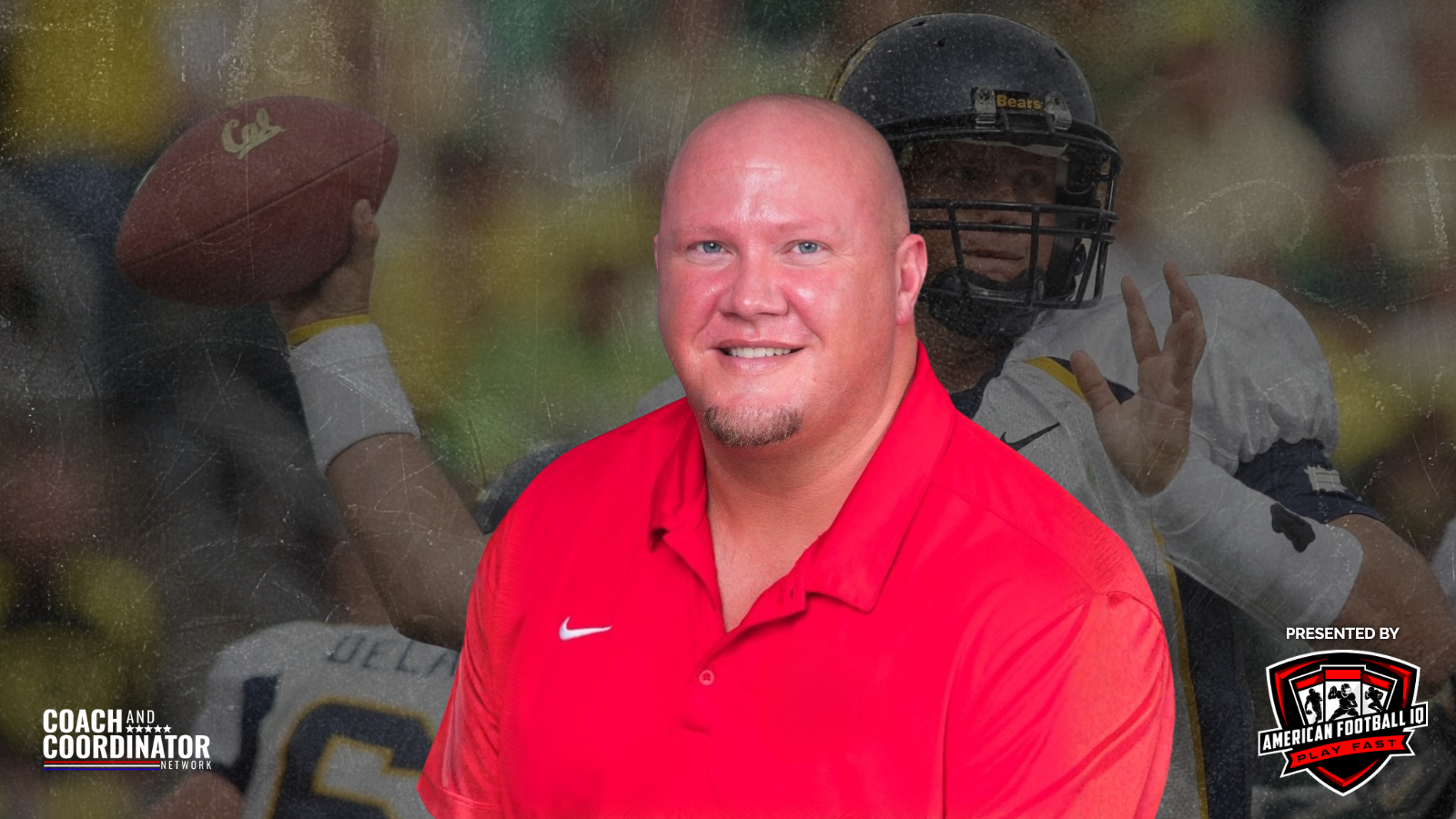
That’s the idea behind a recent conversation on the Coach and Coordinator Network’s Football IQ series with Nate Longshore. Longshore was a four-year starter at Cal, where he led the Golden Bears to a 2006 Holiday Bowl win. After a college coaching career, he founded the QB Method, where he’s developed quarterbacks from the high school level to the NFL for more than twenty years.
Here’s what coaches can take from his approach to teaching football IQ.
Engage the Senses Before You Teach
Coaches are teachers first. Longshore’s goal, like any teacher’s, is to get what’s in his head into a player’s head as fast as possible. One trick he uses: music.
Before big walkthroughs, his quarterbacks listen to the same songs every time. The sound becomes a cue. Hear it, and the brain shifts into game-prep mode. It works the same way a hotel lobby scent tells you where you are the moment you walk in.
“I would guarantee if you hit all of them now, it’s on their playlist,” Longshore said of his players. “And when it probably comes up, they immediately go into game prep mode.”
The lesson for coaches: small, repeatable cues can prime a player’s mind for learning before a single word is spoken.
A Checkers Board Built Football IQ
Longshore played for Cal coach Jeff Tedford, who had his own low-tech way of testing football IQ. Tedford bought checkers pieces in bulk, marked each one with a Sharpie to represent a position, and glued a magnet to the back so they’d stick to a whiteboard.
Instead of watching young players struggle to draw up a formation, he’d have them move the checkers into place. It cut through the confusion of players who couldn’t align eleven guys on a diagram. Tedford also used it as a recruiting tool, asking recruits to draw up their favorite play on the board to see how well they understood the game.
The takeaway isn’t the checkers. It’s the principle: find the simplest tool that gets a player interacting with the concept, rather than just watching you explain it.
Why the Install Window Keeps Shrinking
Longshore played in an era before headset communication, when quarterbacks had to identify the front, set the protection, and read leverage before the snap — all without help from the sideline. Today’s transfer portal has changed that timeline. Players often arrive on campus in August with a season opener in September, leaving coaches almost no runway to install a full system.
That shift has pushed offenses toward simpler command structures: wristband calls, one-word tags, and concepts built around what a transfer already knows. Longshore was blunt about why that matters.
“If your best player can’t get on the field, you’re an idiot as a coach,” he said.
It’s a hard line, but it’s also the reality of roster turnover. The job isn’t to run the most complex system. It’s to get your best players on the field as fast as possible.
Three Types of Reads Every Quarterback Should Know
When it comes to teaching quarterbacks how to process a defense, Longshore breaks it into three categories.
Pure progression reads apply when a quarterback loses vision on the defense, like on a naked bootleg off outside zone. The quarterback simply works through receivers one through four in order because there’s no time to identify the coverage first.
Alert progressions are used in most modern spread and West Coast concepts. The quarterback identifies a favorable matchup before the snap and throws there first if it’s available, then works through the rest of the progression in rhythm.
Combination reads rely on defensive dictation. The quarterback has an if-then rule based on the coverage, like reading the flat defender on a curl-flat combination regardless of whether the defense is buzzing a linebacker or clouding a corner.
“Ninety-five percent of all the drop-back passing reads that you have right now” fall into the alert progression category, Longshore noted, which is worth remembering when building an install for a young quarterback.
Building Arm Strength the Right Way
Ask any quarterback trainer how to add arm strength, and long toss usually comes up. Longshore compared it to a question he gets from lifters: how do I increase my power clean? The answer starts with identifying limitations, whether that’s flexibility, mechanics, or experience, before chasing more weight or more distance.
He’s also quick to point out that a picture-perfect throwing motion isn’t the goal. Quarterbacks like Philip Rivers and Colt Brennan built Hall-of-Fame-caliber careers with unconventional mechanics. What matters is getting the ball to the receiver in the best possible spot, in the shortest amount of time.
The Mental Game Still Decides Games
Longshore also teaches quarterbacks that the next play is always the most important one. Celebrating too hard after a big play, or dwelling too long on a bad one, tends to bleed into the snaps that follow. It’s a message worth reinforcing with any player who plays a position where mistakes happen in front of everyone.
His advice for underrecruited players carries the same theme of staying forward-focused. The transfer portal and expanded roster movement mean a single strong season can reset a player’s entire trajectory, something that wasn’t true a generation ago. One good year, stacked on good decisions, can put a player back on the path he wants.
The Bottom Line
Football IQ isn’t built through one drill or one presentation. It’s built through repeatable cues, simple tools, clear read progressions, and a mental approach that keeps players moving forward after both good plays and bad ones. Longshore’s approach, shaped by two decades of coaching quarterbacks at every level, is a reminder that the best teaching often comes from making complex ideas as simple as possible for the player in front of you.