
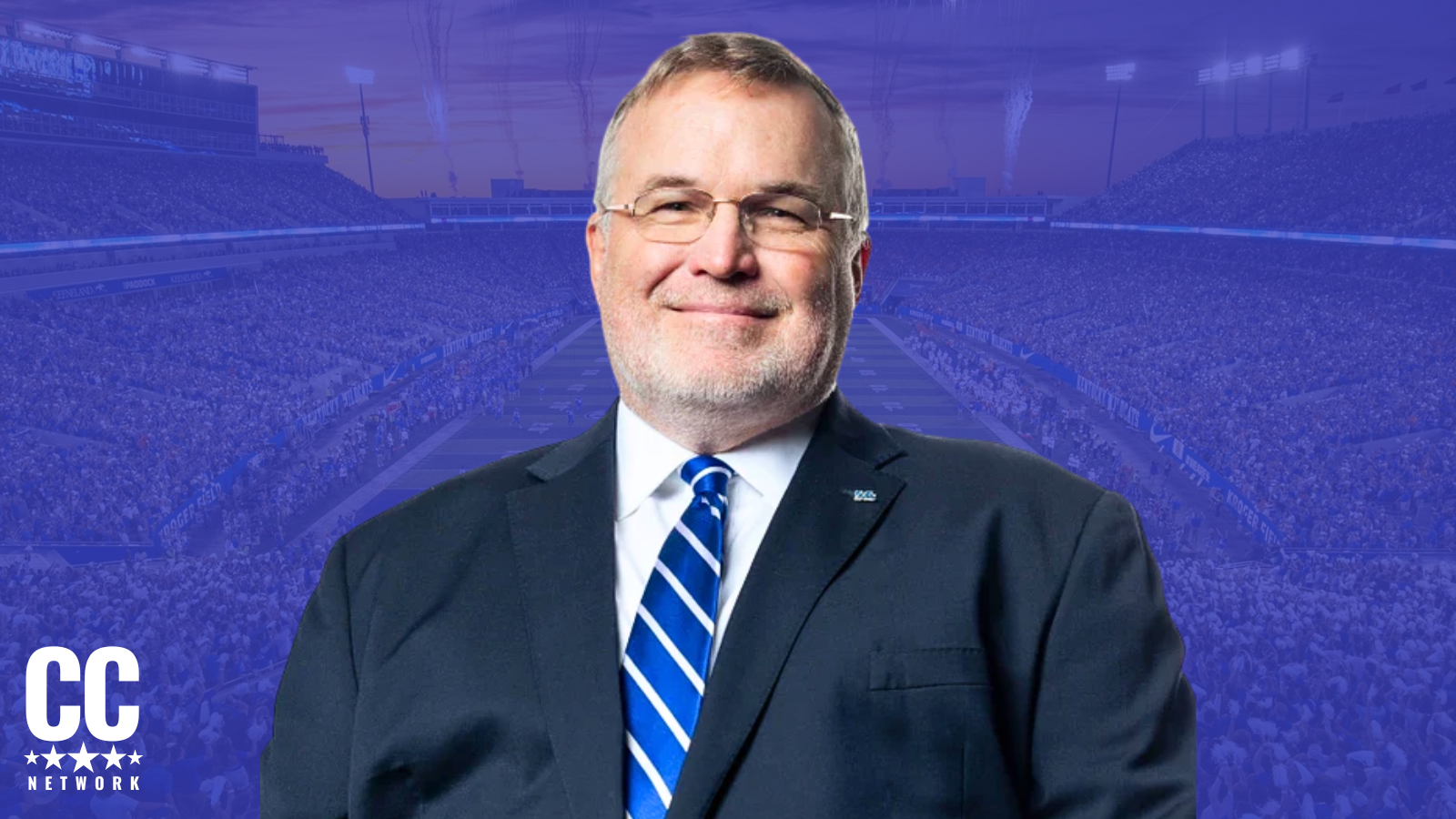
Andrew Coverdale never played much football. He’ll tell you that himself. His playing career ended in eighth grade, and by most conventional measures, that should have been the end of his story in the sport. Instead, it became the beginning of one of the more quietly remarkable careers in American football coaching, a journey that has taken him from lugging pads at LSU to the press box at the University of Kentucky, where he now serves as pass game coordinator under head coach Will Stein.
“I always knew I wanted to coach,” Coverdale said. “I had a great high school coach who allowed me to mentor and do some things that guys like me ordinarily didn’t get to do.”
That early access, a kind of proto student coach role before the title existed, planted seeds that grew slowly and deliberately over the next three decades.
The LSU Years and a Winding Road Home
Coverdale paid a significant chunk of his college tuition at LSU working as a student equipment manager, a role that put him in proximity to high-level football and, more importantly, high-level people. He credits the late Jeff Boss, a legendary figure in LSU’s program, with shaping his early understanding of leadership and hard work.
When he returned to Indiana after college, he had no connections and no clear path in. So he did what most coaches without a network do: he volunteered. He worked for several well-regarded high school coaches, including Dan Robinson, a name he returns to repeatedly when asked about his development. Robinson ran a system at a small three-A school in rural northern Indiana that, by Coverdale’s account, was decades ahead of its time.
“Dan showed that anything’s possible on a football field,” Coverdale said. “A lot of what really became the structure of those books came from his offense.”
Those books, Coverdale co-authored foundational texts on the compressed passing game and quick game that became required reading for a generation of coaches who couldn’t afford clinic trips and had to learn from what they could get their hands on, grew out of that relationship with Robinson. Coverdale is careful to share the credit.

Building Something at Trinity
His first real full-time coaching opportunity came under Kevin Wright, who brought him on as offensive coordinator at Trinity High School in Louisville, Kentucky, in 1999. When Wright departed after a year, Bob Beatty arrived and what followed was, by any reasonable measure, a dynasty.
Trinity had been a winning program before. But Beatty’s arrival, and the offensive framework he and Coverdale developed together, elevated it to a national stage. In a football environment still deeply rooted in single-I formations and spot-drop passing, Trinity was running vertical reads out of two-by-two and three-by-one 10-personnel sets, releasing routes on the backside, and challenging defenses in ways that opponents in Kentucky simply weren’t prepared for.
“We were able to capitalize on some of those things very quickly,” Coverdale said. “Bob’s system put us ahead of the game, and then we were able to evolve.”
Evolve they did. Trinity developed a national scheduling profile out of necessity, when Kentucky opponents stopped booking games against them, the Shamrocks went looking for competition in Cincinnati, Nashville, and Indianapolis. In 2011, they were named national champions.
Coverdale describes Beatty as the ideal environment for a creative coach: demanding on execution, but genuinely curious and willing to let his staff explore. “There was a really good tension,” he said, “between my creative impulses and his execution impulses. He made me a better coach.”
The relationship with Beatty also connected Coverdale to Bobby Petrino, who was building his Louisville Cardinal program just across town. Two-way access to one of the more complete offensive minds in college football at the time proved invaluable. One of Petrino’s sons, Nick, was the Trinity quarterback who preceded Will Stein, and Petrino himself was generous with his time.
The Offensive Philosophy That Emerged
Over nearly two decades at the high school level, Trinity and later Cincinnati St. Xavier, where he joined Steve Speck’s staff, Coverdale built an offensive identity that has become deeply influential in how coaches think about the passing game.
At its core was a simple problem: if you’re not going to throw the ball more than 15 times a game, don’t ask your best playmaker, the running back, to stand in six-man protection trying to chip defensive ends. Get him in the route. And if you’re going to get him in the route, your screen game has to be a genuine weekly threat, not a changeup.
“We wanted the screen game to show up on every down and distance at every personnel group,” Coverdale said, “so that you were not as enamored with your six-man hot pressures.”
His broader passing philosophy orbited around a concept he calls “finishers.” The idea originated with his study of spacing concepts, initially a half-field read, then, after watching quarterbacks like Nick Petrino and Will Stein work it, a full-field idea. The principle: build every concept so that something useful is arriving in the quarterback’s vision late, when everything he thought would work has been taken away.
“It’s not even so much the curl-flat part of it,” he said. “It’s having the full field alive for as long as you can have it alive. You need things at the end that are working into the quarterback’s vision and friendly to him.” Those finishing routes might be a dig, a return, a spot route, a swirl — the specific answer matters less than the discipline of always having one.
He was also a committed proponent of play action as the primary explosive mechanism. Not as a trick, but as a foundational element. “Our explosives came from quick rhythm drop back where you taught the finer skills of catch and run really well, or screen game against pressure, or hard big boy play action where you max the protection and made them restart their rush with some kind of hard run action.”
The College Transition: A Steep and Satisfying Climb
When former Trinity quarterback Brian Brohm, by then a college coach, reached out about a quality control position at Louisville, Coverdale made a decision that surprised even people who knew him well. He left high school coaching, left his full-time teaching job, and stepped into the college game for the first time in his career.
“I really did have two full-time jobs and I loved both of them,” he said. “At the end of the day, there weren’t enough hours to do both of them great.”
The transition was humbling in the best way. College football’s sophistication, not in the number of formations or concepts, but in the depth of defensive understanding required, caught him off-guard. The structures weren’t as wildly varied as what he’d seen in high school, but what lived behind those structures was far more nuanced.
“Every single defensive call you face in practice from a guy like Jay Bateman or Ryan Bush is packed with so much detail and intent and nuance,” Coverdale said. “And if you don’t understand that nuance, you’re setting your kids up for problems.”
He spent two years at Louisville learning under Brohm and the staff there, then made the leap to Kentucky when Will Stein was named head coach this past January. Stein is a player Coverdale coached at Trinity, the same kid who ran the spacing concepts that Coverdale had once been skeptical a high school quarterback could execute.
“Will always knew exactly what he wanted to do and exactly what he was going to do,” Coverdale said. “This is not a surprise for anybody that’s known him.”
On Coaching Relationships and What They’re Really For
One of the threads running through every chapter of Coverdale’s career is the depth and durability of his coaching relationships. Dan Robinson. Kevin Wright. Bob Beatty. Scott Loeffler, the Michigan quarterback coach who expanded his offensive thinking during the Lloyd Carr years. Rob Spence, who taught him the screen game. Bobby Petrino. Brian Brohm. Will Stein.
He’s clear-eyed about what made those relationships matter, and it’s not what people tend to assume.
“The words transactional and transformative hadn’t been introduced into a lot of our vocabulary yet,” he said, crediting Robinson with the lesson. “But he really taught me that relationships are the essence of the profession. They’re not the means to the end.”
He wasn’t building a network. He was being fully present in the relationships as they came, without calculating what they might eventually produce. The job at Kentucky didn’t happen because he worked his contacts. It happened because he loved and stayed connected to a kid he coached in high school, and that kid, years later, became a head coach who wanted to build something.
“It’s one of the things you don’t really understand as a young coach,” Coverdale said, “that really is one of the best parts of the profession.”
What He’d Tell Himself
Asked what he would go back and change, Coverdale gives two answers.
First: spend time on the other side of the ball. He never coached defense full-time, and he sees it now as a genuine gap. The coaches he most admires in his own background — Scott Loeffler, the Shanahan coaching tree, all made a point of learning the game from the defensive side. At Kentucky, watching practice film with the defensive staff has become one of the most valuable parts of his week, a chance to build the literacy he didn’t develop earlier.
Second: stop worrying about public perception sooner. “It’s easy as a young coach to worry a great deal about what your public perception is,” he said. “I definitely got over it at a certain point in my life, but I just wish I had reached some of those conclusions earlier.”
For a man who never played the game, who had to volunteer his way into the profession, who published books that coaches read by lamplight at night trying to figure out what he was doing, those aren’t bad lessons to leave behind.
Andrew Coverdale is the pass game coordinator at the University of Kentucky.
Watch Smart Clinics: Move the Chains now!


Related:
Connect on X:
Andrew Coverdale – @AndrewCoverdale
Keith Grabowski – @CoachKGrabowski