

What Matt Drinkall Gets Right About Leadership, Culture, and Sustainability
By Keith Grabowski
College football has changed faster in the last three years than it did in the previous three decades. The calendar never stops. The portal never sleeps. Expectations rise while margins shrink. In that environment, leadership is not about slogans, perks, or volume. It is about systems, trust, and people.
After spending time inside the program led by Matt Drinkall at Central Michigan University, one thing is clear. His approach to building a staff is not tied to a level, a budget, or a trend. It is rooted in principles that scale.
This is not theory. It is a lived practice.
Compensation Is More Than Money
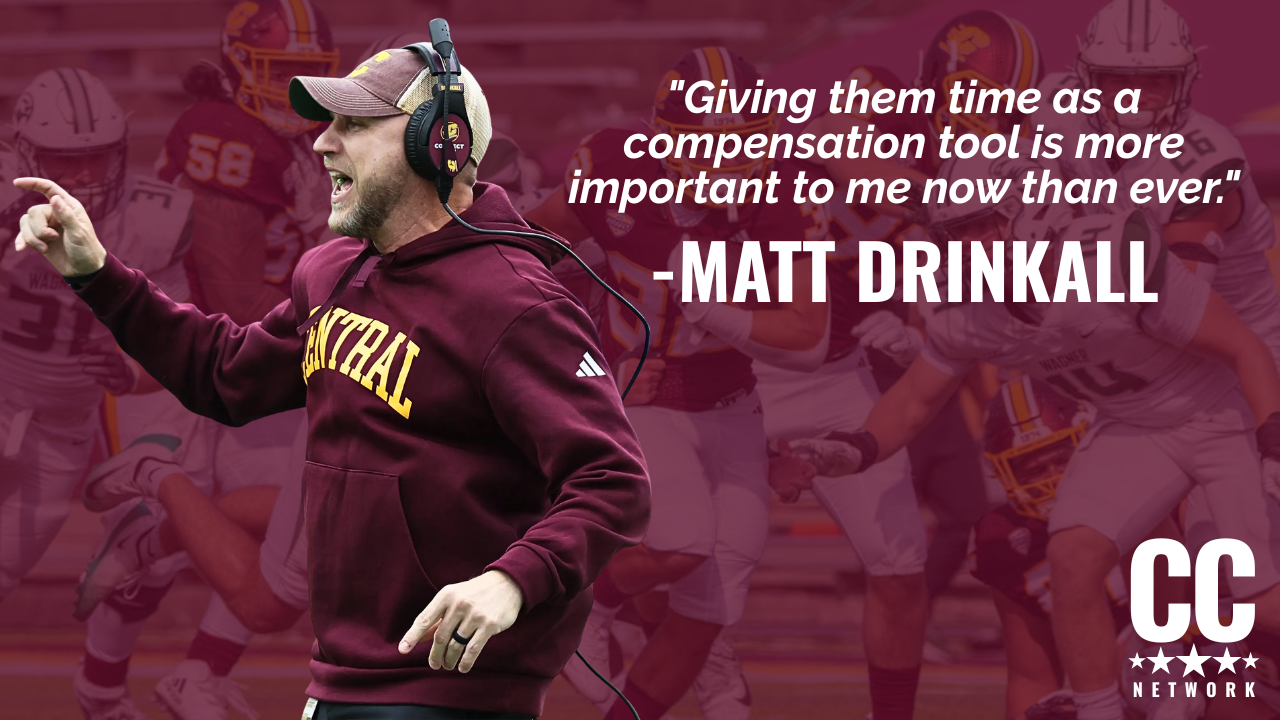
When Matt Drinkall was a young head coach at Kansas Wesleyan University, he could not compete financially. Instead, he compensated with time, clarity, environment, and trust. That philosophy did not disappear as resources increased. It became more important.
At the FBS level, coaches can justify burnout by salary. That logic destroys energy and shortens careers. Drinkall flips that equation. He actively pushes coaches out of the building when the work is done. He protects recharge time because he understands a simple truth.
Fatigued people make poor decisions.
In a nonstop calendar, time becomes the most valuable currency a leader can offer.
Systems Reduce Fatigue, Not Standards
Early in a rebuild, there is no shortcut. Everyone wears more hats. The workload spikes. What separates sustainable programs is what happens next.
Drinkall builds systems so the program eventually runs itself. That does not lower expectations. It removes chaos. Once systems take hold, clarity replaces guesswork. Staff members know what matters, when it matters, and why it matters.
That clarity is not accidental. It is designed.
Loyalty Over Skill Still Wins
One of Drinkall’s non-negotiables has never changed. He hires loyalty before skill.
That does not mean hiring friends. It means hiring team-oriented, aligned, and committed people. He uses a simple filter. If two people cannot enjoy a two-hour car ride together, they do not belong in the same building.
Talent without alignment corrodes culture. Talent with loyalty multiplies it.
At higher levels, mobility increases. Money increases. Temptation increases. Loyalty gets tested differently. Drinkall’s response is not control. It is development.
If a coach grows, earns opportunity, and advances, that is not disloyalty. That is success.
Empowerment Without Silos
Modern staffs are large. Specialists are necessary. The risk is fragmentation.
Drinkall avoids silos by clearly structuring leadership. Coordinators own their areas. A general manager runs the business side. Strength, analytics, and support staff have defined authority. Information flows constantly across departments.
Alignment meetings replace assumptions. Transparency replaces guessing. Everyone understands not just decisions, but reasoning.
When people know why, they pull in the same direction.
Identity Is Behavioral, Not Verbal
Physical football is part of the Chippewa identity, but not as a catchphrase. It shows up in daily behavior.
Physicality starts mentally. It shows up in preparation, accountability, and willingness to do hard things consistently. Drinkall learned this deeply during his time at the United States Military Academy, where standards are not situational.
You do not install physicality with hype. You inspect it daily. You train it methodically. When the mindset is real, the film follows.
Transparency Builds Trust With Players
Internally, the program runs on brutal transparency. Players know that decisions are made in their best interest. Academics, scheduling, training, and football all follow that rule.
That honesty eliminates confusion. It also eliminates resentment.
Externally, Drinkall acknowledges reality. College football is not what it used to be. Pretending otherwise alienates people. Explaining reality earns buy-in.
Authenticity Beats Authority
One of the most important leadership lessons Drinkall lives by is simple.
Authenticity scales. Authority expires.
Titles may open doors, but they do not sustain relationships. Drinkall does not rely on position to lead. He relies on truth, consistency, and vulnerability. He invites staff members to challenge him. He demands honesty upward, not just downward.
The hardest thing for a leader to get is the truth. Without it, blind spots grow. Cultures fail quietly before they collapse publicly.
Why This Matters Beyond Football
Strip away the logos and the noise, and these lessons apply anywhere.
High-functioning teams require clarity.
Sustainable performance requires rest.
Trust requires transparency.
Culture requires behavior, not branding.
Matt Drinkall’s approach works because it is human. It respects people. It builds systems that serve them. And it refuses to confuse intensity with effectiveness.
In a profession addicted to more, this is a model built on better.
That is leadership worth studying.
Coach and Coordinator AI – Alignment in Action Companion

The Alignment in Action Companion is built entirely from the Central Michigan Alignment in Action series. It is designed to help coaches examine alignment through behavior and apply those lessons to their own environment.
This tool helps coaches identify where alignment holds and where it breaks, clarify ownership and authority, and evaluate whether standards survive when responsibility moves away from the head coach. It focuses on real decisions, real behaviors, and real pressure moments.
The companion does not add outside leadership frameworks, invent examples, or offer generic advice. It only works off of the transcripts from the Central Michigan Alignment in Action episodes.
This tool works best when coaches describe what actually happens in their program. Avoid aspirational language. Be specific about situations, decisions, and behaviors. Use it to pressure test standards, expose dependence on your presence, and build alignment that functions without constant oversight.
Related
Alignment in Action: A Behavior-Based Leadership Tool for Coaches
Culture OS – Matt Drinkall, Offensive Line Coach, Army West Point
Defeating the Tite Front – Matt Drinkall, Co-OC and OL Coach, Army
Running Game and Tempo – Matt Drinkall, TE Coach, Army
Less Is More: Strategic Practice Management
Keeping the Team Focused and Motivated
Creating Individual Drills and Practice Periods That Translate to Game Day
Mid-Camp Evaluation and Adjustments of Personnel and Scheme